
Executive vs Regular Communication: 10 Key Patterns
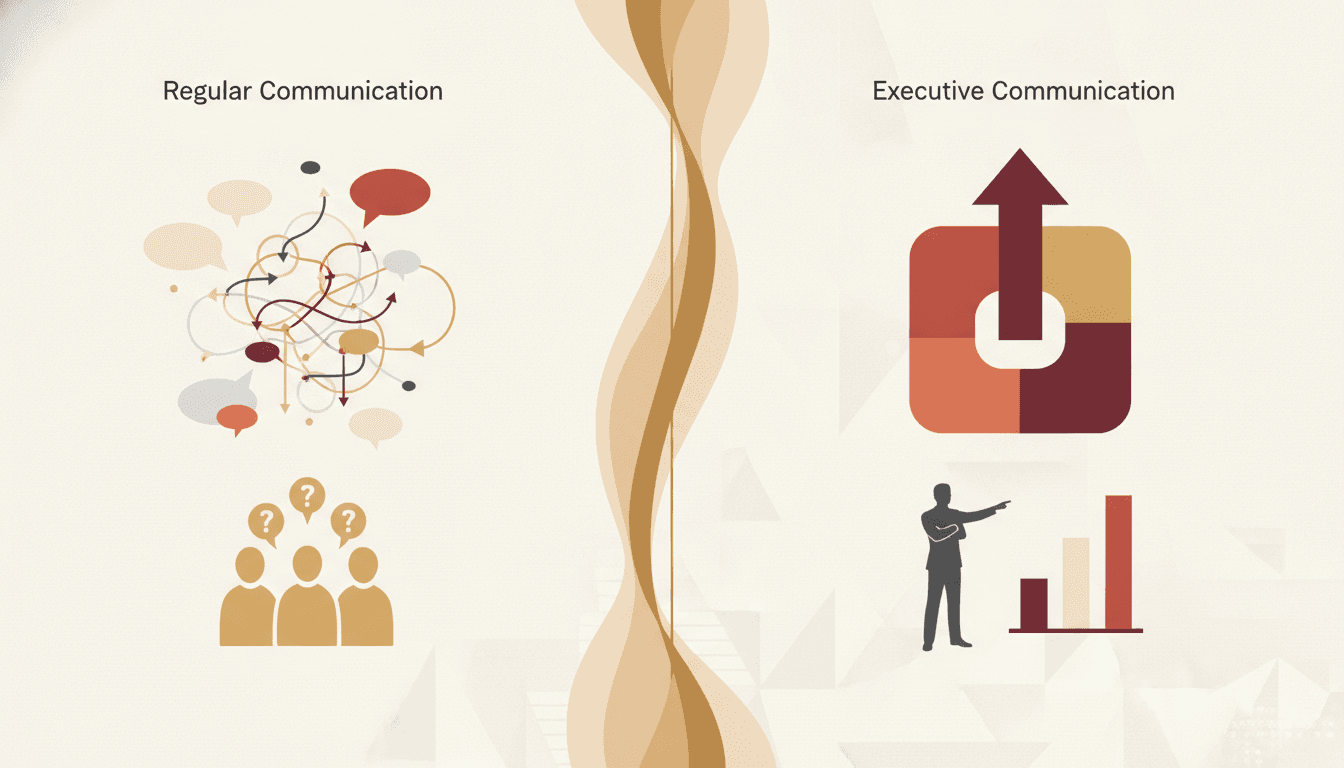
The difference between executive communication and regular communication comes down to ten distinct patterns: executives lead with outcomes instead of details, use decisive language instead of hedging, structure messages top-down instead of chronologically, speak in strategic terms instead of tactical ones, and manage attention rather than just sharing information. They also listen more selectively, frame problems as decisions, use silence deliberately, communicate with consistent brevity, and project authority through vocal and physical presence. Mastering these patterns can transform how others perceive your credibility and competence.
What Is Executive Communication?
Executive communication is a strategic approach to workplace interaction where every message — spoken, written, or nonverbal — is designed to drive decisions, build trust, and signal leadership authority. It prioritizes clarity, brevity, and impact over thoroughness or detail.
Unlike regular professional communication, which often focuses on conveying information accurately, executive communication focuses on shaping perception and moving people toward action. It's the difference between reporting what happened and framing what it means — and what should happen next.
Understanding this distinction matters because communication style is one of the strongest predictors of career advancement. According to a 2023 study by the Harvard Business Review, executives who communicate with clarity and brevity are perceived as 1.5 times more competent than peers who provide more detailed but less structured communication.
Pattern 1: Leading with Outcomes vs. Leading with Context
How regular communicators set up their message

Most mid-level professionals build their communication chronologically. They start with background, walk through the process, and arrive at the conclusion at the end. This feels logical — it mirrors how they experienced the work.
Here's a typical example: "We spent three weeks analyzing the Q3 data, then we ran a regression model, compared it to last year's benchmarks, and found that customer churn increased by 12%."
The problem? Decision-makers have already checked out before you reach the point.
How executives flip the structure
Executives use what communication researchers call the "pyramid principle" — they lead with the conclusion, then provide supporting evidence only as needed.
The same message delivered with executive communication: "Customer churn is up 12% in Q3. I recommend we invest in retention targeting our top-tier accounts. Here's why."
This single shift — putting the outcome first — signals confidence and strategic thinking. It tells your audience, "I've done the analysis. Here's what matters." According to research from McKinsey & Company, senior leaders spend an average of just 9 minutes on any single topic in meetings, which means your first sentence determines whether you're heard or ignored.
If you want to practice this shift daily, our guide on how to communicate like a senior leader breaks it down into eight actionable habits.
Pattern 2: Decisive Language vs. Hedging Language
The hedging habit that kills credibility
Regular communicators often soften their language to avoid seeming overconfident or wrong. They say things like:
- "I think maybe we should consider..."
- "It sort of seems like..."
- "I could be wrong, but..."
- "Does that make sense?"
These phrases feel polite, but they signal uncertainty. Research from the University of Texas at Austin found that speakers who use hedging language are rated 35% less persuasive than those who state positions directly, even when the content is identical.
How executives state positions with clarity
Executives replace hedging with direct, ownable statements:
- "I recommend we..."
- "The data shows..."
- "Here's my position..."
- "What questions do you have?"
Notice the difference in the closing question. "Does that make sense?" puts the burden on you — it implies your communication might have been unclear. "What questions do you have?" assumes clarity and invites engagement from a position of strength.
This doesn't mean being rigid or arrogant. It means speaking with authority while remaining open to input. Executives hold strong opinions loosely — but they express them firmly.
Pattern 3: Strategic Framing vs. Tactical Reporting
Thinking in systems, not tasks
Regular communicators describe what they did. Executive communicators describe what it means.
Consider this contrast:
Regular: "We completed the website redesign on time and under budget." Executive: "The website redesign positions us to capture 20% more qualified leads in Q1, which directly supports our growth target."The first version is accurate. The second version is strategic. It connects the work to a business outcome that matters to leadership.
The "So What?" test
Every time you prepare a message for senior stakeholders, run it through the "So What?" test. State your point, then ask yourself: So what? Why does this matter to the business?
Keep asking until you reach a strategic outcome — revenue, risk, competitive advantage, customer impact, or operational efficiency. That's your lead.
A 2022 Gartner survey found that 67% of C-suite executives say they dismiss communications from direct reports that fail to connect to strategic priorities. Your work might be excellent, but if you frame it tactically, it becomes invisible at the executive level.
For a deeper dive into connecting your communication to strategic value, explore our framework on how to communicate your strategic value at work.
Ready to communicate like the leader you're becoming? The patterns in this article are just the beginning. Discover The Credibility Code — a complete system for building authority, credibility, and commanding presence in every professional interaction.
Pattern 4: Attention Management vs. Information Dumping
Why more information isn't better

Regular communicators operate under a flawed assumption: the more information they share, the more credible they'll appear. In reality, the opposite is true.
Executives understand that attention is a finite resource. They manage it ruthlessly. They decide what their audience needs to hear — not what they want to say — and they cut everything else.
The 3-point rule
Senior leaders rarely make more than three points in any single communication. Whether it's an email, a presentation, or a hallway conversation, they distill their message to three core ideas.
Here's why this works: cognitive psychology research by George Miller (Princeton University) established that working memory holds approximately 7 ± 2 items, but persuasion research shows that three arguments are the optimal number for changing minds. Beyond three, audiences become skeptical rather than more convinced.
Regular communicator in a status meeting: Shares 12 slides covering every detail of the project. Executive communicator in the same meeting: "Three things you need to know: we're on track for the March launch, we've identified a supply chain risk that could delay us by two weeks, and I need a decision on budget reallocation by Friday."If you struggle with conciseness, our guide on how to speak concisely in meetings offers six clarity frameworks you can use immediately.
Pattern 5: Problem-as-Decision Framing vs. Problem Reporting
Bringing solutions, not just problems
Regular communicators flag problems: "We have a problem with vendor delivery times."
Executive communicators frame problems as decisions: "We have three options for addressing the vendor delay: renegotiate terms, bring in a secondary vendor, or adjust our timeline. I recommend option two. Here's the cost-benefit analysis."
This shift is transformative. When you bring a problem to leadership, you're creating work for them. When you bring a decision with a recommendation, you're demonstrating judgment — which is the core competency that separates managers from executives.
The decision-ready format
Use this structure every time you escalate an issue:
- Situation: One sentence describing the problem
- Options: Two to three viable paths forward
- Recommendation: Your suggested course of action with rationale
- Ask: What you need from the decision-maker
This format respects your leader's time, demonstrates your strategic thinking, and positions you as someone who solves problems rather than escalates them. It's one of the key patterns covered in our piece on how executives build instant credibility.
Pattern 6: Deliberate Silence vs. Filling Every Gap
The discomfort of silence
Most mid-level professionals are terrified of silence. In meetings, after presentations, during negotiations — they rush to fill every pause with words. They over-explain, add unnecessary caveats, or circle back to points already made.
This impulse comes from a good place: they want to be thorough. But it undermines their authority.
How executives weaponize the pause
Executives use silence as a communication tool. They pause before answering difficult questions — signaling that they're thinking, not reacting. They let silence sit after making a key point — giving it room to land. They don't rush to fill gaps in conversation — allowing others to speak first and reveal their position.
A study published in the Journal of Experimental Psychology found that speakers who paused for 2-3 seconds before answering complex questions were perceived as more thoughtful and credible than those who responded immediately — even when the immediate responders gave equally accurate answers.
Regular communicator after a tough question: Immediately launches into a rambling answer, thinking out loud, backtracking, and qualifying. Executive communicator after the same question: Pauses. Takes a breath. Responds with a structured, concise answer. Stops talking.The ability to be comfortable with silence is one of the hallmarks of gravitas in leadership. It signals that you don't need to perform — you simply need to communicate.
Pattern 7: Selective Listening vs. Passive Listening
The difference in how leaders process information
Regular communicators listen to understand content. Executive communicators listen for decision points, risks, and opportunities.
In a project update meeting, a regular communicator hears the details and asks clarifying questions about the work. An executive listener hears the same update and asks: "What's the risk to our Q2 commitment?" or "How does this change our competitive position?"
Active filtering in real time
Executives practice what organizational psychologists call "strategic listening." They filter incoming information through three lenses:
- Relevance: Does this affect a decision I need to make?
- Risk: Does this represent a threat or opportunity?
- Action: Does this require me to do something?
Everything else is filed away or delegated. This isn't dismissiveness — it's efficiency. And when you demonstrate this kind of listening in meetings, others notice. You start asking the questions that matter, which is a key signal of leadership presence.
Pattern 8: Consistent Brevity vs. Variable Length
Why executives write shorter emails
According to a 2019 study by Boomerang (analyzing over 40 million emails), emails between 50 and 125 words received the highest response rates. Executive emails tend to cluster in this range. Mid-level professional emails average 200-300 words.
This isn't because executives are lazy. It's because they understand that brevity is a form of respect — and a signal of clarity of thought.
The brevity framework
Executives apply a consistent standard to all communication:
- Emails: State the purpose in the first line. Include the ask. Cut everything else.
- Meetings: State your point in under 60 seconds. Support it with one piece of evidence. Stop.
- Presentations: One idea per slide. Ten slides maximum. Twenty minutes maximum.
For a complete system on writing with executive-level impact, check out our guide on how to write like a senior leader.
Communication patterns are habits — and habits can be changed. If you're ready to systematically upgrade how you communicate, lead, and show up at work, Discover The Credibility Code for a proven framework that builds lasting authority.
Pattern 9: Authority Through Presence vs. Authority Through Content
Beyond what you say: how you say it
Regular communicators focus almost entirely on content — getting the facts right, covering all the details, having the perfect slide deck. Executive communicators understand that delivery carries as much weight as content.
This includes:
- Vocal tone: Lower pitch, measured pace, deliberate emphasis on key words
- Body language: Open posture, steady eye contact, minimal fidgeting
- Physical stillness: Executives move less. They don't pace, sway, or gesture excessively.
- Spatial confidence: They take up appropriate space — sitting fully back in their chair, placing materials deliberately, maintaining comfortable proximity
Research from UCLA's Albert Mehrabian (often cited in communication training) suggests that nonverbal elements account for a significant portion of how messages are received, particularly when verbal and nonverbal signals conflict. While the exact percentages are debated, the principle holds: if your body language says "uncertain" while your words say "confident," people believe your body.
For a comprehensive breakdown of authority-signaling body language, our guide on body language that conveys authority covers twelve specific signals you can practice today.
Pattern 10: Consistent Identity vs. Situational Adaptation
The executive communication brand
Regular communicators adapt their style dramatically based on context. They might be assertive with peers but deferential with executives. Confident in email but hesitant in meetings. Articulate in prepared presentations but scattered in spontaneous conversations.
Executive communicators maintain a consistent communication identity across all contexts. Their tone, pace, vocabulary, and confidence level remain stable whether they're speaking to the CEO, presenting to a board, or chatting with a direct report.
Why consistency matters
This consistency is what builds a professional brand. People learn to expect a certain quality of communication from you. They know that when you speak, it will be concise, clear, and worth listening to. This predictability builds trust — and trust is the foundation of credibility.
Building this kind of consistent identity is a core element of personal branding for professionals. It's not about being rigid — it's about being reliably excellent.
How to start building consistency
Pick one communication pattern from this article — just one — and commit to using it in every interaction for 30 days. Whether it's leading with outcomes, cutting hedging language, or practicing the pause, consistency in one area will create momentum for the rest.
Putting It All Together: The 10 Patterns at a Glance
| Pattern | Regular Communication | Executive Communication |
|---|---|---|
| 1. Message structure | Context → Conclusion | Conclusion → Context |
| 2. Language certainty | Hedging, qualifying | Direct, decisive |
| 3. Framing level | Tactical, task-focused | Strategic, outcome-focused |
| 4. Information volume | Comprehensive, detailed | Selective, curated |
| 5. Problem presentation | Reports problems | Frames decisions |
| 6. Use of silence | Fills every gap | Pauses deliberately |
| 7. Listening approach | Passive, content-focused | Active, decision-focused |
| 8. Message length | Variable, often long | Consistently brief |
| 9. Authority source | Content accuracy | Presence and delivery |
| 10. Style consistency | Situationally variable | Stable across contexts |
The gap between these two columns isn't about talent or intelligence. It's about learned patterns. Every executive you admire developed these habits over time — and you can too.
Frequently Asked Questions
What is the main difference between executive communication and regular communication?
The main difference is intent. Regular communication aims to share information accurately and completely. Executive communication aims to drive decisions, shape perception, and build authority. Executives prioritize impact over thoroughness, leading with conclusions rather than building up to them. This strategic orientation affects everything from word choice to message structure to body language.
Can you learn executive communication skills without being an executive?
Absolutely. Executive communication is a skill set, not a title requirement. Many professionals begin practicing these patterns as mid-level managers and find that it accelerates their career advancement. Start with one or two patterns — like leading with outcomes and eliminating hedging language — and build from there. Our guide on how to speak with authority as a new manager is designed specifically for this transition.
How is executive communication different from confident communication?
Confident communication focuses on how you feel and how that feeling is projected — managing anxiety, speaking up, and asserting yourself. Executive communication is a broader strategic framework that includes confidence but also encompasses message structure, strategic framing, brevity, listening strategy, and consistent professional identity. You can be confident without being strategic, but executive communication requires both.
Does executive communication work in virtual meetings?
Yes, and it may matter even more in virtual settings. With reduced nonverbal cues and shorter attention spans, the executive patterns of brevity, leading with outcomes, and deliberate pausing become critical. Virtual meetings amplify the impact of hedging language and information dumping because audiences can easily disengage. For specific tactics, see our guide on leadership presence in virtual meetings.
How long does it take to shift from regular to executive communication?
Most professionals see noticeable changes within 30 to 60 days of deliberate practice. The first pattern to master — leading with outcomes instead of context — can be implemented immediately and often produces feedback within the first week. Full integration of all ten patterns typically takes three to six months of consistent effort. The key is focusing on one pattern at a time rather than trying to overhaul everything at once.
Is executive communication only for in-person interactions?
No. These patterns apply across every communication channel: email, presentations, phone calls, Slack messages, written reports, and one-on-one conversations. In fact, written communication is often where the differences are most visible. Executive emails are shorter, more decisive, and action-oriented. For specific guidance on written communication, explore our guide on how to sound authoritative in emails.
You've just learned the 10 patterns that separate executive communicators from everyone else. The next step is building these patterns into your daily habits. Discover The Credibility Code — the complete playbook for professionals who want to communicate with authority, build lasting credibility, and command respect in every room they enter.
Ready to Command Authority in Every Conversation?
Transform your professional communication with proven techniques that build instant credibility. The Credibility Code gives you the frameworks top leaders use to project confidence and authority.
Discover The Credibility CodeRelated Articles
How Executives Communicate vs Managers: Key Differences
Executives and managers communicate with fundamentally different goals, structures, and language patterns. While managers tend to communicate about tasks, timelines, and team coordination, executives communicate to align strategy, influence decisions, and shape organizational direction. The key difference lies in framing: executives lead with outcomes and business impact, while managers lead with process and progress. Understanding these shifts—and practicing them—is what separates mid-level com

Write Emails That Get Executive Attention: 5 Rules
To write emails that get executive attention, lead with your ask or key insight in the first two sentences, use an action-oriented subject line, keep the body under 125 words, structure information in the inverted pyramid format (conclusion first, details second), and close with one clear next step. Executives scan—they don't read. Every email you send either builds or erodes your professional credibility, so treat each one as a strategic communication, not a casual message.

Executive vs Regular Communication: Key Differences
Executive communication differs from regular professional communication in six critical ways: structure, brevity, strategic framing, audience orientation, decision-focus, and authority signaling. While regular communication tends to be detail-heavy, process-oriented, and chronological, executive communication leads with the bottom line, frames everything around business impact, and drives toward decisions. Understanding these differences is the single most important shift mid-career professional