
How to Develop Gravitas as a Leader: The Complete Guide

Developing gravitas as a leader requires deliberate work across four dimensions: emotional regulation, communication weight, strategic thinking signals, and composure under pressure. It's not about being the loudest voice in the room — it's about cultivating a presence that makes people stop, listen, and trust your judgment. This guide breaks down a multi-dimensional development plan with specific frameworks, daily practices, and real-world scenarios so you can build genuine gravitas starting today.
What Is Gravitas in Leadership?
Gravitas is the quality that makes a leader's words carry weight, their presence command attention, and their judgment earn trust — without relying on title, volume, or force. It's the combination of emotional steadiness, intellectual depth, and communication discipline that signals to others: this person is worth listening to.In a modern leadership context, gravitas isn't about being stern or unapproachable. It's about demonstrating substance. A leader with gravitas can walk into a tense boardroom, say fewer words than anyone else, and still be the person whose opinion shapes the final decision. According to a study by the Center for Talent Innovation (now Coqual), gravitas was identified as the core characteristic of executive presence by 67% of senior leaders surveyed — ranking above communication and appearance combined.
If you're looking to understand the broader landscape of how presence shows up in professional settings, our guide on executive presence vs. leadership presence breaks down the key distinctions.
The Four Pillars of Leadership Gravitas
Before diving into tactics, you need a framework. Gravitas isn't a single skill — it's the intersection of four pillars that reinforce each other. Weakness in one pillar undermines the others. Strength across all four creates a compounding effect that people experience as authority.

Pillar 1: Emotional Regulation
This is the foundation. A leader who reacts impulsively, shows visible anxiety, or gets rattled under questioning will never project gravitas — no matter how smart they are.
Emotional regulation doesn't mean suppressing emotions. It means creating a gap between stimulus and response. When a colleague challenges your proposal in front of the CEO, gravitas is the two-second pause before you respond with clarity instead of defensiveness.
Research published in the Journal of Organizational Behavior found that leaders rated high in emotional regulation were 3.2 times more likely to be perceived as having "executive presence" by their direct reports.
Pillar 2: Communication Weight
This is how you speak, write, and structure your ideas. Leaders with gravitas don't ramble. They don't hedge every statement with qualifiers. They say what they mean with precision and let the words land.
Communication weight means your sentences carry meaning. Compare: "I kind of think we might want to maybe consider looking at the Q3 numbers" versus "We need to examine the Q3 numbers. Here's what I'm seeing." The second version signals a mind that has already done the thinking. For a deeper dive into this skill, explore our guide on how to speak with gravitas.
Pillar 3: Strategic Thinking Signals
Gravitas requires that people believe you see further than others. This doesn't mean you need to be the smartest person in the room — it means you need to consistently demonstrate that you think beyond the immediate problem.
When you connect a team decision to a market trend, when you ask the question nobody else thought to ask, when you frame a problem in a way that reveals hidden complexity — you're signaling strategic depth.
Pillar 4: Composure Under Pressure
This is where gravitas is tested and proven. Anyone can appear authoritative when things are calm. The leader who maintains steady judgment, clear communication, and visible calm during a crisis is the one who earns lasting gravitas.
A 2023 survey by DDI's Global Leadership Forecast found that only 12% of leaders rated themselves as highly effective at leading through ambiguity — which means composure under pressure is a massive differentiator.
How to Build Emotional Regulation for Gravitas
Emotional regulation is trainable. It's not a personality trait you either have or don't. Here are specific methods that build the internal steadiness gravitas requires.
The 3-Second Reset Technique
When you feel a reactive emotion surge — frustration during a meeting, anxiety before a presentation, anger when challenged — use this micro-practice:
- Inhale for 3 seconds through your nose (this activates your parasympathetic nervous system).
- Name the emotion silently: "That's frustration." Naming an emotion reduces its intensity. Neuroscience research from UCLA showed that affect labeling — putting feelings into words — reduced amygdala reactivity by up to 43%.
- Choose your response from a position of calm rather than reaction.
Building an Emotional Baseline Through Preparation
Most emotional dysregulation in professional settings comes from being caught off guard. The antidote is preparation — not just of content, but of emotional scenarios.
Before any high-stakes interaction, ask yourself: What's the hardest question someone could ask me? What would make me defensive? What would throw me off? Then mentally rehearse your composed response. Our resource on projecting calm authority under pressure provides a detailed method for this rehearsal process.
Developing a Non-Reactive Physical Presence
Your body broadcasts your emotional state. Leaders with gravitas have trained their bodies to remain steady even when their minds are racing.
Key physical practices:
- Plant your feet. When standing, keep both feet flat and shoulder-width apart. When seated, keep both feet on the floor. This grounding posture sends stability signals to your brain and your audience.
- Slow your gestures by 30%. Fast, jerky movements signal anxiety. Deliberate movement signals control.
- Maintain steady eye contact for 3-5 seconds at a time — long enough to show confidence, short enough to avoid intensity.
For a comprehensive breakdown of physical presence, see our guide on body language for leadership presence.
Ready to Accelerate Your Leadership Presence? The frameworks in this article are just the beginning. The Credibility Code gives you the complete system for building authority, composure, and commanding presence in every professional interaction. Discover The Credibility Code
How to Develop Communication Weight
Communication weight is what separates leaders whose words land from those whose words float past. Here's how to develop it systematically.

The Subtraction Method: Say Less, Mean More
Most professionals undermine their gravitas by over-talking. They add qualifiers, repeat points, fill silence with noise. The Subtraction Method reverses this habit.
Step 1: Audit your filler. Record yourself in a meeting (with permission) or review your last five emails. Highlight every hedge word: "just," "kind of," "I think maybe," "sort of," "does that make sense?" These are credibility leaks. Step 2: Cut 30% of your words. Before sending an email or making a point in a meeting, ask: "Can I say this in fewer words without losing meaning?" Almost always, the answer is yes. Step 3: Let silence do the work. After making a key point, stop talking. Don't fill the pause with "so, yeah" or "does that make sense?" Silence after a statement signals that you believe your words carry enough weight to stand alone.Research from the University of Michigan found that speakers who used strategic pauses were rated 12% more credible and 18% more competent than those who spoke continuously. For more on eliminating habits that undermine your authority, read how to stop undermining yourself at work.
The Bottom-Line-Up-Front (BLUF) Framework
Leaders with gravitas structure their communication so the most important point comes first. This is the BLUF framework, borrowed from military communication and adapted for executive settings.
Structure:- Lead with the conclusion or recommendation. "I recommend we delay the product launch by three weeks."
- Follow with the top two or three reasons. "Our beta testing revealed two critical UX issues, and our competitor just moved their launch date."
- Offer supporting detail only if asked. "I have the full analysis if you'd like to review it."
Developing Vocal Gravitas
Your voice is an instrument of authority. Leaders with gravitas tend to speak at a lower pitch, a measured pace, and with deliberate emphasis on key words.
Three vocal shifts to practice:- Lower your pitch slightly at the end of sentences. Upward inflection (making statements sound like questions) signals uncertainty. Downward inflection signals conviction.
- Slow your pace by 15-20%. Rushing signals nervousness. A measured pace signals that you expect people to wait for your words.
- Emphasize one key word per sentence. This creates natural rhythm and helps your audience track your most important points.
For a complete vocal training approach, our guide on how to develop a commanding voice at work covers exercises you can practice daily.
How to Signal Strategic Thinking
Gravitas requires that people perceive you as someone who thinks at a higher level. You don't need to be a strategy consultant — you need to consistently demonstrate that you connect dots others miss.
The "Zoom Out" Technique
In any meeting or conversation, most people operate at the tactical level — discussing tasks, timelines, and immediate problems. The leader with gravitas regularly "zooms out" to the strategic level.
Practice this by asking three types of questions:- Connection questions: "How does this relate to our Q4 priority of reducing churn?"
- Implication questions: "If we go this route, what does that mean for the partnership we're building with [client]?"
- Assumption questions: "What are we assuming about the market that might not hold in six months?"
Building a Reputation for Intellectual Depth
Strategic thinking signals aren't just about what you say in meetings. They're about the reputation you build over time. Leaders with gravitas are known for being well-read, well-informed, and thoughtful.
Practical habits:- Read one industry report per week and share a single key insight with your team or leadership. Don't summarize — interpret. Say what it means for your organization.
- Develop a point of view on your industry's biggest trend. When someone asks "What do you think about AI in our space?" you should have a clear, nuanced answer — not a generic one.
- Write more. Leaders who write — even internally — build a reputation for clear thinking. Our guide on communicating your strategic value at work shows you how to make your thinking visible.
The "Three Moves Ahead" Habit
Chess players think several moves ahead. Leaders with gravitas do the same in organizational contexts.
Before proposing any decision or recommendation, ask yourself:
- Move 1: What happens immediately if we do this?
- Move 2: What second-order effects will follow?
- Move 3: What will our competitors, customers, or stakeholders do in response?
When you present a recommendation that already accounts for these downstream effects, people perceive you as operating at a senior level — regardless of your actual title. This is a powerful strategy for anyone looking to position themselves for promotion through authority.
How to Maintain Composure Under Pressure
Composure is the ultimate test of gravitas. Here's how to build it as a reliable skill rather than hoping it shows up when you need it.
The Pressure Protocol: A Three-Step Framework
When a high-pressure moment hits — an unexpected question from the CEO, a project crisis, a confrontational stakeholder — use this protocol:
Step 1: Anchor physically. Press your feet into the floor. Relax your shoulders. Unclench your jaw. This takes two seconds and prevents your body from broadcasting panic. Step 2: Buy time with a bridge phrase. You don't have to respond instantly. Use phrases like:- "That's an important question. Let me think about that for a moment."
- "I want to give that the answer it deserves."
- "Let me make sure I address that precisely."
These phrases signal thoughtfulness, not stalling.
Step 3: Respond with structure. Even under pressure, use the BLUF framework: lead with your answer, support it with one or two reasons, and stop. Structure signals composure. Rambling signals panic. Scenario: During a quarterly review, the CEO asks: "Why are we behind on the product roadmap?" Instead of launching into a defensive explanation, you anchor, pause, and respond: "We're behind by two sprints, primarily due to the enterprise client escalation in January that redirected 40% of engineering capacity. We've since re-prioritized and expect to close the gap by end of Q2. I can walk through the recovery plan if that would be helpful." Calm. Structured. Accountable. That's gravitas under fire.Building Pressure Tolerance Through Exposure
Composure improves with practice. You can't build pressure tolerance by avoiding pressure — you build it by systematically increasing your exposure.
A progressive exposure plan:- Week 1-2: Volunteer to answer one challenging question in every meeting you attend.
- Week 3-4: Present to a group one level above your usual audience.
- Week 5-6: Lead a meeting on a topic where you'll face pushback.
- Week 7-8: Seek out a difficult conversation you've been avoiding.
Each step builds your neural pathways for calm under pressure. According to research from the American Psychological Association, repeated controlled exposure to stressful situations reduces cortisol response by an average of 25% over time.
For specific scripts and frameworks for handling high-pressure moments, see our guide on how to respond when put on the spot at work.
Build Unshakable Professional Presence If you're serious about developing the kind of gravitas that earns trust, commands rooms, and accelerates your career, The Credibility Code provides the complete framework — from emotional regulation to executive communication mastery. Discover The Credibility Code
A 30-Day Gravitas Development Plan
Knowing the pillars is one thing. Implementing them is another. Here's a practical 30-day plan that builds gravitas progressively.
Days 1-10: Foundation (Emotional Regulation + Physical Presence)
- Daily: Practice the 3-Second Reset three times per day, even in low-stakes situations. Build the habit before you need it.
- In meetings: Focus on physical grounding — feet flat, shoulders relaxed, deliberate gestures. Don't worry about changing your communication yet. Just change your body.
- Evening review: At the end of each day, write down one moment where you reacted emotionally and one where you responded with composure. Track the ratio.
Days 11-20: Communication (Weight + Structure)
- Daily: Before every email over three sentences, apply the BLUF framework. Lead with your point.
- In meetings: Commit to the Subtraction Method. Before speaking, mentally cut 30% of what you planned to say. Deliver the rest with conviction and a downward inflection.
- Weekly: Record yourself making a two-minute point on a work topic. Review it for filler words, upward inflection, and pace. Adjust and re-record.
Days 21-30: Strategic Depth + Pressure Testing
- Daily: Use the "Zoom Out" technique in at least one conversation. Ask one strategic question per meeting.
- Weekly: Volunteer for one high-visibility speaking opportunity — a presentation, a meeting lead, a stakeholder update.
- End of month: Seek feedback from one trusted colleague. Ask specifically: "When I communicate in meetings, do I come across as someone whose opinion carries weight? What would make it stronger?"
This progressive approach ensures you're building on a solid foundation rather than trying to change everything at once. For a complementary 30-day communication training plan, explore our guide on leadership communication skills training.
Frequently Asked Questions
What is gravitas in leadership?
Gravitas in leadership is the quality of being perceived as substantial, trustworthy, and authoritative. It combines emotional steadiness, communication discipline, strategic thinking, and composure under pressure. Leaders with gravitas don't need to demand attention — they earn it through the consistent weight of their words, judgment, and presence. It's the core component of executive presence, cited by 67% of senior leaders as the most important factor (Center for Talent Innovation).
How long does it take to develop gravitas?
Most professionals begin to notice shifts within 30 to 60 days of deliberate practice. Others will start perceiving changes in your presence within 60 to 90 days. However, true gravitas — the kind that becomes your default operating mode — typically takes 6 to 12 months of consistent effort. The key is progressive practice: start with emotional regulation and physical presence, then layer in communication weight and strategic signaling.
Gravitas vs. executive presence: what's the difference?
Executive presence is the broader package of how a leader shows up — including appearance, communication style, and gravitas. Gravitas is the substance underneath executive presence. You can have polished executive presence without gravitas (all style, no depth), but you can't have lasting executive presence without it. Think of gravitas as the engine and executive presence as the vehicle. Our detailed comparison of executive presence vs. leadership presence explores this further.
Can introverts develop gravitas?
Absolutely. In fact, many qualities associated with introversion — thoughtfulness, listening depth, measured speech, and comfort with silence — are natural advantages for gravitas. Introverts often need to work less on saying fewer words and more on ensuring their words are heard. The key is learning to project your natural depth outward through strategic communication and physical presence. Our guide on building leadership presence as an introvert provides a tailored approach.
How do I develop gravitas as a young leader?
Young leaders face the additional challenge of perceived inexperience. Focus on three accelerators: (1) over-prepare for every high-visibility interaction so your knowledge exceeds expectations, (2) adopt the communication patterns of senior leaders — BLUF structure, strategic framing, minimal filler, and (3) build a track record of composure in difficult moments, which earns trust faster than any credential. Our guide on how to build gravitas as a young leader has a complete roadmap.
What are the biggest mistakes that destroy gravitas?
The top gravitas killers are: over-apologizing (signals low self-worth), over-explaining (signals insecurity about your position), reacting emotionally to criticism (signals fragility), seeking validation after making a point — "Does that make sense?" (signals doubt in your own ideas), and inconsistency between what you say and what you do (destroys trust). Eliminating these habits often has a faster impact than adding new skills.
Your Gravitas Starts Here You've just read the complete framework for developing the kind of leadership gravitas that commands respect and accelerates careers. The Credibility Code takes these principles further — with advanced scripts, daily practice systems, and communication frameworks designed for professionals who are done being overlooked. Discover The Credibility Code
Ready to Command Authority in Every Conversation?
Transform your professional communication with proven techniques that build instant credibility. The Credibility Code gives you the frameworks top leaders use to project confidence and authority.
Discover The Credibility CodeRelated Articles

Leadership Presence: What It Is and How to Build It
Leadership presence is the ability to project confidence, competence, and composure in a way that inspires trust and commands attention — even before you speak. It combines gravitas, communication skills, professional appearance, and emotional composure into a unified impression that signals authority. Unlike charisma, leadership presence is a learnable set of behaviors, not an innate personality trait. This article defines each component and gives you a practical framework to develop your own.
How to Develop Leadership Presence: A 5-Step Framework
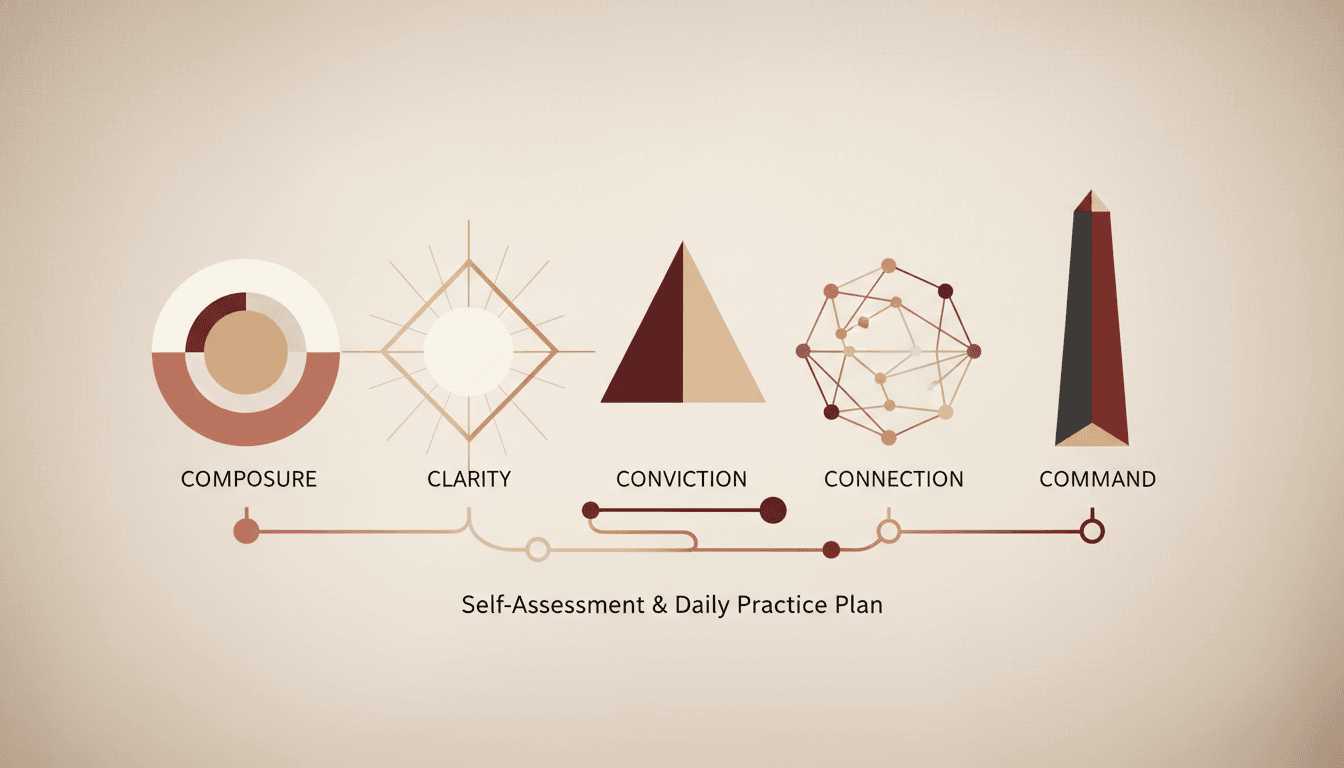
To develop leadership presence, build five core dimensions: composure (staying calm under pressure), clarity (communicating with precision), conviction (speaking with certainty), connection (building trust through empathy), and command (directing attention and action). Leadership presence isn't an inborn trait—it's a set of learnable skills. By assessing yourself across these five dimensions and practicing targeted daily habits, you can transform how others perceive your authority, credibility,

How to Build Presence as a Leader: A Practical Guide
Building presence as a leader requires deliberate practice across four dimensions: how you communicate, how you carry yourself physically, how you regulate your emotions under pressure, and how strategically visible you are within your organization. Leadership presence isn't a personality trait you're born with—it's a set of learnable habits. This guide breaks down a practical framework for cultivating genuine authority and gravitas, whether or not you hold a formal title.