
How to Speak Concisely in Meetings: 6 Clarity Frameworks
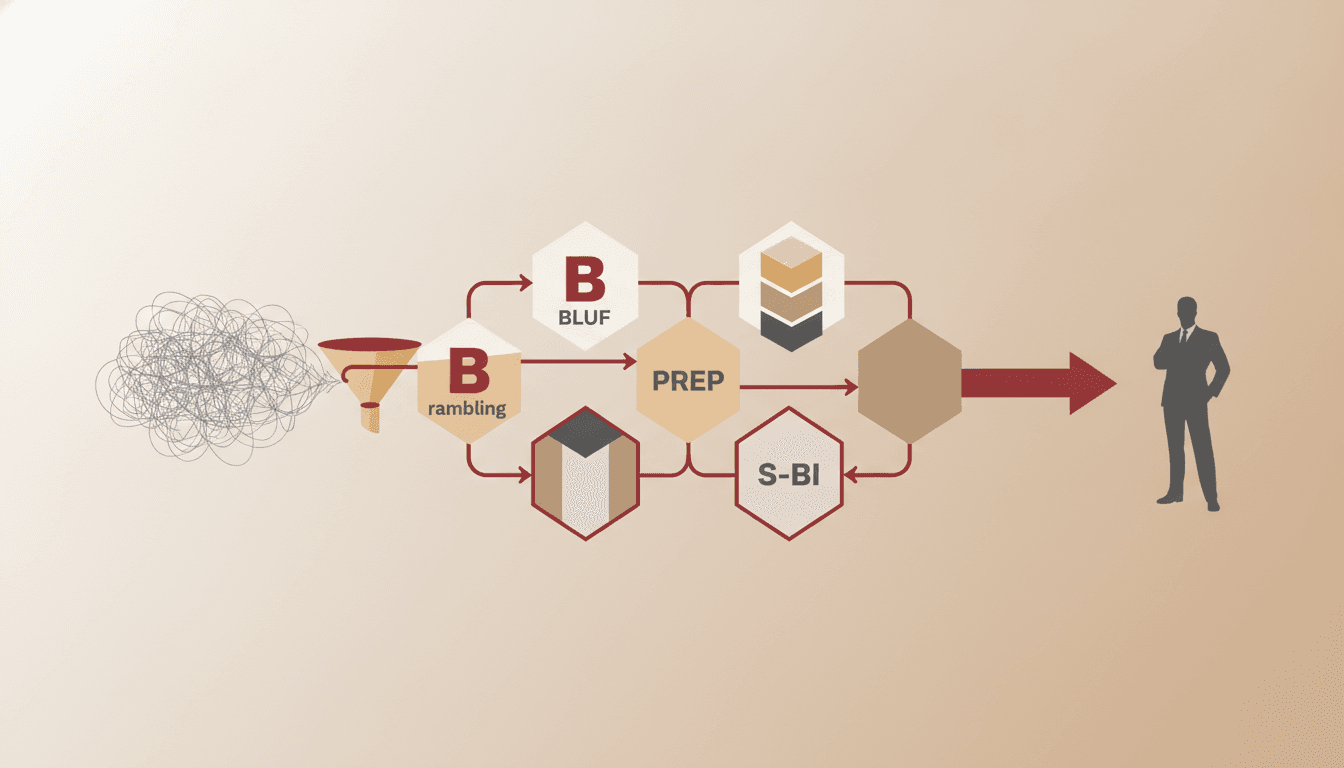
To speak concisely in meetings, use a structured communication framework that forces you to lead with your point and cut filler. The most effective approach is BLUF (Bottom Line Up Front): state your conclusion first, then provide only the supporting evidence your audience needs. Pair this with the PREP, SBI, What-So What-Now What, Rule of Three, and CEO frameworks outlined below to match any meeting scenario—from status updates to executive briefings.
What Does It Mean to Speak Concisely in Meetings?
Speaking concisely in meetings means delivering your message in the fewest words necessary without losing meaning, context, or impact. It's the ability to organize your thoughts before you open your mouth, lead with your main point, and stop talking once you've made it.
Concise communication isn't about saying less for the sake of brevity. It's about saying exactly what matters, in the right order, so your audience understands and acts—without needing you to repeat yourself. According to a Harvard Business Review study, executives consider the ability to communicate concisely one of the top skills that separates high-potential leaders from their peers.
This skill is a core component of leadership presence in meetings—and one of the fastest ways to sound more senior at work.
Why Rambling in Meetings Destroys Your Credibility
Before diving into frameworks, it's worth understanding what's at stake. Rambling doesn't just waste time—it actively undermines how people perceive your competence.

The Credibility Tax of Over-Talking
Research from the University of Michigan found that listeners begin mentally disengaging after roughly 30 seconds of unstructured speaking. Every second past that window, your credibility drops. People stop hearing your point and start wondering when you'll finish.
When you ramble, colleagues unconsciously code you as unprepared, uncertain, or lacking strategic thinking. This is especially damaging in meetings with senior leadership, where communicating like an executive requires precision and economy of words.
The "Thinking Out Loud" Trap
Most rambling isn't caused by having too much to say. It's caused by not knowing your point before you start talking. You're essentially processing your thoughts in real time, and your audience is forced to watch you sort through ideas until you land somewhere.
This is the single biggest habit to break. Every framework below solves this problem by giving you a structure to organize your thinking before you speak—or in the first few seconds of speaking.
What Concise Speakers Do Differently
Concise communicators share three habits: they decide their point before speaking, they structure their response in a predictable pattern, and they stop once the point is made. A study by Quantified Communications found that top-rated business communicators use 40% fewer words than average communicators to convey the same information—and are rated as 42% more competent by their audiences.
If you've ever felt overlooked in meetings, adopting these habits can shift how people perceive you almost immediately.
Framework 1: BLUF (Bottom Line Up Front)
BLUF is a military communication technique adopted by executives worldwide. It's the single most powerful framework for sounding senior in any meeting.
How BLUF Works
The structure is simple: state your conclusion, recommendation, or key point in your very first sentence. Then—and only then—provide the supporting context.
The formula:- Bottom line — Your main point, recommendation, or answer
- Supporting reason(s) — 1-3 pieces of evidence or context
- Stop — Resist the urge to add more
Before and After: BLUF in Action
Before (rambling):"So I was looking at the Q3 numbers and there were some interesting trends, particularly in the Southeast region where we saw a dip in July but then a recovery in August, and I think part of that was the new pricing model, but also there was a competitor launch, and anyway, the net result is that we're 8% over target."
After (BLUF):"We're 8% over target for Q3. The Southeast dipped in July due to a competitor launch but recovered in August after our pricing adjustment took hold. No action needed—just wanted to flag the pattern."
The BLUF version is 60% shorter and infinitely more credible. Notice how the "after" version tells the listener exactly what to do with the information (nothing—it's informational). That's executive-level clarity.
When to Use BLUF
Use BLUF for status updates, project reports, answering direct questions, email summaries, and any time someone asks "What's the update?" It pairs naturally with how executives structure their thoughts before speaking.
Ready to Sound More Senior in Every Meeting? The frameworks in this article are a starting point. The Credibility Code gives you the complete system for commanding authority in any professional conversation. Discover The Credibility Code
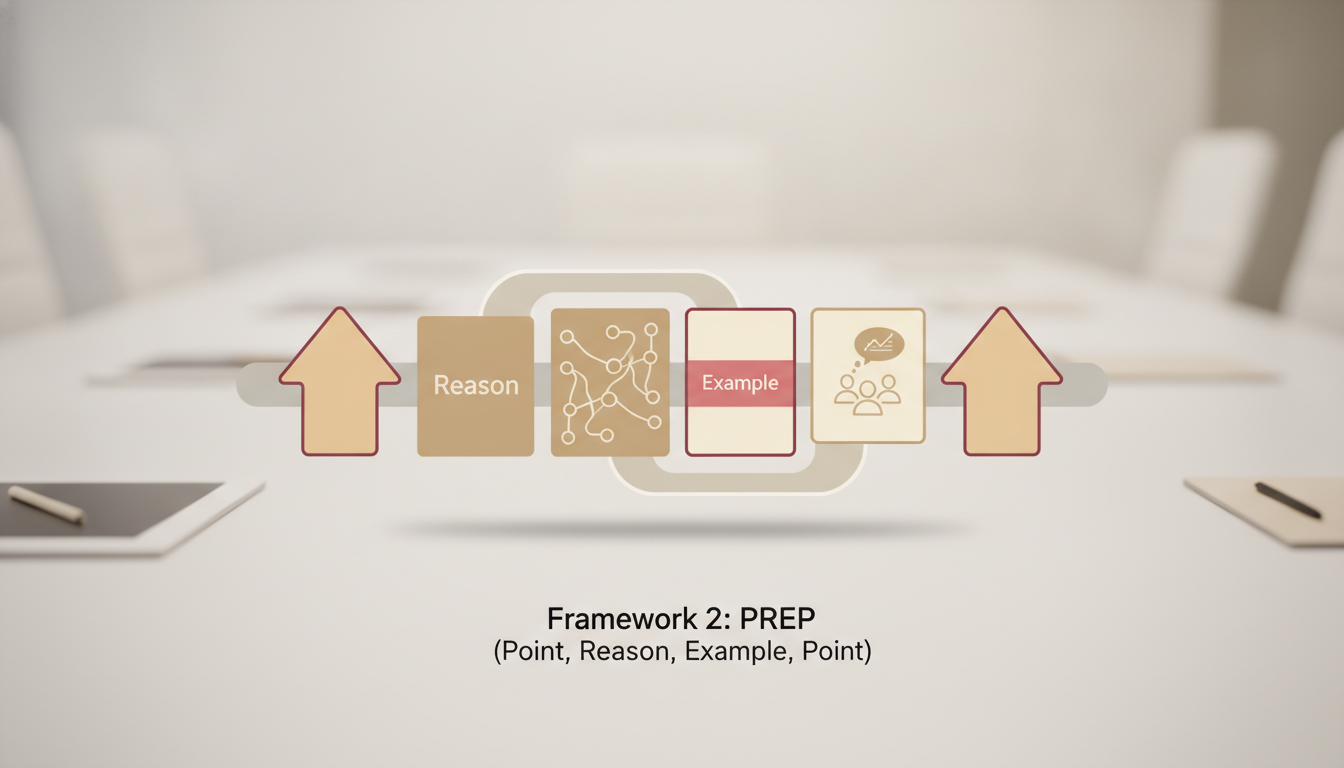
Framework 2: PREP (Point, Reason, Example, Point)
PREP is ideal when you need to make a persuasive argument or share an opinion in a meeting—without spiraling into a monologue.
How PREP Works
- Point — State your position clearly
- Reason — Give one compelling reason why
- Example — Provide a specific, concrete example
- Point — Restate your position to land it
Before and After: PREP in Action
Before (rambling):"I think we should probably consider maybe pushing the launch back. There are a few things I've been thinking about—the QA team is behind, and I talked to Sarah and she mentioned some concerns, and also the marketing assets aren't finalized, and I just feel like it might be risky to go ahead as planned."
After (PREP):"I recommend we push the launch back two weeks. (Point) QA has flagged three unresolved critical bugs that would ship to production. (Reason) Last quarter, we launched the billing module with a similar bug count and had a 23% support ticket spike in week one. (Example) A two-week delay protects the customer experience and our team's bandwidth. (Point)"
PREP works because it contains your argument in a closed loop. You state your point, support it, prove it, and land it—all in under 30 seconds.
When to Use PREP
Use PREP when sharing opinions, making recommendations, disagreeing with leadership, or responding to "What do you think?" questions. It's especially useful for professionals learning to speak up in meetings with confidence.
Framework 3: SBI (Situation, Behavior, Impact)
SBI was developed by the Center for Creative Leadership and is the gold standard for delivering feedback concisely. But it's also a powerful framework for reporting problems, flagging risks, or raising concerns in meetings without rambling.
How SBI Works
- Situation — Set the context briefly (when and where)
- Behavior — Describe the specific action or event (what happened)
- Impact — Explain the result or consequence (why it matters)
Before and After: SBI in Action
Before (rambling):"I wanted to bring up something about the client calls. I've noticed that sometimes when we're on calls with the Meridian account, there's a tendency to go off-script, and I think it's causing some confusion because the client asked me about pricing that wasn't what we agreed on, and I'm not sure if everyone is aligned on the messaging, and it's just something I think we should talk about."
After (SBI):"On Tuesday's Meridian call (Situation), our team quoted pricing that contradicted the approved rate card (Behavior). The client flagged the discrepancy in a follow-up email to their VP, which puts our contract renewal at risk (Impact). I'd like to align on messaging before Thursday's follow-up."
The SBI version is direct, specific, and impossible to misunderstand. It also ends with a clear next step—a hallmark of communicating with gravitas.
When to Use SBI
Use SBI for giving feedback, raising concerns, reporting incidents, or flagging risks. It keeps emotional situations factual and prevents the common trap of over-explaining when you're frustrated or nervous.
Framework 4: What — So What — Now What
This three-part framework is a favorite among management consultants and senior leaders. It forces you to connect information to meaning to action—which is exactly how executives think.
How It Works
- What — State the fact, data point, or observation
- So What — Explain why it matters (the implication)
- Now What — Recommend the next step
Before and After in Action
Before (rambling):"So customer churn went up last month. It was about 4.2%, which is higher than usual. I think there might be some issues with onboarding, and also the new pricing tier might be a factor. We should probably look into it. Maybe we could survey some of the churned accounts or set up a task force or something."
After (What — So What — Now What):"Customer churn hit 4.2% last month, up from our 3.1% average. (What) If this trend continues, we'll miss our annual retention target by Q3. (So What) I recommend we run exit interviews on the 15 highest-value churned accounts this week to identify the root cause before our next pricing review. (Now What)"
According to McKinsey's research on executive communication, senior leaders consistently prefer communication structured around "insight and action" rather than "data and description." This framework delivers exactly that.
When to Use It
Use this framework for data presentations, strategy discussions, board updates, and any time you're reporting metrics. It's the backbone of how to present ideas to senior management.
Framework 5: The Rule of Three
The Rule of Three leverages a cognitive principle: people remember and process information best in groups of three. When you limit yourself to three points, you sound organized, deliberate, and in control.
How It Works
Before you speak, ask yourself: "What are the three things my audience needs to know?" Then deliver only those three things.
Structure:- "There are three things to cover here..."
- "I see three options..."
- "Three takeaways from this quarter..."
Before and After in Action
Before (rambling):"There are a lot of reasons this project is behind. Resourcing has been an issue, and then there were the scope changes, and also the vendor was late, and we had some internal alignment problems, and the testing phase took longer than expected, and honestly the timeline was aggressive to begin with."
After (Rule of Three):"This project is behind for three reasons. First, two scope changes added 40 hours of unplanned work. Second, our vendor delivered assets three weeks late. Third, we lost our lead developer to the Atlas project for two sprints. I have a revised timeline that accounts for all three—I'll share it after this meeting."
The Rule of Three also prevents a common credibility killer: listing so many reasons that none of them sound important. When everything is a priority, nothing is. Three points signal that you've done the thinking to prioritize.
When to Use It
Use the Rule of Three for project updates, answering "why" questions, making cases for resources, and structuring any impromptu response. It pairs well with techniques for how to respond when put on the spot at work.
Want the Complete System for Commanding Authority? These frameworks are just one piece of the puzzle. The Credibility Code gives you the full communication playbook—from meetings to negotiations to executive presentations. Discover The Credibility Code
Framework 6: The CEO Framework (Context, Evaluation, Outcome)
The CEO Framework is designed for high-stakes moments: executive briefings, board presentations, and cross-functional leadership meetings where every word carries weight.
How It Works
- Context — One sentence of relevant background (assume your audience is smart but busy)
- Evaluation — Your assessment or analysis of the situation
- Outcome — The result you're driving toward or the decision you need
Before and After in Action
Before (rambling):"So as you know, we've been working on the platform migration for about six months now, and there have been some challenges along the way. The team has been working really hard, and we've made a lot of progress, but there are still some outstanding items. I wanted to talk about where we are and what we might need going forward, because I think there are some resource implications that we should probably discuss."
After (CEO Framework):"We're in month six of the platform migration, currently 78% complete. (Context) The remaining 22% includes the payment integration, which requires specialized security expertise we don't have in-house. (Evaluation) I need approval to bring in a contract security engineer for eight weeks at $45K to hit our September deadline. (Outcome)"
Notice how the CEO version respects the audience's time, demonstrates clear thinking, and ends with a specific ask. This is how people who sound more senior at work actually communicate.
When to Use It
Use the CEO Framework for executive briefings, budget requests, cross-functional updates, and any conversation where you need a decision from someone with limited time and high authority.
How to Practice These Frameworks Daily
Knowing frameworks is one thing. Using them under pressure is another. Here's how to build the habit.
The 10-Second Pause Technique
Before speaking in any meeting, take a silent breath and ask yourself: "What is my point?" Then choose the framework that fits. This pause—which feels long to you but barely registers to others—is the difference between rambling and precision. Research published in the Journal of Experimental Psychology found that brief pauses before speaking increase perceived speaker confidence by up to 30%.
The Post-Meeting Audit
After every meeting, review one contribution you made. Ask: Did I lead with my point? Could I have said it in fewer words? Which framework would have worked better? This five-minute habit compounds quickly. Within two weeks, you'll notice a significant shift in how concisely you communicate.
The "Headline First" Drill
Practice writing one-sentence summaries of your key points before meetings. If you can't summarize your message in one sentence, you don't yet know your message. This discipline is central to how to speak concisely at work and transfers directly into verbal communication.
Frequently Asked Questions
How long should my speaking turns be in meetings?
Aim for 30 to 60 seconds per contribution in most meetings. Research from the University of Michigan shows listener attention drops sharply after 30 seconds of unstructured speaking. Use a framework to structure your point, deliver it, and stop. If the topic requires more time, break it into segments and check for questions between each one.
What's the difference between BLUF and PREP?
BLUF is best for delivering information—updates, answers, reports—where your audience needs the conclusion first. PREP is better for persuasion—sharing opinions, making recommendations, or arguing a position. Use BLUF when someone asks "What's the status?" and PREP when someone asks "What do you think we should do?"
How do I stop rambling when I'm nervous in meetings?
Nervousness causes rambling because your brain races ahead of your mouth. The fix is structural: choose a framework before you speak, state your first sentence, then follow the framework step by step. The 10-Second Pause Technique described above is specifically designed for high-pressure moments. You can also explore how to sound confident in meetings when you feel anxious for additional strategies.
Can I be too concise in meetings?
Yes. Being overly terse can come across as dismissive or withholding. The goal is appropriate conciseness—giving your audience exactly what they need, no more and no less. If you're presenting to a technical team, they may need more detail than a C-suite audience. Match your depth to your audience's needs and decision-making context.
How do I speak concisely when I'm asked a question I didn't prepare for?
Use the Rule of Three or PREP framework as a stalling structure. Say, "There are three things I'd highlight here..." and then use the pause to organize your thoughts around three points. For a deeper dive on this exact scenario, read our guide on how to answer questions you don't know without faking.
Which framework should I use for executive presentations?
For executive presentations, combine BLUF with the CEO Framework. Open with your bottom line (recommendation or key finding), then use Context-Evaluation-Outcome for each supporting section. Executives want your conclusion first and your evidence second. This approach aligns with how to brief executives quickly.
Turn Every Meeting Into a Credibility Moment. The six frameworks in this article will help you speak concisely—but true professional authority goes beyond meetings. The Credibility Code gives you the complete system for building commanding presence in every conversation, presentation, and negotiation. Discover The Credibility Code
Ready to Command Authority in Every Conversation?
Transform your professional communication with proven techniques that build instant credibility. The Credibility Code gives you the frameworks top leaders use to project confidence and authority.
Discover The Credibility CodeRelated Articles

How to Speak Concisely at Work: The Clarity Framework
To speak concisely at work, lead with your main point first (bottom-line-up-front), structure supporting details using the rule of three, and cut filler words ruthlessly. The most respected communicators in any workplace share one trait: they say more by saying less. This article gives you a proven Clarity Framework — including specific techniques, before/after examples, and daily practice methods — so every word you speak earns attention and respect.

How to Communicate With Gravitas at Work: A Framework
Communicating with gravitas at work requires mastering five interconnected dimensions: language precision, emotional regulation, strategic silence, structured thinking, and physical presence. Gravitas isn't about being loud or dominant—it's about speaking with such clarity, composure, and conviction that people naturally give your words more weight. This framework breaks each dimension into daily practices you can start using immediately, so every interaction—from a hallway conversation to a boa

How to Speak With Authority as a Woman at Work
To speak with authority as a woman at work, focus on five core areas: use declarative sentence structures instead of hedging language, lower your vocal pitch slightly at the end of statements, claim physical and verbal space in meetings, prepare strategic talking points in advance, and address double-bind dynamics with confident warmth. These research-backed strategies help women project credibility and command respect without sacrificing authenticity.