
How to Communicate Your Strategic Value at Work Clearly

Most professionals work hard but struggle to articulate why their work matters. To communicate your strategic value at work, stop describing tasks and start translating your contributions into business outcomes. Use a value translation framework: connect every project, initiative, or result to a measurable business impact—revenue growth, cost reduction, risk mitigation, or operational efficiency. Align your language with stakeholder priorities, and consistently position yourself as someone who thinks beyond their role. This shift changes how leaders perceive you and accelerates your career trajectory.
What Is Strategic Value Communication?
Strategic value communication is the practice of articulating your professional contributions in terms of business impact rather than task completion. Instead of saying "I managed the project," you say "I led a cross-functional initiative that reduced onboarding time by 30%, saving the company an estimated $200K annually."
It's the difference between being seen as someone who does work and someone who drives results. This skill bridges the gap between individual effort and organizational priorities, making your contributions visible, memorable, and promotable.
Strategic value communication isn't bragging. It's a professional competency—one that senior leaders use instinctively and one that mid-career professionals must develop deliberately.
Why Most Professionals Fail to Communicate Their Value
The Task Trap: Describing What You Did Instead of Why It Mattered

Most people default to task-based language in emails, meetings, and performance reviews. They say things like "I updated the dashboard" or "I coordinated with the vendor." This language is accurate but invisible. It tells stakeholders what happened without explaining why it matters.
A 2023 survey by Gartner found that 70% of employees feel their contributions are not fully recognized by leadership. The root cause isn't always bad management—it's often poor value translation by the employee themselves.
Assuming Your Work Speaks for Itself
This is the most common and most damaging assumption in professional communication. High-quality work does not automatically get noticed, especially in large organizations where leaders are processing hundreds of data points per week.
If you've ever been passed over for a promotion despite strong performance, this assumption may be the reason. Your manager isn't ignoring you—they simply can't see the strategic thread connecting your daily work to organizational outcomes. If this pattern sounds familiar, you may want to explore why people don't take you seriously at work and how to fix it.
Confusing Humility with Invisibility
Many professionals—especially introverts and those from cultures that value modesty—equate self-advocacy with arrogance. But there's a critical difference between bragging and building credibility without being self-promotional.
Strategic value communication is factual, outcome-oriented, and stakeholder-focused. It's not about you—it's about helping decision-makers understand the impact of the work being done.
The Value Translation Framework: A 4-Step Method
This is the core framework for transforming how you communicate your contributions. Use it in emails, meetings, performance reviews, and one-on-ones.
Step 1: Identify the Business Outcome
Before you describe any project or task, ask yourself: What business outcome did this serve? Every piece of work connects to one of these five categories:
- Revenue growth (new sales, client retention, upselling)
- Cost reduction (efficiency gains, waste elimination, automation)
- Risk mitigation (compliance, error reduction, contingency planning)
- Operational efficiency (speed, throughput, process improvement)
- Strategic positioning (market advantage, innovation, competitive differentiation)
If you can't identify the business outcome, you're either doing work that doesn't matter (unlikely) or you haven't yet drawn the connection (very likely).
Step 2: Quantify the Impact
Numbers transform vague claims into credible statements. According to a 2022 study published in the Harvard Business Review, professionals who quantify their contributions in performance conversations are 40% more likely to receive above-average ratings.
You don't need exact figures. Estimates, percentages, and ranges all work:
- "Reduced processing time by approximately 25%"
- "Contributed to a pipeline increase of $1.2M over two quarters"
- "Decreased client escalations from 12 per month to 3"
Step 3: Connect to Stakeholder Priorities
Different stakeholders care about different outcomes. Your CEO cares about growth and market position. Your VP of Operations cares about efficiency and cost. Your direct manager cares about team performance and deliverables.
Tailor your value language to the person you're speaking with. The same project can be framed three different ways:
- To your CEO: "This initiative positions us ahead of competitors in the mid-market segment."
- To your CFO: "This reduced our customer acquisition cost by 18%."
- To your manager: "This freed up 10 hours per week for the team to focus on Q4 priorities."
This stakeholder alignment is a hallmark of executive-level communication.
Step 4: Use the "So That" Bridge
The simplest linguistic tool for value translation is the phrase "so that." It forces you to connect action to outcome.
Before: "I redesigned the client onboarding process." After: "I redesigned the client onboarding process so that new clients reach full activation 40% faster, which directly improves first-year retention."Practice this bridge in every email, update, and status report. Within weeks, it becomes automatic.
Ready to Command More Credibility in Every Conversation? The Credibility Code gives you the exact frameworks, scripts, and strategies to position yourself as a strategic authority at work—not someday, but starting this week. Discover The Credibility Code
Where to Apply Strategic Value Communication
In Performance Reviews and Self-Assessments
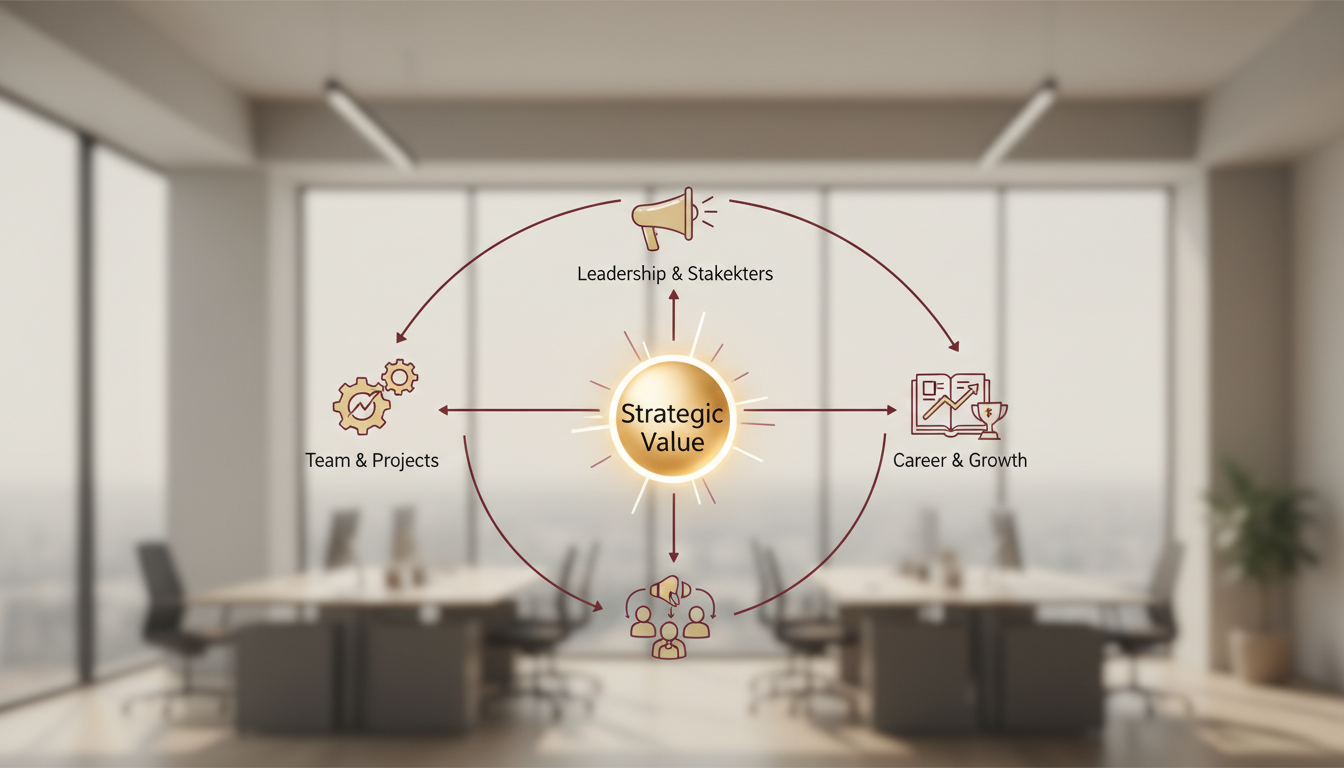
Performance reviews are where strategic value communication matters most—and where most professionals fumble. A 2023 report from McKinsey & Company found that managers spend an average of just 11 minutes reviewing each employee's self-assessment. You have a tiny window to make your impact clear.
Use this structure for each accomplishment:
- Action: What you did (one sentence)
- Impact: The measurable result (one sentence with numbers)
- Strategic link: How it connects to team or company goals (one sentence)
"Led the migration to the new CRM platform (action). This reduced data entry errors by 60% and saved the sales team an estimated 15 hours per week (impact). This directly supports our Q3 goal of improving sales productivity by 20% (strategic link)."
In Meetings and Verbal Updates
When you give verbal updates in meetings, resist the urge to narrate your to-do list. Instead, lead with the outcome and work backward.
Weak: "This week I worked on the vendor contracts, had three calls with the legal team, and started drafting the RFP." Strong: "We're on track to finalize vendor selection by Friday, which keeps us aligned with the April launch timeline. I've resolved the key legal blockers and the RFP is in final draft."The second version communicates progress, strategic alignment, and confidence. For more on this, explore our guide on how to speak with confidence in meetings.
In Emails to Senior Leaders
Executives scan emails in seconds. They don't want context—they want conclusions. When writing to leadership, put the strategic value in the first sentence.
Weak subject line: "Update on Project Atlas" Strong subject line: "Project Atlas: On Track to Deliver $350K in Annual Savings"The body of your email should follow the same principle. Lead with impact, then provide supporting details only if necessary. Our guide on writing emails that get executive attention covers this in depth.
How to Position Yourself as a Strategic Thinker
Speak in Outcomes, Not Activities
This is the single most important language shift you can make. According to research from the Center for Creative Leadership, leaders who consistently frame contributions in terms of outcomes are rated 2.5x more likely to be seen as "high potential" by senior leadership.
Start monitoring your own language. Every time you're about to say "I worked on..." or "I handled...", pause and reframe around the result.
| Activity Language | Strategic Value Language |
|---|---|
| "I created a report for the team." | "I identified three underperforming segments, which informed our reallocation of $500K in marketing spend." |
| "I managed the vendor relationship." | "I renegotiated vendor terms that reduced our annual spend by 12%." |
| "I trained the new hires." | "I built an onboarding program that cut ramp-up time from 8 weeks to 5, accelerating team productivity." |
Ask Strategic Questions in Meetings
You don't need to have all the answers to be seen as strategic. Asking the right questions signals that you think beyond your immediate responsibilities.
Examples of strategic questions:
- "How does this align with our priorities for next quarter?"
- "What's the risk if we don't act on this by [date]?"
- "Have we considered how this impacts the customer experience?"
- "What does success look like from the executive team's perspective?"
These questions shift your positioning from executor to strategic thinker—someone who sees the bigger picture.
Build a Strategic Value Portfolio
Don't wait for performance review season to document your impact. Keep a running "value log"—a simple document where you record accomplishments using the Action → Impact → Strategic Link format.
Update it weekly. Spend five minutes every Friday noting what you delivered, the measurable result, and the business goal it supported. After three months, you'll have a powerful portfolio that makes self-advocacy effortless and evidence-based.
This practice also supports your personal brand as a leader, giving you concrete proof points for networking conversations, LinkedIn content, and internal visibility opportunities.
Turn Your Contributions Into Career Authority If you're tired of being overlooked despite doing exceptional work, The Credibility Code will show you exactly how to translate your expertise into influence. Discover The Credibility Code
Common Mistakes That Undermine Your Strategic Messaging
Over-Explaining and Burying the Lead
When you give too much context before the outcome, you lose your audience. Senior leaders in particular have limited attention bandwidth. A 2024 study by Microsoft found that the average professional's attention span during meetings has dropped to approximately 8 minutes for any single topic.
Lead with the punchline. State the result first, then offer context only if someone asks for it.
Using Hedging Language
Phrases like "I just wanted to share," "I think this might have helped," or "It's not a big deal, but..." actively undermine your strategic positioning. They signal uncertainty and invite others to minimize your contributions.
Replace hedging with direct, confident statements:
- Instead of: "I think the new process might be saving some time."
- Say: "The new process is saving the team 12 hours per week."
If hedging language is a pattern for you, our guide on how to stop undermining yourself at work offers 12 specific fixes.
Failing to Tailor Your Message to the Audience
Communicating the same way to your direct reports, your peers, and your VP is a strategic communication failure. Each audience has different priorities, different time constraints, and different definitions of value.
Before any important communication, ask: What does this person care about most? Then frame your contribution accordingly. This audience-first mindset is what separates good communicators from truly influential ones.
Frequently Asked Questions
What does "strategic value" mean in a professional context?
Strategic value refers to the measurable business impact of your work—not the tasks you perform, but the outcomes those tasks produce. It includes contributions to revenue, cost savings, risk reduction, efficiency, and competitive advantage. When you communicate strategic value, you connect your daily work to the goals that matter most to your organization and its leadership.
How is communicating strategic value different from self-promotion?
Self-promotion centers on you—your skills, your effort, your importance. Strategic value communication centers on business outcomes—what the organization gained from the work. It's factual, evidence-based, and stakeholder-focused. When done correctly, it doesn't feel like bragging because the focus is on results, not ego. Think of it as reporting impact rather than requesting recognition.
How do I communicate my value if I'm in a support or operational role?
Every role creates strategic value—it just requires deeper translation. If you're in HR, IT, finance, or operations, focus on efficiency gains, error reduction, compliance improvements, or cost savings. For example, "I streamlined the invoice approval workflow, reducing processing time from 5 days to 2, which improved vendor relationships and eliminated late-payment penalties of approximately $15K per quarter."
How often should I communicate my strategic value at work?
Consistently, but not constantly. Aim to include value-framed language in weekly status updates, monthly one-on-ones, and quarterly reviews. Avoid saving all your impact communication for annual performance reviews—by then, leaders have already formed their impressions. Small, regular signals of strategic contribution are far more effective than one large annual summary.
Can I communicate strategic value in writing, or is it better done verbally?
Both channels matter. Written communication—especially emails and performance self-assessments—creates a documented record of your impact. Verbal communication in meetings and one-on-ones adds personal presence and conviction. The most effective professionals use both: they write with strategic clarity and speak with confident authority. For email-specific strategies, see our guide on how to sound authoritative in emails.
Strategic value communication vs. executive communication: what's the difference?
Executive communication is a broader skill set that includes brevity, presence, tone, and audience management when interacting with senior leaders. Strategic value communication is a specific subset—the ability to frame contributions in business-impact terms. You need strategic value communication skills to excel at executive communication, but executive communication also encompasses areas like commanding presence, stakeholder management, and decision framing.
Your Work Deserves to Be Seen—and Valued The Credibility Code is the complete system for professionals who want to stop being overlooked and start being recognized as the strategic leaders they already are. Inside, you'll find the frameworks, scripts, and daily practices that transform how people perceive your contributions. Discover The Credibility Code
Ready to Command Authority in Every Conversation?
Transform your professional communication with proven techniques that build instant credibility. The Credibility Code gives you the frameworks top leaders use to project confidence and authority.
Discover The Credibility CodeRelated Articles

Professional Communication Tips for Managers Who Lead
The professional communication tips that separate respected managers from average ones come down to six core habits: leading with clarity over detail, framing feedback around behavior rather than character, adapting your communication style when speaking upward versus downward, mastering the strategic pause, writing with executive brevity, and building psychological safety through how you listen—not just what you say. Below, you'll find the specific frameworks and techniques for each.

Communicate With Impact at Work: 8 High-Influence Habits
To communicate with impact at work, build daily habits that signal clarity, confidence, and competence. The eight most effective habits include leading with your conclusion, using decisive language, structuring messages with frameworks, managing your vocal delivery, writing emails that command attention, asking strategic questions, calibrating your body language, and closing every interaction with a clear next step. These habits shift how colleagues and leaders perceive your authority—and they c

How to Communicate Strategic Thinking at Work Clearly
To communicate strategic thinking at work, stop leading with tasks and start leading with outcomes. Frame every idea around business impact: connect your recommendation to a company goal, quantify the stakes, and propose a clear path forward. Use the "So What → So Now" structure—state the insight, explain why it matters to the business, then recommend the next move. This shift from operational detail to strategic narrative is what separates contributors from leaders in the eyes of senior decisio