
Write Emails That Get Executive Attention: 5 Rules

What Are Executive-Attention Emails?
Executive-attention emails are strategically structured messages designed to match how senior leaders actually process information—quickly, selectively, and with a bias toward action. They prioritize clarity over completeness and lead with outcomes rather than backstory.
Unlike standard workplace emails, executive-attention emails are built on a core principle: respect the reader's time as if it were the most expensive resource in the room—because it is. These emails signal credibility, authority, and strategic thinking before the reader finishes the first line.
If you want to deepen your understanding of how writing style shapes perception, explore our guide on leadership presence in email and writing with authority.
Why Most Professional Emails Get Ignored by Executives
The Volume Problem

The average executive receives 120 emails per day, according to a 2023 report by the Radicati Group. That means your message competes with 119 others for a sliver of attention. Most executives spend fewer than 11 seconds scanning an email before deciding to act, delegate, or delete it (Microsoft Workplace Insights, 2022).
Your email isn't being evaluated on effort. It's being evaluated on signal-to-noise ratio. If the first three lines don't answer "Why should I care?" and "What do you need from me?"—you've already lost.
The Credibility Gap
Here's what most mid-career professionals miss: the way you write is interpreted as the way you think. A rambling, unfocused email doesn't just get skipped—it quietly repositions you as someone who lacks strategic clarity.
A McKinsey study on executive communication found that leaders consistently rated colleagues who communicated concisely as more competent and promotable than those who provided exhaustive detail (McKinsey Quarterly, 2021). Your email format is a proxy for your leadership potential.
If you've ever felt overlooked in professional settings, the issue may extend beyond email. Our post on why people don't take you seriously at work breaks down the full picture.
Rule 1: Lead With the Ask, Not the Context
The Inverted Pyramid Format
Journalists have used the inverted pyramid for over a century: put the most important information first, then layer in supporting detail. Executive emails should follow the same structure.
Instead of this:"Hi Sarah, I wanted to follow up on our conversation from last week's quarterly review where we discussed the timeline for the infrastructure migration. After reviewing the vendor proposals and talking to the engineering team about capacity constraints, I think we need to adjust the launch date..."Write this:
"Hi Sarah, I'm recommending we push the infrastructure migration launch from March 15 to April 1. Two factors: vendor delays (2-week slip on hardware) and engineering capacity (team is at 115% utilization through March). Happy to walk through details—15 min this week?"
The second version delivers the conclusion, the reasoning, and the ask in under 50 words.
The "So What?" Test
Before you hit send, read your first sentence and ask: "Does this tell the executive what they need to know or do?" If your opening line is background, a greeting filler, or a recap of previous conversations, rewrite it.
Executives don't need to be walked through your thought process. They need your conclusion and enough evidence to trust it. This is a core skill in communicating with senior executives effectively.
Rule 2: Write Subject Lines That Drive Action
The Three-Part Subject Line Formula
Your subject line is a headline. According to Boomerang's analysis of over 300,000 emails, messages with 3-4 word subject lines had the highest response rates. For executive emails, use this formula:
[Action Needed] + [Topic] + [Timeframe]Examples:
- Decision Needed: Q3 Budget by Friday
- FYI: Client Escalation – Resolved
- Approval Request: New Hire – Marketing Lead
- Update: Product Launch On Track
What to Avoid in Subject Lines
Never use vague subject lines like "Quick question," "Following up," or "Thoughts?" These signal low-priority content. Equally damaging are overly long subject lines that get cut off on mobile—where 81% of emails are first opened (Litmus, 2023).
A strong subject line does two things: it tells the executive whether to open the email now, and it tells them what kind of response you need. That's it.
Your Emails Are Your Professional Brand — Every message you send to leadership shapes how you're perceived. Discover The Credibility Code to master the communication patterns that build lasting authority.
Rule 3: Use Strategic Brevity—125 Words or Fewer
Why Brevity Signals Authority

Brevity isn't about dumbing things down. It's about demonstrating that you can distill complexity into clarity—which is exactly what executives do all day. When you write a 400-word email, you're asking the executive to do the synthesis work for you. When you write 100 words, you've already done it.
Harvard Business Review found that emails under 125 words had a 51% response rate, compared to just 44% for emails over 200 words (HBR, 2022). Shorter emails don't just get read faster—they get answered more often.
The Anatomy of a 125-Word Executive Email
Here's a template that works in almost any context:
Line 1: The ask or key takeaway (1 sentence) Lines 2-3: Supporting evidence or context (2-3 sentences, max) Line 4: Clear next step with a deadline (1 sentence) Sign-off: Your name, no fluffExample:
Subject: Approval Needed: Vendor Contract – by Thursday
>
Hi James,
>
I'm recommending we move forward with Acme Solutions for the CRM migration at $185K (12% under budget). They scored highest on security compliance and can start two weeks earlier than the runner-up. Contract is attached for your review.
>
Can you approve or flag concerns by Thursday EOD so we can lock in the March start date?
>
Thanks,
Rachel
That's 67 words. It's complete. It's actionable. It signals that Rachel thinks like a leader.
For a deeper dive into this skill, read our guide on how to write like an executive: concise, clear, commanding.
Rule 4: Format for Scanning, Not Reading
Use Bullets, Bold, and White Space
Executives don't read emails top to bottom. They scan. Your formatting should support this behavior, not fight it.
Formatting rules for executive emails:- Bold your key ask or recommendation
- Use bullet points for any list of 3+ items
- Keep paragraphs to 2 sentences max
- Add a blank line between every section
- Never write a wall of text
The "Glance Test"
Hold your email at arm's length (or shrink your screen to 50%). Can you still identify the main point and the ask? If not, you need more visual structure.
This principle applies beyond email. If you struggle with being concise in verbal settings too, our article on how to speak concisely at work offers a framework that translates directly to writing.
Rule 5: Close With One Clear Next Step
Eliminate Decision Fatigue
The fastest way to kill an executive's momentum is to end your email with multiple open-ended questions or a vague "Let me know your thoughts." Instead, close with one specific action and one specific deadline.
Weak close:"Let me know what you think and if you'd like to discuss further. Also, should we loop in the legal team? Happy to set up a meeting whenever works."Strong close:
"Can you confirm approval by Wednesday at noon? I'll handle legal coordination once we have your green light."
The strong close reduces the executive's cognitive load to a single decision: yes or no.
The "Reply in 10 Seconds" Standard
Design your closing so that the executive can respond in under 10 seconds. The best executive emails often get replies like "Approved," "Go ahead," or "Let's discuss Thursday at 2." If your email requires a paragraph-length response, you've made it too complicated.
This approach to reducing friction in high-stakes communication is also central to how to brief executives quickly using the 60-second framework.
Ready to Communicate Like a Senior Leader? — Writing emails that command attention is just one piece of the credibility puzzle. Discover The Credibility Code for the complete framework on building authority in every professional interaction.
Putting It All Together: Before and After
Here's a real-world scenario showing all five rules in action.
Before (typical mid-career professional email):Subject: Infrastructure Update
>
Hi David, Hope you had a good weekend. I wanted to give you an update on the infrastructure project. As you know, we've been working with three vendors over the past six weeks to evaluate options for the cloud migration. The team met last Thursday to review the final proposals. After extensive analysis, we believe CloudFirst is the strongest option based on their pricing model, security certifications, and implementation timeline. However, there are some concerns about their support SLA that I think we should discuss. The budget impact would be approximately $240K, which is within the approved range. I've attached the full comparison matrix for your review. Let me know if you'd like to discuss or if you have any questions. Also, I wasn't sure if we should include the compliance team at this stage—what do you think?After (executive-attention email):
Subject: Decision Needed: Cloud Vendor – by Wednesday
>
Hi David,
>
Recommendation: Go with CloudFirst for the cloud migration ($240K, within budget).
>
Why:
- Strongest security certifications of all three finalists
- Fastest implementation: 8 weeks vs. 12 for the runner-up
- One concern: support SLA is 4-hour response vs. our 2-hour target (I'm negotiating this down)
>
Next step: Can you approve by Wednesday so I can finalize the contract? Comparison matrix attached if you want the details.
>
Rachel
Same information. Half the words. Twice the impact.
For more examples of assertive, high-impact email writing, check out our post on how to be more assertive in emails with 12 before-and-after examples.
Frequently Asked Questions
How long should an email to an executive be?
Aim for 125 words or fewer. Research from Harvard Business Review shows that emails under 125 words receive significantly higher response rates than longer messages. If your topic requires more detail, put your ask and recommendation in the email body and attach supporting information as a separate document. The email itself should always be scannable in under 15 seconds.
What's the best subject line format for executive emails?
Use the formula: [Action Type] + [Topic] + [Timeframe]. For example, "Approval Needed: Q4 Budget by Friday" or "FYI: Client Issue Resolved." This format tells the executive exactly what the email is about and what kind of response you need before they even open it. Avoid vague subject lines like "Quick question" or "Update."
How to write emails that get executive attention vs. emails for peers?
Executive emails prioritize the conclusion first and supporting detail second (inverted pyramid). Peer emails often follow a narrative structure—context, analysis, then conclusion. With executives, eliminate pleasantries, reduce options to a clear recommendation, and always close with one specific next step. With peers, more collaborative and exploratory language is appropriate.
Should I use bullet points in emails to executives?
Yes. Bullet points dramatically improve scannability, and executives prefer them for any list of three or more items. Use bold text for your key recommendation and bullets for supporting evidence. Avoid long, unformatted paragraphs—they signal that you haven't distilled your thinking. Formatting is a credibility signal, not just a style choice.
How do I follow up with an executive who hasn't responded?
Wait 48 business hours, then send a brief follow-up that restates your ask in one sentence. Example: "Hi Sarah—circling back on the vendor approval. Can you confirm by Thursday EOD so we can hold the March start date?" Keep it under 30 words. Don't re-explain the entire situation. If you still get no response, consider whether the ask is better suited for a 5-minute conversation.
Is it unprofessional to send very short emails to executives?
No—it's the opposite. Short, well-structured emails signal strategic thinking and respect for the reader's time. What's unprofessional is forcing a busy executive to wade through unnecessary context to find your point. Brevity combined with clarity is one of the strongest credibility signals in professional communication.
Build the Authority That Gets You Heard — The five rules in this article are a starting point. The Credibility Code gives you the complete system for communicating with confidence, commanding respect, and accelerating your career. Discover The Credibility Code and start writing, speaking, and leading with authority today.
Ready to Command Authority in Every Conversation?
Transform your professional communication with proven techniques that build instant credibility. The Credibility Code gives you the frameworks top leaders use to project confidence and authority.
Discover The Credibility CodeRelated Articles
Executive vs Regular Communication: 10 Key Patterns
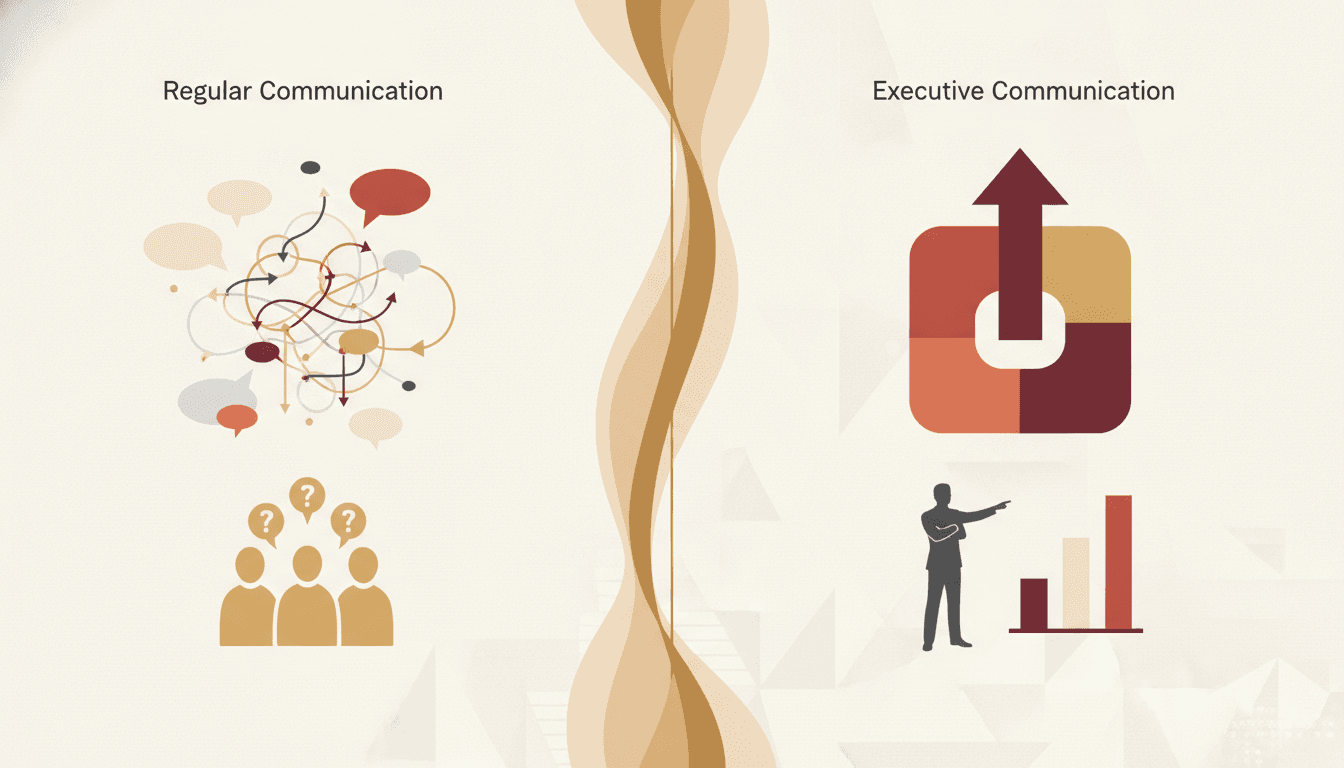
The difference between executive communication and regular communication comes down to ten distinct patterns: executives lead with outcomes instead of details, use decisive language instead of hedging, structure messages top-down instead of chronologically, speak in strategic terms instead of tactical ones, and manage attention rather than just sharing information. They also listen more selectively, frame problems as decisions, use silence deliberately, communicate with consistent brevity, and p
How Executives Structure Emails for Maximum Impact
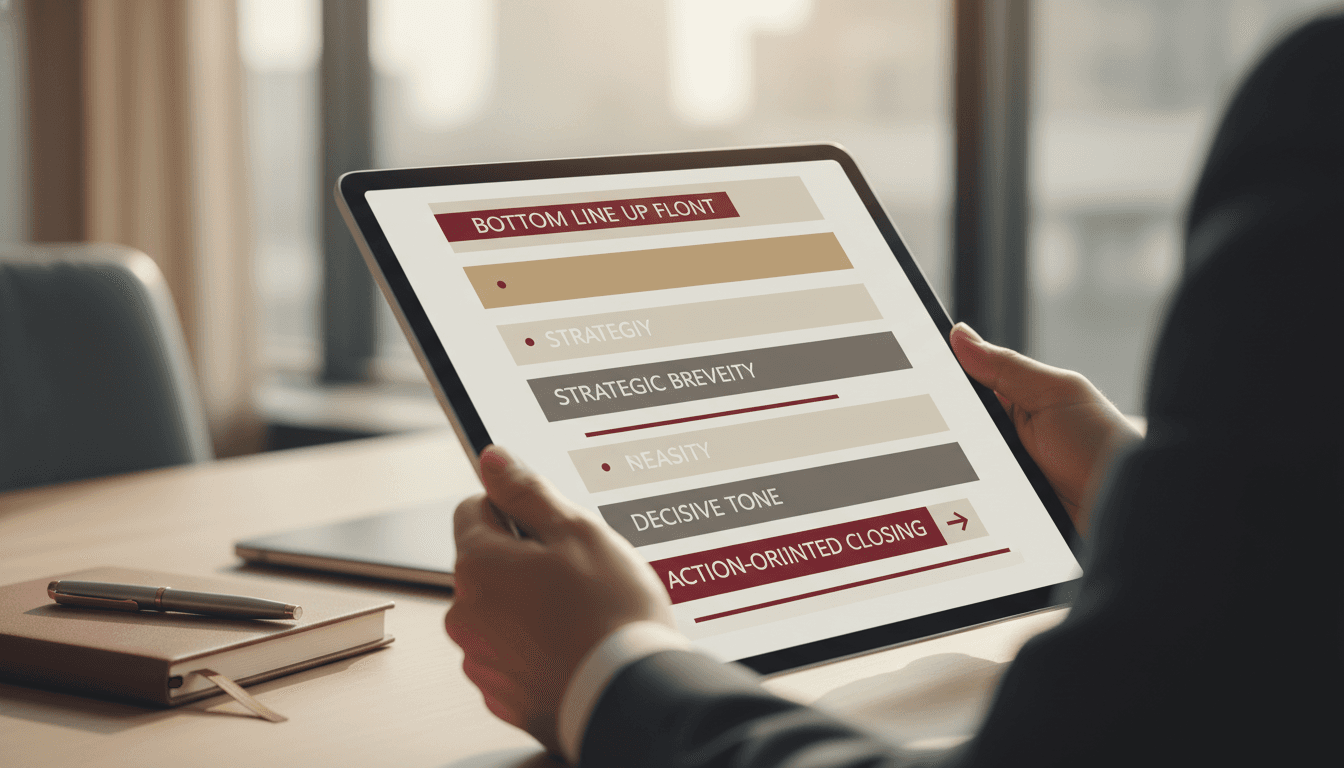
Executives structure emails for impact by leading with the bottom line first, keeping messages under five sentences when possible, using decisive language free of hedging words, and closing with a single clear action item and deadline. They treat every email as a leadership signal—prioritizing clarity over courtesy padding, structuring information hierarchically so the busiest reader gets the point in seconds, and using formatting strategically to guide the eye. This approach ensures their messa

Write Emails That Get Executive Responses: 8 Rules
To write emails that get responses from executives, you need to match how senior leaders actually read email: fast, selectively, and with a bias toward action. Lead with your ask or recommendation in the first two sentences. Use a specific, outcome-driven subject line. Structure the body using the inverted pyramid—conclusion first, then context, then detail. Keep the total length under 150 words. Frame every message around a decision, not a data dump. These eight rules will transform your execut