
Body Language That Conveys Authority: 12 Proven Signals

Body language that conveys authority includes expansive posture, deliberate hand gestures, sustained eye contact, controlled movement, and strategic use of space. Research from Harvard Business School shows that nonverbal cues account for over 55% of how your message is received. The 12 signals below—grouped into posture, gestures, eye contact, spatial positioning, and movement—are used by the most credible leaders to project confidence and command respect without saying a word.
What Is Authoritative Body Language?
Authoritative body language is the set of nonverbal signals—posture, gestures, facial expressions, eye contact, and movement patterns—that communicate confidence, competence, and leadership presence to others. It's not about intimidation or dominance. It's about physical consistency with the message you're delivering.
When your body language aligns with your words, people trust you more. When it contradicts your words—fidgeting while claiming confidence, shrinking while presenting a bold idea—your credibility collapses. As Albert Mehrabian's foundational communication research established, when verbal and nonverbal signals conflict, people believe the body over the voice nearly every time.
Authoritative body language is a learnable skill. It can be practiced, refined, and deployed strategically in meetings, presentations, negotiations, and everyday workplace interactions. If you've been working on how to communicate with authority at work, mastering these physical signals is the essential complement to your verbal strategy.
Posture Signals That Project Authority
Your posture is the first thing people read—often before you've spoken a single word. It's the foundation of every other nonverbal signal on this list.

Signal 1: The Vertical Spine (Standing Tall Without Stiffness)
Stand with your spine elongated, shoulders back and down, and your weight evenly distributed across both feet. This isn't military rigidity—it's relaxed verticality. Picture a string pulling gently from the crown of your head.
Why it works: A 2017 study published in the journal Health Psychology found that upright posture increased positive affect, reduced fatigue, and improved self-esteem compared to slumped posture. People who stand tall are consistently rated as more competent and confident by observers. Professional scenario: Before walking into a boardroom presentation, pause outside the door. Roll your shoulders back twice, lengthen your spine, and take one deep breath. This 5-second reset changes how every person in the room perceives you from the moment you enter.Signal 2: The Open Torso (No Barriers)
Keep your chest and torso open and unblocked. No crossed arms, no clutching a notebook to your chest, no hunching forward over the table. Your torso faces the person or group you're addressing.
An open torso signals that you have nothing to hide and nothing to fear. Crossed arms, by contrast, have been shown in research by Allan and Barbara Pease (The Definitive Book of Body Language) to reduce listener retention by up to 38%. When you close off your body, you close off your influence.
Signal 3: The Grounded Stance (Feet Planted, No Swaying)
Plant both feet flat on the floor, roughly shoulder-width apart. Avoid shifting your weight from foot to foot, crossing your ankles, or standing on one leg. When seated, place both feet flat on the ground.
Professional scenario: During a Q&A session after a presentation, many speakers unconsciously start swaying or rocking. This signals nervousness. Instead, ground yourself. Feel the floor beneath both feet. This physical anchoring creates visual stability that your audience reads as emotional stability. For more on commanding the room during presentations, see our guide on how to command a room when presenting.Hand Gestures That Communicate Confidence
Your hands are among the most expressive parts of your body. Research from the MIT Media Lab found that the most successful TED speakers use an average of nearly 500 hand gestures in an 18-minute talk—almost double the number used by the least successful speakers.
Signal 4: The Steeple (Fingertip-to-Fingertip)
Touch the fingertips of both hands together, forming a steeple shape. Hold the gesture at chest or table level. This is one of the most universally recognized authority gestures, used by executives, politicians, and thought leaders worldwide.
Why it works: The steeple signals certainty. It's nearly impossible to steeple your fingers while feeling anxious—try it. The gesture naturally calms your nervous system and projects deliberate thought. Angela Merkel's signature "diamond" hand position is a variation of this gesture and has become synonymous with composed authority.Signal 5: Palms-Down Emphasis
When making a definitive statement, turn your palms face-down and press gently downward. This is the gesture of authority and finality. Compare it to palms-up (which signals openness or asking) and palms-inward (which signals neutrality).
Professional scenario: In a negotiation, when you state your position—"Our timeline is firm at six weeks"—a subtle palms-down gesture at table level reinforces that this is not a suggestion. It's a decision. For more on projecting confidence in negotiations, explore our negotiation phrases that show confidence.Signal 6: Visible, Controlled Hands
Keep your hands visible at all times. Hands hidden under the table, stuffed in pockets, or clasped behind your back trigger subconscious distrust. Visible hands signal transparency.
The key is controlled visibility. Avoid fidgeting, touching your face, adjusting your clothing, or tapping. Every unnecessary hand movement dilutes your authority. When you're not gesturing, let your hands rest calmly at your sides (standing) or on the table (seated).
Ready to Build Commanding Presence in Every Interaction? The 12 body language signals in this article are just one dimension of professional authority. The Credibility Code gives you the complete system—verbal frameworks, nonverbal mastery, and mindset shifts—to communicate with unshakeable confidence. Discover The Credibility Code
Eye Contact Patterns That Build Credibility
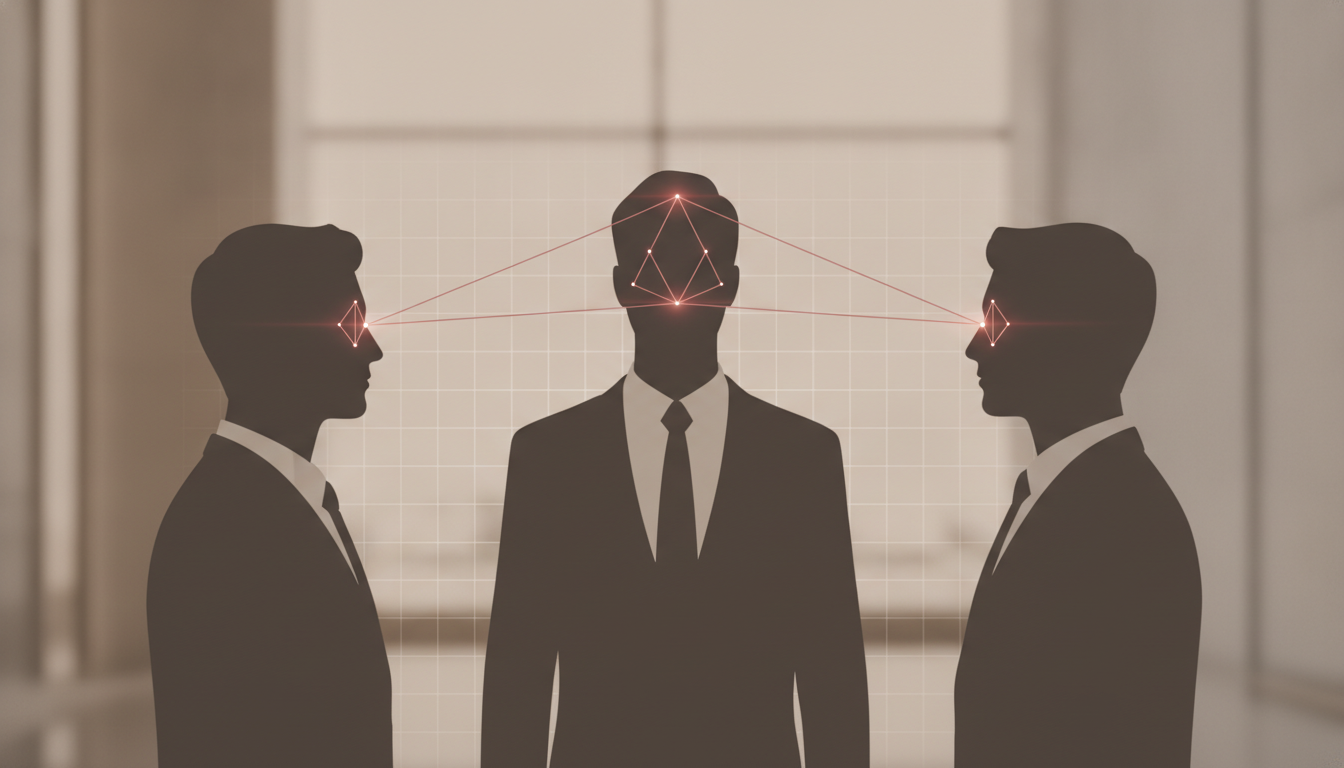
Eye contact is the single most powerful nonverbal tool for establishing trust and authority. A study published in the Journal of Experimental Social Psychology found that speakers who maintained appropriate eye contact were rated as 33% more credible than those who avoided it.
Signal 7: The 3-Second Hold
Maintain eye contact with one person for approximately 3 seconds before moving to the next person. This duration is long enough to create connection but short enough to avoid discomfort. In one-on-one conversations, aim for eye contact about 60-70% of the time.
Professional scenario: When presenting to a group of eight executives, avoid the "lighthouse sweep" where your eyes scan the room without landing anywhere. Instead, deliver one complete thought to one person, make eye contact for 2-3 seconds, then move to the next person for your next thought. This creates the feeling that you're having a series of personal conversations, which dramatically increases your perceived authority.Signal 8: The Listening Lock
When someone else is speaking—especially during a meeting or Q&A—maintain steady, focused eye contact with the speaker. Don't look at your notes, your phone, or other people in the room. This "listening lock" signals that you are fully present and in control of your attention.
Leaders who master this signal are perceived as more confident, more thoughtful, and more decisive. It also gives you a tactical advantage: you absorb more information, which leads to better responses. This connects directly to how to sound credible in meetings—your physical attentiveness reinforces the weight of everything you say.
Signal 9: The Slow Blink
Avoid rapid blinking, which signals anxiety. Instead, practice a natural, slightly slower blink rate. Research from the University of Portsmouth found that blink rate increases significantly under stress—and observers unconsciously register this as a sign of nervousness or deception.
You don't need to stare. Simply become aware of your blink rate in high-stakes situations and consciously slow it down. Combined with the 3-second hold, this creates an impression of calm composure that few professionals master.
Spatial Positioning and Territorial Signals
How you occupy and move through physical space communicates volumes about your authority level. According to environmental psychologist Robert Sommer's research on personal space, high-status individuals consistently claim more space and control the spatial dynamics of interactions.
Signal 10: The Claim (Expanding Your Physical Footprint)
Spread your materials out on the conference table. Rest your arm along the back of an adjacent chair. Stand with your feet shoulder-width apart rather than pressed together. These spatial claims signal ownership and comfort.
Professional scenario: Watch what happens in your next leadership meeting. The most senior person typically takes more physical space—wider arm placement, materials spread across the table, leaning back with expansive posture. The most junior person compresses—elbows tucked, materials stacked neatly in a small area, body pulled inward. Consciously expanding your spatial footprint—without encroaching on others—signals that you belong at the table.This doesn't mean being rude or territorial. It means occupying space with the quiet confidence of someone who has earned their seat. If you're building authority in a new role, our guide on how to build authority in a new role in the first 90 days covers both the verbal and physical strategies you need.
Signal 11: Strategic Positioning in the Room
Where you sit or stand in a room shapes how much authority you project. The head of the table, the front of the room, and positions where you can see the door all carry higher status associations. Standing while others sit—even briefly—creates an automatic authority differential.
Key positioning principles:- In meetings: Sit where you can see the most people without turning your head. Avoid corners.
- In presentations: Stand at the center of the room's focal point, not off to the side near the screen.
- In one-on-ones: Sit at a 90-degree angle rather than directly across (which can feel confrontational). This creates collaborative authority.
- In group settings: Position yourself near (but not next to) the highest-status person in the room.
For more on commanding group dynamics, see leadership presence in group settings.
Movement Patterns That Signal Control
The way you move—your pace, your transitions, your stillness—is the final layer of authoritative body language. Movement is where many professionals unknowingly sabotage their presence.
Signal 12: The Deliberate Pause (Strategic Stillness)
The most powerful movement signal is actually the absence of movement. When you finish making a key point, stop moving. Stop gesturing. Stand still. Hold eye contact. Let the silence work.
According to a study by the University of Michigan, speakers who paused for 2-3 seconds after key statements were rated as significantly more confident and persuasive than those who immediately moved to their next point.
Professional scenario: You're presenting quarterly results to senior leadership. After delivering the most important data point—"We exceeded our target by 14%"—resist the urge to immediately click to the next slide. Instead, pause. Stand still. Let the number land. This deliberate stillness signals that you know the weight of what you've said and you're confident enough to let it breathe. For a deeper dive into pacing and pausing, see our guide on how to stop rushing when presenting. Bonus movement principles:- Walk with purpose. When moving across a room or stage, walk at a measured pace with your head up. Avoid shuffling, pacing, or wandering.
- Minimize self-touch. Touching your hair, face, neck, or jewelry signals discomfort. Keep your hands away from your body.
- Transition deliberately. When shifting from one position to another—standing to sitting, moving to the whiteboard—do it with intention, not as a nervous reaction.
Your Body Is Speaking Before You Do—Make Sure It's Saying the Right Things. The Credibility Code teaches you exactly how to align your nonverbal signals with your verbal message so every interaction builds your professional authority. Discover The Credibility Code
Putting It All Together: The Authority Body Language Audit
You don't need to deploy all 12 signals simultaneously. That would look rehearsed and unnatural. Instead, use this framework to audit and improve your nonverbal presence over time:
Step 1: Record yourself. Video a practice presentation or ask a trusted colleague to observe you in a meeting. Identify your 2-3 biggest nonverbal weaknesses. Step 2: Pick two signals to practice. Start with the ones that address your specific gaps. If you fidget, focus on Signal 6 (visible, controlled hands) and Signal 12 (deliberate pause). If you avoid eye contact, focus on Signals 7 and 8. Step 3: Practice in low-stakes settings first. Try your new signals in casual conversations, team check-ins, or phone calls (yes, your posture affects your voice even when no one can see you). A study published in Psychological Science confirmed that adopting expansive postures changes hormone levels—increasing testosterone and decreasing cortisol—which means the physical practice literally rewires your confidence. Step 4: Layer in additional signals. Once your first two signals feel natural, add one more every two weeks. Within three months, authoritative body language becomes your default.If you're working on your overall leadership presence, these body language signals integrate seamlessly with the vocal, verbal, and strategic dimensions of executive communication.
Frequently Asked Questions
What body language makes you look like a leader?
Leadership body language combines upright posture, open torso, visible hands, steady eye contact, and deliberate movement. The key is physical stillness and spatial confidence—leaders take up appropriate space, move with purpose, and avoid fidgeting. These signals communicate that you are calm, in control, and certain of your message, which are the three traits people most associate with leadership.
How can I use body language to appear more confident in meetings?
Start with three fundamentals: sit upright with your back away from the chair, keep your hands visible on the table with relaxed fingers, and maintain 3-second eye contact with whoever is speaking. Avoid crossing your arms, touching your face, or looking down at your notes while others talk. These shifts alone will change how colleagues perceive your confidence level. For more meeting-specific strategies, see our guide on how to sound confident in a meeting.
Body language vs. verbal communication: which matters more for authority?
Both matter, but body language sets the frame. Albert Mehrabian's research found that when verbal and nonverbal signals conflict, people believe the nonverbal cue 93% of the time. However, the most authoritative communicators achieve alignment—their words, tone, and body language all deliver the same message. Neither channel works optimally without the other.
Can body language that conveys authority be learned, or is it innate?
Authoritative body language is absolutely learnable. While some people develop confident nonverbal habits early in life, research consistently shows that deliberate practice changes both behavior and internal state. A 2012 study by Carney, Cuddy, and Yap found that practicing expansive postures for as little as two minutes shifted participants' hormonal profiles toward greater confidence. With consistent practice over 8-12 weeks, new body language patterns become automatic.
What body language mistakes undermine authority at work?
The five most common authority-killing body language mistakes are: fidgeting with objects (pens, phones, jewelry), avoiding eye contact during key statements, crossing arms during discussions, swaying or rocking while standing, and nodding excessively while listening. Each of these signals uncertainty, anxiety, or submission—the opposite of the composed confidence that defines authoritative presence.
How is authoritative body language different for virtual meetings?
In virtual settings, your visible frame is limited to your head and shoulders, which amplifies certain signals and eliminates others. Focus on upright posture, steady eye contact with the camera (not the screen), visible hand gestures within the frame, and a neutral-to-pleasant facial expression. Avoid looking at other tabs, leaning back too far, or allowing your eyes to wander. Your face becomes your primary authority signal on camera. For a complete virtual presence strategy, explore leadership presence in virtual meetings.
From Overlooked to Unmistakable. You've just learned 12 research-backed body language signals that the most credible professionals use daily. But body language is only one piece of the authority puzzle. The Credibility Code gives you the complete system—nonverbal mastery, vocal authority, strategic language patterns, and confidence frameworks—to transform how you're perceived in every professional interaction. Discover The Credibility Code
Ready to Command Authority in Every Conversation?
Transform your professional communication with proven techniques that build instant credibility. The Credibility Code gives you the frameworks top leaders use to project confidence and authority.
Discover The Credibility CodeRelated Articles

Leadership Presence Body Language: 11 Cues That Signal Power
Leadership presence body language cues are the specific nonverbal signals—such as expansive posture, deliberate gestures, steady eye contact, controlled facial expressions, and strategic spatial positioning—that communicate authority and confidence before you say a single word. Research from Harvard Business School shows that nonverbal cues account for over 55% of how your message is perceived. The 11 cues below, backed by behavioral science, will help you project power in meetings, presentation

How to Develop a Commanding Presence: 10 Daily Practices
To develop a commanding presence, practice these daily habits: ground your body language before entering any room, speak with deliberate pace and lower pitch, hold steady eye contact for 3-5 seconds per person, pause before responding instead of rushing, take up appropriate physical space, manage your emotional energy, prepare your opening lines, listen with visible intensity, dress with intentional authority, and anchor every interaction in a clear point of view. Presence isn't a personality tr

How to Look Confident With Body Language: A Pro Guide
To look confident with body language, focus on five core signals: stand with an upright, open posture; maintain steady eye contact for 3–5 seconds at a time; use purposeful hand gestures at chest height; take up appropriate space rather than shrinking; and move with deliberate, unhurried pace. These nonverbal cues account for a significant portion of how others judge your competence and authority—often before you say a single word.