
Leadership Presence vs Charisma: Key Differences Explained
What Is Leadership Presence?
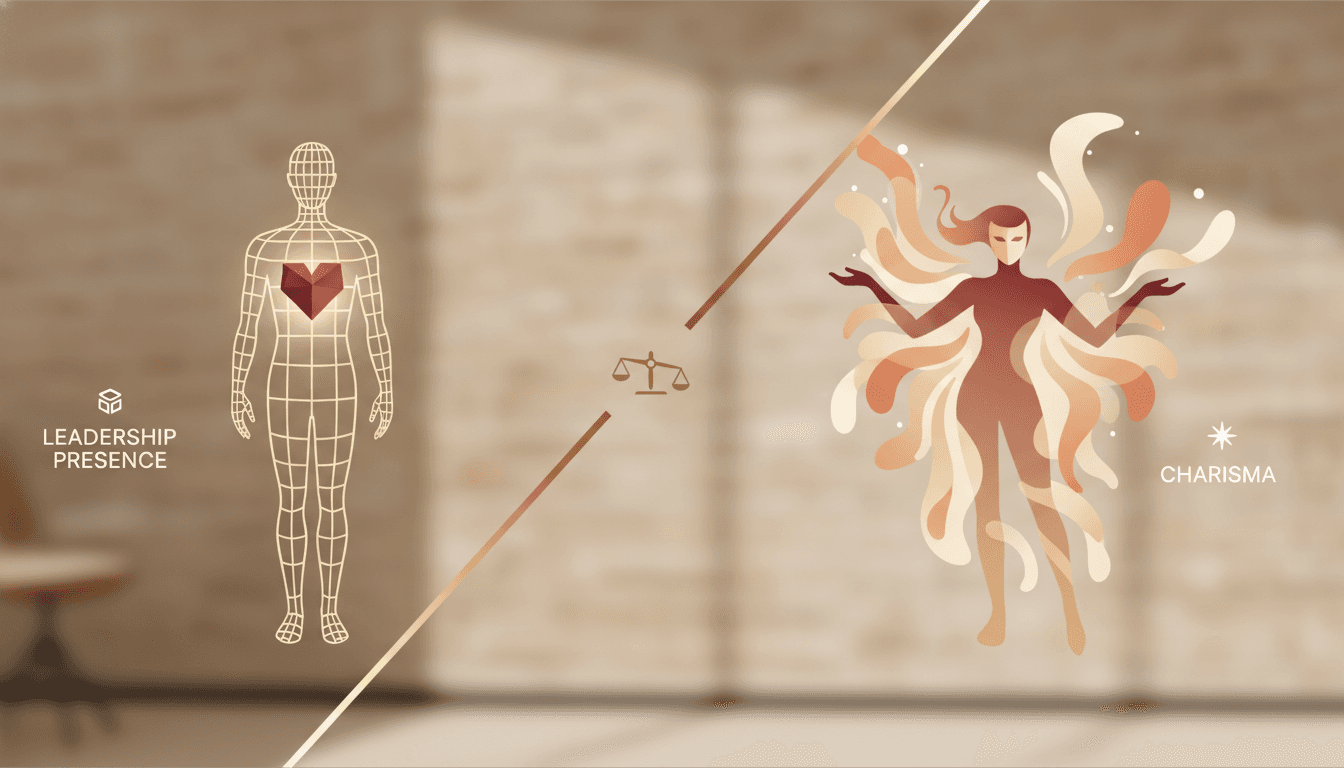
Leadership presence is the ability to project confidence, credibility, and calm authority in professional settings — regardless of your personality type or energy level. It's how you make others feel that you are competent, trustworthy, and worth listening to.
Unlike charisma, leadership presence doesn't depend on being the most dynamic person in the room. It depends on being the most grounded. It's built through consistent daily practices that signal competence: how you speak, how you listen, how you hold yourself under pressure, and how reliably your words match your actions.
According to a 2012 study published in the Harvard Business Review by Sylvia Ann Hewlett, executive presence accounts for 26% of what it takes to get promoted to senior leadership — making it one of the most measurable career accelerators available.
What Is Charisma?
Charisma is a personal magnetism that makes others feel energized, inspired, or emotionally drawn to you. It's often associated with warmth, expressiveness, storytelling ability, and high social energy.

Charismatic leaders like Steve Jobs or Oprah Winfrey captivate audiences through emotional resonance and compelling vision. But charisma is heavily personality-dependent. Research by psychologist John Antonakis at the University of Lausanne found that while certain charismatic behaviors can be trained (such as metaphor use and animated delivery), the overall effect is strongly tied to individual temperament and context.
Here's the problem: charisma without substance erodes trust. A leader who dazzles in a keynote but fumbles in a one-on-one crisis meeting reveals the gap between performance and presence.
5 Key Differences Between Leadership Presence and Charisma
Understanding the distinction between these two qualities isn't academic — it has direct implications for how you develop yourself professionally. Here are the five differences that matter most.
1. Source: Credibility vs. Personality
Leadership presence is rooted in credibility. It comes from demonstrated competence, consistent follow-through, and the ability to communicate with authority across different situations. People trust you because you've earned it.
Charisma is rooted in personality. It comes from emotional expressiveness, social energy, and the ability to make others feel something in the moment. People are drawn to you because of how you make them feel.
Example: A VP of operations who calmly presents a turnaround plan with clear data and measured confidence has leadership presence. A VP of sales who rallies the team with an electrifying speech has charisma. Both are valuable — but only one holds up under sustained scrutiny.2. Sustainability: Consistent vs. Situational
Leadership presence is durable. It shows up in emails, meetings, hallway conversations, and crisis moments equally. It doesn't depend on your mood, the audience, or whether you had your coffee.
Charisma is situational. It peaks during high-energy moments — presentations, social events, team rallies — and often fades in low-key or high-pressure contexts. A 2017 study in the Journal of Personality and Social Psychology found that perceived charisma fluctuates significantly based on context, while perceived competence and trustworthiness remain more stable.
3. Teachability: Learnable System vs. Natural Trait
This is perhaps the most important distinction for professionals investing in their development. Leadership presence can be built through deliberate practice. It has identifiable components — vocal authority, body language, structured communication, emotional regulation — each of which can be trained.
Charisma is harder to teach. While Antonakis's research shows that charismatic leadership tactics (CLTs) can improve a leader's perceived charisma by roughly 60%, the effect is strongest for people who already have baseline social comfort. For introverts and quieter professionals, building leadership presence without being loud is a far more accessible and authentic path.
4. Trust Mechanism: Earned vs. Felt
Leadership presence generates trust through evidence: your track record, your composure under pressure, your ability to deliver on commitments. It's rational trust.
Charisma generates trust through emotion: your warmth, your enthusiasm, your ability to paint a compelling vision. It's emotional trust. Emotional trust forms faster but breaks faster. Rational trust takes longer to build but is far more resilient.
5. Scalability: Works Everywhere vs. Works in Person
Leadership presence translates across mediums. It comes through in virtual meetings, written communication, phone calls, and asynchronous collaboration. In a world where 58% of knowledge workers now operate in hybrid environments (according to McKinsey's 2023 American Opportunity Survey), this scalability matters enormously.
Charisma, by contrast, is strongest in person. It relies on physical energy, eye contact, vocal dynamics, and real-time audience feedback — all of which diminish through screens and written channels.
Ready to Build Credibility-Based Presence? The Credibility Code gives you the exact frameworks, daily practices, and communication scripts to develop leadership presence that works in every setting — not just when the spotlight is on. Discover The Credibility Code
The Leadership Presence Self-Assessment Framework
Before you can build leadership presence, you need to know where you stand. Use this five-dimension framework to assess yourself honestly. Rate each dimension on a scale of 1 (rarely) to 5 (consistently).

Dimension 1: Composure Under Pressure
Do you remain calm and clear when challenged, interrupted, or put on the spot? Composure is the foundation of presence. Leaders who lose their composure in difficult conversations lose credibility instantly, regardless of how charismatic they are in calmer moments.
Assessment questions:- When someone disagrees with me publicly, do I respond with measured clarity or emotional reactivity?
- In high-stakes meetings, does my voice stay steady and my language stay precise?
- Can colleagues predict how I'll behave under stress?
Dimension 2: Communication Clarity
Do you speak concisely, structure your ideas logically, and eliminate filler words and hedging language? Clarity is the most visible marker of presence. A 2019 study by Quantified Communications found that leaders rated as "highly effective communicators" used 40% fewer words to convey the same ideas as their less effective peers.
Assessment questions:- Do I get to the point within the first 30 seconds of speaking?
- Do people frequently ask me to clarify or repeat myself?
- Can I explain complex ideas in plain language?
Dimension 3: Consistent Authority Signals
Do your body language, vocal tone, and word choices consistently signal confidence? This dimension covers the nonverbal and paraverbal elements of presence — how you look, sound, and carry yourself in professional settings.
Assessment questions:- Do I maintain steady eye contact and open posture in meetings?
- Is my vocal tone even and grounded, or does it rise at the end of statements?
- Do I use decisive language ("I recommend" vs. "I think maybe")?
Dimension 4: Reliability and Follow-Through
Do your actions match your words? This is where presence separates from performance. Charismatic leaders can promise the moon and inspire belief. Leaders with presence deliver on Tuesday what they committed to on Monday.
Assessment questions:- Do I consistently meet deadlines and honor commitments?
- When I can't deliver, do I communicate proactively?
- Do colleagues describe me as someone they can count on?
Dimension 5: Emotional Regulation
Do you manage your emotional reactions so they serve rather than undermine your message? This doesn't mean suppressing emotions — it means channeling them. Leaders with presence feel frustration but express it as firm clarity. They feel excitement but channel it into focused energy.
Assessment questions:- Do I avoid reactive emails or messages when frustrated?
- Can I deliver critical feedback without becoming visibly agitated?
- Do I recover quickly from setbacks without spiraling?
7 Daily Practices to Build Genuine Leadership Presence
Leadership presence isn't built in a workshop. It's built through daily micro-behaviors that compound over time. Here are seven practices you can start today.
Practice 1: The 10-Second Pause
Before responding to any challenging question or comment, pause for a full beat. Count to two silently. This micro-pause signals composure and gives your brain time to formulate a precise response. It also eliminates the filler words ("um," "so," "like") that undermine authority.
Scenario: Your director asks in a team meeting, "Why is this project behind schedule?" Instead of rushing to defend yourself, pause. Then say: "Two factors contributed. Here's what we've already adjusted, and here's what I need from you to get back on track."Practice 2: The First-Sentence Discipline
Make your first sentence in any contribution the most important one. State your conclusion, recommendation, or key point before any context or background. This mirrors how executives communicate and immediately signals strategic thinking.
Scenario: Instead of "So I've been looking at the data and there are a few interesting trends and I think we might want to consider..." try "We should shift our Q3 budget to digital. Here's why."Practice 3: The Posture Reset
Three times per day — before your first meeting, after lunch, and before your last meeting — do a 15-second posture reset. Plant both feet flat. Straighten your spine. Drop your shoulders. Lift your chin to neutral. This isn't about "power posing." It's about eliminating the physical signals of uncertainty (slouching, crossed arms, fidgeting) that undermine everything you say.
Practice 4: The Written Authority Audit
Once per week, review your last five sent emails. Highlight every hedge word ("just," "I think," "sorry to bother you," "does that make sense?"). Replace each one with a direct alternative. This practice builds written authority that reinforces your verbal presence.
Practice 5: The Deliberate Contribution
In every meeting you attend, make at least one deliberate, prepared contribution. Don't wait for inspiration. Before the meeting, identify one point you want to make and craft it into two clear sentences. Leaders with presence don't speak up only when they feel confident — they prepare so that confidence follows preparation.
Practice 6: The Consistency Check
At the end of each day, ask yourself: "Did my behavior today match what I said I'd do?" Leadership presence is built on predictability. If you told your team you'd review their proposal by end of day, did you? If you committed to staying calm in a tense conversation, did you? Small consistency builds compounding credibility.
Practice 7: The Feedback Loop
Once per month, ask one trusted colleague: "When I communicate in meetings, what's one thing that strengthens my credibility and one thing that undermines it?" This external data is essential because presence is defined by how others perceive you, not how you perceive yourself.
Turn These Practices Into a System The Credibility Code includes a 30-day presence-building protocol with daily exercises, scripts, and self-assessment checkpoints designed for busy professionals. Discover The Credibility Code
Why Credibility-Based Presence Outperforms Charisma Long-Term
If charisma is so compelling, why does leadership presence win over time? Three reasons.
Charisma Has a Trust Ceiling
Research by management professors Joyce Bono and Remus Ilies, published in the Journal of Applied Psychology (2006), found that while charismatic leaders initially generate higher follower motivation, the effect diminishes when followers perceive inconsistency between the leader's public persona and private behavior. Charisma without credibility creates what researchers call a "trust ceiling" — a point beyond which emotional appeal cannot compensate for substantive gaps.
Presence Compounds; Charisma Peaks
Charisma delivers its maximum impact immediately. The first time you hear a charismatic speaker, you're captivated. The fifth time, the effect has diminished. Presence works in reverse. The first interaction may be unremarkable. But by the tenth interaction, your consistency, composure, and competence have built an unshakable reputation. Presence compounds like interest; charisma depreciates like novelty.
Organizations Reward Presence Over Charisma
A 2022 DDI Global Leadership Forecast surveying over 15,000 leaders found that the top-rated leadership competency across industries was "building trust and credibility" — not "inspiring and motivating." Organizations increasingly recognize that sustainable leadership requires the steady, credibility-based influence that defines presence, not the episodic energy that defines charisma.
This doesn't mean charisma is worthless. If you naturally have it, it's a powerful amplifier. But it should sit on top of a presence foundation, not replace it. The most effective leaders in any organization have both — but if forced to choose, credibility always outranks charm.
Frequently Asked Questions
Can you have leadership presence without charisma?
Absolutely. Leadership presence is built on credibility, composure, and consistent communication — none of which require charisma. Many of the most respected leaders in organizations are not charismatic in the traditional sense. They're steady, reliable, and clear. Introverts, in particular, can develop powerful leadership presence by leveraging their natural strengths of listening, reflection, and measured communication.
Can you develop charisma if you're not naturally charismatic?
Partially. Research by John Antonakis shows that specific charismatic behaviors — using metaphors, telling stories, expressing moral conviction, setting high expectations, and using animated delivery — can be trained. However, the overall effect depends on personality and context. A more productive goal for most professionals is to build leadership presence first and then layer in charismatic techniques where they feel authentic.
Is executive presence the same as leadership presence?
They're closely related but not identical. Executive presence typically refers to the specific qualities expected at the C-suite level — strategic communication, board-level composure, and enterprise-wide influence. Leadership presence is broader and applies at every career level. You can read a detailed breakdown in our guide on executive presence vs. leadership presence.
What is the difference between charisma and gravitas?
Charisma is about emotional magnetism — making others feel inspired or energized. Gravitas is about weight and substance — making others feel that your words carry authority and depth. Gravitas is a core component of leadership presence, while charisma is separate from it. You can develop gravitas through deliberate practice in how you speak, what you say, and how consistently you deliver.
Why do some charismatic leaders fail?
Charismatic leaders fail when their emotional appeal outpaces their substance. Without credibility, follow-through, and composure under sustained pressure, charisma becomes a liability. Teams initially drawn to a charismatic leader grow disillusioned when promises don't materialize or when the leader's behavior is inconsistent. This is why organizations increasingly prioritize credibility-based presence in leadership development.
How long does it take to build leadership presence?
Most professionals report noticeable shifts within 30-60 days of deliberate practice. Others begin to perceive you differently within 2-3 months. Full transformation — where presence becomes your default operating mode rather than a conscious effort — typically takes 6-12 months of consistent daily practice. The key is systematic repetition, not occasional effort.
Build the Presence That Lasts This article outlined the differences between leadership presence and charisma — and why credibility-based presence is the foundation of lasting professional authority. The Credibility Code gives you the complete system: daily practices, communication frameworks, and self-assessment tools to build the kind of presence that earns trust in every room, every email, and every conversation. Discover The Credibility Code
Category: Leadership Presence Tags: leadership presence, charisma, executive presence, professional development, influence Featured Image Alt Text: Professional leader standing confidently in a boardroom, demonstrating calm authority and leadership presence during a team meeting
Ready to Command Authority in Every Conversation?
Transform your professional communication with proven techniques that build instant credibility. The Credibility Code gives you the frameworks top leaders use to project confidence and authority.
Discover The Credibility CodeRelated Articles
How to Develop Leadership Presence: A 5-Step Framework
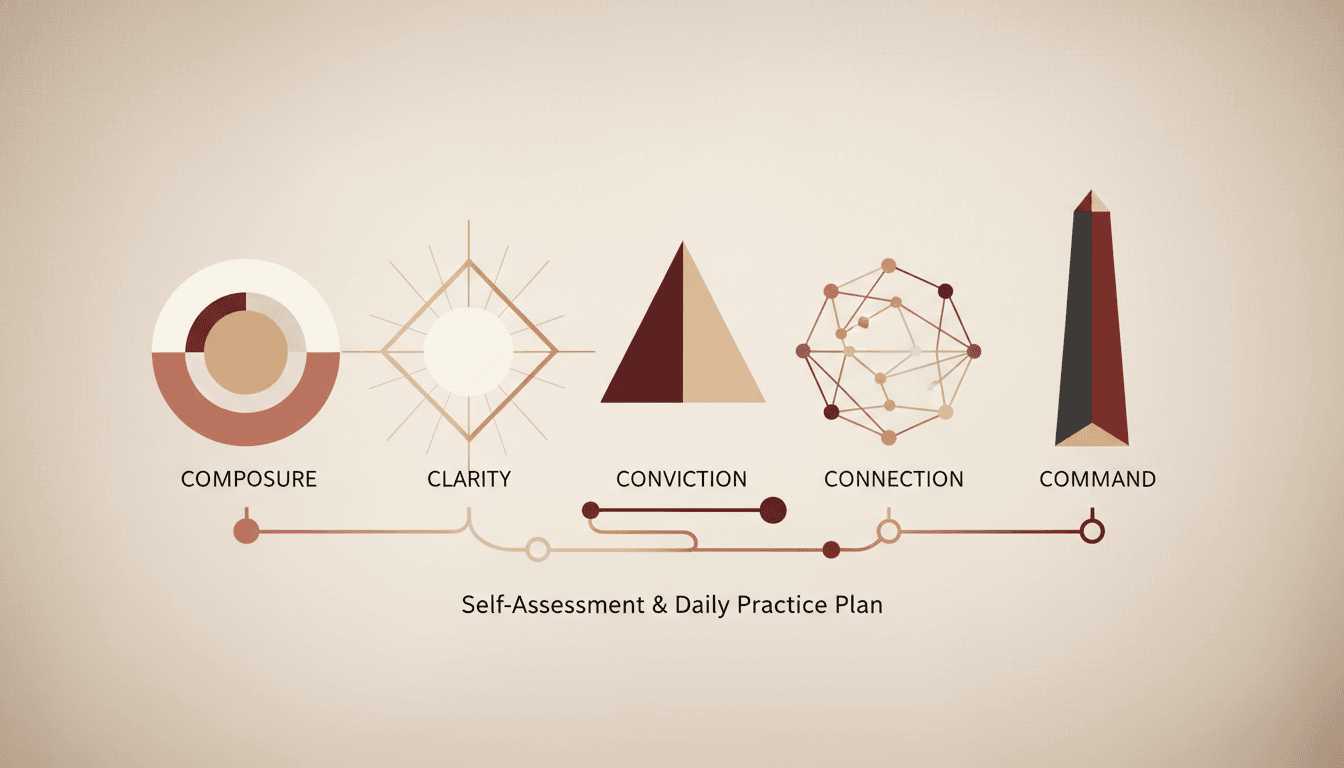
To develop leadership presence, build five core dimensions: composure (staying calm under pressure), clarity (communicating with precision), conviction (speaking with certainty), connection (building trust through empathy), and command (directing attention and action). Leadership presence isn't an inborn trait—it's a set of learnable skills. By assessing yourself across these five dimensions and practicing targeted daily habits, you can transform how others perceive your authority, credibility,

Leadership Presence in Meetings: 10 Habits That Command Respect
Leadership presence in meetings is the difference between being heard and being overlooked. The professionals who consistently command respect in meetings share ten specific habits: they choose strategic seating, open with clarity, use deliberate pauses, hold composed body language, listen actively before speaking, handle disagreement with poise, ask high-impact questions, manage airtime intentionally, close discussions with clear next steps, and follow up with authority. Each of these habits is

Leadership Presence vs Executive Presence: Key Differences
Leadership presence and executive presence are related but distinct professional competencies. Leadership presence is the ability to inspire, influence, and connect with others at any level—regardless of title. Executive presence is a more specific set of signals—gravitas, communication polish, and appearance—that convey readiness for senior-level roles. Understanding the difference matters because developing the wrong one first can stall your career. This article breaks down both, compares them