
How to Communicate With Gravitas: 8 Daily Practices
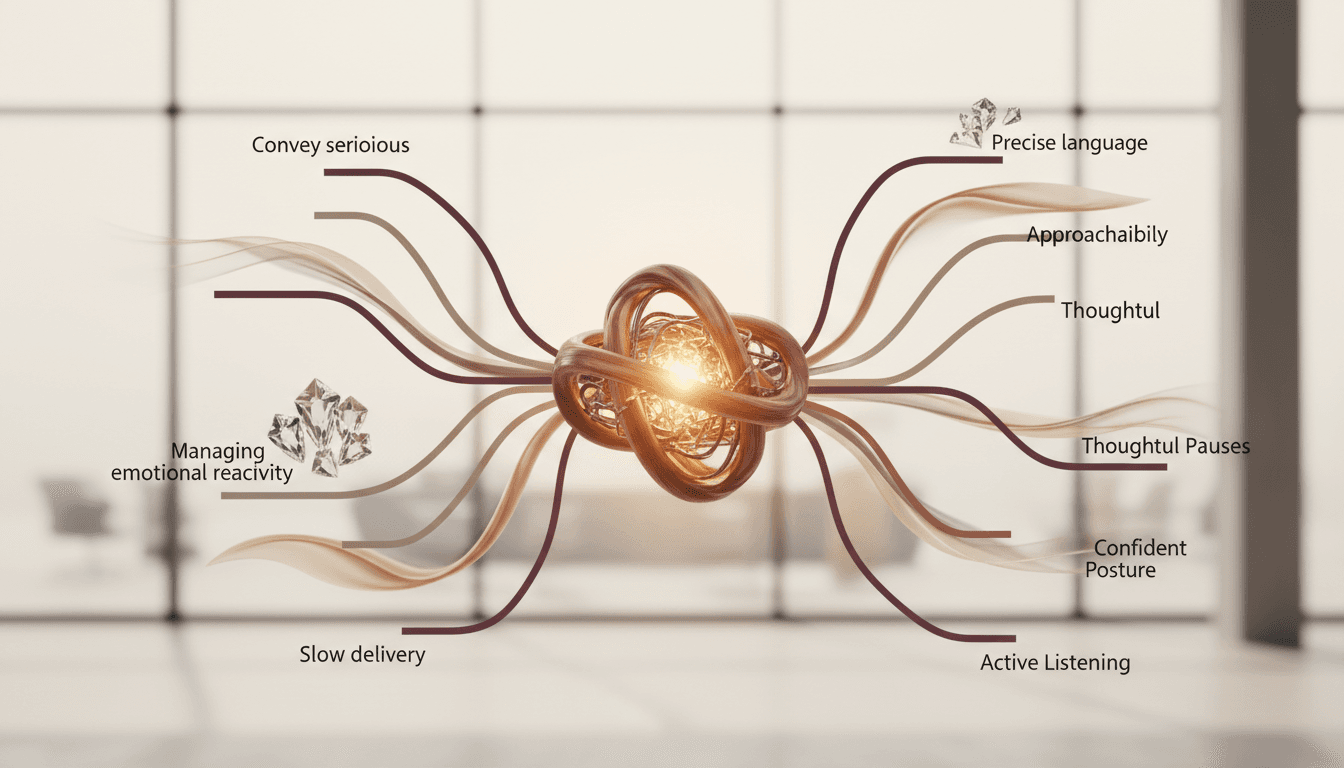
What Is Gravitas in Professional Communication?
Gravitas is the quality of commanding weight, seriousness, and respect through how you communicate — not what title you hold. It's the combination of composure, clarity, and conviction that makes people stop and listen when you speak.
Unlike charisma, which draws attention through energy and charm, gravitas draws attention through substance and steadiness. A 2012 study by the Center for Talent Innovation (now Coqual) found that gravitas was the single most important dimension of executive presence, cited by 67% of senior leaders as the core characteristic that signals leadership readiness.
In practice, gravitas shows up as the ability to stay calm under pressure, speak with precision, and convey that your words carry meaning. It's not about being loud, dominant, or intimidating. It's about being substantive and composed — every time you open your mouth. For a deeper exploration of this quality, see our complete guide on how to develop gravitas as a leader.
Why Gravitas Matters More Than Ever in the Workplace
The Credibility Gap Most Professionals Don't See

Here's a hard truth: most professionals overestimate how seriously they're taken. They assume their ideas speak for themselves. But research from Albert Mehrabian's communication studies — though often oversimplified — confirms that delivery accounts for a significant portion of how messages land. Your tone, pacing, and body language shape whether people trust your content before they even process it.
Without gravitas, you can deliver brilliant strategy and still be overlooked. You can present sound data and still lose the room. The gap between what you know and how you're perceived is the credibility gap — and gravitas is what closes it.
Gravitas as a Career Accelerator
According to a 2023 survey by the Chartered Management Institute, 71% of managers said that communication presence directly influenced promotion decisions in their organizations. Professionals who communicate with gravitas get invited into higher-stakes conversations, trusted with larger projects, and considered for leadership roles earlier.
This isn't about performing confidence you don't feel. It's about building communication habits that naturally project authority and substance. If you've been overlooked at work, developing gravitas is often the missing piece.
Practice 1: Slow Your Delivery Deliberately
The Power of Pacing
Fast speech signals nervousness. It tells listeners you're rushing to get through your point before someone interrupts — or before you lose your nerve. Slowing down does the opposite. It signals control, confidence, and the belief that your words deserve space.
Research published in the Journal of Experimental Psychology found that speakers who used a moderate pace (around 140–150 words per minute) were rated as significantly more credible and competent than those who spoke faster. Fast speakers were perceived as less trustworthy, even when delivering identical content.
How to Practice This Daily
Before your next meeting, pick one key point you plan to make. When you deliver it, cut your speed by roughly 20%. Pause between sentences. Let your words land before you add more. You'll feel uncomfortably slow at first — that's normal. To everyone else, you'll sound authoritative.
A useful benchmark: record yourself speaking for 60 seconds. Count the words. If you're consistently above 170 words per minute in professional settings, you're rushing. Practice bringing it down to 140–150.
Practice 2: Choose Precise Language Over Filler
Why Word Choice Signals Authority
Gravitas lives in specificity. When you say "We should probably look into maybe adjusting the timeline somewhat," you've communicated almost nothing — and you've signaled uncertainty five different ways. Compare that with: "I recommend we extend the deadline by two weeks to ensure quality."
The second version is clear, direct, and decisive. It uses fewer words and carries more weight. Professionals with gravitas choose precise nouns, strong verbs, and concrete numbers. They avoid vague qualifiers like "sort of," "kind of," "just," and "a little bit."
A Daily Elimination Drill
Each morning, choose one filler word or hedge phrase to eliminate for the day. Monday: "just." Tuesday: "I think." Wednesday: "sort of." Track how often you catch yourself reaching for it. Over time, your default language becomes cleaner and more commanding. For a deeper dive into this, explore our guide on how to stop sounding unsure when you speak at work.
Ready to Build Unshakable Professional Credibility? These daily practices are just the beginning. Discover The Credibility Code — the complete system for communicating with authority, gravitas, and commanding presence in every professional interaction.
Practice 3: Eliminate Hedging and Over-Qualifying
How Hedging Undermines Your Message

Hedging is the habit of softening your statements so much that they lose all force. Phrases like "I could be wrong, but…," "This is just my opinion…," or "I'm not sure if this makes sense, but…" are credibility killers. They invite your audience to dismiss you before you've even made your point.
A 2019 study from the University of Zurich's Department of Communication found that speakers who used fewer hedging phrases were rated 32% more persuasive and 28% more competent than those who frequently qualified their statements — even when the underlying content was identical.
The Replacement Framework
Instead of hedging, use what we call the State-Support-Stand method:
- State your point directly: "We need to restructure the onboarding process."
- Support it with one piece of evidence: "New hire ramp-up time has increased by three weeks over the past quarter."
- Stand behind it with a clear recommendation: "I propose we pilot a revised program starting in Q2."
This structure replaces uncertainty with authority. Practice it once a day — in a meeting, an email, or even a one-on-one conversation.
Practice 4: Master Emotional Reactivity
Why Composure Is the Foundation of Gravitas
Nothing destroys gravitas faster than visible emotional reactivity. When you visibly bristle at criticism, rush to defend yourself, or let frustration leak into your voice, you hand your authority to whoever triggered the reaction. Composure, by contrast, communicates that you're operating from a position of strength.
This doesn't mean suppressing emotions. It means creating a gap between stimulus and response — what psychologists call "affect regulation." Leaders with gravitas feel the same frustration, surprise, or defensiveness that everyone else does. They just don't let it drive their next sentence.
The 3-Second Reset Technique
When you feel an emotional reaction rising in a meeting or conversation, use this three-step reset:
- Breathe — One slow inhale through your nose (2 seconds).
- Ground — Press your feet into the floor or your hands flat on the table (1 second).
- Choose — Select your response deliberately rather than reactively.
Three seconds. That's all it takes to shift from reactive to composed. Practice this during low-stakes moments (a mildly annoying email, a minor scheduling conflict) so it becomes automatic during high-stakes ones. For more techniques, see our guide on leadership presence in tough conversations.
Practice 5: Use Purposeful Silence
Why Pausing Projects Power
Most people fill silence because it makes them uncomfortable. They add unnecessary words, repeat themselves, or rush to the next point. But silence — used intentionally — is one of the most powerful tools in a communicator's arsenal.
A well-placed pause after a key statement gives your audience time to absorb it. It signals that you believe what you just said is important enough to let it sit. According to research from the Max Planck Institute for Psycholinguistics, listeners perceive speakers who use strategic pauses as more thoughtful, more confident, and more authoritative.
Three Places to Insert Silence Daily
- Before answering a question. Pause for two full seconds before responding. This signals you're thinking, not scrambling.
- After making a key point. Let the statement breathe. Don't immediately pile on with qualifications or additional context.
- When someone challenges you. Instead of responding instantly, pause. This communicates that you're considering their point — and that you're not threatened by it.
Mastering the pause is also essential for speaking with authority in presentations and high-stakes conversations.
Practice 6: Lead With the Conclusion
The Executive Communication Structure
Professionals without gravitas tend to build up to their point. They provide background, context, caveats, and supporting details — and finally arrive at the conclusion. By then, they've often lost the room.
Professionals with gravitas do the opposite. They lead with the conclusion, then provide supporting evidence. This is the structure that senior leaders use and expect, and it immediately signals that you think at a strategic level.
The Bottom-Line-Up-Front (BLUF) Method
Borrowed from military communication, BLUF is simple: state your conclusion or recommendation first, then support it.
Without BLUF: "So I've been looking at the Q3 numbers, and there are some interesting trends in customer acquisition costs, and I noticed that our CAC has gone up in two segments, and after talking to the marketing team, I think we might want to consider reallocating budget…" With BLUF: "I recommend we reallocate $40K from Segment B to Segment A marketing. Our Q3 data shows Segment A's customer acquisition cost is 35% lower, and the marketing team confirms capacity to scale."Practice BLUF in one email and one verbal communication each day. Within a few weeks, it becomes your default structure. For more on this approach, read about how executives communicate differently.
Practice 7: Anchor Your Body Language
Physical Presence Communicates Before You Speak
Research from Harvard Business School professor Amy Cuddy and colleagues, published in Psychological Science, demonstrated that expansive, open body postures are associated with perceptions of confidence and competence. Before you say a word, your posture, eye contact, and stillness (or lack of it) have already shaped how people perceive your authority.
Fidgeting, swaying, avoiding eye contact, and self-touching (adjusting hair, touching your face) all undermine gravitas. Stillness, grounded posture, and steady eye contact reinforce it.
The Daily Anchoring Checklist
Before any important interaction, run through this 10-second body language check:
- Feet — Planted shoulder-width apart, weight evenly distributed.
- Hands — Visible and still. Resting on the table or at your sides. Not clasped, fidgeting, or hidden.
- Shoulders — Back and down, not hunched forward.
- Eye contact — Direct but not staring. Hold for 3–5 seconds per person in a group setting.
- Movement — Minimal and purposeful. Gesture to emphasize, not to fill space.
Practice this anchoring routine before meetings, presentations, and even phone calls (your posture affects your vocal tone). For a comprehensive approach, explore our guide on body language for leadership presence.
Practice 8: Prepare Your Key Messages in Advance
Why Preparation Is the Hidden Engine of Gravitas
Gravitas looks effortless, but it's almost always prepared. The leaders who seem to speak with natural authority in meetings have usually thought through their key messages beforehand. They know what they want to say, how they want to say it, and what they want the audience to take away.
Preparation doesn't mean scripting every word. It means identifying your one to three key messages for any interaction and rehearsing them enough that they flow naturally.
The 5-Minute Pre-Meeting Prep
Before any meeting or important conversation, invest five minutes in this framework:
- What is my one key message? Write it in one sentence.
- What is my supporting evidence? Identify one or two data points, examples, or outcomes.
- What is my ask or recommendation? Be specific about what you want to happen next.
- What objections might arise? Prepare one calm, composed response for the most likely pushback.
This simple habit transforms how you show up. Instead of reacting in real time and hoping for the best, you enter every room with a clear point of view and the evidence to back it up.
Turn These Practices Into a Complete Communication System. The eight practices above will transform how you're perceived — but they're even more powerful when combined with a full credibility-building framework. Discover The Credibility Code and learn the complete system for commanding respect in every professional interaction.
Frequently Asked Questions
What is gravitas in communication?
Gravitas in communication is the quality of conveying weight, seriousness, and authority through how you speak and present yourself. It combines composure under pressure, precise language, confident delivery, and substantive content. People with gravitas are perceived as credible, trustworthy, and worth listening to — regardless of their title or seniority. It's a skill that can be developed through deliberate daily practice, not an innate personality trait.
How long does it take to develop gravitas?
Most professionals notice measurable changes within 30–60 days of consistent daily practice. Individual habits — like eliminating hedge words or slowing your delivery — can produce visible results within one to two weeks. However, building deep, consistent gravitas that holds up under pressure typically takes three to six months of deliberate effort. The key is daily repetition, not occasional performance.
Gravitas vs. charisma: what's the difference?
Charisma draws people in through energy, warmth, and enthusiasm. Gravitas commands respect through composure, substance, and weight. Charismatic communicators are magnetic; communicators with gravitas are authoritative. You can have both, but they serve different purposes. Charisma makes people like you. Gravitas makes people trust and follow you. In leadership contexts, gravitas is typically the more valued quality for high-stakes decisions.
Can introverts develop gravitas?
Absolutely. In fact, introverts often have natural advantages in developing gravitas. Their tendency toward thoughtful listening, measured responses, and discomfort with unnecessary small talk aligns well with the qualities that define gravitas. Introverts can lean into their strengths — depth of thought, composure, and precision — rather than trying to mimic extroverted communication styles. See our guide on how to build leadership presence as an introvert for a tailored approach.
How do I communicate with gravitas in virtual meetings?
Virtual meetings require extra intentionality. Position your camera at eye level, maintain direct eye contact with the lens (not the screen), and eliminate background distractions. Slow your delivery by an additional 10% — audio compression flattens vocal nuance. Use the BLUF structure to lead with your conclusion, and pause longer than feels natural after key points. Mute when not speaking to eliminate ambient noise that undermines presence.
Can you have gravitas without being senior?
Yes. Gravitas is not tied to rank — it's tied to how you communicate. Junior professionals who speak with precision, maintain composure under pressure, and lead with conclusions are consistently perceived as more leadership-ready than senior colleagues who ramble, hedge, or react emotionally. Building gravitas early in your career is one of the most effective strategies for positioning yourself as a leader before promotion.
Your Gravitas Journey Starts Today. You've just learned eight daily practices that can fundamentally change how people perceive your authority and credibility. But knowing what to do is only half the equation — you need a system to make it stick. Discover The Credibility Code and get the complete playbook for building commanding professional presence, one day at a time.
Ready to Command Authority in Every Conversation?
Transform your professional communication with proven techniques that build instant credibility. The Credibility Code gives you the frameworks top leaders use to project confidence and authority.
Discover The Credibility CodeRelated Articles

How to Communicate With Gravitas at Work: 8 Shifts
To communicate with gravitas at work, make eight deliberate shifts: replace hedging language with direct statements, slow your speaking pace, lead with conclusions instead of backstory, use strategic pauses, ground your body language, speak in shorter sentences, anchor claims in evidence, and hold your composure under pressure. Gravitas isn't about being the loudest voice—it's about carrying weight in every word you choose.

How to Communicate With Gravitas at Work: 8 Key Shifts
Communicating with gravitas at work means speaking with a deliberate blend of authority, composure, and substance that makes people stop and listen. It requires eight specific shifts: leading with your conclusion, eliminating hedging language, slowing your delivery, grounding your body language, using strategic silence, choosing precise words, anchoring claims in evidence, and holding your ground under pressure. These shifts transform you from someone who shares ideas into someone whose ideas sh

How to Communicate With Authority at Work: A Framework
To communicate with authority at work, you need to master four pillars: language precision (eliminating weak words and using decisive phrasing), vocal delivery (controlling pace, pitch, and pauses), structural clarity (organizing ideas so they land instantly), and conviction signaling (aligning body language, tone, and message). This framework gives you specific, repeatable techniques for each pillar—with before-and-after examples for presenting ideas, giving feedback, and handling pushback.