
Vocal Authority: How to Sound Like a Leader When You Speak

What Is Vocal Authority?
Vocal authority is the quality that makes a speaker sound credible, confident, and in control—regardless of the words they choose. It's the sonic dimension of leadership presence, shaped by how you use pitch, pace, volume, resonance, and silence.
Think of it this way: two people can read the same quarterly earnings script. One sounds like they're asking permission. The other sounds like they own the room. The difference isn't content—it's vocal authority. It's the reason some professionals get interrupted constantly while others hold attention without raising their voice.
Vocal authority is not about being loud or aggressive. It's about vocal control—the ability to modulate your voice intentionally so that every word carries weight.
Why Vocal Authority Matters More Than You Think
The Science Behind How Voice Shapes Perception

Research from the University of California, Los Angeles found that vocal qualities account for approximately 38% of a speaker's perceived credibility—more than the actual words spoken, which account for just 7% (Albert Mehrabian, Silent Messages, 1971). While this study is often oversimplified, the core finding holds: how you sound dramatically shapes how people judge your competence.
A 2017 study published in the Journal of Experimental Psychology found that speakers with lower-pitched voices were perceived as more dominant, competent, and trustworthy in professional settings (Puts et al., 2017). Participants consistently rated deeper, steadier voices as more "leader-like"—even when the content was identical.
This means your vocal delivery is doing heavy lifting in every meeting, presentation, and negotiation—whether you're aware of it or not.
What Vocal Authority Looks Like in the Workplace
Imagine two scenarios. In the first, a project manager presents a timeline update to senior leadership. She speaks quickly, ends her sentences with a rising inflection, and fills pauses with "um" and "so." The executives start checking their phones.
In the second, the same project manager delivers the same update. But she slows her pace, drops her pitch at the end of each key statement, pauses for a full beat before her recommendation, and projects from her diaphragm. The room stays locked in.
Same person. Same data. Completely different impact. Vocal authority is what separates professionals who get taken seriously at work from those who get talked over.
The Career Cost of a Weak Vocal Presence
According to a Quantified Communications study analyzing thousands of executive presentations, speakers who scored in the top quartile for vocal variety and confidence were rated 1.5 times more persuasive and 1.3 times more trustworthy than those in the bottom quartile. Weak vocal delivery doesn't just hurt one conversation—it compounds over time, shaping your professional reputation and limiting your trajectory.
If you're working to build professional credibility, your voice is one of the fastest levers you can pull.
The Five Pillars of Vocal Authority
Pillar 1: Pitch — Finding Your Power Register
Your "power register" is the lower third of your natural vocal range. It's where your voice sounds most grounded and authoritative. When you're nervous, your vocal cords tighten, pushing your pitch higher. This signals stress to listeners—even if your words sound confident.
How to find your power register:- Hum gently and let your voice drop to its most comfortable low note.
- Speak a sentence at that pitch: "We need to move forward with this decision."
- Notice the resonance in your chest. That vibration is your anchor.
Practice reading headlines aloud in your power register for two minutes each morning. You're not trying to sound artificially deep—you're training your voice to default to its most grounded, natural tone rather than its stressed, elevated one.
Pillar 2: Pace — The Discipline of Deliberate Speed
Fast talkers signal nervousness. Slow talkers signal boredom. Authoritative speakers vary their pace strategically.
A study by the University of Michigan's Institute for Social Research found that the most persuasive speakers averaged 3.5 words per second—roughly 210 words per minute—but critically, they varied their speed to emphasize key points (José Benki et al., 2011).
The 3-Speed Framework:- Normal pace (180-200 wpm): For context and background information
- Slow pace (120-140 wpm): For key recommendations, data, and conclusions
- Quick pace (220+ wpm): Brief bursts for energy, enthusiasm, or urgency
When you present ideas to senior management, slow down for your main point. Speed through the supporting context. This contrast creates emphasis without raising your volume.
Pillar 3: Projection — Speaking From Your Core
Projection is not shouting. It's the difference between pushing sound from your throat and sending it from your diaphragm. Throat-driven speech sounds strained and thin. Diaphragm-driven speech sounds full, resonant, and effortless.
Daily Projection Exercise (2 minutes):- Stand with your feet shoulder-width apart.
- Place one hand on your stomach.
- Inhale through your nose for 4 counts—feel your stomach expand.
- Exhale on a sustained "haaaa" for 8 counts, keeping your throat relaxed.
- Now speak a sentence on that same supported breath: "This is the direction I recommend."
- Repeat five times, gradually increasing the distance you imagine your voice reaching—across a desk, across a conference room, across an auditorium.
This exercise trains your body to support your voice with air rather than tension. Within two weeks of daily practice, you'll notice your voice carries further with less effort.
Pillar 4: Pausing — The Most Underused Power Tool
Silence terrifies most speakers. That's exactly why it's so powerful. A well-placed pause signals confidence, gives your audience time to absorb your point, and creates anticipation for what comes next.
Research from Columbia University found that speakers who used strategic pauses of 1-2 seconds were perceived as more thoughtful, credible, and in control than those who filled every gap with filler words (Columbia Business School Executive Education, 2019).
Three Types of Strategic Pauses:- The Setup Pause: Pause before your key point to create anticipation. "After reviewing all the data... [pause]... we need to change direction."
- The Landing Pause: Pause after your key point to let it sink in. "Revenue dropped 15%. [pause] Here's what that means for Q3."
- The Transition Pause: Pause between sections to signal a shift. This replaces filler words like "so" and "um."
If filler words are currently undermining your pauses, our guide on how to stop using filler words in professional speaking provides a step-by-step elimination system.
Ready to Build Unshakable Vocal Presence? The Credibility Code gives you the complete system for commanding authority in every professional conversation—from vocal mechanics to body language to strategic communication frameworks. Discover The Credibility Code and start leading with your voice.
Pillar 5: Inflection — Eliminating Uptalk and Owning Your Statements
Uptalk—the habit of ending declarative statements with a rising inflection, as if asking a question—is one of the most common credibility killers in professional communication. It transforms confident recommendations into uncertain suggestions.
Uptalk vs. Downward Inflection:- Uptalk: "I think we should launch in Q2?" (sounds like you're asking permission)
- Downward inflection: "We should launch in Q2." (sounds like you've made a decision)
Every time you reach a period in your written notes, imagine physically placing a heavy dot at the end of your sentence. Let your pitch drop to match. Practice with these three sentences:
- "This is my recommendation."
- "The data supports this approach."
- "I'm confident in this timeline."
Record yourself. Listen back. If any sentence sounds like a question, repeat it with a deliberate downward pitch on the final two words. This single adjustment can transform how others perceive your assertiveness at work.
The 10-Minute Daily Vocal Authority Routine
Minutes 1-3: Breath and Resonance Warm-Up

Start with diaphragmatic breathing (described in Pillar 3). Then add humming: hum a low, steady note for 10 seconds, feeling the vibration in your chest and face. Repeat three times, each time imagining the resonance expanding. This warms up your vocal cords and connects your breath to your sound.
Minutes 4-7: The Power Phrase Drill
Choose five sentences you'll likely say at work that day. Speak each one three times, focusing on a different pillar each round:
- Round 1: Focus on pitch. Deliver each sentence in your power register.
- Round 2: Focus on pace. Slow down on the most important word in each sentence.
- Round 3: Focus on inflection. End every sentence with a downward pitch.
Example sentences to practice:
- "Here's what I recommend."
- "Let me walk you through the numbers."
- "I disagree, and here's why." (For more on this, see our guide on how to disagree professionally.)
- "The bottom line is this."
- "I'd like to propose a different approach."
Minutes 8-10: Record and Review
Use your phone to record yourself delivering a 60-second summary of your most important meeting topic for the day. Play it back and listen for:
- Uptalk on any statement
- Filler words filling pauses
- Rushed pacing through key points
- Thin or strained vocal quality
Pick one issue to focus on for the day. Targeted, daily practice beats occasional marathon sessions every time.
Advanced Vocal Authority Techniques for High-Stakes Situations
The Gravity Open for Presentations
When you begin a presentation, your first sentence sets the vocal tone for everything that follows. Most speakers start too fast, too high, and too quiet—burning their authority before they've delivered a single insight.
The Gravity Open formula:- Walk to your position. Stand still. Say nothing for 2-3 seconds.
- Make eye contact with three people in the room.
- Deliver your opening line at 70% of your normal speed, in your power register, with a downward inflection.
Example: "[Pause. Eye contact.] Last quarter, we left twelve million dollars on the table. [Pause.] Today I'm going to show you how we get it back."
This technique is a cornerstone of commanding any room and works equally well in boardrooms and on conference calls.
Vocal Authority in Negotiations
In negotiations, your voice is a strategic instrument. According to research by Harvard Business School professor Deepak Malhotra, negotiators who spoke at a measured pace with deliberate pauses achieved better outcomes than those who spoke quickly or filled silence with concessions (Negotiating the Impossible, 2016).
Three vocal rules for negotiation:- State your position with downward inflection. "Our rate for this scope is $150,000." Not a question. A fact.
- After stating your number, pause. Let the silence work. The first person to speak after a number is usually the one who concedes.
- Match your pace to your confidence. Slow down when delivering your terms. Speed up slightly when describing the value they'll receive.
For a complete negotiation framework, explore our guide on how to negotiate without being pushy.
Your Voice Is Your Leadership Brand. Inside The Credibility Code, you'll find the exact exercises, scripts, and frameworks that transform how you show up in every professional conversation. Discover The Credibility Code and start speaking with the authority your expertise deserves.
Vocal Recovery: What to Do When Your Voice Fails You
Even trained speakers have moments when nerves hijack their voice—a cracking tone in a board meeting, a racing pace during a confrontation, a sudden uptick in filler words. The key is recovery, not perfection.
The 3-Second Reset:- Stop mid-sentence if needed. (This feels dramatic to you. It barely registers with your audience.)
- Take one slow breath through your nose.
- Drop your shoulders and restart the sentence at half speed.
This micro-reset reconnects your breath to your voice and signals composure rather than panic. It's one of the most practical strategies for sounding confident at work, especially in high-pressure moments.
Frequently Asked Questions
How long does it take to develop vocal authority?
Most professionals notice a measurable difference within two to three weeks of daily practice. The 10-minute routine outlined above targets the highest-impact vocal habits—uptalk, filler words, and projection. Deeper changes to your default speaking patterns typically solidify within 60-90 days of consistent practice. The key is daily repetition, not occasional intensive sessions.
What is the difference between vocal authority and vocal projection?
Vocal projection is one component of vocal authority. Projection refers specifically to your ability to send your voice across a room using diaphragmatic support rather than throat strain. Vocal authority is broader—it encompasses projection plus pitch control, strategic pacing, deliberate pausing, and downward inflection. You can project well but still lack authority if your inflection rises or your pace is erratic.
Can introverts develop vocal authority?
Absolutely. Vocal authority is not about being loud or dominating conversations. Many of the most authoritative speakers are introverts who use strategic pausing, measured pacing, and precise word choice to command attention. In fact, introverts often have a natural advantage with pausing—they're less likely to fill silence with nervous chatter. The techniques in this guide are especially effective for professionals looking to build confidence in meetings as an introvert.
Does vocal authority differ for men and women?
The principles of vocal authority—pitch control, pacing, projection, pausing, and inflection—apply universally. However, research shows women face disproportionate penalties for uptalk and vocal fry in professional settings (Anderson et al., PLOS ONE, 2014). Women may benefit from placing extra emphasis on downward inflection and strategic pausing, not because their natural voices lack authority, but because workplace bias demands it. The goal is always to speak in your authentic, grounded voice—not to imitate someone else's.
How can I practice vocal authority for virtual meetings?
Virtual meetings amplify vocal weaknesses because participants can't rely on body language cues. Three adjustments help: First, use a quality external microphone—built-in laptop mics flatten your resonance. Second, stand up during important virtual presentations to engage your diaphragm naturally. Third, exaggerate your pauses by about 50%, since digital compression and latency can swallow brief silences.
Can vocal exercises actually change my natural voice?
Vocal exercises don't change your natural voice—they help you access its full range. Most professionals use only a fraction of their vocal capability because stress, habit, and lack of training keep them locked in a narrow, elevated register. Daily practice expands your usable range, strengthens your breath support, and builds the muscle memory needed to default to your most authoritative tone under pressure.
Transform How You Sound, Transform How You Lead. The Credibility Code is the complete playbook for professionals who want to communicate with authority, presence, and confidence in every interaction. From vocal mechanics to executive communication frameworks, it gives you the tools to be heard, respected, and followed. Discover The Credibility Code
Ready to Command Authority in Every Conversation?
Transform your professional communication with proven techniques that build instant credibility. The Credibility Code gives you the frameworks top leaders use to project confidence and authority.
Discover The Credibility CodeRelated Articles

Communicate With Senior Leadership: The Unwritten Playbook
To communicate effectively with senior leadership, lead with the outcome first, not the backstory. Senior leaders operate under extreme time pressure and make dozens of decisions daily. Structure every message around business impact, keep updates under two minutes unless asked to expand, and frame requests as decisions rather than open-ended questions. The professionals who earn leadership's attention consistently speak the language of strategy, risk, and results—not tasks and processes.
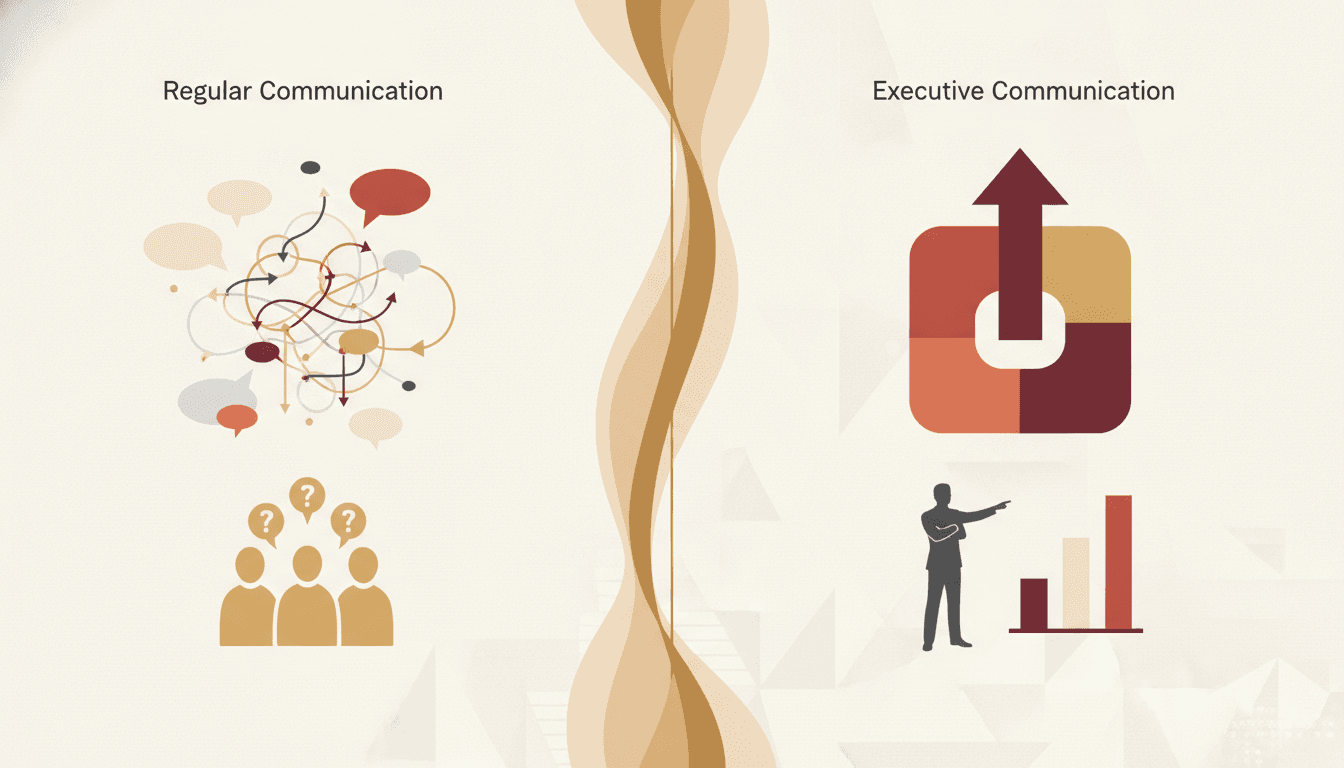
Executive vs Regular Communication: 10 Key Patterns
The difference between executive communication and regular communication comes down to ten distinct patterns: executives lead with outcomes instead of details, use decisive language instead of hedging, structure messages top-down instead of chronologically, speak in strategic terms instead of tactical ones, and manage attention rather than just sharing information. They also listen more selectively, frame problems as decisions, use silence deliberately, communicate with consistent brevity, and p

Executive Communication in Crisis: 6 Authority Principles
When a crisis hits your organization, the way you communicate in the first hours and days determines whether you retain or destroy stakeholder trust. The six authority principles executives use during crises are: lead with calm certainty, structure before you speak, practice radical transparency within guardrails, own what you don't know, control the narrative cadence, and communicate through your people. These principles help leaders project authority, reduce panic, and maintain credibility—eve