
Leadership Presence in Town Halls: How to Command Any Room

What Is Leadership Presence in Town Halls?
Leadership presence in town halls is the combination of verbal authority, physical composure, and emotional connection that makes a leader appear credible, trustworthy, and in command during large-scale company meetings. It's not about charisma or showmanship — it's about the consistent ability to hold a room's attention while making every person feel included in the conversation.
Unlike one-on-one conversations or small team meetings, town halls amplify everything. Your nervous fidgeting is visible to hundreds. Your vocal uncertainty echoes through a microphone. But so does your confidence, your clarity, and your conviction. As a format, the town hall is one of the highest-leverage communication moments a leader has — and presence is what separates a forgettable update from a defining leadership moment.
For a deeper look at the building blocks of presence across settings, see our complete guide on leadership presence definition, components, and how to build it.
Why Town Halls Are the Ultimate Leadership Presence Test
The Visibility Multiplier Effect
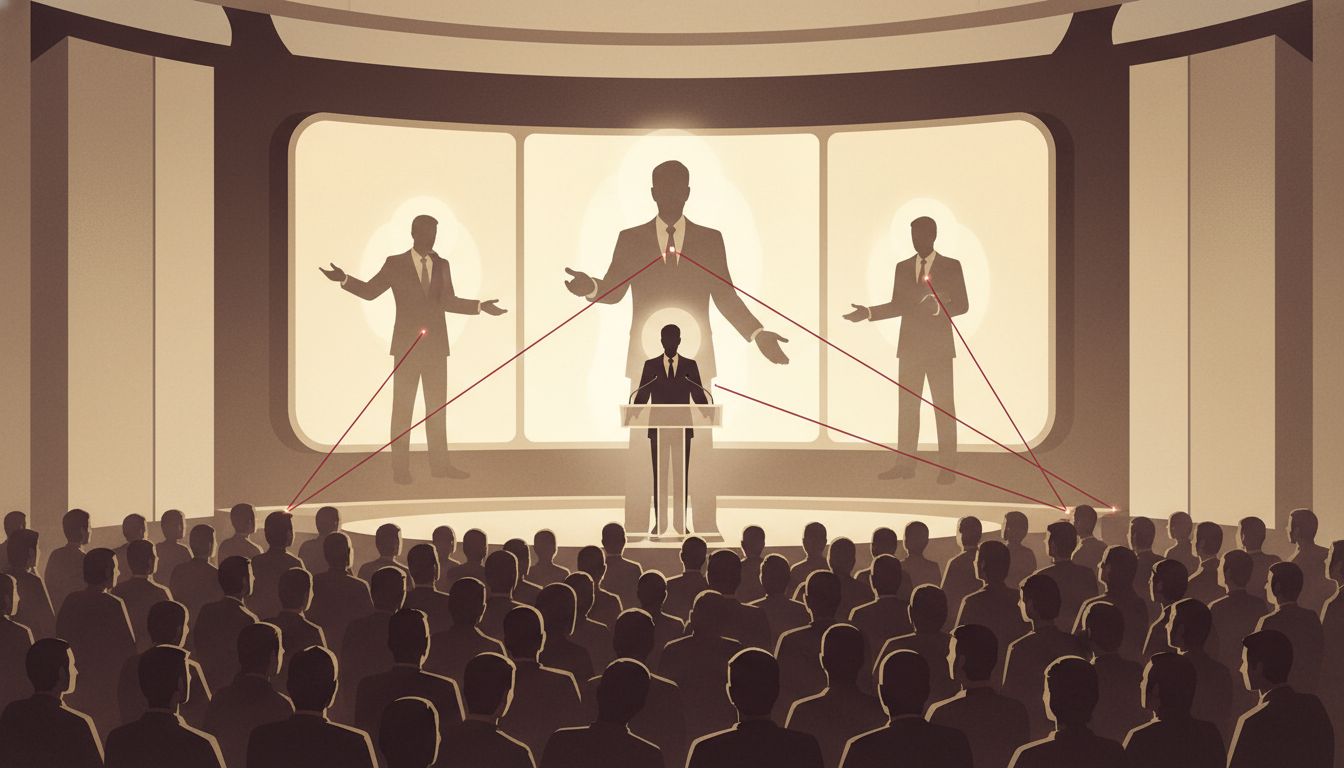
Town halls put you in front of more people, at more levels, with more scrutiny than almost any other professional setting. A Gallup study found that only 23% of U.S. employees strongly agree that they trust the leadership of their organization (Gallup, State of the American Workplace, 2023). Town halls are one of the rare opportunities to move that number — or to confirm every doubt.
When you speak at a town hall, you're not just delivering information. You're being evaluated by hundreds of people simultaneously — your direct reports, their teams, peer leaders, and often the board. Every word, pause, and gesture is being interpreted through the lens of "Do I trust this person to lead us?"
What Employees Actually Judge You On
Research from the Center for Creative Leadership shows that leaders are evaluated on three dimensions of presence: character (integrity and intent), substance (knowledge and expertise), and style (communication and composure). In a town hall, style carries disproportionate weight because it's the most visible dimension.
Employees aren't taking notes on your quarterly metrics. They're watching whether you seem confident or rehearsed, authentic or scripted, calm or rattled. They're reading your body language before they process your words.
The Cost of Getting It Wrong
A poorly delivered town hall doesn't just waste time — it erodes trust at scale. One rambling, defensive, or disconnected performance can undo months of credibility-building. If you've ever struggled with how presence differs from natural charm, our breakdown of leadership presence vs. charisma clarifies the distinction.
How to Prepare for a Town Hall Like a High-Presence Leader
The One-Theme Anchor Method
The biggest mistake leaders make in town halls is trying to cover too much. High-presence leaders anchor every town hall around a single, clear theme. Before you build a single slide, answer this question: If people remember only one thing from this town hall, what must it be?
Here's how to apply this:
- Identify your one theme — e.g., "We're investing in our people this quarter."
- Open with it — State it directly in your first 60 seconds.
- Reinforce it — Connect every section of your talk back to this theme.
- Close with it — End by restating it in slightly different language.
This isn't oversimplification. It's strategic clarity. According to a study published in the Harvard Business Review, audiences retain only about 10% of a presentation after 48 hours — but that 10% is almost always the core message if it was repeated consistently (HBR, "Make Your Presentations More Persuasive," 2019).
Script Your First 90 Seconds — Then Let Go
Your opening sets the emotional tone for the entire town hall. Script it word for word, rehearse it until it feels natural, and deliver it without notes. After that, you can shift to bullet points and conversational delivery.
A strong opening follows this structure:
- Acknowledgment — Recognize the audience and the moment ("Thank you for being here. I know Q3 has been demanding.")
- Theme statement — Deliver your one theme with conviction.
- Preview — Tell them what you'll cover and why it matters to them.
For more on crafting powerful openings, explore our guide on how to open a speech memorably with 11 proven openers.
Rehearse for the Room, Not the Mirror
Most leaders rehearse alone, sitting down, reading slides on a laptop. That's nothing like the actual experience. High-presence leaders rehearse standing, using a microphone if possible, in the actual room or a room of similar size. They rehearse with a timer. They rehearse transitions between sections, not just content.
If you can, do one full run-through with a trusted colleague who can give honest feedback on pace, energy, and clarity. A 2022 study by Prezi found that 70% of professionals consider presentation skills critical for career success — yet only 20% invest significant time in rehearsal. That gap is your competitive advantage.
Ready to Build Unshakable Presence? The Credibility Code gives you the exact frameworks leaders use to project authority in every high-stakes moment — from town halls to boardrooms. Discover The Credibility Code
Stage Presence Tactics That Command a Large Room
Own the Physical Space

In a town hall, your body communicates before your voice does. High-presence leaders use three physical strategies to command attention:
Plant and pause. When you walk to the front of the room or onto a stage, don't start talking immediately. Stand still, make eye contact with several sections of the audience, take a breath, and then begin. This 3-5 second pause signals control and confidence. Use the triangle. Move intentionally between three points on stage — center, stage left, and stage right. This creates visual energy and helps you connect with different sections of the audience. Avoid pacing, which signals anxiety. Gesture above the waist. Research from the University of Chicago found that speakers who use purposeful hand gestures above the waist are perceived as more competent and confident (Hostetter & Alibali, Gesture, 2008). Keep your gestures open, deliberate, and visible to the back of the room.For a comprehensive breakdown, see our guide on body language for leadership presence.
Master the Microphone
Many leaders underestimate how much a microphone changes the game. A lavalier mic frees your hands but picks up every breath and filler word. A handheld mic gives you a prop to manage but limits gestures. A podium mic locks you in one position.
Whichever setup you use, remember these rules:
- Drop your volume by 15-20%. The mic does the work. Speaking too loudly into a mic sounds aggressive and strained.
- Slow down by 10%. Amplified speech sounds faster to the audience than it does to you.
- Eliminate filler words ruthlessly. "Um" and "uh" are magnified by a microphone. Replace them with silence — a technique we cover in depth in our article on how to stop using filler words in professional speaking.
Use Strategic Silence
The most underused tool in a town hall is the pause. Most leaders rush through content because silence feels uncomfortable when hundreds of people are watching. But silence is what gives your words weight.
Use pauses in three specific moments:
- After your theme statement — Let it land.
- Before a key data point — Create anticipation.
- After a difficult truth — Show you're not afraid of the weight of your own words.
A well-placed two-second pause in a town hall communicates more confidence than ten minutes of polished slides.
Audience Engagement Strategies for Large Groups
The "Talk to Sections" Technique
In a room of 200+ people, you can't make individual eye contact with everyone. Instead, divide the room into five zones — front left, front right, center, back left, back right — and rotate your eye contact through these zones every 20-30 seconds.
This creates the feeling that you're speaking to everyone, even though you're actually looking at small clusters. The people in each zone will feel personally addressed, which dramatically increases engagement.
Build In Interaction Points
A 45-minute monologue will lose any audience. According to Microsoft research, the average human attention span during meetings has dropped to approximately 10 minutes before engagement declines significantly (Microsoft WorkLab, 2023). Build interaction points every 8-10 minutes.
Effective interaction techniques for large groups include:
- Raise-your-hand polls — "How many of you have experienced this?" Simple, fast, and it creates physical movement in the room.
- Turn-and-talk moments — "Take 30 seconds and tell the person next to you your biggest takeaway so far." This resets attention and creates energy.
- Live polling tools — Platforms like Slido or Mentimeter let hundreds of people participate simultaneously and see results in real time.
Tell One Story That Sticks
Data informs. Stories transform. Every high-impact town hall includes at least one narrative that makes the abstract personal. The most effective town hall stories follow a simple arc:
- Specific person or team — Name them if appropriate.
- Challenge they faced — Connect it to the broader company situation.
- What they did — Show the behavior or value in action.
- Result — Tie it back to your one theme.
For example: "Last month, our customer success team in Austin got a call from a client ready to cancel. Sarah Martinez spent two hours on the phone — not selling, but listening. By the end of the call, the client not only stayed but expanded their contract. That's what I mean when I say we're investing in our people."
For more on this technique, our article on storytelling for leaders: frameworks that drive action provides additional structures you can use.
How to Handle Live Q&A Without Losing Authority
The ACES Framework for Town Hall Q&A
Live Q&A is where most leaders either solidify or shatter their credibility. The unpredictability is what makes it powerful — and dangerous. Use the ACES framework to handle any question with composure:
- A — Acknowledge the question and the person. "Thank you for raising that, David. That's on a lot of people's minds."
- C — Clarify if needed. "Just to make sure I'm addressing what you're asking — are you referring to the timeline or the budget?"
- E — Execute your answer. Be direct. Lead with the conclusion, then provide supporting context. Don't ramble.
- S — Steer back to your theme. "And this connects directly to why we're prioritizing X this quarter."
Handling Hostile or Loaded Questions
Every leader will face a pointed question in a town hall. Maybe it's about layoffs, pay equity, or a failed initiative. The key is to never become defensive. Defensiveness signals insecurity and erodes trust instantly.
Instead, use this approach:
- Pause before responding. Take a full breath. This signals composure.
- Validate the emotion, not the framing. "I understand the frustration behind that question" is better than "That's not a fair characterization."
- Be honest about what you can and can't share. "Here's what I can tell you today..." is always more credible than a vague non-answer.
- Don't try to win. Your goal isn't to defeat the questioner — it's to demonstrate integrity to the 300 people watching how you handle pressure.
For a detailed breakdown of managing tough questions, see how to handle Q&A after a presentation like a pro.
When You Don't Know the Answer
Saying "I don't know" in front of hundreds of people feels terrifying. But according to a 2021 Edelman Trust Barometer, 68% of employees say they trust leaders more when those leaders admit what they don't know rather than bluffing through an answer.
Use this script: "That's an important question, and I want to give you an accurate answer rather than speculate. Let me follow up with [specific person/team] and get back to you by [specific date]." Then actually follow up. The follow-through is what builds lasting credibility.
Turn High-Stakes Moments Into Career-Defining Ones. The Credibility Code equips you with proven frameworks for projecting authority when it matters most — including live Q&A, difficult conversations, and executive-level communication. Discover The Credibility Code
After the Town Hall: Extending Your Presence
The 24-Hour Follow-Up Rule
Your leadership presence doesn't end when you leave the stage. Within 24 hours, send a follow-up communication that reinforces your one theme, summarizes key decisions or announcements, and addresses any unanswered questions from the Q&A.
This follow-up is also an opportunity to demonstrate written authority. If you want to ensure your post-town-hall emails carry the same weight as your in-person delivery, our guide on leadership presence in email: write with authority covers the essential principles.
Gather Honest Feedback
High-presence leaders treat every town hall as a rehearsal for the next one. Ask 2-3 trusted colleagues for specific feedback:
- "What was the one thing that landed best?"
- "Where did you feel I lost the room?"
- "Did my Q&A responses feel confident or evasive?"
This isn't about seeking validation — it's about continuous calibration. Over time, this feedback loop is what separates leaders who are merely competent at town halls from those who are genuinely commanding.
Track Your Presence Growth
Keep a simple log after each town hall: What worked, what didn't, and one specific thing to improve next time. Leaders who track their communication performance improve faster than those who rely on general impressions. This practice aligns with the broader system we outline in how to develop leadership presence: the complete roadmap.
Frequently Asked Questions
How do I calm my nerves before speaking at a town hall?
Focus on controlled breathing — inhale for 4 counts, hold for 4, exhale for 6 — in the 10 minutes before you go on. Arrive early to familiarize yourself with the room and test the microphone. Rehearse your opening until it's automatic so your first 90 seconds require zero improvisation. Physical preparation reduces anxiety more reliably than mental pep talks. For more techniques, read our guide on how to calm nerves before speaking.
What's the difference between leadership presence in town halls vs. regular meetings?
In regular meetings, presence is built through conversational dynamics — how you listen, respond, and hold space. In town halls, presence is performative at scale. You need larger gestures, more deliberate vocal projection, structured storytelling, and the ability to manage a room where most people can't speak back. The core principles overlap, but town halls demand more preparation and more intentional energy management.
How long should a town hall presentation be?
Most effective town halls run 30-45 minutes total, including Q&A. Research from TED suggests that 18 minutes is the ideal length for a single-speaker presentation before attention drops significantly. If your town hall runs longer, break it into segments with different speakers or interaction points every 8-10 minutes to reset audience engagement.
How do I project authority in a virtual town hall?
Virtual town halls require adapted presence tactics: position your camera at eye level, use a clean and well-lit background, look directly into the camera lens (not the screen) when making key points, and use shorter sentences since audio compression flattens vocal nuance. For a full breakdown, see our article on leadership presence in virtual meetings.
What should I do if I make a mistake during a town hall?
Acknowledge it briefly, correct it, and move on. Saying "Let me correct that — the actual number is..." demonstrates confidence and transparency. What destroys presence isn't the mistake — it's the visible panic or the attempt to pretend it didn't happen. Audiences respect leaders who handle errors with composure far more than leaders who deliver flawlessly but seem robotic.
How do I handle a town hall when delivering bad news?
Lead with honesty and empathy. State the difficult truth clearly within the first few minutes — don't bury it. Acknowledge the emotional impact. Then pivot to what's being done and what people can expect next. Avoid corporate euphemisms that feel dishonest. For a complete framework, see our guide on how to deliver bad news professionally and with poise.
Your Next Town Hall Can Be Your Defining Moment. The Credibility Code gives you the complete system for building authority, commanding attention, and communicating with confidence in every high-stakes professional setting. Stop hoping you'll come across well — start knowing you will. Discover The Credibility Code
Ready to Command Authority in Every Conversation?
Transform your professional communication with proven techniques that build instant credibility. The Credibility Code gives you the frameworks top leaders use to project confidence and authority.
Discover The Credibility CodeRelated Articles

Leadership Presence Without Being Extroverted: A Guide
You don't need to be the loudest voice in the room to command respect. Leadership presence without being extroverted is built through strategic listening, calm confidence, deliberate communication, and consistent follow-through. Introverted and quieter professionals can develop powerful executive presence by leveraging depth over volume — using techniques like strategic brevity, written authority, one-on-one influence, and composed body language. This guide shows you exactly how to build leaders

Build Leadership Presence as an Introvert Manager: A Guide
Leadership presence doesn't require a booming voice, dominant personality, or the ability to command every room you walk into. Introverted managers can build powerful leadership presence by leveraging preparation-based confidence, strategic visibility, and deep listening — strengths that extroverted leaders often struggle to develop. This guide gives you a tactical, research-backed system for developing commanding authority without pretending to be someone you're not. You'll learn specific frame

Leadership Presence in Difficult Conversations: A Method
Leadership presence in difficult conversations is the ability to maintain composure, credibility, and authority when workplace tension is high—whether you're delivering tough feedback, navigating conflict, or pushing back on a senior stakeholder. The method involves four pillars: emotional regulation before and during the conversation, strategic framing of your message, deliberate body language under pressure, and specific language patterns that de-escalate without surrendering your position. Th