
How to Handle Q&A After a Presentation Like a Pro

To handle Q&A after a presentation like a pro, prepare for likely questions in advance, use a structured response framework (like the PREP method: Point, Reason, Example, Point), and maintain confident body language throughout. When you don't know an answer, say so honestly and offer to follow up. Set clear ground rules at the start of Q&A, repeat each question for the audience, and always end on your terms by closing with a prepared final statement that reinforces your core message.
What Is a Presentation Q&A Session?
A presentation Q&A session is the structured period following a presentation where audience members ask questions, seek clarification, or challenge the speaker's ideas. It serves as a real-time credibility test where your expertise, composure, and communication skills are on full display.
Unlike the presentation itself — which you can rehearse and control — Q&A is inherently unpredictable. That unpredictability is exactly why it matters. According to a study published in the International Journal of Business Communication, audience members rate speakers as significantly more credible when they handle Q&A effectively, regardless of how polished the formal presentation was (Guyer & Boyd, 2019).
In short, Q&A is where authority is either cemented or lost.
Why the Q&A Matters More Than You Think
Q&A Is Your Credibility Multiplier

Most professionals pour hours into slide design and scripting their delivery, then treat Q&A as an afterthought. That's a strategic mistake. Your audience forms lasting impressions during the unscripted moments. A Harvard Business Review analysis found that 67% of executive decision-makers say their perception of a presenter changes — positively or negatively — based on how they handle questions (HBR, 2020).
Think about it: anyone can deliver a polished script. But responding to a curveball with clarity and composure? That signals genuine expertise. If you're working on building credibility with senior leadership, mastering Q&A is one of the fastest paths.
What's Really at Stake
When you fumble during Q&A — rambling, getting defensive, or freezing — you don't just lose that moment. You undermine everything you said in the presentation. Your audience begins to wonder: Did they really know what they were talking about?
Conversely, when you handle tough questions with confidence and precision, you create what psychologists call a "recency effect." The last thing people experience shapes their overall memory of the event. That's why closing a presentation with impact and nailing the Q&A are two sides of the same coin.
The Visibility Opportunity
Q&A sessions — especially in front of senior stakeholders — are career-defining visibility moments. They're unscripted auditions for leadership. Every time you handle a hard question with grace, you're demonstrating the kind of leadership presence that commands a room.
How to Prepare for Q&A Before Your Presentation
Anticipate the Top 10 Questions
Before any presentation, write down the 10 most likely questions your audience will ask. Then categorize them:
- Clarification questions: "Can you explain how that metric was calculated?"
- Challenge questions: "Doesn't this contradict what the data from Q2 showed?"
- Expansion questions: "How would this apply to the APAC market?"
- Political questions: "How does this affect the restructuring plan?"
For each question, draft a concise answer using the PREP framework (detailed below). This isn't about memorizing scripts. It's about building neural pathways so your brain can access relevant answers under pressure.
Prepare Your "Bridge" Phrases
Bridge phrases are transitional statements that let you redirect a question toward your key message without appearing evasive. Stock your mental toolkit with phrases like:
- "That's an important consideration, and it connects directly to..."
- "The core issue behind that question is actually..."
- "I'd frame it slightly differently — here's why..."
These phrases buy you two to three seconds of thinking time while keeping you in control. They're especially useful when you need to respond when put on the spot at work.
Set the Ground Rules Early
Before opening the floor, establish structure. Say something like:
"I'd love to take your questions. We have about 10 minutes, so I'll ask that you keep questions focused on the proposal we've discussed. I'll take questions one at a time and make sure everyone who wants to contribute gets a chance."This accomplishes three things: it sets a time boundary, defines scope, and positions you as the facilitator — not the person on trial.
The PREP Framework: How to Answer Any Question with Authority
What PREP Stands For
The PREP framework is a battle-tested method for delivering concise, authoritative answers under pressure:
- P — Point: State your answer directly. Lead with the headline.
- R — Reason: Give one clear reason or piece of evidence.
- E — Example: Provide a brief, concrete example or data point.
- P — Point: Restate your answer to close the loop.
Research from the Wharton School shows that structured responses are perceived as 42% more persuasive than unstructured ones, even when the content quality is identical (Berger, 2023). Structure signals competence.
PREP in Action: A Real-World Scenario
Imagine you've just presented a new go-to-market strategy. A VP of Sales asks: "Why should we shift resources away from our existing channel partners?"
Here's PREP in action:
Point: "We're not eliminating channel partners — we're rebalancing investment toward the channels showing the highest growth." Reason: "Our data shows that direct digital acquisition has a 3x lower customer acquisition cost compared to our legacy channel partners." Example: "Last quarter, our pilot in the Northeast region shifted 20% of channel spend to digital and saw a 34% increase in qualified leads." Point: "So the recommendation is strategic rebalancing, not elimination — and the data supports it."That answer took about 30 seconds. It was direct, evidence-based, and ended on a strong note. This is the kind of concise communication that earns respect in professional settings.
When You Don't Know the Answer
Here's a truth that separates amateurs from professionals: saying "I don't know" with confidence is more credible than faking an answer.
Use this formula:
- Acknowledge the question's value: "That's a critical question."
- Be honest: "I don't have that specific data point in front of me."
- Commit to follow-up: "I'll get you a precise answer by end of day tomorrow."
- Bridge back: "What I can tell you based on what we do know is..."
A Gallup workplace survey found that leaders who admit knowledge gaps and follow through are rated 23% higher in trustworthiness by their teams (Gallup, 2021). Honesty isn't weakness. It's a credibility strategy.
Ready to Build Unshakable Presentation Confidence? The frameworks in this article are just the beginning. Discover The Credibility Code — a complete system for communicating with authority in every professional setting, from boardrooms to Q&A sessions.
How to Handle Hostile, Off-Topic, and Tricky Questions
Dealing with Hostile or Aggressive Questioners
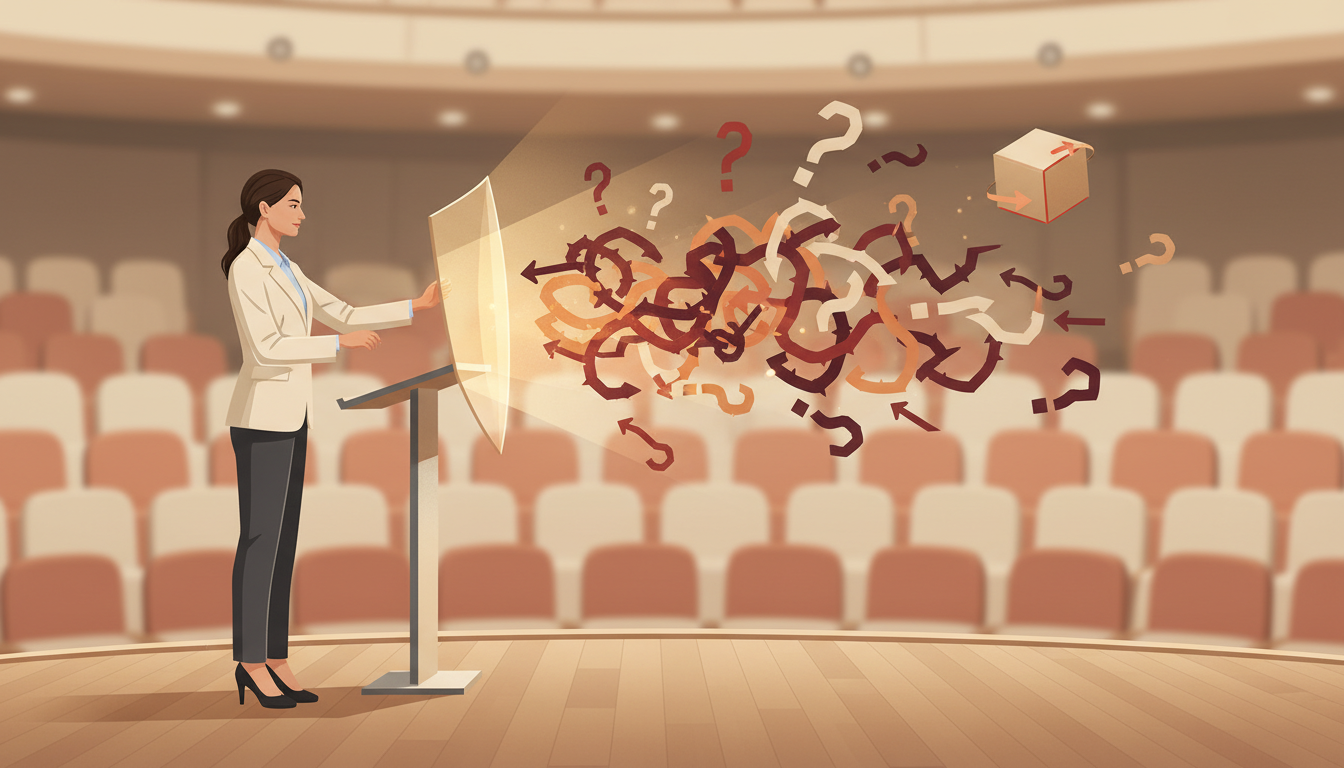
Hostile questions aren't really about information — they're about power dynamics. The questioner is trying to establish dominance, and your audience is watching to see how you respond.
The golden rule: Never match aggression with aggression.Instead, use the "Acknowledge, Reframe, Respond" technique:
- Acknowledge: Validate the emotion without agreeing with the premise. "I can see this is a topic you feel strongly about."
- Reframe: Redirect to a productive frame. "The underlying concern seems to be whether the timeline is realistic."
- Respond: Answer the reframed question with PREP.
This approach disarms the hostility while keeping you in control. It's the same principle behind disagreeing professionally without burning bridges — you address the substance without taking the bait.
Redirecting Off-Topic Questions
When someone asks a question that's clearly outside the scope of your presentation, try this:
"That's an important topic that deserves its own discussion. For today, I want to keep us focused on [your topic]. I'm happy to connect with you afterward to explore that further."This response is respectful, firm, and keeps the session on track. You're not dismissing the person — you're managing the room.
Handling the "Gotcha" Question
Sometimes a questioner has an agenda. They're not seeking information; they're trying to make you look bad. You'll recognize these by their setup: "Didn't you say last quarter that..." or "How do you explain the fact that..."
For gotcha questions, slow down. Literally. Take a breath. Then:
- Repeat the question aloud (this buys time and ensures the audience hears your framing, not theirs).
- Separate fact from implication: "The data point you're referencing is accurate. The conclusion you're drawing from it, however, doesn't account for..."
- Pivot to your evidence.
Maintaining composure under pressure is a hallmark of gravitas at work. The audience will remember your poise far more than the question itself.
Body Language and Vocal Presence During Q&A
Why Nonverbal Cues Matter Even More in Q&A
During your presentation, your slides and script carry much of the communication load. During Q&A, you are the only visual. Every micro-expression, posture shift, and vocal inflection is amplified.
Research by Albert Mehrabian — often misquoted but still directionally relevant — found that when verbal and nonverbal messages conflict, audiences overwhelmingly trust the nonverbal signal. If your words say "I'm confident" but your body says "I'm terrified," the audience believes your body.
Tactical Body Language for Q&A
Follow these specific practices:
- Plant your feet. Don't pace or rock. Stand with feet shoulder-width apart and weight evenly distributed.
- Make eye contact with the questioner while they ask, then shift to the broader audience as you answer. This signals you're addressing the room, not having a private conversation.
- Use open hand gestures. Avoid crossed arms, hands in pockets, or gripping the podium.
- Nod slowly while listening. This signals active engagement without rushing the questioner.
For a deeper dive into nonverbal authority, explore our guide on body language for leadership presence.
Vocal Authority Under Pressure
Your voice is your most powerful tool during Q&A. When nervous, most people speak faster and at a higher pitch — both of which signal anxiety.
Counter this with three vocal techniques:
- Downward inflection: End statements with a downward pitch. Upward inflection (making statements sound like questions) undermines authority.
- Strategic pausing: Pause for one to two seconds before answering. This signals thoughtfulness, not hesitation.
- Volume control: Speak at the same volume (or slightly louder) than the questioner. Never let a hostile question cause you to shrink vocally.
These are the same vocal authority habits that separate emerging leaders from everyone else in the room.
Master the Art of Commanding Any Room Q&A confidence is just one piece of the leadership communication puzzle. Discover The Credibility Code for the complete framework professionals use to build authority in every interaction.
How to End Q&A and Maintain Control
Never Let Q&A Be Your Last Word
Here's a mistake even experienced presenters make: they let the Q&A session be the final moment of their presentation. The problem? You're ending on someone else's terms — their question, their framing, their energy.
Always reclaim the closing. After your final answer, say:
"Thank you for those excellent questions. Before we wrap, I want to leave you with one thought..."Then deliver a prepared 15-to-30-second closing statement that reinforces your core message. This is your presentation close — the last thing the audience will remember.
Managing the Clock
If you have 10 minutes for Q&A, announce at the 8-minute mark: "We have time for one more question." This keeps you in control and prevents the session from dragging.
If no one asks questions (which can happen), don't panic. Have a self-prompted question ready: "One question I often get is..." This fills the silence and demonstrates preparedness.
The Post-Q&A Follow-Through
Your Q&A responsibilities don't end when you leave the room. Within 24 hours:
- Send a follow-up email addressing any questions you committed to answering later.
- Share any additional resources or data points referenced.
- Thank specific questioners by name if appropriate.
This follow-through is what transforms a single presentation into a lasting credibility asset. It's the same principle behind building a professional reputation that opens doors.
Frequently Asked Questions
How long should a Q&A session last after a presentation?
A Q&A session should typically last 15-25% of your total presentation time. For a 30-minute presentation, plan for 5-8 minutes of Q&A. For a 60-minute presentation, 10-15 minutes is standard. Always set a time limit upfront and manage the clock yourself. If questions are still flowing when time runs out, offer to continue one-on-one afterward.
What should I do if no one asks questions during Q&A?
Silence after "Any questions?" is common and doesn't mean your presentation failed. Have two to three self-prompted questions ready, such as: "A question I frequently hear is..." You can also try a softer invitation: "What surprised you most about the data?" or "What concerns would you want addressed before moving forward?" These prompts lower the barrier to participation.
Q&A during the presentation vs. Q&A at the end — which is better?
Q&A at the end is better for formal presentations, executive briefings, and persuasive pitches because it lets you control the narrative arc. Q&A during the presentation works better for workshops, training sessions, and small-group discussions where engagement matters more than narrative flow. For high-stakes settings, save Q&A for the end and let your audience know upfront when questions will be welcome.
How do I handle a question I don't understand?
Ask for clarification without embarrassment. Say: "I want to make sure I address your question accurately — could you rephrase that?" or "Are you asking about X or Y?" This shows active listening and prevents you from answering the wrong question. It's far more professional than guessing and delivering an irrelevant answer.
How do I stop rambling when answering questions?
Use the PREP framework (Point, Reason, Example, Point) to structure every answer. Start with your conclusion, support it with one reason and one example, then restate your point. Practice the discipline of stopping after your second "P." If the questioner wants more detail, they'll ask. Concise answers signal confidence; rambling signals uncertainty. For more on this, explore our guide on how to stop using filler words in professional speaking.
How do I prepare for Q&A when presenting to senior executives?
Senior executives ask pointed, high-level questions focused on business impact, risk, and ROI. Prepare by anticipating their priorities: financial implications, competitive positioning, timeline risks, and resource requirements. Have backup data slides ready but don't show them unless asked. Keep answers concise — executives value brevity. Our guide on presenting to senior leadership covers this in depth.
Turn Every Q&A Into a Career-Defining Moment The difference between professionals who get overlooked and those who get promoted often comes down to unscripted moments — like Q&A. Discover The Credibility Code and learn the complete system for communicating with authority, building credibility, and commanding presence in every professional interaction.
Ready to Command Authority in Every Conversation?
Transform your professional communication with proven techniques that build instant credibility. The Credibility Code gives you the frameworks top leaders use to project confidence and authority.
Discover The Credibility CodeRelated Articles

How to Open a Presentation With Confidence: 8 Openers
The quickest way to open a presentation with confidence is to start with a pre-planned, rehearsed opener that immediately establishes your authority and captures attention. The eight most effective openers include a bold statement, a relevant statistic, a story, a provocative question, a quotation, a "what if" scenario, a contrarian claim, and a silence-then-speak technique. Choosing the right one depends on your audience, context, and the outcome you want to drive.

How to Open a Speech Memorably: 11 Proven Openers
To open a speech memorably, lead with a technique that disrupts your audience's autopilot within the first 30 seconds. The most effective openers include a bold, surprising statement, a vivid story, a provocative question, a striking statistic, or a powerful quote. Top executives and thought leaders rarely start with "Thank you for having me" — they start with a moment that commands attention, earns trust, and sets the emotional trajectory for everything that follows. The 11 techniques below giv
How to Start a Presentation With Confidence: 8 Openers
To start a presentation with confidence, open with a deliberate, audience-specific hook in the first 30 seconds—not a timid "So, um, thanks for having me." The eight most effective openers include a bold claim, a targeted question, a striking statistic, a short story, a contrarian statement, a relevant quote, a "what if" scenario, and a direct challenge. Each one signals authority, captures attention, and sets the tone for everything that follows.