
How to Calm Nerves Before Speaking: 11 Expert Methods
To calm nerves before speaking, use a combination of physiological and cognitive techniques: practice box breathing (inhale 4 seconds, hold 4, exhale 4, hold 4), reframe anxiety as excitement, arrive early to own the space, and do a 60-second physical warm-up. Research from Harvard Business School shows that reframing anxiety as excitement can measurably improve speaking performance. The most effective approach combines body-based calming with mental preparation at least 30 minutes before you speak.
What Is Pre-Speaking Anxiety?
Pre-speaking anxiety — commonly called "stage fright" or communication apprehension — is the body's stress response triggered by the anticipation of speaking in front of others. It manifests as a racing heart, shallow breathing, sweaty palms, a shaky voice, and mental blanking.
It is not a character flaw. It's a neurological event. Your brain perceives social evaluation as a threat and activates the same fight-or-flight system that protected our ancestors from physical danger. According to the National Institute of Mental Health, approximately 73% of the population experiences some degree of speech anxiety, making it one of the most common social fears in the world.
The good news: pre-speaking anxiety is highly manageable. The methods below are used by executive coaches, professional speakers, and leadership communication experts to transform nervous energy into commanding presence.
Method 1-3: Breathing and Physiological Reset Techniques
Your body drives your mind more than you realize. When adrenaline floods your system before a presentation or meeting, the fastest way to regain control is through your physiology — specifically, your breath.
Box Breathing (The Navy SEAL Method)
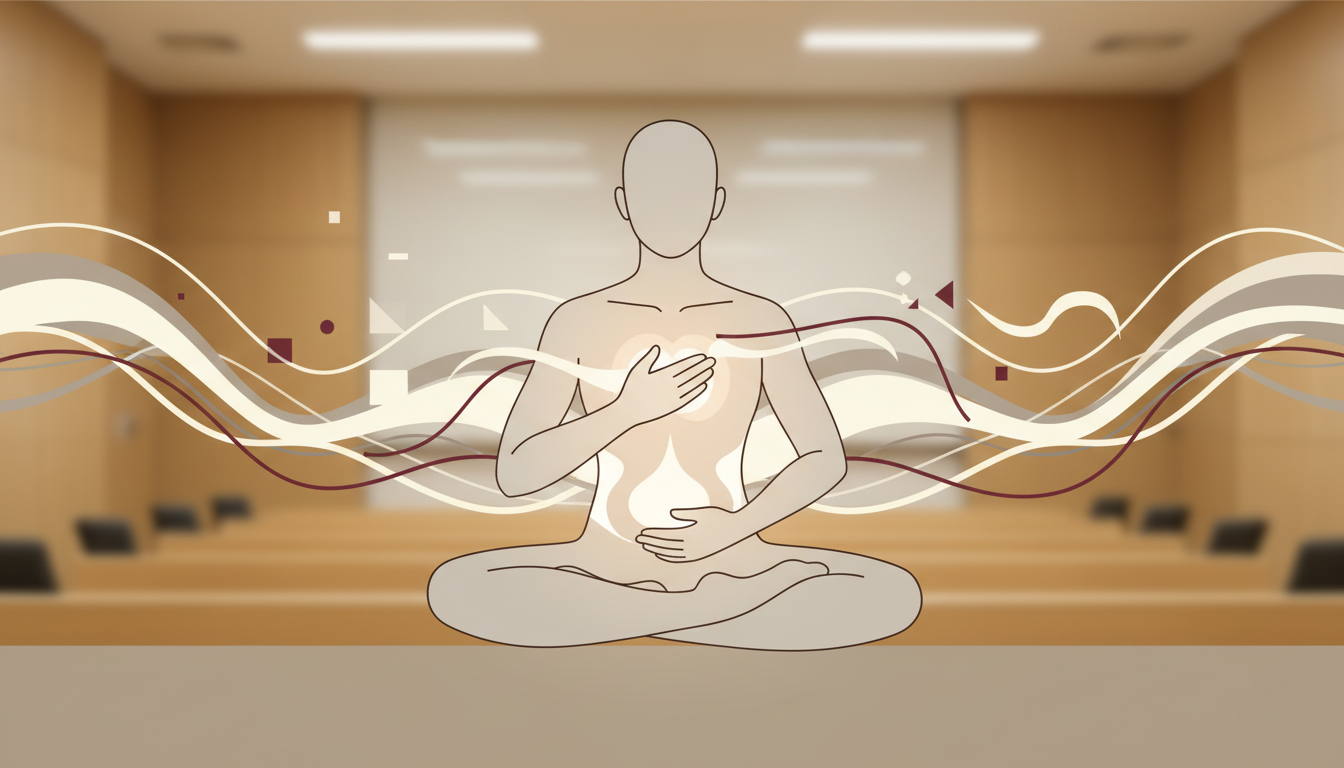
Box breathing is the single most reliable technique for calming nerves before speaking. Used by Navy SEALs, surgeons, and elite athletes, it activates your parasympathetic nervous system within 60-90 seconds.
Here's the protocol:
- Inhale through your nose for 4 seconds
- Hold your breath for 4 seconds
- Exhale slowly through your mouth for 4 seconds
- Hold at empty for 4 seconds
- Repeat 4-6 cycles
A 2017 study published in Frontiers in Psychology found that controlled diaphragmatic breathing significantly reduces cortisol levels — the hormone most responsible for that panicky, scattered feeling before you speak. Do this in the restroom, at your desk, or even while walking to the meeting room.
The Physiological Sigh (Stanford Research)
Neuroscientist Dr. Andrew Huberman at Stanford University identified the "physiological sigh" as the fastest known way to reduce real-time stress. It takes five seconds:
- Double inhale through the nose (one full breath, then a short second sip of air on top)
- Long, slow exhale through the mouth
This technique reinflates the tiny air sacs in your lungs that collapse under stress, maximizing carbon dioxide offloading. Do two or three of these back-to-back when you feel a spike of anxiety — for example, right before your name is called in a meeting or as you walk to the podium.
Power Posture and Physical Warm-Up
Your muscles hold tension that feeds your anxiety loop. A brief physical warm-up breaks that cycle.
Try this 60-second routine before any speaking event:
- Shake out your hands vigorously for 10 seconds
- Roll your shoulders backward 5 times
- Stretch your jaw open wide, then release (this prevents a tight, strained voice)
- Stand tall with feet shoulder-width apart, arms relaxed at your sides, for 15 seconds
While Amy Cuddy's original "power pose" research has faced replication debates, a 2018 meta-analysis in Psychological Bulletin confirmed that expansive body postures do influence self-reported feelings of confidence. The physical act of opening your body sends a safety signal to your brain. For a deeper dive into how body language shapes perception, see our guide on confident body language for public speaking.
Method 4-6: Cognitive Reframing Strategies
Breathing calms your body. Reframing calms your mind. These three cognitive techniques change how you interpret the anxiety you're feeling — which changes everything about how you perform.
The Excitement Reframe
This is arguably the most research-backed mental technique for managing speaking nerves. Professor Alison Wood Brooks at Harvard Business School conducted a landmark 2014 study showing that people who said "I am excited" before a stressful speaking task performed significantly better than those who tried to calm down.
Why? Anxiety and excitement are physiologically almost identical — elevated heart rate, adrenaline, heightened alertness. Telling yourself to "calm down" asks your body to make a massive state shift. Telling yourself "I'm excited" simply relabels the same energy.
In practice: Before your next presentation, say out loud (or firmly in your mind): "I'm excited about this. This energy means I care, and I'm ready." It sounds simple. The data says it works.The Service Mindset Shift
Most speaking anxiety comes from self-focused thinking: What if I mess up? What if they judge me? What if I forget my point?
Flip the lens. Instead of thinking about yourself, think about your audience. Ask: What does this audience need from me right now? What's the one thing I can give them that will make their day better or their decision easier?
This reframe is especially powerful in workplace settings. If you're presenting a quarterly update, you're not performing — you're informing people who need your data to do their jobs. If you're pitching an idea, you're offering a solution, not auditioning. This mindset is central to developing a confident communication style that feels natural rather than forced.
Labeling the Emotion
Neuroscience research from UCLA's Dr. Matthew Lieberman shows that simply naming an emotion reduces its intensity. When you notice anxiety rising, mentally label it: "I'm noticing nervousness. That's just adrenaline. It will peak and pass."
This technique, called "affect labeling," activates the prefrontal cortex and dampens the amygdala's alarm response. It creates a tiny but critical gap between feeling the emotion and being controlled by it.
Method 7-9: Preparation and Rehearsal Techniques
Anxiety thrives in uncertainty. The more prepared you are — not just with your content, but with your delivery — the less space nervousness has to operate.
The 3-3-3 Rehearsal Method
Most people either over-rehearse (memorizing a script, which creates rigidity and panic if they lose their place) or under-rehearse (winging it, which creates justified anxiety). The 3-3-3 method hits the sweet spot:
- Know your first 3 sentences cold. The opening is where anxiety peaks. If you can deliver your first three sentences on autopilot, you buy yourself time to settle in.
- Know your 3 key points. Don't memorize paragraphs. Know the three things your audience must walk away with.
- Know your last 3 sentences. A strong close gives you a destination, which reduces mid-speech anxiety about "where this is going."
This approach is especially effective when you need to start a presentation with confidence but don't have hours to rehearse.
Visualization and Mental Rehearsal
Olympic athletes have used mental rehearsal for decades, and the science transfers directly to professional speaking. A study published in Neuropsychologia found that mental rehearsal activates many of the same neural pathways as physical practice.
Here's a structured visualization protocol:
- Close your eyes and picture the room where you'll speak
- See yourself walking in calmly, making eye contact, standing tall
- Hear yourself delivering your opening lines in a steady, clear voice
- Feel the moment when you hit your stride and the audience is engaged
- End by visualizing yourself finishing strong and receiving positive feedback
Do this for 3-5 minutes the night before and again the morning of your speaking event. The more vivid and sensory-rich the visualization, the more effective it is.
Environmental Familiarization
Whenever possible, visit the space where you'll be speaking before the event. Stand at the front of the room. Test the microphone. Sit in the audience's chairs. Walk the path you'll take from your seat to the podium.
This isn't superstition — it's neuroscience. Novel environments heighten your brain's threat detection. Familiar environments lower it. Even arriving 15 minutes early to a conference room and settling in before others arrive can significantly reduce your baseline anxiety. This principle is a cornerstone of projecting calm authority under pressure.
Method 10-11: Vocal and Physical Anchoring Techniques
Your voice and body are the delivery vehicles for your message. When nerves hijack them — a shaky voice, fidgeting hands, a locked posture — your credibility suffers even if your content is excellent.
Vocal Warm-Up and Grounding
A nervous voice is often a cold voice. Professional speakers and actors warm up their vocal instruments before every performance, and you should too.
Try this 2-minute vocal warm-up:
- Hum at a comfortable pitch for 20 seconds (this relaxes your vocal cords)
- Say "mmmm-AHHH" five times, starting low and opening up (this warms your resonance)
- Read your opening sentence aloud three times, each time slightly slower and more deliberately
- Drop your pitch slightly from where it naturally sits when you're anxious (nervousness raises pitch)
According to research from Quantified Communications, speakers who exhibit vocal variety and lower pitch are perceived as 38% more competent and 28% more trustworthy. For a complete vocal authority system, explore our guide on how to control your voice when nervous presenting.
The Physical Anchor Technique
A physical anchor is a deliberate, repeatable action that you pair with a state of calm confidence during practice, then trigger before speaking to access that state under pressure.
Here's how to build one:
- During a relaxed rehearsal where you feel confident, press your thumb and forefinger together firmly
- Hold the press for 10 seconds while focusing on how confident and prepared you feel
- Repeat this pairing across 5-10 practice sessions
- Before your actual speaking event, press your thumb and forefinger together. Your brain will associate the physical cue with the practiced emotional state.
This is a simplified version of a technique from Neuro-Linguistic Programming (NLP) called "anchoring." While NLP as a whole has mixed scientific support, the underlying principle — classical conditioning of emotional states to physical cues — is well-established in behavioral psychology.
Pair this with the body language strategies in our guide on how to look confident with body language for a complete physical confidence system.
Build Unshakeable Speaking Confidence These 11 methods are powerful on their own. Inside The Credibility Code, you'll find the full framework for turning nervous energy into commanding professional presence — in meetings, presentations, and every high-stakes conversation. Discover The Credibility Code
How to Build a Pre-Speaking Routine That Works
The most effective approach isn't picking one technique — it's building a personalized pre-speaking routine that layers several methods together. Here's a sample routine used by executive communication coaches:
The 30-Minute Pre-Speaking Protocol
30 minutes before:- Do your 3-3-3 content review (key points, opening, close)
- Run through your visualization for 3 minutes
- Arrive at the space, familiarize yourself with the environment
- Do your 60-second physical warm-up (shake, roll, stretch, stand)
- Perform 4-6 cycles of box breathing
- Do your 2-minute vocal warm-up
- Apply the excitement reframe: "I'm excited. This energy means I'm ready."
- Trigger your physical anchor
- Take one physiological sigh
- Focus on your service mindset: "What does my audience need from me?"
This routine works because it addresses anxiety on every level — content, cognitive, physiological, and vocal. Customize it based on which methods resonate most with you. For ongoing strategies to manage workplace speaking anxiety, see our complete guide on managing speaking anxiety at work.
Frequently Asked Questions
How long does it take for breathing exercises to calm nerves before speaking?
Most breathing techniques begin reducing physiological anxiety within 60-90 seconds. Box breathing and the physiological sigh work fastest because they directly activate the parasympathetic nervous system. For best results, start your breathing exercises at least 5 minutes before speaking and combine them with a cognitive technique like the excitement reframe.
What is the difference between stage fright and general anxiety?
Stage fright (performance anxiety) is situational — it's triggered specifically by the prospect of speaking or performing in front of others and typically subsides once the event is over. General anxiety disorder (GAD) is a chronic condition involving persistent worry across many life areas. If your anxiety is severe, persistent, and affects daily functioning beyond speaking events, consult a mental health professional.
Can you completely eliminate nerves before speaking?
No — and you shouldn't try to. A moderate level of arousal actually improves performance, a principle known as the Yerkes-Dodson Law. The goal isn't zero nerves. It's managing your nervous energy so it fuels your performance rather than sabotaging it. Even seasoned executives and professional speakers report feeling nervous before important talks. The difference is they have systems to channel that energy productively.
How do I calm nerves before speaking in a meeting versus a presentation?
The core techniques are the same, but the timing differs. For meetings, you often have less warning, so quick-access methods like the physiological sigh, the excitement reframe, and the physical anchor are most practical. For presentations, you have more lead time to use the full 30-minute protocol including visualization and vocal warm-ups. Our guide on how to speak with confidence in meetings covers meeting-specific strategies in detail.
Does practice actually reduce speaking anxiety over time?
Yes. Repeated exposure to speaking situations reduces anxiety through a well-documented psychological process called habituation. A longitudinal study from Penn State University found that students who gave regular speeches showed significant reductions in communication apprehension over a single semester. Each positive speaking experience rewires your brain's threat assessment, making the next one easier.
What should I do if my voice shakes when I'm nervous?
A shaky voice is caused by tension in the laryngeal muscles and shallow breathing. First, do the vocal warm-up described above (humming, resonance exercises). Second, slow your speaking pace — rushing amplifies vocal tremor. Third, focus on exhaling fully before you begin speaking, as a full exhale naturally steadies the voice. For a complete system, see our guide on how to control your voice when nervous presenting.
Speak So the Room Takes You Seriously
The Credibility Code covers the verbal patterns that make presenters sound authoritative, and the ones that make audiences tune out.
Discover The Credibility CodeRelated Articles
How to Sound Confident in a Presentation: 9 Vocal Shifts
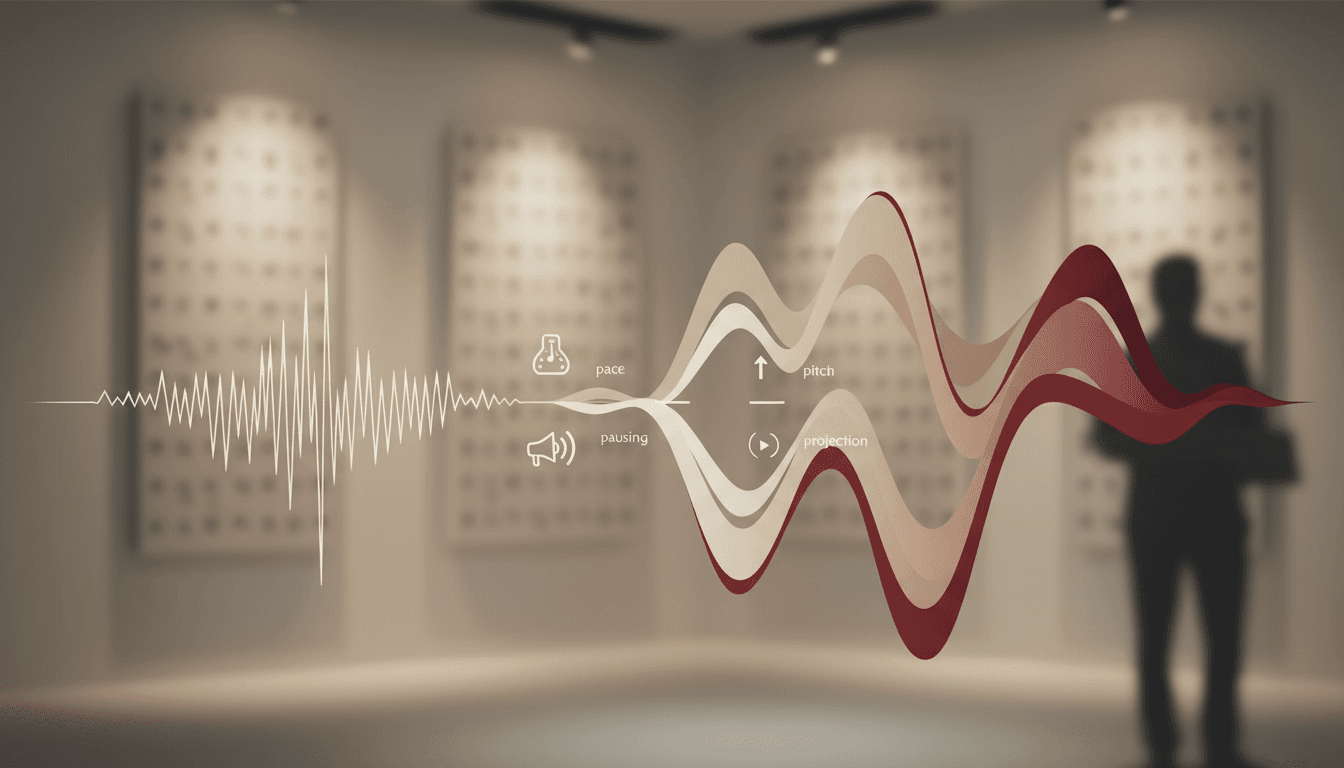
To sound confident in a presentation, focus on nine specific vocal shifts: lower your pitch at the end of sentences, slow your pace by 20%, use strategic pauses of 2–3 seconds, project from your diaphragm, eliminate filler words, vary your vocal range, articulate consonants crisply, front-load key words with emphasis, and match your volume to the room. These changes are learnable and produce immediate results—even when you're nervous inside.

Control Nervous Energy Before Public Speaking: 9 Methods
To control nervous energy before public speaking, use evidence-based techniques that work with your body's stress response rather than against it. The most effective methods include physiological sighing (a double-inhale followed by a long exhale), cognitive reappraisal (relabeling anxiety as excitement), somatic grounding exercises, and structured pre-speech rituals. These approaches don't eliminate nervous energy—they channel it into focused, commanding stage presence that makes you a more dyn

Handle Public Speaking Mistakes Gracefully: Pro Recovery
To handle public speaking mistakes gracefully, pause instead of panicking, acknowledge the error briefly without over-apologizing, then redirect your audience's attention forward. The key insight most speakers miss: audiences judge you far more on your *recovery* than on the mistake itself. A composed, even slightly humorous recovery can actually boost your credibility—because it signals confidence, self-awareness, and the kind of poise that audiences instinctively trust. Below, you'll find exac