
How to Handle Being Interrupted in Meetings Professionally

What Is Meeting Interruption and Why Does It Matter?
Meeting interruption is any instance where someone cuts off, talks over, or redirects attention away from a person who is actively speaking in a professional setting. It ranges from blatant interjections—someone loudly starting their own point mid-sentence—to subtler forms like side conversations, dismissive body language, or someone "building on" your idea before you've finished stating it.
Interruptions aren't just annoying. They erode your perceived authority over time. According to a study published in the Journal of Language and Social Psychology, men interrupted 33% more often than women in mixed-gender conversations, and intrusive interruptions (those that disrupted the speaker's point) were the most damaging to the interrupted person's perceived competence. When you're repeatedly interrupted without response, colleagues unconsciously begin to see you as someone whose contributions are optional—not essential.
Understanding how to handle being interrupted in meetings is a core leadership presence skill, not a "soft" nicety. It directly impacts whether you're seen as a credible authority or someone who can be sidelined.
The Real Cost of Not Addressing Interruptions
Your Credibility Erodes Silently

Every unaddressed interruption sends a signal to the room—not just to the interrupter, but to every observer. Research from Brigham Young University found that in group settings, women needed to represent at least 80% of participants before they achieved equal speaking time, in part because interruptions went unchallenged. But this isn't exclusively a gender issue. Junior professionals, introverts, remote participants, and anyone new to a team face the same dynamic.
When you let an interruption stand, you implicitly agree that your point wasn't worth finishing. Do this three times in a meeting and the room recalibrates: your ideas become background noise.
It Compounds Into Career Consequences
Being interrupted isn't a single-meeting problem. It's a pattern that, left unchecked, leads to being overlooked for leadership roles. If senior leaders consistently see you yielding the floor, they form a mental model: this person doesn't command attention. That perception follows you into promotion discussions, project assignments, and high-visibility opportunities.
A 2014 study by researchers at George Washington University found that people who were interrupted frequently in meetings reported lower feelings of belonging and influence within their teams. The psychological toll is real—and it feeds a cycle where reduced confidence leads to even less assertive communication.
The Interrupter Often Doesn't Realize the Impact
Here's what most people miss: many chronic interrupters aren't malicious. They're enthusiastic, impatient, or simply unaware. According to organizational psychologist Adam Grant, many interrupters see themselves as collaborative rather than domineering. This matters because your response strategy should account for intent. A colleague who's excited about your idea and jumps in too early requires a different approach than someone who's deliberately undermining you.
In-the-Moment Scripts: How to Reclaim the Floor
When you're interrupted, you have roughly a 2-3 second window to respond before the conversation moves on. These scripts are designed to be deployed instantly, without sounding aggressive or petty.
The Calm Continuation Method
This is your default move for most interruptions. It works because it doesn't acknowledge the interruption as a power play—it simply reasserts your right to finish.
What to say:- "I want to finish this thought—then I'd love to hear yours."
- "Hold that thought. Let me land this point first."
- "I'm almost done—give me ten more seconds."
This technique works because it's generous—you're promising the interrupter their turn—while being firm. It reframes the dynamic from confrontation to sequence management.
The Direct Redirect
Use this when someone has fully taken the floor and you need to pull the conversation back. It's slightly more assertive and best used when the interruption has already derailed your point.
What to say:- "Before we move on—I want to make sure my earlier point landed. What I was saying is..."
- "That's a great addition, and I want to connect it to what I was building toward."
- "I appreciate that input. Let me finish the framework I was laying out, and then let's discuss."
The Direct Redirect works especially well in meetings with senior stakeholders. It signals that you're tracking the conversation strategically, not just reacting emotionally. This is a hallmark of how to communicate with authority at work.
The Naming Technique (For Repeat Offenders)
When the same person interrupts you consistently, naming the pattern—calmly, without accusation—is the most effective intervention.
What to say:- "I've noticed I haven't been able to finish my last few points. I'd like the space to complete this one."
- "I want to make sure everyone gets to finish their thoughts, myself included. Let me wrap up."
Ready to Build Unshakable Presence in Every Meeting? The scripts above are a starting point. The Credibility Code gives you a complete system for commanding attention, projecting authority, and never being sidelined again. Discover The Credibility Code
Body Language That Prevents and Stops Interruptions
Your nonverbal signals account for a significant portion of whether you get interrupted in the first place. Research by Albert Mehrabian (often cited, frequently misquoted) found that nonverbal cues heavily influence how messages are received in ambiguous situations—and meetings are full of ambiguity about who "has the floor."
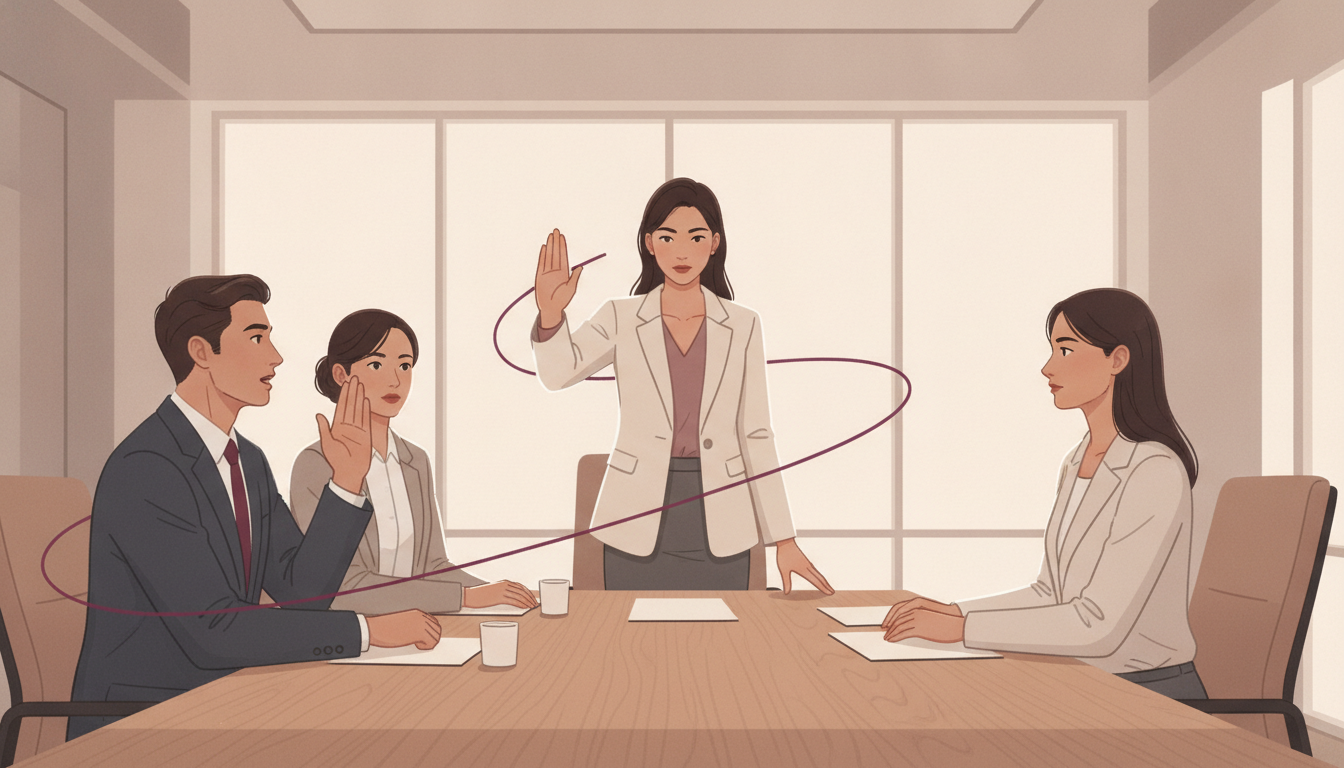
Pre-Meeting Positioning
Where you sit and how you hold yourself before you even speak sets the interruption threshold.
- Sit where you can be seen. Avoid corner seats or positions behind laptop screens. Sit at the table, not against the wall. In virtual meetings, position your camera at eye level and sit close enough that your shoulders and hands are visible.
- Claim physical space. Place your materials on the table. Rest your forearms on the surface. Spread out slightly. A study from Columbia and Harvard researchers found that expansive postures increased feelings of power and were perceived as more authoritative by observers.
- Make early eye contact. Before the meeting starts, make brief eye contact with key participants. This registers you as present and engaged—a person, not a backdrop.
These cues align with the broader principles of leadership presence body language that signal authority without a word.
During-Speech Body Language
While you're speaking, certain nonverbal habits make you harder to interrupt:
- Use deliberate hand gestures. People who gesture while speaking are perceived as more confident and are interrupted less frequently. Keep gestures in the "power zone"—between your waist and shoulders.
- Slow your pace slightly. Rushed speech signals uncertainty and invites interruption. A measured pace signals that you expect to be heard. For more on this, see our guide on executive speaking cadence techniques.
- Hold your posture when interrupted. Don't lean back, cross your arms, or look down. When someone cuts in, keep your body still and oriented toward the group. This nonverbal "hold" communicates that you're not yielding.
The Strategic Pause
Counterintuitively, pausing mid-thought can actually reduce interruptions. A brief, intentional pause (1-2 seconds) after a key statement signals confidence and gives your words weight. People are less likely to interrupt someone who pauses with purpose than someone who fills every gap with filler words.
If you struggle with filler words that create interruption openings, our guide on how to stop using filler words in professional speaking offers practical drills.
Proactive Strategies: Prevent Interruptions Before They Happen
The best approach to handling interruptions is reducing their frequency in the first place. These strategies work at the structural level—changing the conditions that allow interruptions to thrive.
Pre-Frame Your Contributions
Before making a substantive point, signal its structure. This creates a verbal "container" that makes interrupting feel socially awkward.
Examples:- "I have three points on this. First..."
- "I want to walk through a quick framework. It'll take about sixty seconds."
- "Before we move to the next item, I want to address two things."
Pre-framing works because it creates an implicit social contract. The room now expects three points, and interrupting after the first one feels like a violation. According to communication researcher Dr. Deborah Tannen, conversational framing significantly impacts who holds the floor and for how long.
Build Strategic Alliances
Identify one or two colleagues who will support your speaking time. This isn't about creating a clique—it's about establishing mutual respect for airtime.
How it works: Before the meeting, tell a trusted colleague, "I'm going to present my analysis of the Q3 numbers today. If I get cut off, it would help if you could say something like 'I want to hear the rest of Sarah's point.'" Then do the same for them.This is particularly effective in meetings with dominant personalities. When an ally says, "Wait—I want to hear where Jordan was going with that," it carries social weight without you having to advocate for yourself in the moment.
Set Meeting Norms (If You're the Leader)
If you run meetings—or can influence how they're run—establish explicit norms:
- "Let's make sure everyone finishes their thought before we respond."
- "I'm going to use a speaker queue so we don't talk over each other."
- Use a visible hand-raise system (physical or digital).
A 2019 study by Catalyst found that inclusive meeting practices, including structured turn-taking, increased participation from underrepresented voices by 35%. This isn't just fairness—it's better decision-making.
For more on leading meetings with authority, see our guide on how to lead a meeting confidently.
Stop Being Sidelined. Start Being Heard. The Credibility Code teaches you the complete system for building authority in meetings, presentations, and every professional conversation. It's the playbook mid-career professionals use to become the person the room listens to. Discover The Credibility Code
Handling Specific Interruption Scenarios
Not all interruptions are the same. Here's how to handle the most common types you'll encounter.
The "Idea Hijacker"
Scenario: You share an idea, get interrupted, and the interrupter restates your idea as their own—often with slight modifications. Response script: "I appreciate you building on that. To be clear, the core concept I was proposing is [restate your idea]. I'd like to develop it further before we iterate." Why it works: You reclaim ownership without accusing anyone of theft. For more on this specific dynamic, see our article on what to do when someone takes credit for your idea.The "Enthusiastic Overtaker"
Scenario: A colleague gets excited and starts talking over you—not out of disrespect, but out of enthusiasm. Response script: "I love the energy—let me finish this thought and then I want to hear your take." Why it works: It validates their enthusiasm while maintaining your floor time. This keeps the relationship intact while establishing a boundary.The Senior Leader Interrupt
Scenario: Your VP or C-suite executive cuts you off mid-presentation. Response script: "Great question—let me address that in the next section" or "I want to make sure I give that the attention it deserves. Can I finish this point and then come back to it?"This requires particular finesse. You're not going to tell a senior executive to wait their turn. Instead, you redirect their interruption into your structure. This is a key skill in communicating with senior leadership.
The Chronic Interrupter (Private Conversation)
When someone interrupts you repeatedly across multiple meetings, a private conversation is warranted.
Script: "Hey, I wanted to mention something I've noticed in our team meetings. I've been getting cut off before I finish my points, and I think it's affecting how my ideas land with the group. I don't think it's intentional, but I'd appreciate it if you could let me finish before jumping in. I'll do the same for you." Key principles: Be specific (mention the meeting context), assume positive intent, and offer reciprocity. This is assertive communication at its most effective—direct, respectful, and solution-oriented.Building a Long-Term Anti-Interruption Reputation
Handling individual interruptions is important. But the real goal is becoming someone who people don't interrupt in the first place. This is about building what we call "conversational authority"—the unspoken signal that when you speak, the room listens.
Speak Less, But With More Weight
People who talk constantly in meetings get interrupted more. It's a volume problem—if you're always talking, people feel less social pressure to wait. Instead, be selective. When you do speak, make it count.
This aligns with the principle of leadership presence in meetings without talking too much. The professionals who command the most attention are often the ones who speak the least frequently—but with the most substance.
Develop Your Vocal Authority
A study published in the journal PLOS ONE found that speakers with lower pitch variation and slower speech rates were perceived as more dominant and were interrupted less frequently. You don't need to artificially lower your voice. But you can:
- Eliminate upspeak (rising intonation at the end of statements)
- Reduce filler words ("um," "like," "sort of")
- Practice ending sentences with a downward inflection
These vocal shifts signal certainty. And certainty is an interruption deterrent. For a deeper dive, explore our guide on how to develop a commanding voice at work.
Track and Reflect
After each meeting, spend 60 seconds reflecting: Was I interrupted? How did I respond? What would I do differently? This simple habit builds self-awareness and accelerates improvement. Over time, you'll notice patterns—certain topics, certain people, certain meeting formats—that trigger interruptions. That awareness is power.
Frequently Asked Questions
How do you politely stop someone from interrupting you in a meeting?
Use a calm, firm redirect phrase like "I'd like to finish my point—then I want to hear yours" or "Hold that thought, let me complete this." Maintain steady eye contact, keep your body language open, and don't raise your voice. The goal is to signal confidence without confrontation. Pairing assertive language with composed delivery makes the intervention feel professional, not personal.
Why do I keep getting interrupted in meetings?
Chronic interruptions often stem from a combination of factors: speaking too quickly, using hedging language ("I just think maybe..."), sitting in low-visibility positions, or not pre-framing your contributions. It may also be a team culture issue where dominant voices go unchecked. Addressing both your communication habits and the meeting environment is key. Our guide on being overlooked in meetings covers this in depth.
Being interrupted in meetings vs. being talked over—what's the difference?
Being interrupted means someone cuts in while you're mid-sentence, actively taking the floor. Being talked over means someone starts speaking simultaneously, often louder, drowning out your voice. Both undermine your authority, but they require slightly different responses. Interruptions call for verbal redirects ("Let me finish this thought"). Being talked over requires you to maintain your volume and continue speaking without yielding—stopping signals that their voice matters more than yours.
How do you address a boss who constantly interrupts you?
Address it privately, not in the meeting. Use a respectful, specific approach: "I've noticed in our team meetings that I sometimes get cut off before finishing my points. I want to make sure my ideas land clearly with the team. Could we work on that?" Frame it as a collaboration, not a complaint. Most managers will respect the direct feedback—and many don't realize they're doing it.
How do you handle being interrupted in virtual meetings?
Virtual meetings make interruptions harder to manage because nonverbal cues are limited. Use the chat function to type "I wasn't finished—coming back to my point" if someone talks over you. Use the raise-hand feature proactively. When you do speak, pre-frame with structure ("I have two points") to create a verbal container. Position your camera at eye level and speak slightly slower than normal to project authority through the screen. For more, see our guide on leadership presence in virtual meetings.
Is it unprofessional to call out someone who interrupts you?
No—when done calmly and without accusation, it's a sign of professional maturity. Phrases like "I'd like to finish my thought" or "Let me complete this point" are widely recognized as appropriate in professional settings. What is unprofessional is responding with sarcasm, aggression, or passive-aggressive sighing. The line between assertive and aggressive is tone and intent, not the act of speaking up itself.
Your Voice Deserves to Be Heard—Every Time. The strategies in this article are a strong start. But building lasting authority in meetings, presentations, and high-stakes conversations requires a complete system. The Credibility Code gives you the frameworks, scripts, and daily practices to transform how you're perceived at work—from overlooked to unmistakable. Discover The Credibility Code
Ready to Command Authority in Every Conversation?
Transform your professional communication with proven techniques that build instant credibility. The Credibility Code gives you the frameworks top leaders use to project confidence and authority.
Discover The Credibility CodeRelated Articles

How to Speak With Authority in Meetings: 11 Proven Shifts
To speak with authority in meetings, make eleven specific shifts: replace hedging language with declarative statements, lower your vocal pitch at the end of sentences, pause before key points instead of rushing, lead with your conclusion rather than your reasoning, claim physical space through open body language, use structured frameworks when presenting ideas, eliminate filler words, time your contributions strategically, name the dynamic in the room, hold silence after your point, and anchor y

How to Disagree With Your Boss in a Meeting (Respectfully)
You can disagree with your boss in a meeting without damaging the relationship by using a three-step approach: acknowledge their perspective first, frame your dissent around shared goals, and propose an alternative rather than simply objecting. The key is treating disagreement as strategic alignment, not confrontation. Timing, tone, and framing determine whether you're seen as a thoughtful contributor or a difficult employee. This guide gives you the exact scripts, decision frameworks, and recov

How to Speak Up in Meetings as an Introvert (Without Forcing It)
Speaking up in meetings as an introvert doesn't require you to become someone you're not. The most effective approach combines strategic pre-meeting preparation, low-risk entry points like asking clarifying questions or building on others' ideas, and concise contribution frameworks that play to introvert strengths — deep thinking, careful observation, and substance over volume. The goal isn't to talk more; it's to contribute in ways that carry weight.