
Being Overlooked in Meetings? 7 Strategies to Fix It

If you're being overlooked in meetings, fix it by preparing strategically before the meeting, claiming space in the first five minutes, using assertive language instead of hedging, leveraging the "echo and expand" technique when interrupted, building alliances with colleagues who amplify your voice, following up with written summaries that anchor your contributions, and consistently showing up with a visible point of view. These seven strategies shift you from invisible participant to recognized contributor.
What Does Being Overlooked in Meetings Mean?
Being overlooked in meetings is the experience of having your contributions ignored, your ideas talked over, or your input credited to someone else during group discussions. It goes beyond a single awkward moment — it's a recurring pattern where your voice consistently fails to register with the room.
This isn't just a feelings problem. A 2021 study by McKinsey & Company found that women and people of color are 1.5 times more likely than white men to report having their ideas credited to someone else in workplace meetings. When being overlooked becomes chronic, it erodes your professional visibility, stalls career advancement, and chips away at your confidence over time.
The good news: being overlooked is rarely about the quality of your ideas. It's almost always about how you position, deliver, and reinforce those ideas. And that's something you can change starting with your next meeting.
Strategy 1: Pre-Meeting Positioning That Sets You Up to Be Heard
The most effective meeting strategy starts before anyone sits down at the table. Professionals who consistently command attention in meetings don't wing it — they arrive with a plan.

Stake Your Claim on the Agenda
If your meeting has an agenda, get your name on it. Email the meeting organizer 24 hours in advance and say: "I have a perspective on [topic] I'd like to share during the discussion. Can I have 3 minutes to present it?"
This does two things. First, it signals to the organizer that you have something substantive to contribute. Second, it creates a built-in moment where the room's attention is directed to you. You're no longer hoping for an opening — you've created one.
If there's no formal agenda, send a brief pre-meeting message to key attendees: "I've been thinking about [topic] and have a recommendation I'd like to run by the group. Looking forward to discussing it." This plants a seed so people expect to hear from you.
Prepare a Lead-In Statement
Most people get overlooked because they enter meetings reactively — waiting, listening, hoping for the right moment. Instead, prepare one clear statement you'll deliver in the first five minutes.
According to research published in the Harvard Business Review, the first person to speak on a topic in a meeting disproportionately shapes the direction of the conversation. Your lead-in doesn't need to be groundbreaking. It just needs to be early and clear.
Try this format: "Before we dive deeper, I want to flag something I think is critical to this decision: [your point]."
For more on structuring your thoughts with this kind of precision, read our guide on how executives structure their thoughts before speaking.
Strategy 2: Claim Physical and Vocal Space in the Room
Where you sit, how you sit, and how you use your voice in the first moments of a meeting determine whether people register you as a participant or a spectator.
Choose a Power Position
A study from the University of British Columbia found that people who sit at the center of a table are perceived as more influential and are spoken to more frequently than those seated at the edges. Stop sitting in the back row. Stop choosing the corner chair.
Arrive early enough to claim a seat at the center of the table, or directly across from the meeting leader. If it's a virtual meeting, turn your camera on, position yourself at eye level, and make sure your face fills the frame. These are small moves with outsized impact on how others perceive your presence.
Use Your Voice Strategically in the First Two Minutes
Say something — anything substantive — within the first 120 seconds. This could be a greeting that includes a content reference ("Good morning. I've been reviewing the Q3 data and I'm curious to hear how we're thinking about the variance"), or a brief reaction to the first topic raised.
The longer you stay silent, the harder it becomes to break in. Early vocal participation signals to the room that you're an active player, not a passive observer.
If speaking up early feels uncomfortable, our article on how to speak up in meetings when nervous offers a practical framework to build that habit.
Ready to Command Every Room You Walk Into? These meeting strategies are just the beginning. The Credibility Code gives you the complete system for building authority and presence in every professional interaction. Discover The Credibility Code
Strategy 3: Replace Hedging Language With Assertive Framing
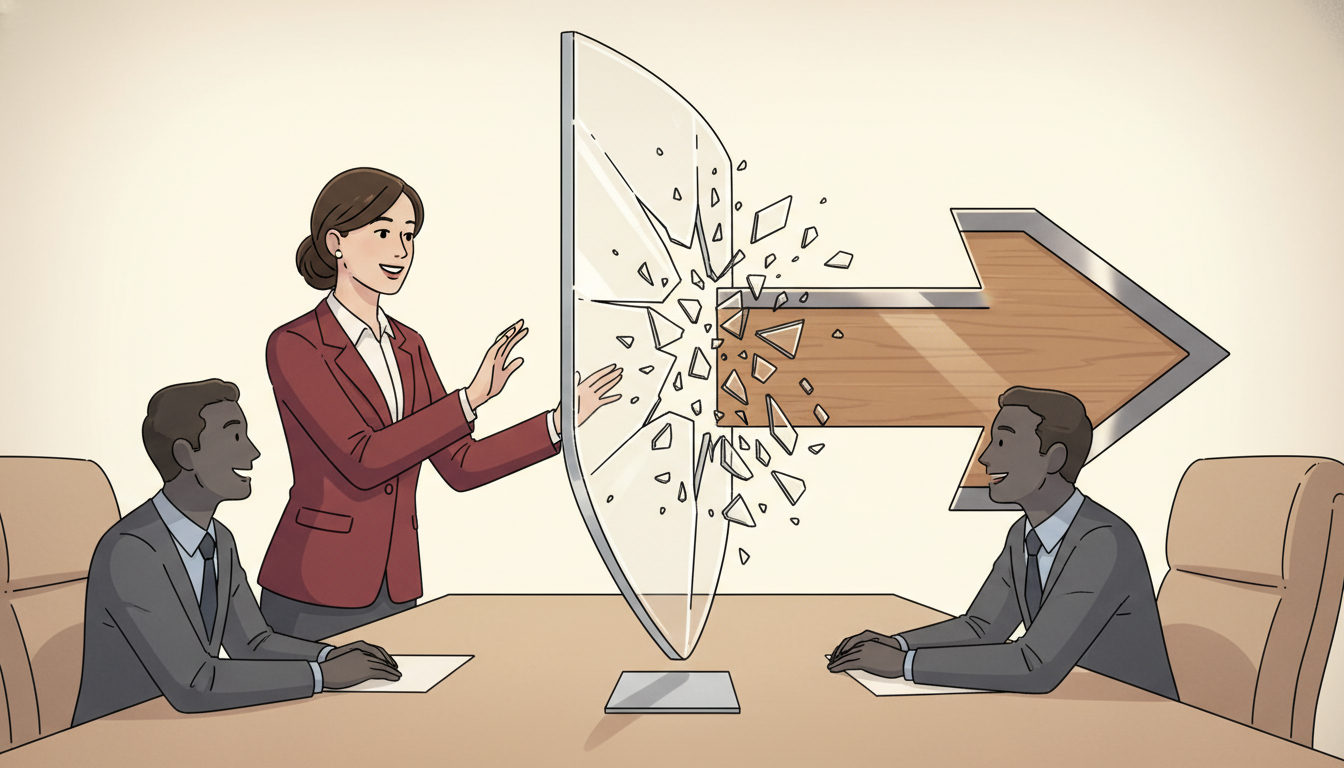
One of the fastest ways to get overlooked is to undermine your own ideas with weak language. Most professionals do this unconsciously, and it's one of the most fixable problems in workplace communication.
Eliminate the Confidence Killers
Phrases like "I'm not sure if this is right, but...", "This might be a dumb question...", or "I just think maybe we could..." tell the room to discount what comes next. A study from the University of Texas found that speakers who used hedging language were rated 25-35% less competent and persuasive than those who stated the same ideas directly.
Here's what to say instead:
- Instead of: "I just wanted to add..." → Say: "I want to add an important point."
- Instead of: "Sorry, but I think..." → Say: "Here's what I recommend."
- Instead of: "This might not work, but..." → Say: "Here's one approach worth considering."
- Instead of: "I kind of feel like..." → Say: "Based on the data, my assessment is..."
The shift is subtle but powerful. You're saying the same thing — but framing it as a contribution worth hearing.
Use the "Bottom Line Up Front" (BLUF) Method
Military and executive communicators use the BLUF method to ensure their core message lands before attention drifts. State your conclusion first, then provide supporting context.
Example: Instead of "So I was looking at the customer feedback from last quarter, and there were some interesting patterns, and I noticed that our churn rate is connected to onboarding delays, so I was thinking maybe we should..." — try: "We should overhaul our onboarding process. Customer feedback shows it's the primary driver of churn. Here's what I recommend."For a deeper dive into eliminating weak language patterns, check out stop hedging language at work: speak with certainty.
Strategy 4: Handle Interruptions and Idea Theft in Real Time
Being overlooked often happens in the moment — someone talks over you, or restates your idea as their own five minutes later. You need in-the-moment techniques to address this without creating conflict.
The "Hold and Return" Technique for Interruptions
When someone interrupts you, don't retreat. Use a calm, firm redirect:
- "I'd like to finish my point — it's directly relevant to what we're deciding."
- "Let me complete this thought, and then I want to hear your perspective."
- "Hold that thought — I'm almost done."
Deliver these lines with steady eye contact and a neutral tone. No anger, no apology. You're not being rude — you're exercising your right to finish speaking.
The "Echo and Expand" Method for Idea Attribution
When someone restates your idea without credit, use this three-part response:
- Acknowledge: "Yes, that's exactly what I was proposing earlier."
- Reclaim: "To build on my original point..."
- Expand: Add a new layer of detail that demonstrates ownership.
This isn't petty — it's professional self-advocacy. For more on handling these dynamics, see our guide on how to handle being talked over in meetings.
Strategy 5: Build Strategic Alliances That Amplify Your Voice
You don't have to fight for visibility alone. Research from Harvard professor Rosabeth Moss Kanter shows that professionals who have even one active ally in meetings are significantly more likely to have their ideas adopted and credited correctly.
The "Amplification Pact"
Find one or two trusted colleagues and make an explicit agreement: when one of you makes a point in a meeting, the other reinforces it by name.
How it sounds in practice:- "I want to go back to what Sarah said about the timeline — I think that's the right call."
- "Marcus raised an important point earlier about the budget. I'd like to build on that."
This technique was famously used by women in the Obama White House, who noticed their contributions were consistently overlooked. They created a deliberate amplification strategy, and President Obama began calling on them more frequently as a result.
Pre-Brief Your Allies
Before important meetings, share your key points with your allies. Tell them: "I'm going to recommend X during the meeting. If it resonates with you, I'd appreciate you backing it up." This isn't manipulation — it's how effective professionals build coalitions.
This kind of strategic relationship-building is also central to building a personal brand that gets you promoted.
Strategy 6: Follow Up With Written Reinforcement
What happens after the meeting matters as much as what happens during it. A well-crafted follow-up email can anchor your contributions in the record and ensure your ideas aren't lost or misattributed.
Send a Strategic Summary Email
Within two hours of the meeting, send a brief email to the group:
"Great discussion today. To summarize the key points I raised:- [Point 1 with brief context]
- [Point 2 with brief context]
This accomplishes three things: it creates a written record of your contributions, it positions you as someone who takes ownership, and it reinforces your ideas in people's minds after the meeting ends.
According to a 2022 study by Grammarly and The Harris Poll, professionals spend an average of 19 hours per week on written communication, yet most neglect the strategic value of post-meeting follow-ups. Don't be one of them.
For more on using written communication to build authority, explore how to project authority in emails.
Document Patterns Over Time
If being overlooked is a recurring issue, start keeping a private log. Note dates, specific instances, and who was involved. This isn't about building a case for HR (though it could serve that purpose if needed). It's about identifying patterns.
Are you overlooked more in certain types of meetings? With specific colleagues? When discussing particular topics? Patterns reveal where to focus your strategy.
Turn Invisible Contributions Into Undeniable Authority. The Credibility Code gives you the exact frameworks, scripts, and daily practices to build the kind of presence that ensures you're never overlooked again. Discover The Credibility Code
Strategy 7: Build a Long-Term Visibility System
Individual meetings are battles. Your career is the war. The professionals who stop being overlooked are the ones who build a consistent, visible presence that extends beyond any single meeting.
Become the Person Who Shares Insights Before and After Meetings
Start sending brief, relevant insights to your team or stakeholders between meetings. A quick email with a relevant article, a data point, or a one-paragraph analysis positions you as someone who's always thinking, always contributing.
This creates what psychologists call a "halo effect" — when people associate you with valuable insights outside of meetings, they're primed to pay more attention when you speak inside them.
Develop Your Point of View
People who get overlooked often lack a recognizable professional point of view. They respond to whatever comes up instead of being known for a specific perspective or area of expertise.
Decide what you want to be known for. Maybe it's customer experience strategy, operational efficiency, or data-driven decision-making. Then consistently contribute through that lens. When you become the person with a clear, consistent perspective, people start turning to you — not past you.
For a complete framework on building this kind of professional identity, read how to position yourself as a leader at work.
Frequently Asked Questions
Why do I keep getting overlooked in meetings?
Being overlooked usually stems from a combination of positioning, language, and timing — not the quality of your ideas. Common causes include sitting in low-visibility positions, using hedging language that signals uncertainty, speaking too late in the discussion, and lacking allies who reinforce your contributions. Cultural and systemic factors like gender bias and seniority dynamics also play a significant role. The strategies in this article address both the controllable and structural elements.
How do I speak up in meetings without seeming aggressive?
There's a clear difference between assertiveness and aggression. Assertiveness means stating your ideas clearly and directly while respecting others. Use phrases like "I'd like to offer a different perspective" or "Based on my analysis, I recommend..." Keep your tone steady and your body language open. You're not attacking anyone — you're contributing. For more on this balance, see our guide on being more assertive in meetings without being aggressive.
Being overlooked in meetings vs. being interrupted — what's the difference?
Being interrupted is an active disruption — someone cuts you off mid-sentence. Being overlooked is more passive — your contributions are ignored, not acknowledged, or credited to others. Both are damaging, but they require different responses. Interruptions call for immediate "hold and return" techniques, while being overlooked requires a broader strategy involving pre-meeting positioning, alliance building, and post-meeting follow-up.
How do I handle someone taking credit for my idea in a meeting?
Use the "Echo and Expand" method: calmly acknowledge the idea, reclaim it by referencing your original contribution, and then add a new detail that demonstrates ownership. For example: "I'm glad we're aligned — that's the approach I outlined at the start of the discussion. Let me add the implementation detail I had in mind." Stay composed and factual. The goal is attribution, not confrontation.
Should I talk to my manager about being overlooked in meetings?
Yes, if the pattern persists despite your efforts. Frame it as a professional development conversation, not a complaint. Say something like: "I want to increase my visibility and impact in team meetings. I've noticed my contributions sometimes get lost in the discussion. Can we talk about strategies for me to have more presence?" A good manager will appreciate your initiative and may actively create space for you in future meetings.
How can introverts stop being overlooked in meetings?
Introverts often excel at preparation and written communication — leverage those strengths. Prepare your key points in advance, claim agenda time before the meeting, and follow up with written summaries afterward. You don't need to be the loudest voice. You need to be the most strategic one. For a full framework, explore how to speak up in meetings as an introvert without forcing it.
Stop Being the Best-Kept Secret in the Room. Being overlooked in meetings isn't a permanent condition — it's a communication pattern you can break. The Credibility Code by Confidence Playbook gives you the complete system of frameworks, scripts, and daily practices to build the authority and presence that ensures your voice is heard, your ideas are credited, and your career moves forward. Discover The Credibility Code
Ready to Command Authority in Every Conversation?
Transform your professional communication with proven techniques that build instant credibility. The Credibility Code gives you the frameworks top leaders use to project confidence and authority.
Discover The Credibility CodeRelated Articles

How to Stop Being Overlooked at Work: 11 Authority Moves
Being overlooked at work usually isn't about your competence—it's about your visibility and communication patterns. To stop being overlooked, you need to shift from passive contributor to active authority by changing how you speak up, position your ideas, claim credit, and show up in key moments. The 11 moves below target the root causes: weak positioning, hedging language, invisible contributions, and missed opportunities to demonstrate leadership presence. Most professionals see a noticeable s

How to Advocate for Yourself at Work Without Bragging
Advocating for yourself at work means proactively communicating your contributions, articulating your value, and asking for what you deserve—without crossing the line into arrogance. The key is to frame self-advocacy around impact, not ego. Use data-driven language, connect your work to organizational outcomes, and make it easy for decision-makers to recognize your contributions. When done well, self-advocacy doesn't feel like bragging—it feels like leadership.

Assertive Communication at Work: 15 Before & After Examples
Assertive communication at work means expressing your ideas, needs, and boundaries clearly and respectfully — without being passive or aggressive. Here are 15 real-world before-and-after examples: Instead of saying "Sorry, I just think maybe we could…" say "I recommend we take a different approach. Here's why." Instead of staying silent when your idea is taken, say "I appreciate you building on the point I raised earlier — let me expand on it." These examples, and 13 more below, cover meetings,