
Executive Speaking Cadence: Techniques That Command

Executive speaking cadence is the deliberate control of pace, rhythm, pauses, and tempo variation that separates commanding communicators from forgettable ones. The most effective executives don't just choose better words — they master how those words land. The core techniques include strategic deceleration (slowing to 120-130 words per minute for key points), the power pause (2-4 seconds of intentional silence before and after critical statements), tempo contrast (alternating between faster contextual passages and slower decisive statements), and rhythmic grouping (chunking ideas into digestible 3-5 word phrases). These techniques can be practiced daily and produce noticeable results within weeks.
What Is Executive Speaking Cadence?
Executive speaking cadence is the intentional pattern of pacing, pausing, and rhythmic variation a speaker uses to convey authority, control, and confidence. It's distinct from simply "speaking slowly" — it's the architecture of how words are delivered over time.
Think of it as the difference between a metronome and a symphony. A metronome keeps one steady beat. A symphony uses tempo changes, rests, and dynamic shifts to move an audience. Executive speaking cadence is that symphony applied to professional communication.
Research from the University of Michigan found that speakers who varied their rate of speech were rated as 36% more engaging and significantly more credible than those who spoke at a constant pace (University of Michigan, 2011). Cadence isn't a nice-to-have — it's a measurable driver of how people perceive your authority.
Why Cadence Matters More Than Word Choice
The Neuroscience of Pacing and Persuasion

Your brain processes spoken language in rhythmic chunks, not as a continuous stream. Neuroscientists at Princeton University discovered that when a speaker's cadence is well-structured, listeners' brain waves actually synchronize with the speaker's — a phenomenon called "neural coupling" (Hasson et al., Princeton Neuroscience Institute, 2010). The stronger the coupling, the deeper the comprehension and trust.
This means your cadence literally shapes whether your audience's brain locks onto your message or drifts away. Executives who master cadence aren't just sounding more authoritative — they're creating neurological alignment with their listeners.
How Poor Cadence Undermines Credibility
Consider two scenarios. A director presents quarterly results at a steady, rapid 170 words per minute, never pausing, running sentences together. The content is solid, but the room checks their phones. The next week, a peer presents similar results at a varied pace — slowing for the key insight, pausing before the recommendation, speeding through the background context. The room leans in.
The difference isn't intelligence or preparation. It's cadence. A study published in the Journal of Personality and Social Psychology found that speakers who used strategic pauses were perceived as more competent and thoughtful, even when delivering identical content (Scherer, Feldstein, Bond & Rosenthal, 1985). If you've ever felt overlooked despite having strong ideas, your cadence may be the hidden culprit. If this resonates, you may also benefit from understanding why people don't take you seriously at work and how to fix it.
The Executive Cadence vs. the Manager Cadence
There's a measurable difference between how executives communicate versus managers. Managers tend to speak at a consistent pace, fill silence with filler words, and rush through conclusions. Executives do the opposite: they slow down at decision points, embrace silence, and use tempo shifts to signal "this is the part that matters."
This isn't about personality. It's a learned skill — and the techniques below will show you exactly how to build it.
The Four Core Executive Cadence Techniques
Technique 1: Strategic Deceleration
The average conversational speaking rate is 150-160 words per minute. Most nervous or under-trained speakers push past 170 wpm in professional settings. Executive speakers intentionally drop to 120-130 wpm when delivering their most important points.
How to practice Strategic Deceleration:- Identify your anchor sentence. Before any meeting or presentation, pinpoint the single most important statement you'll make.
- Mark it mentally. When you reach that sentence, consciously halve your speed.
- Elongate key words. Instead of "We need to restructure the division," say "We need... to re-struc-ture... the division." Stretch the critical word.
- Time yourself. Record a 60-second passage. Count your words. If you're above 160, practice the same passage at 130. The difference in how it feels to listeners is dramatic.
Technique 2: The Power Pause
Silence is the most underused tool in professional communication. According to research by Columbia University's Teachers College, speakers who paused for 2-3 seconds before key statements were rated as 40% more confident than those who filled gaps with "um," "so," or "you know" (Columbia University, 2015).
The three types of power pause:- The Pre-Statement Pause (2-3 seconds). Pause before your key point. This creates anticipation. "After reviewing all the data... [pause]... we're recommending a full pivot."
- The Post-Statement Pause (2-4 seconds). Pause after your key point. This lets the idea land. "We're shutting down the legacy product line. [pause]" The silence gives weight to the statement.
- The Transition Pause (1-2 seconds). Pause between sections or ideas. This signals a mental shift and gives listeners time to process.
Ready to Speak With Commanding Authority? The Credibility Code gives you a complete system for building the vocal presence, strategic communication habits, and leadership cadence that get you heard — and respected. Discover The Credibility Code
Technique 3: Tempo Contrast
Monotone delivery isn't just about pitch — it's about pace. Speaking at the same speed for an entire presentation creates a hypnotic (and not in a good way) effect. Executive speakers use deliberate tempo contrast to create a sense of movement and emphasis.
The Tempo Contrast Framework:| Content Type | Target Pace | Purpose |
|---|---|---|
| Background/context | 150-160 wpm | Move through efficiently |
| Data/evidence | 140-150 wpm | Allow processing |
| Key insight/recommendation | 120-130 wpm | Signal importance |
| Call to action | 110-125 wpm | Drive commitment |
| Storytelling/anecdote | Varied (fast → slow) | Build and release tension |
Technique 4: Rhythmic Grouping (Chunking)
Effective executives don't speak in long, unbroken streams. They chunk their language into rhythmic groups of 3-5 words, separated by micro-pauses. This creates a cadence that sounds deliberate, composed, and easy to follow.
Compare these two deliveries of the same content:❌ "I think we should probably consider moving forward with the new vendor because our current contract is expiring and the pricing is significantly better."
✅ "We should move forward / with the new vendor. / Our contract expires next month. / The pricing is 30% lower."
The second version uses short, rhythmic phrases. Each chunk delivers one idea. The micro-pauses between chunks let the listener absorb each piece before the next arrives.
Practice method: Write out a key statement you need to deliver this week. Break it into chunks of 3-5 words using slash marks. Practice reading it aloud with a slight pause at each slash. This trains your brain to think and speak in executive-caliber rhythm. For a deeper dive into structuring your thoughts this way, explore how executives structure their thoughts before speaking.Building Your Cadence: A 10-Minute Daily Practice Routine
The Morning Cadence Drill (5 Minutes)
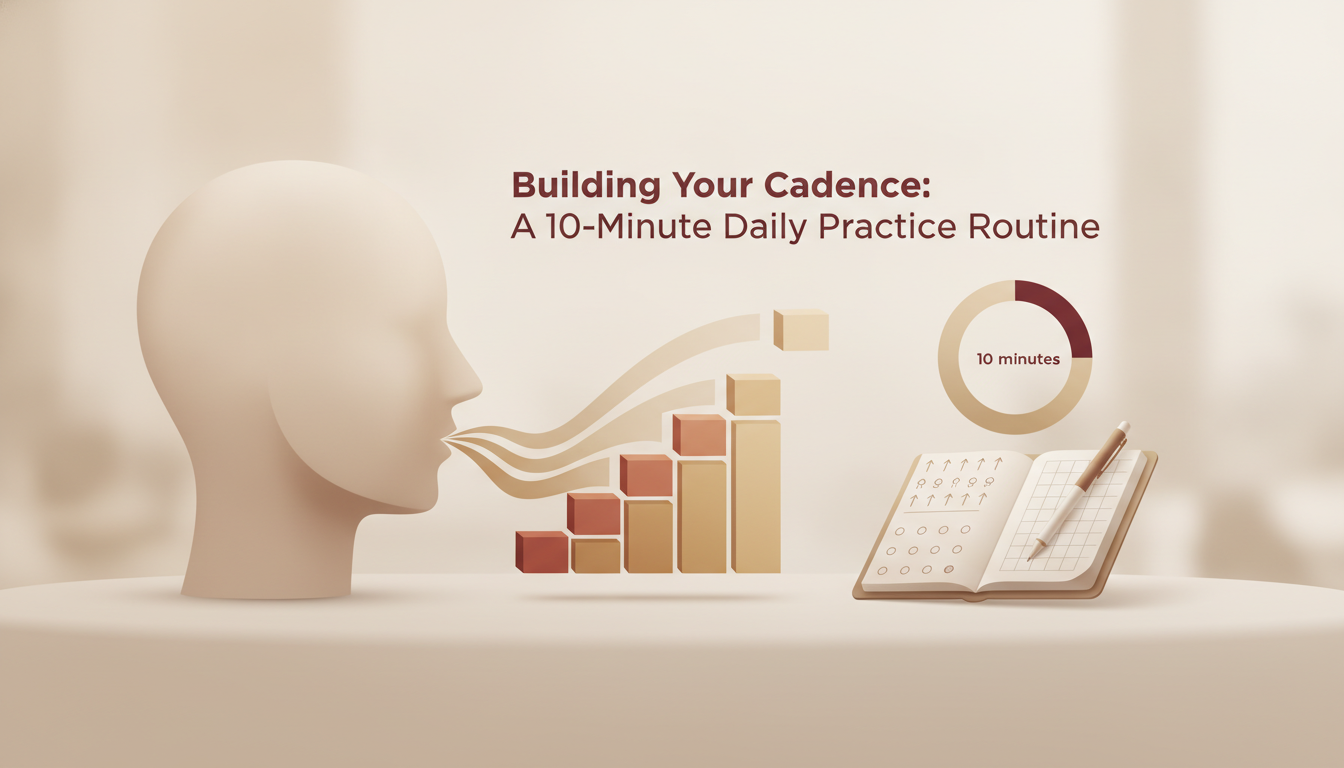
This drill builds your cadence muscle before you need it in a live setting.
- Choose a passage — any paragraph from a business article, book, or your own notes. (2-3 sentences is enough.)
- Read it aloud at your natural pace. Time yourself. Note your wpm.
- Read it again at 20% slower. Focus on elongating vowels in key words.
- Read it a third time with deliberate pauses. Insert a 2-second pause before the most important word or phrase.
- Read it a final time with tempo contrast. Speed up the context, slow down the conclusion.
This takes five minutes. Do it every morning for 30 days, and your default speaking cadence will shift permanently. If you want to pair this with broader vocal development, our guide on how to develop a commanding voice at work provides complementary exercises.
The Pre-Meeting Calibration (3 Minutes)
Before any important meeting or presentation:
- Identify your one key message. Write it down in 10 words or fewer.
- Practice delivering it at 120 wpm with a 2-second pause before and after.
- Rehearse the first 30 seconds of what you plan to say, using rhythmic grouping.
This brief calibration primes your brain for executive cadence. According to a study in Psychological Science, brief pre-performance routines improved delivery quality by up to 22% (Brooks, Harvard Business School, 2014).
The Weekly Recording Review (2 Minutes)
Once a week, record yourself in a real meeting (with permission) or during a practice session. Listen for:
- Rushing: Are you speeding up when you get to your main point? (Most people do.)
- Filler words: Are "um" and "so" filling spaces where pauses should be?
- Monotone pacing: Does every sentence sound the same speed?
Mark one specific thing to improve the following week. This single habit accelerates cadence development faster than any other practice.
Advanced Cadence Strategies for High-Stakes Moments
Cadence in Negotiations
In negotiations, cadence becomes a tactical tool. Speaking slowly during your offer signals confidence and finality. Pausing after the other party's counteroffer signals that you're considering it carefully — even if you've already decided.
The most effective negotiation cadence follows what communication researchers call the "slow close" pattern: start at a natural pace during rapport-building, maintain a steady pace during information exchange, then progressively slow your cadence as you approach your key terms. This deceleration subconsciously signals that your words carry increasing weight.
For more on using vocal tone as a negotiation asset, see our guide on negotiation tone of voice and how to sound confident.
Cadence in Crisis Communication
When delivering difficult news or leading through uncertainty, cadence is your anchor. A measured pace — 110-125 wpm — projects calm authority. Rushing signals panic. According to leadership communication research by the Center for Creative Leadership, leaders who slowed their speaking pace during crisis communications were rated as 47% more trustworthy by their teams (CCL, 2019).
The pattern for crisis cadence: Slow. Short sentences. Frequent pauses. "Here's what we know. [pause] Here's what we're doing. [pause] Here's what I need from each of you." This rhythmic structure gives people something to hold onto when everything else feels chaotic. For a complete framework on maintaining composure under pressure, explore how to speak with poise under pressure.
Cadence When Presenting to Senior Leadership
When presenting to the C-suite, your cadence should match the way executives process information: fast context, slow conclusions, decisive pauses.
Executives are impatient with preamble. Move through background quickly (155-160 wpm). When you reach your recommendation or ask, drop to 120 wpm and use the Power Pause. This signals respect for their time and confidence in your conclusion.
Command Every Room You Walk Into. The Credibility Code is the complete system for professionals who want to communicate with the authority, cadence, and presence of a senior executive — starting today. Discover The Credibility Code
Common Cadence Mistakes (and How to Fix Them)
Mistake 1: The Nervous Acceleration
Under pressure, most people speed up. Their pace climbs from 150 to 180+ wpm without them realizing it. The fix: anchor your feet, take one deep breath before your first sentence, and mentally commit to your opening pace. If you catch yourself accelerating, pause for two seconds. The pause resets your rhythm and signals confidence to your audience. For more on managing the physical symptoms of speaking anxiety, see our guide on how to calm nerves before a presentation.
Mistake 2: The Artificial Slowdown
Some professionals, after learning about executive cadence, overcorrect by speaking unnaturally slowly throughout an entire presentation. This sounds condescending or robotic. Remember: cadence is about variation, not constant slowness. Speed up for context. Slow down for conclusions. The contrast is what creates authority.
Mistake 3: Filling Every Pause
The instinct to fill silence is powerful. But every "um," "so," or "you know" that fills a potential power pause erodes your credibility. The fix isn't willpower — it's practice. The more you rehearse deliberate pauses, the more comfortable silence becomes. Within three weeks of daily pause practice, most professionals report that silence feels natural rather than terrifying.
Frequently Asked Questions
What is the ideal speaking pace for executives?
The ideal executive speaking pace varies by context, but research consistently points to 120-140 words per minute for key messages and recommendations. Background context can be delivered at 150-160 wpm. The critical factor isn't a single "correct" speed — it's the contrast between faster contextual passages and slower, more deliberate delivery of your most important points. This variation is what signals authority and keeps listeners engaged.
How do I slow down my speaking pace without sounding unnatural?
Focus on elongating vowel sounds in key words rather than adding gaps between every word. Practice with a specific passage: read it at your natural speed, then re-read it 20% slower by stretching the vowels in the most important words. Also, replace filler words with genuine 2-second pauses. Recording yourself and listening back is the fastest way to calibrate — what feels painfully slow to you usually sounds perfectly composed to your audience.
Executive speaking cadence vs. public speaking cadence: what's the difference?
Public speaking cadence tends to be more performative, with dramatic pauses, wider tempo swings, and more vocal energy — designed for large audiences and stages. Executive speaking cadence is subtler and more conversational, optimized for boardrooms, meetings, and one-on-one conversations. The pauses are shorter (2-3 seconds vs. 3-5+), the tempo range is narrower, and the goal is credibility and decisiveness rather than entertainment or inspiration.
Can introverts develop a commanding speaking cadence?
Absolutely. In fact, introverts often have a natural advantage with cadence because they tend to be more deliberate and reflective in their speech. The key techniques — strategic pausing, rhythmic grouping, and deceleration — align well with an introverted communication style. Introverts typically need to focus less on slowing down (they're often already measured) and more on tempo contrast — adding energy and pace to contextual sections so their key points stand out through deceleration.
How long does it take to change your speaking cadence?
Most professionals notice a measurable shift within 2-3 weeks of daily practice (10 minutes per day). Significant, habitual change — where executive cadence becomes your default mode — typically takes 6-8 weeks. A study in the European Journal of Social Psychology found that forming a new behavioral habit takes an average of 66 days (Lally et al., 2010). Consistent daily drills, weekly recording reviews, and real-world application in meetings accelerate the process substantially.
Does speaking cadence matter in virtual meetings?
It matters even more. In virtual settings, participants lack body language cues and are more prone to distraction. Research by Virtira Consulting found that 49% of remote meeting participants admit to multitasking during calls. A varied cadence — with clear pauses, tempo shifts, and rhythmic grouping — is one of the most effective tools for recapturing attention through a screen. Slowing down for key points and using the Power Pause are especially critical in virtual environments.
Your Voice Is Your Most Powerful Leadership Tool. This article gave you the cadence techniques — The Credibility Code gives you the complete system for building authority, presence, and confidence in every professional interaction. From vocal delivery to strategic communication frameworks, it's the playbook for professionals who refuse to be overlooked. Discover The Credibility Code
Ready to Command Authority in Every Conversation?
Transform your professional communication with proven techniques that build instant credibility. The Credibility Code gives you the frameworks top leaders use to project confidence and authority.
Discover The Credibility CodeRelated Articles

How to Sound Authoritative in Emails: 9 Proven Shifts
To sound authoritative in emails, eliminate hedging language ("I just wanted to," "I think maybe"), lead with your conclusion instead of burying it, use direct requests instead of passive suggestions, and keep sentences short and decisive. Authoritative email writers state what they need, why it matters, and by when — without over-explaining or apologizing for taking up space. These nine shifts transform tentative emails into messages that command respect and get results.

How to Communicate Like a Senior Leader: 10 Principles
To communicate like a senior leader, shift from sharing information to shaping decisions. Senior leaders speak with brevity, frame every message around business impact, use decisive language, and structure their thinking before they speak. They lead with the conclusion, eliminate hedging, and take ownership of their words. These ten principles will help you make that shift—whether you're preparing for a promotion or already in the role.

Executive Communication Style: Real Examples & Patterns
Executive communication style is defined by strategic brevity, decisive language, and outcome-focused framing. Top executives cut filler words, lead with the bottom line, and frame every message around decisions and impact—not background or process. Below, you'll find real before-and-after examples of email tone, meeting language, decision framing, and verbal patterns that separate senior leaders from mid-level professionals, along with rewrite templates you can apply to your own communication t