
Stop Being Overlooked for Leadership Roles: 8 Credibility Moves

Being overlooked for leadership roles rarely comes down to skill or performance. The professionals who get tapped for leadership consistently send eight specific credibility signals that decision-makers are trained to notice—signals that most high-performers never learn to send. This article breaks down each signal, explains why it matters, and gives you actionable moves to shift from "reliable contributor" to "obvious leadership candidate" starting this week.
What Does It Mean to Be Overlooked for Leadership Roles?
Being overlooked for leadership roles means you're consistently passed over for promotions, stretch assignments, or leadership opportunities despite strong performance reviews and technical competence. It's the frustrating gap between doing excellent work and being seen as someone who can lead others to do excellent work.
This happens because decision-makers don't promote based on past performance alone. They promote based on perceived future leadership potential—a perception shaped by specific communication behaviors, strategic visibility, and what researchers call "leadership prototypicality," or how closely you match the mental image of a leader in your organization.
Why High Performers Get Overlooked: The Visibility-Credibility Gap
The "Head Down, Work Hard" Trap

Here's the painful truth: the habits that made you a top performer are often the same habits keeping you invisible. A 2018 study published in the Harvard Business Review found that only 1 in 4 employees believe their organization's promotion process is fair, and high performers are frequently passed over because they prioritize output over influence.
Consider Sarah, a senior product manager at a mid-size tech company. She consistently delivered projects under budget and ahead of schedule. But when a director role opened, leadership chose a peer whose project results were merely average—but who had spent months building cross-functional relationships and presenting strategic recommendations to the VP.
Sarah made a classic mistake: she assumed her results would speak for themselves. They almost never do.
What Decision-Makers Actually Evaluate
Research from the Center for Creative Leadership reveals that executives weigh three factors when selecting future leaders: demonstrated competence (which you likely already have), strategic thinking (which you may have but aren't showing), and leadership presence (which is the factor most high performers neglect entirely).
Leadership presence isn't about charisma or being the loudest person in the room. It's a set of observable behaviors—how you communicate in meetings, how you frame problems, how you handle pressure—that signal to others, "This person can lead." If you want a deeper understanding of this concept, explore our guide on how to develop leadership presence.
The Cost of Staying Invisible
According to a 2023 Gallup workplace report, employees who feel overlooked for advancement are 3.5 times more likely to be actively disengaged. Being passed over doesn't just stall your career—it erodes your confidence, your motivation, and eventually your performance. It creates a downward spiral that makes the next promotion even harder to win.
The good news: the credibility signals that get people promoted are learnable. They're not personality traits. They're strategic behaviors. Here are the eight that matter most.
The 8 Credibility Moves That Get You Noticed for Leadership
Move 1: Communicate in Outcomes, Not Activities
The single fastest way to be seen as a leader is to change what you talk about. Contributors report on tasks. Leaders communicate in outcomes and impact.
Before: "I've been working on the Q3 customer retention analysis and I'm about halfway through the data." After: "The Q3 retention data is revealing a pattern—we're losing 18% of mid-tier customers at the 90-day mark. I'm building a recommendation to address the root cause, and I'd like 10 minutes at next week's leadership meeting to present options."Notice the shift. The second version frames the work in terms of business impact, signals initiative, and requests a leadership-level platform. This is the kind of strategic communication that makes decision-makers see you differently.
Your move this week: Before every status update, email, or meeting comment, ask yourself: "Am I describing what I did, or what it means for the business?" Reframe accordingly.Move 2: Claim Your Strategic Point of View
Leaders don't just execute—they have a perspective on where things should go. If you only ever respond to others' strategies without offering your own, you'll be categorized as an executor, not a strategist.
A McKinsey study on leadership development found that "strategic perspective" is one of the top three differentiators between people who advance to senior leadership and those who plateau at mid-management.
How to build this habit:- Pick one area where you have deep expertise.
- Develop a clear, 2-3 sentence point of view on what should change or improve.
- Share it proactively—in meetings, in emails to your manager, in cross-functional discussions.
For example: "Based on what I'm seeing in our onboarding data, I believe we need to rethink our first-30-days experience entirely. The current approach optimizes for speed, but our churn data suggests we should optimize for engagement instead."
This is how you position yourself as a strategic thinker at work—not by asking for a seat at the table, but by bringing something valuable enough that people pull up a chair for you.
Move 3: Build a Cross-Functional Reputation
Decision-makers don't promote people known only within their own team. They promote people whose reputation extends across departments, because leadership roles require cross-functional influence.
Your move: Identify two to three stakeholders outside your direct team—people who interact with leadership and whose work intersects with yours. Begin contributing value to their projects, even in small ways. Offer a data insight. Volunteer to present a joint update. Ask for their input on your work.Within 90 days, you'll have advocates in rooms you've never been in. This is the foundation of building authority without a title.
Move 4: Master the Leadership Meeting Voice
How you speak in meetings is the most visible credibility signal you send. Research from Yale University's School of Management found that people form judgments about leadership potential within the first 30 seconds of hearing someone speak in a group setting.
Leaders in meetings do four things consistently:
- They speak early. Contributing in the first five minutes signals confidence and engagement.
- They speak concisely. Rambling signals uncertainty. Aim for 30-60 second contributions.
- They build on others' ideas. "I want to build on what Marcus said..." signals collaborative leadership.
- They name the tension. "The real question we're dancing around is..." signals strategic clarity.
If meetings feel like your weak spot, our guide on how to speak with authority in meetings provides a complete framework.
Ready to Command the Room? These meeting behaviors are just the beginning. The Credibility Code gives you the full system for building leadership presence in every professional interaction. Discover The Credibility Code
Move 5: Make Your Manager's Job Easier (Strategically)
This move is counterintuitive but powerful. The professionals who get promoted fastest don't just perform well—they make their manager look strategic. When your manager can point to you as evidence of their leadership development skills, promoting you becomes their win.
How to do this without being sycophantic:- Proactively send your manager a brief monthly summary of your impact (not your tasks—your impact).
- Before big meetings, ask: "Is there anything I can prepare that would help you make the case for our team's priorities?"
- When your manager delegates, don't just complete the task—come back with the task plus a recommendation for next steps.
This positions you as a partner, not just a report. And it gives your manager concrete language to use when your name comes up in talent reviews.
Move 6: Control Your Professional Narrative
Most professionals let others define their reputation by default. Leaders actively shape how they're perceived.
According to a 2022 LinkedIn Workforce Confidence survey, 70% of professionals who received promotions had actively communicated their career goals to their managers—compared to just 35% of those who didn't advance.
Your narrative framework:- Who you are: "I'm a [role] who specializes in [specific area of impact]."
- What you deliver: "I'm known for [specific, measurable outcomes]."
- Where you're headed: "I'm building toward [specific leadership goal]."
Practice saying this out loud. Use it in one-on-ones, networking conversations, and performance reviews. If this feels uncomfortable, you're not alone—but building a personal brand that gets you promoted is a skill, not a personality trait.
Move 7: Demonstrate Composure Under Pressure
Nothing signals leadership readiness like staying calm when things go sideways. Decision-makers watch how you handle conflict, pushback, and unexpected challenges—because those moments preview how you'd perform in a leadership role.
The composure protocol:- Pause before responding. Even two seconds of silence signals control.
- Acknowledge the difficulty. "This is a complex situation, and I want to make sure we address it thoughtfully."
- Offer a structured response. "Here's what I know, here's what I recommend, and here's what I need from this group."
This is the essence of communicating with gravitas—not performing confidence, but demonstrating the kind of steady, clear-headed thinking that teams need from their leaders.
Move 8: Ask for Leadership Opportunities Directly
This is the move most people skip entirely—and it's often the most important one.
A 2019 study by Lean In and McKinsey & Company found that women are 24% less likely than men to receive advice from managers about advancing to leadership. But the gap isn't just gendered—across all demographics, professionals who explicitly ask for leadership opportunities are significantly more likely to receive them.
Scripts that work:- "I'd like to be considered for the next leadership opportunity on our team. Can we talk about what I'd need to demonstrate?"
- "I'm ready to take on more strategic responsibility. What would it take for you to see me as a candidate for [specific role]?"
- "I'd like to lead the [specific project]. I believe my experience with [specific skill] makes me the right fit."
Asking directly does two things: it puts you on the radar, and it gives your manager a chance to tell you exactly what the gap is—so you can close it.
The 90-Day Credibility Acceleration Plan
Weeks 1-30: Foundation
Focus on Moves 1, 4, and 6. Start communicating in outcomes instead of activities. Shift your meeting behavior. Write your professional narrative and share it with your manager in your next one-on-one.
During this phase, audit your current visibility. Ask yourself: "If the VP of my division were asked to describe me in one sentence, what would they say?" If you don't know—or if the answer would be vague—you have a visibility problem, not a performance problem.
Weeks 31-60: Expansion
Add Moves 2, 3, and 5. Develop your strategic point of view and begin sharing it. Build two to three cross-functional relationships. Start sending your manager monthly impact summaries.
This is also the time to build credibility with senior leadership by volunteering for a visible project or presenting a recommendation to a leadership audience.
Weeks 61-90: Activation
Execute Moves 7 and 8. Look for a high-pressure moment to demonstrate composure. And have the direct conversation with your manager about leadership opportunities.
By the end of 90 days, you won't just feel more like a leader—you'll be perceived as one. That perception shift is what opens doors.
Your 90-Day Leadership Visibility Plan Starts Here. The Credibility Code gives you the exact frameworks, scripts, and daily practices to make these eight moves second nature—so you never get passed over again. Discover The Credibility Code
Common Mistakes That Keep You Invisible
Waiting for Permission to Lead

Many overlooked professionals share a common belief: "When they give me the title, I'll start acting like a leader." This is backwards. Decision-makers promote people who are already demonstrating leadership behavior. You have to be seen as a leader before the promotion, not after.
Confusing Busyness with Visibility
Working 60-hour weeks doesn't make you visible—it makes you indispensable in your current role. There's a critical difference between being valued as a contributor and being seen as a future leader. If your visibility strategy is "work harder," you're building a cage, not a ladder.
Undermining Your Own Credibility
Small language habits—hedging, over-apologizing, qualifying every statement—erode your authority in ways you may not notice. Phrases like "I might be wrong, but..." or "Sorry, just a quick thought..." signal uncertainty to decision-makers. Eliminating these patterns is one of the fastest ways to sound more credible at work.
Frequently Asked Questions
How long does it take to stop being overlooked for leadership roles?
Most professionals see a noticeable shift in how they're perceived within 60-90 days of consistently applying credibility-building behaviors. However, landing a specific leadership role depends on organizational timing and openings. The key is to start building your leadership reputation now so you're the obvious choice when the opportunity arises, rather than scrambling to prove yourself at the last minute.
What's the difference between executive presence and leadership presence?
Executive presence refers to the specific communication style and gravitas expected at the C-suite and senior executive level—think boardroom composure and strategic brevity. Leadership presence is broader: it's the ability to inspire confidence and trust at any level of an organization. You need leadership presence to get promoted into management; you need executive presence to advance into senior leadership. Both are built through the same foundational credibility signals.
Can introverts be seen as leadership material?
Absolutely. Research from Adam Grant at Wharton shows that introverted leaders often outperform extroverted ones, particularly with proactive teams. The key for introverts isn't to become louder—it's to become more strategically visible. That means contributing high-impact insights in meetings, building one-on-one relationships with decision-makers, and communicating your value in writing. Our guide on building leadership presence as an introvert covers this in depth.
Should I tell my boss I want a leadership role?
Yes—explicitly and clearly. Research consistently shows that professionals who communicate their career aspirations to their managers are significantly more likely to be considered for advancement. Frame it as a development conversation, not a demand: "I'm interested in growing into a leadership role. What skills or experiences would you want to see from me before that happens?"
Why do less qualified people get promoted over me?
In most cases, it's not that they're less qualified—it's that they're more visible. They may communicate their impact more effectively, build broader networks, or actively position themselves for leadership. Promotions are rarely pure meritocracies. They're influenced by perception, relationships, and strategic positioning. The eight credibility moves in this article address exactly this gap.
How do I recover confidence after being passed over for promotion?
Being passed over is painful, but it's also diagnostic. Request specific feedback on why you weren't selected, then map that feedback to the eight credibility moves above. Often, the gap isn't competence—it's one or two visibility behaviors you haven't activated yet. Our guide on rebuilding confidence after being passed over provides a step-by-step recovery plan.
Stop Waiting. Start Leading. The Credibility Code is the complete system for building the authority, presence, and strategic visibility that gets you promoted—not someday, but in your next review cycle. It's the playbook for professionals who are done being overlooked. Discover The Credibility Code
Ready to Command Authority in Every Conversation?
Transform your professional communication with proven techniques that build instant credibility. The Credibility Code gives you the frameworks top leaders use to project confidence and authority.
Discover The Credibility CodeRelated Articles

Sound Confident in Promotion Interviews: 9 Shifts
Quick Answer: To sound confident in a job promotion interview, make nine targeted shifts in your vocal delivery, language choices, and body language. Replace hedging phrases with declarative statements, lower your vocal pitch at sentence endings, frame past contributions as strategic impact rather than task lists, and project physical stillness. These shifts signal to decision-makers that you're already operating at the next level — not asking for permission to try.
How to Stop Undermining Yourself at Work: 11 Hidden Habits
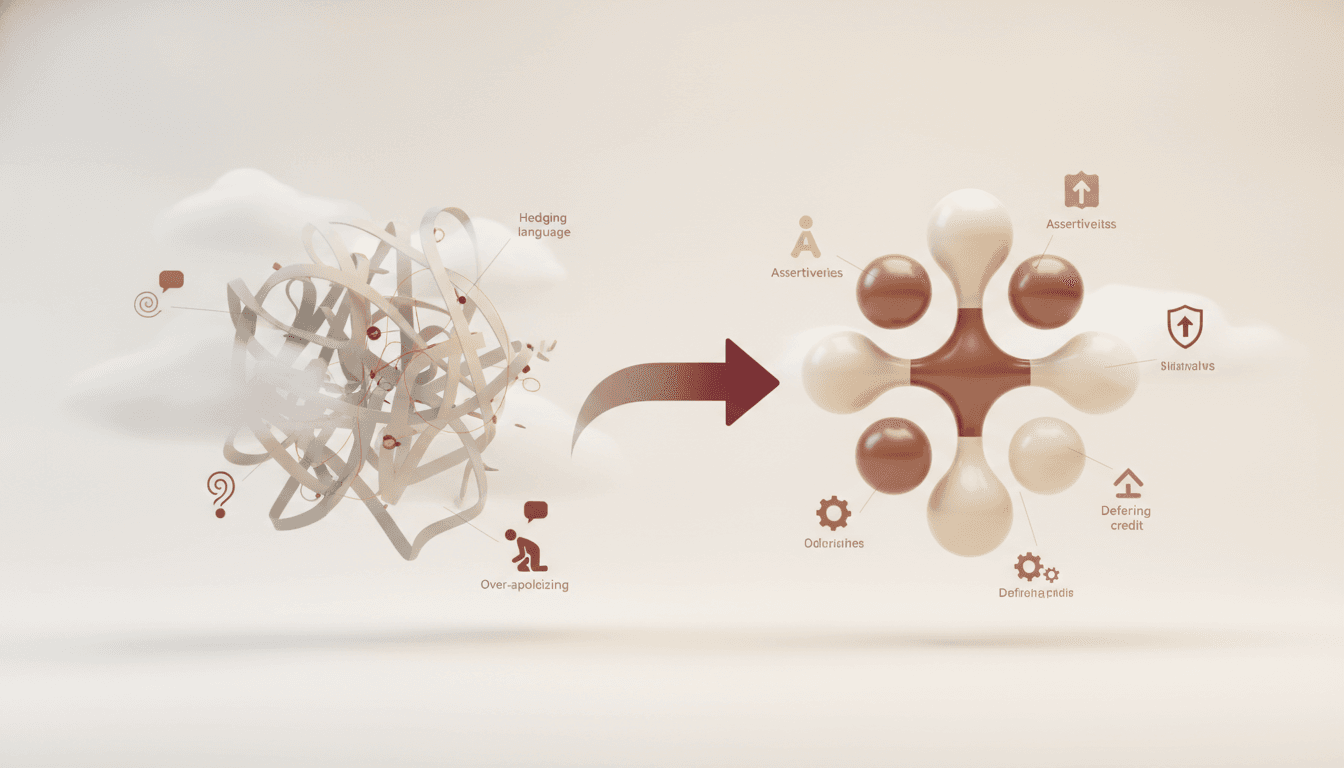
You stop undermining yourself at work by identifying and replacing the subtle communication habits that silently erode your credibility. The most common self-undermining behaviors include hedging your language ("I just think maybe..."), over-apologizing, using upspeak, deferring credit, and shrinking your physical presence. Each habit sends an unintentional signal that you lack conviction—even when your ideas are strong. Below, you'll find all 11 hidden habits with specific before-and-after repl

How to Advocate for Yourself at Work Without Bragging
Advocating for yourself at work means proactively communicating your contributions, articulating your value, and asking for what you deserve—without crossing the line into arrogance. The key is to frame self-advocacy around impact, not ego. Use data-driven language, connect your work to organizational outcomes, and make it easy for decision-makers to recognize your contributions. When done well, self-advocacy doesn't feel like bragging—it feels like leadership.