
How to Develop Leadership Presence: A 5-Step Framework
What Is Leadership Presence?
Leadership presence is the ability to project confidence, competence, and authority in a way that inspires trust and motivates action—without relying on a title or formal power. It's the quality that makes people listen when you speak, defer to your judgment in high-stakes moments, and see you as someone ready for greater responsibility.
Unlike charisma, which is often personality-driven and situational, leadership presence is a consistent, buildable set of behaviors that signal credibility across every interaction—from one-on-one conversations to boardroom presentations. According to a 2012 study by the Center for Talent Innovation (now Coqual), executive presence accounts for 26% of what it takes to get promoted to the next level, making it one of the most consequential career skills you can develop.
Why Leadership Presence Matters More Than Ever
The Visibility Gap in Modern Workplaces

Most professionals assume their work speaks for itself. It doesn't. A 2023 survey by Gartner found that only 25% of employees feel confident they'll be recognized for their contributions. The gap between doing great work and being seen as a leader is where leadership presence lives.
Consider two directors presenting the same quarterly results. One reads from slides, hedges their recommendations with "I think maybe we should consider…" and avoids eye contact with the CFO. The other opens with a clear headline, delivers data with steady vocal tone, pauses for emphasis, and closes with a decisive recommendation. Same data. Radically different impact.
Presence Drives Promotion, Not Just Performance
Research from Harvard Business Review (2018) found that leaders rated high in "presence" were 2.5 times more likely to be seen as high-potential talent by senior leadership. Technical skills get you hired. Presence gets you promoted, trusted with bigger projects, and invited into rooms where decisions are made.
This is why developing leadership presence isn't optional for mid-career professionals—it's the difference between being a contributor and being seen as a leader. If you've ever felt overlooked despite strong performance, a presence gap is likely the reason.
The Five Dimensions: A Framework You Can Build
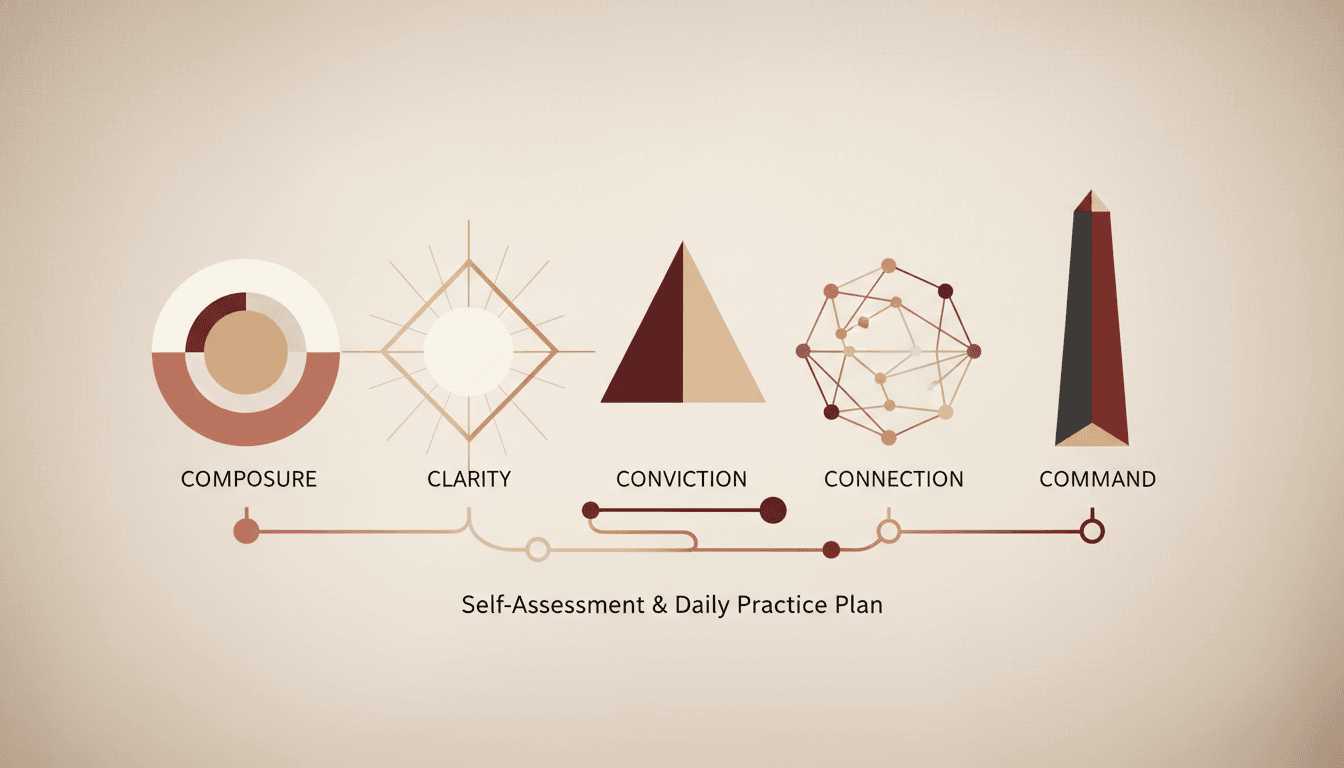
The framework below breaks leadership presence into five buildable dimensions. Each one addresses a different aspect of how others experience your authority. Weakness in even one dimension can undermine the other four.
Here are the five dimensions:
- Composure — How you hold yourself under pressure
- Clarity — How precisely you communicate
- Conviction — How certain and committed you sound
- Connection — How well you build trust and rapport
- Command — How effectively you direct attention and action
Let's break each one down with a self-assessment, real-world scenarios, and a daily practice plan.
Step 1: Build Composure — The Foundation of Presence
What Composure Looks Like in Practice
Composure is the ability to remain steady—physically, vocally, and emotionally—when the stakes are high. It's the dimension people notice first because it's visible. A leader who fidgets, speaks too fast, or visibly panics when challenged immediately loses credibility.
Picture a VP who gets blindsided by a tough question from the CEO during a strategy review. Instead of scrambling or getting defensive, she pauses for two seconds, takes a breath, and says: "That's an important question. Here's what the data shows, and here's where we still need more information." That pause—that visible calm—is composure.
Self-Assessment: Rate Your Composure (1-10)
Ask yourself these diagnostic questions:
- When challenged in meetings, does my voice speed up or my pitch rise?
- Do I maintain open body language when I feel defensive?
- Can I pause for 2-3 seconds before responding without feeling uncomfortable?
- Do others describe me as "calm" or "steady" under pressure?
If you scored below a 6, composure is your highest-leverage starting point.
Daily Practice Plan for Composure
Morning (2 minutes): Practice box breathing—inhale for 4 counts, hold for 4, exhale for 4, hold for 4. This trains your nervous system to default to calm. Do this before your first meeting. During meetings: Implement the "Two-Second Rule." Before responding to any question or challenge, pause for a full two seconds. This single habit transforms how others perceive your thoughtfulness. For more on this, see our guide on how to speak with poise under pressure. Evening (3 minutes): Replay one moment from the day where you felt reactive. Mentally rehearse responding with slower speech, open posture, and a deliberate pause. Visualization research from the Journal of Applied Sport Psychology shows this kind of mental rehearsal improves actual performance by up to 13%.Ready to Build Unshakable Professional Composure? The Credibility Code gives you the complete system for projecting calm authority in every high-stakes moment—with scripts, vocal drills, and body language blueprints. Discover The Credibility Code
Step 2: Develop Clarity — Say More With Less
Why Clarity Is a Leadership Superpower
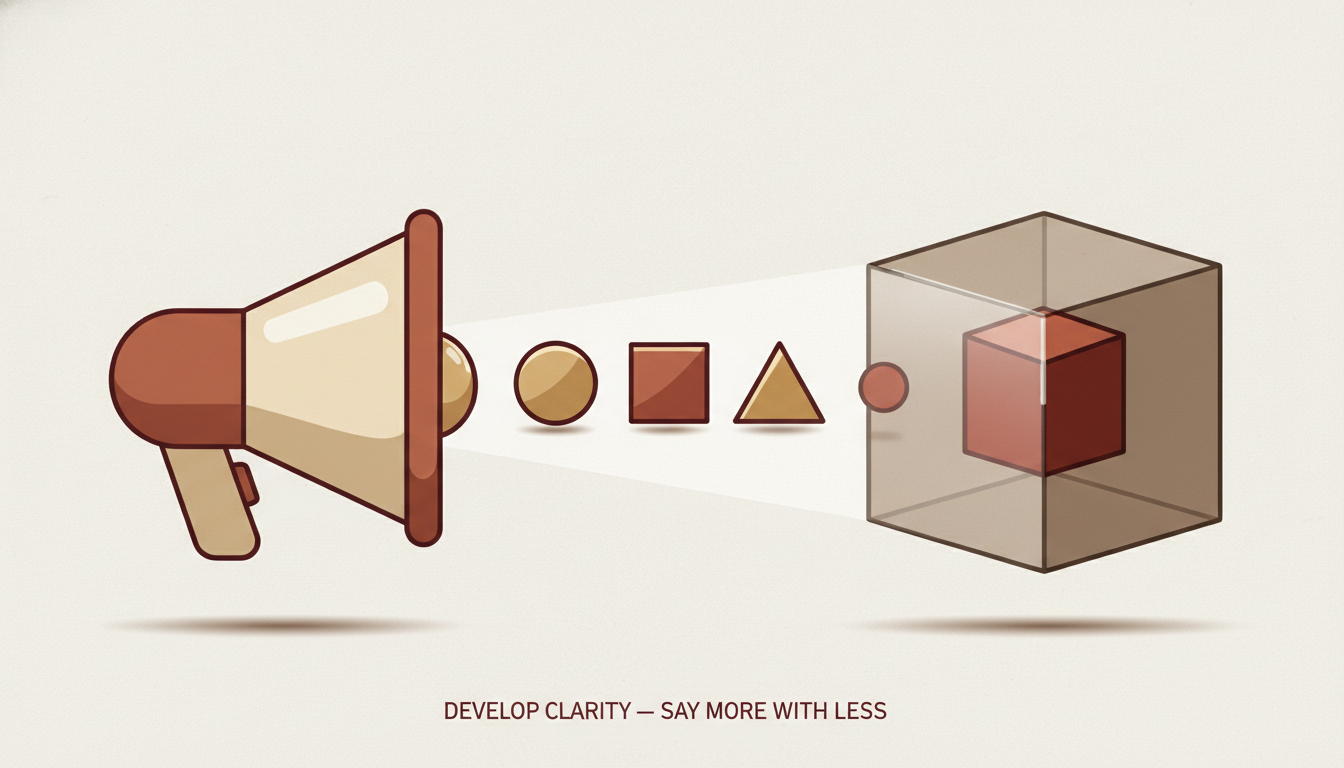
Clarity is the ability to communicate your point in a way that's immediately understood, remembered, and acted upon. It's the opposite of rambling, over-explaining, or burying your point under qualifiers.
A 2019 study published in the MIT Sloan Management Review found that leaders who communicated with "radical clarity"—using fewer words, simpler structures, and direct recommendations—were rated 30% higher in perceived competence by their teams compared to those who gave longer, more nuanced explanations.
This doesn't mean dumbing things down. It means structuring your thinking so the most important point lands first.
The Headline-First Method
Most professionals bury their key message. They give context, then background, then caveats, and finally—if the listener is still paying attention—their actual point. Leaders reverse this.
Use the Headline-First Method:
- Lead with the headline: State your main point or recommendation in one sentence.
- Support with 2-3 points: Give the evidence or reasoning.
- Close with the ask: State what you need from the audience.
For more on structuring your communication like a senior leader, read our guide on how executives structure their thoughts before speaking.
Daily Practice Plan for Clarity
Morning: Before each meeting, write down your one key message in 15 words or fewer. If you can't, you're not clear enough yet. During conversations: Use the "So what?" test. After you make a point, silently ask yourself, "So what does this mean for the listener?" If you haven't answered that, add it. Weekly: Record yourself in one meeting (with permission) or practice call. Listen for filler words, hedging language, and buried points. Our post on words that undermine your credibility is an excellent companion resource.Step 3: Strengthen Conviction — Speak With Certainty
The Difference Between Confidence and Conviction
Confidence is how you feel. Conviction is how you sound. You can feel uncertain internally and still project conviction externally—and that's exactly what effective leaders do.
Conviction shows up in three places: your word choices, your vocal delivery, and your willingness to take a clear position. When you hedge—saying "I feel like maybe" instead of "I recommend"—you signal doubt. When your voice rises at the end of a declarative statement (upspeak), you turn authority into a question.
Conviction Killers to Eliminate
Watch for these patterns that destroy conviction:
- Hedging language: "I think maybe," "sort of," "kind of," "I'm not sure but…"
- Permission-seeking: "Does that make sense?" "Is it okay if I…?"
- Upspeak: Ending statements with a rising pitch, as if asking a question
- Over-qualifying: "This might not be right, but…" or "I could be wrong, however…"
Replace them with conviction language:
| Conviction Killer | Conviction Builder |
|---|---|
| "I think we should maybe consider…" | "I recommend we…" |
| "Does that make sense?" | "Here's what this means for us." |
| "Sorry, but I had a thought…" | "I want to add something important." |
| "I'm not the expert, but…" | "Based on what I've seen…" |
For a deep dive into eliminating weak language patterns, see our guide on how to stop hedging language at work.
Daily Practice Plan for Conviction
Morning: Choose one recommendation you'll need to make today. Practice saying it out loud in a single, declarative sentence with a downward vocal inflection at the end. During meetings: Set a "no-hedge" goal. For one meeting per day, commit to zero hedging phrases. Track yourself mentally. Evening: Write down one opinion you held back during the day. Rewrite it as a clear, direct statement. Practice saying it aloud. This builds the muscle of taking positions.Step 4: Deepen Connection — Lead Through Trust
Why Connection Isn't "Soft"—It's Strategic
Connection is the dimension that separates leaders who command compliance from leaders who inspire commitment. It's the ability to make people feel heard, valued, and understood—even when you're delivering hard truths or making unpopular decisions.
According to a 2021 DDI Global Leadership Forecast, leaders who demonstrated high empathy in communication were 4.6 times more likely to be rated as high-performing by their organizations. Connection isn't a nice-to-have. It's a performance multiplier.
The Acknowledge-Align-Advance Method
When you need to build connection quickly—especially in difficult conversations—use this three-step method:
- Acknowledge: Name what the other person is feeling or experiencing. ("I can see this timeline feels unrealistic given your team's current workload.")
- Align: Show shared interest or common ground. ("We both want this launch to succeed without burning out the team.")
- Advance: Move toward a solution or next step. ("Let's look at which deliverables we can phase to make this workable.")
This method works in difficult conversations with leadership, negotiations, and even casual one-on-ones. It signals that you're not just pushing an agenda—you're leading with awareness.
Daily Practice Plan for Connection
Morning: Before your first interaction, remind yourself of one thing the other person cares about or is struggling with. Enter the conversation with their context in mind. During meetings: Practice "last-word listening"—before responding, mentally repeat the last sentence the other person said. This forces genuine attention and prevents the habit of formulating your response while they're still talking. Weekly: Have one conversation where your only goal is to understand the other person's perspective. Ask questions. Don't offer solutions. This builds your connection capacity over time.Step 5: Develop Command — Direct Attention and Action
What Command Actually Means
Command is the ability to direct the energy of a room—to set the agenda, hold attention, and move people toward a decision or action. It's the most visible dimension of leadership presence, and it's often the one people think of first when they picture a "leader."
But command isn't about being the loudest voice. It's about being the most intentional one. Leaders with command enter a room with purpose, speak with direction, and leave people clear on what happens next.
The Room-Setting Technique
Before any meeting, presentation, or conversation where you need to lead, use this three-part technique:
- Set the frame: Open by stating the purpose and the outcome you're driving toward. ("We're here to make a decision on vendor selection. By the end of this meeting, I want us aligned on our top choice.")
- Control the flow: Guide the conversation by naming transitions. ("We've covered cost. Let's move to implementation timeline.") This signals that you're leading, not just participating.
- Close with clarity: End with a clear summary and explicit next steps. ("Here's what we decided. Here's who owns what. Here's when we reconvene.")
This technique works whether you're leading a town hall or a one-on-one check-in. Command is about intentionality, not volume.
The Body Language of Command
Your physical presence either reinforces or undermines your verbal command. Key command signals include:
- Stillness: Reduce fidgeting, swaying, and unnecessary movement. Stillness reads as control.
- Purposeful gestures: Use open-palm gestures to emphasize points. Avoid self-soothing touches (touching your face, clasping hands).
- Eye contact distribution: In group settings, hold eye contact with one person per sentence (3-5 seconds each). This creates the feeling that you're speaking to people, not at them.
- Spatial confidence: Take up appropriate space. Don't shrink into your chair or hunch over your notes.
For a comprehensive breakdown, read our guide on leadership presence body language: 11 cues that signal power.
Daily Practice Plan for Command
Morning: Before your most important meeting, write down three things: the purpose, the outcome you want, and your opening sentence. Enter with a plan. During meetings: Practice the "name-and-redirect" technique. When conversation drifts, say: "That's a valuable point. Let's capture it and come back to our core question." This positions you as the person who keeps things on track. Evening: Reflect on one moment where you could have taken more control of a conversation. What would you have said to set the frame or close with clarity?Turn These Five Dimensions Into Daily Habits The Credibility Code includes a complete self-assessment for all five presence dimensions, plus 30 days of structured practice exercises designed for working professionals. Discover The Credibility Code
Your 5-Dimension Self-Assessment
Before you start building, you need to know where you stand. Rate yourself 1-10 on each dimension:
| Dimension | Key Question | Your Score (1-10) |
|---|---|---|
| Composure | Do I stay calm and steady when challenged or surprised? | ___ |
| Clarity | Do people immediately understand my main point? | ___ |
| Conviction | Do I speak with certainty and take clear positions? | ___ |
| Connection | Do people feel heard and valued in conversations with me? | ___ |
| Command | Do I direct conversations toward outcomes and action? | ___ |
- 40-50: Strong leadership presence. Focus on refinement.
- 30-39: Solid foundation. One or two dimensions need targeted work.
- 20-29: Developing. Prioritize your two lowest dimensions.
- Below 20: Emerging. Start with composure and clarity—they unlock the others.
Your lowest-scoring dimension is your highest-leverage opportunity. Improving your weakest dimension by even two points will have a disproportionate impact on how others perceive your overall presence.
Building Your Daily Leadership Presence Practice
The 15-Minute Daily Routine
You don't need hours of practice. You need consistency. Here's a daily routine that covers all five dimensions in 15 minutes:
Before work (5 minutes):- Box breathing: 2 minutes (composure)
- Write your headline for today's most important conversation: 1 minute (clarity)
- Say your key recommendation aloud with a downward inflection: 1 minute (conviction)
- Review one colleague's priorities or concerns: 1 minute (connection)
- Apply the Two-Second Rule before responding to challenges (composure)
- Use Headline-First in at least one conversation (clarity)
- Eliminate one hedging phrase (conviction)
- Practice last-word listening in one conversation (connection)
- Set the frame in one meeting (command)
- Journal: What worked? What moment could I replay differently? Which dimension needs more attention tomorrow?
The Weekly Presence Audit
Every Friday, ask yourself:
- Which dimension did I practice most consistently this week?
- Which dimension did I neglect?
- What's one specific moment where my presence made a visible impact?
- What's my focus dimension for next week?
This weekly audit creates a feedback loop that accelerates growth. Within 30 days of consistent practice, you'll notice measurable changes in how people respond to you. For a structured 30-day plan, explore our executive presence self-improvement plan.
Frequently Asked Questions
What is leadership presence and why does it matter?
Leadership presence is the ability to project confidence, credibility, and authority in a way that earns trust and motivates action. It matters because research from the Center for Talent Innovation shows that executive presence accounts for 26% of what it takes to get promoted. Without it, even high performers get overlooked for leadership opportunities, key projects, and career-defining visibility.
How long does it take to develop leadership presence?
Most professionals notice meaningful changes within 30-60 days of consistent, focused practice. Leadership presence isn't one skill—it's five interconnected dimensions. You won't transform overnight, but by targeting your weakest dimension with daily micro-practices (as little as 15 minutes per day), you can see measurable shifts in how colleagues respond to you within a month.
Leadership presence vs. executive presence: what's the difference?
Leadership presence is the broader ability to inspire confidence and trust in any professional setting—regardless of title. Executive presence is a subset focused specifically on the behaviors expected at the senior leadership level, such as strategic communication, boardroom gravitas, and high-stakes decision-making. Think of leadership presence as the foundation and executive presence as the advanced application.
Can introverts develop strong leadership presence?
Absolutely. Leadership presence doesn't require being loud or extroverted. Introverts often excel at composure, clarity, and connection—three of the five dimensions. The key is leveraging your natural strengths (deep listening, thoughtful responses, calm demeanor) while deliberately building the dimensions that feel less natural, like command. Our guide on building leadership presence quietly offers specific strategies.
What are the biggest mistakes people make when trying to build leadership presence?
The three most common mistakes are: (1) focusing only on body language while ignoring clarity and conviction in their actual words, (2) trying to imitate someone else's style instead of building an authentic presence, and (3) practicing sporadically instead of building consistent daily habits. Presence is a system of behaviors—improving one dimension while neglecting others creates an unbalanced impression.
How do I develop leadership presence in virtual meetings?
Virtual meetings require amplified presence because physical cues are reduced. Focus on three adjustments: maintain direct eye contact by looking at your camera (not the screen), use shorter and more structured statements since attention spans are shorter online, and use deliberate pauses instead of filler words to hold attention. Frame-setting and closing with clear next steps become even more critical in virtual settings.
Your Leadership Presence Transformation Starts Here. You now have the five-dimension framework. The Credibility Code gives you the complete system to put it into practice—with self-assessments, daily drills, scripts for high-stakes moments, and a 30-day implementation plan that builds real authority. Discover The Credibility Code
Ready to Command Authority in Every Conversation?
Transform your professional communication with proven techniques that build instant credibility. The Credibility Code gives you the frameworks top leaders use to project confidence and authority.
Discover The Credibility CodeRelated Articles

Leadership Presence: What It Is and How to Build It
Leadership presence is the ability to project confidence, competence, and composure in a way that inspires trust and commands attention — even before you speak. It combines gravitas, communication skills, professional appearance, and emotional composure into a unified impression that signals authority. Unlike charisma, leadership presence is a learnable set of behaviors, not an innate personality trait. This article defines each component and gives you a practical framework to develop your own.
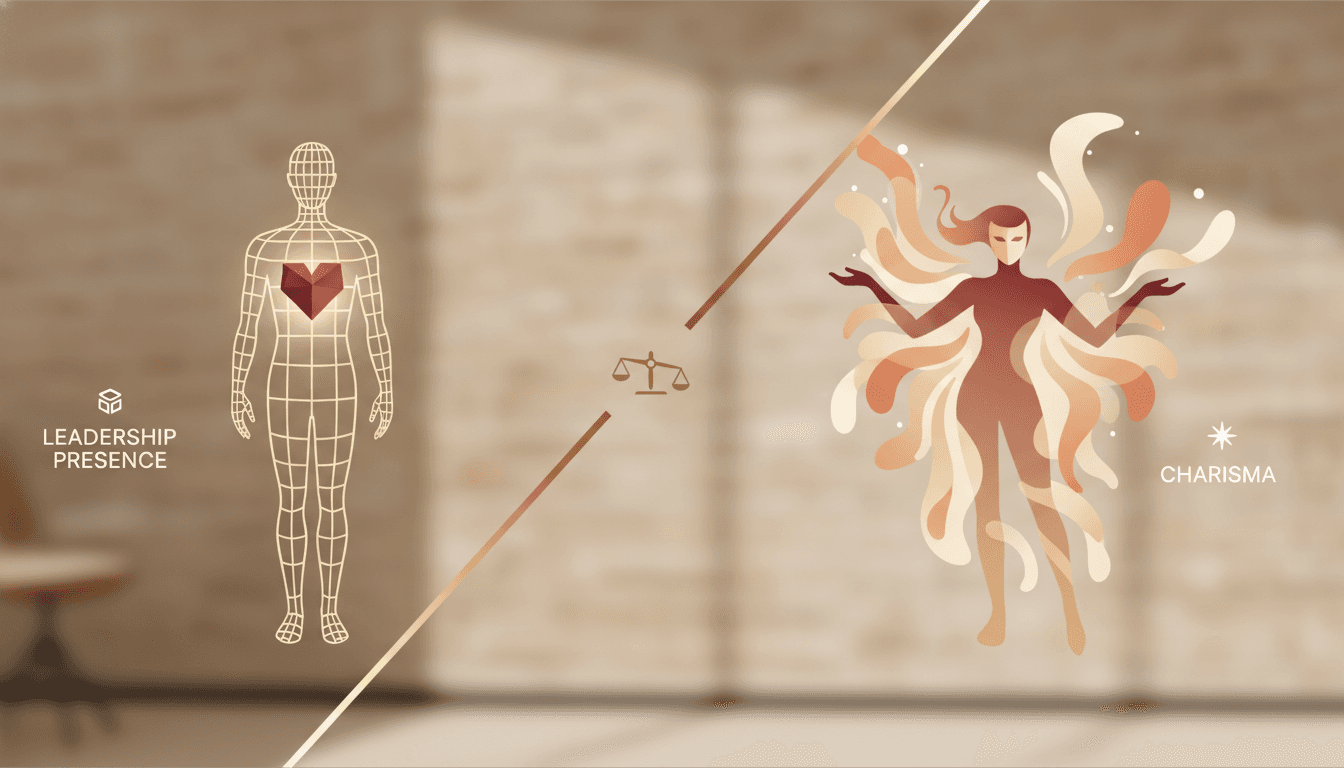
Leadership Presence vs Charisma: Key Differences Explained
Leadership presence and charisma are often confused, but they are fundamentally different. Charisma is a personality-driven magnetism that draws people in through energy and charm. Leadership presence is a credibility-based authority built on consistency, competence, and composure. The critical difference: charisma is largely innate and situational, while leadership presence is learnable, sustainable, and rooted in trust. Professionals who understand this distinction can stop chasing charm and s

How to Develop Gravitas as a Leader: The Complete Guide
Developing gravitas as a leader requires deliberate work across four dimensions: emotional regulation, communication weight, strategic thinking signals, and composure under pressure. It's not about being the loudest voice in the room — it's about cultivating a presence that makes people stop, listen, and trust your judgment. This guide breaks down a multi-dimensional development plan with specific frameworks, daily practices, and real-world scenarios so you can build genuine gravitas starting to