
Executive Presence Self-Improvement Plan: 30-Day Roadmap

An executive presence self-improvement plan is a structured, daily practice schedule that builds the four pillars of leadership presence—communication, body language, emotional composure, and decision-making signals—without hiring an expensive coach. Over 30 days, you'll complete targeted exercises that transform how colleagues perceive your authority, confidence, and credibility. This roadmap gives you the exact daily actions, organized week by week, so you can track measurable progress and show up as a leader others trust and follow.
What Is an Executive Presence Self-Improvement Plan?
An executive presence self-improvement plan is a self-directed development program designed to strengthen how you project authority, confidence, and credibility in professional settings. It breaks the abstract concept of "executive presence" into concrete, trainable skills—vocal tone, body language, concise communication, emotional regulation, and strategic decision-making signals—and assigns daily exercises to build each one.
Unlike generic leadership advice, a structured plan gives you accountability through specific actions, measurable benchmarks, and a clear timeline. According to the Center for Talent Innovation (now Coqual), executive presence accounts for 26% of what it takes to get promoted to the next level, making it one of the highest-leverage skills you can develop on your own.
If you're looking for a foundational understanding of the components involved, our guide on leadership presence definition, components, and how to build it is a strong starting point.
Why You Don't Need a Coach to Build Executive Presence
The Self-Coaching Advantage

Executive coaches charge between $200 and $500 per hour, according to the International Coaching Federation's 2023 Global Coaching Study. That puts sustained coaching out of reach for many mid-career professionals. But the core skills behind executive presence—how you speak, stand, respond under pressure, and frame decisions—are all trainable through deliberate daily practice.
Self-coaching works because executive presence is behavioral, not theoretical. You don't need someone to explain what confidence looks like. You need reps. A structured plan gives you those reps in manageable daily doses.
What Self-Improvement Plans Get Right
The best self-improvement plans succeed for three reasons. First, they break overwhelming goals into small daily actions. Second, they build skills sequentially so each week compounds on the last. Third, they include self-assessment checkpoints so you can measure growth without external feedback.
A 2022 study published in the British Journal of Health Psychology found that people who wrote specific implementation intentions ("I will do X at Y time in Z location") were 2-3 times more likely to follow through than those who simply set goals. This plan uses that principle—every day has a specific exercise, context, and duration.
Who This Plan Is Built For
This 30-day roadmap is designed for mid-career professionals, emerging leaders, and new managers who feel their skills outpace their perceived authority. If you've been told you need "more presence" in performance reviews, if you get talked over in meetings, or if you struggle to sound decisive under pressure, this plan addresses those exact gaps.
For those stepping into a new leadership role specifically, our article on how to speak with authority in a new role during the first 30 days pairs well with this roadmap.
The 4 Pillars of Your 30-Day Plan
Before diving into the daily schedule, understand the four skill areas you'll rotate through each week. Each pillar gets dedicated focus, but they overlap and reinforce each other.
Pillar 1: Communication Authority
This covers how you structure your ideas, choose your words, and deliver messages that land. You'll practice eliminating filler words, using the "bottom-line-up-front" framework, and speaking in shorter, more decisive sentences.
A Harvard Business Review analysis found that executives use 25-30% fewer words than mid-level managers to convey the same information. Conciseness is a credibility signal. Your communication exercises will train this instinct.
Pillar 2: Physical Presence and Body Language
Your body communicates before you open your mouth. This pillar covers posture, eye contact, hand gestures, and how you occupy space in a room (or on a video call). You'll practice specific stances, learn to eliminate nervous fidgeting, and develop what researchers call "postural expansiveness."
For a deep dive into this area, explore our complete guide on body language for leadership presence.
Pillar 3: Emotional Composure
Leaders who lose composure lose credibility. This pillar trains your ability to stay calm under pressure, respond (not react) to conflict, and maintain a steady emotional baseline even when challenged. You'll practice tactical breathing, cognitive reframing, and the "pause-before-response" technique.
Pillar 4: Decision-Making Signals
How you make and communicate decisions shapes how others perceive your leadership. This pillar focuses on sounding decisive (even when uncertain), framing trade-offs clearly, and eliminating hedging language that undermines your authority.
The Complete 30-Day Executive Presence Roadmap
Here's your day-by-day plan. Each exercise takes 10-20 minutes. Consistency matters more than perfection.
Week 1: Foundation Setting (Days 1-7)
Day 1 — Baseline Self-Assessment. Record yourself in a 2-minute "state of my work" video. Watch it back. Note your filler words, posture, eye contact, and energy level. Write down three specific things you want to change. This becomes your "before" benchmark. Day 2 — Filler Word Audit. In every meeting today, tally your filler words (um, uh, so, like, you know). Don't try to fix them yet—just count. Awareness precedes change. Most people use 5-8 fillers per minute without realizing it. Day 3 — Power Posture Practice. Before your first meeting, stand in a grounded stance for 2 minutes: feet shoulder-width apart, shoulders back, chin level. Hold this posture through the meeting. Notice how it changes your vocal tone. Day 4 — Bottom-Line-Up-Front (BLUF) Drill. In every email and verbal update today, lead with your conclusion or recommendation first, then provide supporting details. This single shift mirrors how executives communicate differently from everyone else. Day 5 — The 3-Second Pause. Before answering any question today, pause for a full 3 seconds. This eliminates rushed responses and signals thoughtfulness. It will feel uncomfortable—that's the point. Day 6 — Eye Contact Calibration. In conversations, maintain eye contact for 3-5 seconds at a time before naturally breaking. Practice in low-stakes interactions first (coffee shop, casual hallway chat), then bring it into a meeting. Day 7 — Week 1 Reflection. Review your Day 1 recording. Journal answers to: What felt most unnatural? What already feels different? What do I want to focus on next week?Ready to Accelerate Your Executive Presence? The daily exercises in this roadmap build real skills—but frameworks make them stick. Discover The Credibility Code for the complete system professionals use to build authority in every conversation.
Week 2: Communication Mastery (Days 8-14)
Day 8 — Sentence Length Audit. Record a voice memo explaining a current project in 60 seconds. Play it back and count how many sentences exceed 20 words. Rerecord, cutting each sentence to 15 words or fewer. Shorter sentences sound more authoritative. Day 9 — Eliminate Hedging Language. Remove "I think," "I feel like," "sort of," and "maybe" from your vocabulary today. Replace them with direct statements. Instead of "I think we should consider option B," say "I recommend option B." Our guide on words that make you sound less confident at work has a full list of swaps. Day 10 — The One-Breath Answer. When asked a question in a meeting, deliver your core answer in one breath—roughly 10-15 seconds. Then stop. Let silence do the work. Add detail only if asked. Day 11 — Strategic Framing Practice. Take a routine update and reframe it using this structure: "Here's the situation. Here's what it means. Here's what I recommend." Practice this framework in at least two conversations today. Day 12 — Written Authority Drill. Rewrite your three most recent emails using the principles in our guide on how to project authority in emails. Shorten paragraphs, lead with action items, and remove unnecessary qualifiers. Day 13 — Vocal Variety Exercise. Read a paragraph from a business article aloud three times: once in a monotone, once with exaggerated emphasis, and once finding a natural middle ground. Record the third version. Strong vocal variety increases perceived competence by up to 32%, according to research from Quantified Communications. Day 14 — Week 2 Reflection. Record another 2-minute video on the same topic as Day 1. Compare the two. Note specific improvements in word choice, sentence length, and directness.Week 3: Presence Under Pressure (Days 15-21)
Day 15 — Tactical Breathing. Practice box breathing (inhale 4 seconds, hold 4, exhale 4, hold 4) three times today: morning, before a meeting, and before bed. This activates your parasympathetic nervous system and becomes your go-to composure tool. Day 16 — The Disagreement Drill. In a safe conversation, practice respectfully disagreeing using this script: "I see it differently. Here's why..." followed by one concise reason. This builds the muscle for communicating with confidence in difficult conversations. Day 17 — Put-on-the-Spot Practice. Ask a trusted colleague to surprise you with a random work question. Practice the "acknowledge, bridge, answer" framework: "That's an important question. The key issue is X. My recommendation is Y." Repeat three times with different questions. Day 18 — Composure Under Challenge. When someone pushes back on your idea today, resist the urge to immediately defend. Instead, say: "Tell me more about your concern." Listen fully. Then respond with your position. This signals security, not weakness. Day 19 — Meeting Presence Audit. In your next meeting, focus exclusively on physical presence: sit up straight, keep hands visible on the table, avoid touching your face, and take up appropriate space. Notice how others respond to you differently. Day 20 — Silence as Strategy. After making a key point in a meeting or conversation, stop talking. Count to five internally. Resist the urge to fill silence with qualifiers or additional justification. Leaders are comfortable with silence; anxious communicators are not. Day 21 — Week 3 Reflection. Journal on these questions: When did I feel most composed this week? When did I lose composure? What triggered it? What would I do differently?Week 4: Authority and Integration (Days 22-30)
Day 22 — Decision Communication Drill. Practice announcing a decision using this format: "After reviewing X and Y, I've decided Z. Here's the rationale. Here's what happens next." Use this in at least one real decision today, even a small one. Day 23 — Stakeholder Communication Practice. Prepare a 60-second verbal brief on a current project as if presenting to your CEO. Use the structure from our guide on how to communicate with senior executives effectively. Record it. Trim any word that doesn't earn its place. Day 24 — Body Language Integration. Combine all your physical presence skills into one meeting: grounded posture, calibrated eye contact, visible hands, strategic pauses, and no fidgeting. This is your "full presence" mode. Day 25 — Influence Without Authority Practice. Identify one situation where you need buy-in from someone who outranks you. Prepare your case using the "credibility-first" approach: lead with data, acknowledge their priorities, then make your ask. Our article on how to influence people without formal authority at work provides the full framework. Day 26 — Impromptu Speaking Drill. Set a timer for 90 seconds. Pick a random work topic and speak about it with structure (point, evidence, implication). Do this three times with different topics. This builds the confidence to speak clearly without preparation. Day 27 — Feedback Collection. Ask two trusted colleagues: "Over the past few weeks, have you noticed anything different about how I communicate or show up in meetings?" Their observations will reveal what's working and what needs more practice. Day 28 — Composure Stress Test. Intentionally put yourself in a slightly uncomfortable professional situation—volunteer to lead a meeting, present an idea to a senior leader, or address a conflict you've been avoiding. Apply all four pillars simultaneously. Day 29 — Full Integration Day. Treat today as your "executive presence performance day." In every interaction—email, meeting, hallway conversation, video call—consciously apply the skills from all four pillars. This is your new default operating mode. Day 30 — Final Assessment. Record a final 2-minute video on the same topic as Day 1. Watch all three recordings (Day 1, Day 14, Day 30) back-to-back. Document specific changes. Write your "executive presence personal standard"—a one-paragraph description of how you commit to showing up going forward.Your 30-Day Transformation Deserves a System Behind It. You've built the habits. Now lock them in with a proven framework. Discover The Credibility Code to turn these 30 days of practice into a permanent leadership communication advantage.
How to Measure Your Progress Without a Coach
The Three-Recording Method

Your Day 1, Day 14, and Day 30 recordings are your most objective measurement tool. When reviewing them, score yourself on a 1-5 scale across these dimensions: filler word frequency, sentence conciseness, vocal confidence, posture and body language, and overall perceived authority. Track the scores in a simple spreadsheet.
The Peer Feedback Loop
On Days 7, 14, 21, and 30, ask one trusted colleague the same question: "On a scale of 1-10, how confident and authoritative did I come across in our last interaction?" Track the trend. Even a 1-2 point increase over 30 days represents meaningful behavioral change.
Research from the Corporate Executive Board (now Gartner) shows that professionals who actively seek feedback improve their performance 8.9% faster than those who don't. The act of asking itself signals the executive-level self-awareness you're building.
The Meeting Impact Test
Before starting the plan, note how often you speak in meetings, whether your ideas get adopted, and how frequently you're interrupted. Track these same metrics at Day 30. Tangible shifts in meeting dynamics—fewer interruptions, more follow-up questions, ideas gaining traction—are the strongest evidence of growing executive presence.
For ongoing daily habits that sustain these gains, our article on communicating with confidence at work through daily habits that stick provides a solid maintenance framework.
Common Mistakes That Derail Your Plan
Trying to Change Everything at Once
The most common failure mode is attempting to fix communication, body language, composure, and decision-making signals simultaneously from Day 1. This plan is sequenced intentionally. Week 1 builds awareness. Week 2 focuses on communication. Week 3 targets composure. Week 4 integrates everything. Trust the sequence.
Confusing Volume with Presence
Some professionals interpret "executive presence" as speaking more, speaking louder, or dominating conversations. This backfires. A study by Zenger/Folkman analyzing 360-degree feedback from over 4,000 leaders found that the most effective leaders scored highest on listening, not talking. Presence is about impact per word, not word count.
Skipping the Reflection Days
Days 7, 14, 21, and 30 are reflection days—not rest days. Skipping them removes the feedback mechanism that makes the entire plan work. Self-assessment without reflection is just activity without learning.
Frequently Asked Questions
What is executive presence and why does it matter for career growth?
Executive presence is the combination of communication authority, physical composure, emotional steadiness, and decision-making clarity that makes others perceive you as a leader. It matters because research from Coqual shows it accounts for 26% of promotion decisions. Without it, your technical skills alone won't move you into senior roles. It's the difference between being competent and being seen as leadership material.
How long does it take to develop executive presence?
Meaningful improvement is visible within 30 days of consistent daily practice. However, executive presence is a lifelong development area, not a one-time achievement. Most professionals notice significant shifts in how others respond to them within 2-4 weeks of focused practice. The 30-day plan builds foundational habits; mastery comes from sustained application over months and years.
Executive presence vs. leadership presence: what's the difference?
Executive presence emphasizes how you're perceived in high-stakes, senior-level interactions—boardrooms, executive briefings, and strategic conversations. Leadership presence is broader, encompassing how you inspire and influence teams at any level. Executive presence is a subset of leadership presence focused specifically on authority signals in formal professional contexts. Our article on executive presence vs. leadership presence explores this distinction in detail.
Can introverts develop executive presence?
Absolutely. Executive presence isn't about being the loudest person in the room. Introverts often excel at the composure and listening dimensions of presence. The key adjustments for introverts involve strategic visibility—speaking up at critical moments rather than constantly—and using concise, high-impact statements. Our guide on how to build leadership presence as an introvert provides a tailored approach.
What's the fastest way to improve executive presence without a coach?
Follow a structured daily plan like the 30-day roadmap above, focusing on one skill pillar per week. Record yourself regularly to track progress, seek peer feedback at weekly checkpoints, and prioritize the highest-leverage skill first (usually eliminating filler words and hedging language, which creates immediate perceptible change). Consistency of 15 minutes daily outperforms sporadic hour-long sessions.
How do I maintain executive presence gains after 30 days?
After completing the 30-day plan, shift to a maintenance routine: one communication drill per day, weekly self-recording reviews, and monthly peer feedback requests. Identify your weakest pillar and dedicate extra practice there. Most importantly, write a personal "presence standard" on Day 30 and review it every Monday morning as your weekly intention-setting ritual.
Turn 30 Days of Practice Into Permanent Authority. This roadmap gives you the daily exercises. The Credibility Code gives you the complete system—frameworks, scripts, and strategies—to build unshakable credibility in every professional interaction. Discover The Credibility Code and make your executive presence permanent.
Ready to Command Authority in Every Conversation?
Transform your professional communication with proven techniques that build instant credibility. The Credibility Code gives you the frameworks top leaders use to project confidence and authority.
Discover The Credibility CodeRelated Articles

Executive Presence vs Confidence: Key Differences Explained
While confidence is the internal belief in your own abilities, executive presence is the broader, outward-facing ability to project authority, composure, and influence in professional settings. Confidence is one ingredient of executive presence—but it's not the whole recipe. Executive presence combines gravitas, strategic communication, and commanding body language to shape how others perceive your leadership capability. You can be confident without having executive presence, but you cannot have

Executive Presence for Women in Leadership: A Real Framework
Executive presence for women in leadership is the ability to project authority, credibility, and composure in professional settings—while navigating the gender-specific biases that penalize women for the very behaviors rewarded in men. It requires a bias-aware approach that builds genuine authority through vocal presence, strategic language, and commanding body language, without forcing conformity to outdated masculine leadership norms. This framework gives you concrete, research-backed methods
How Executives Structure Presentations Differently
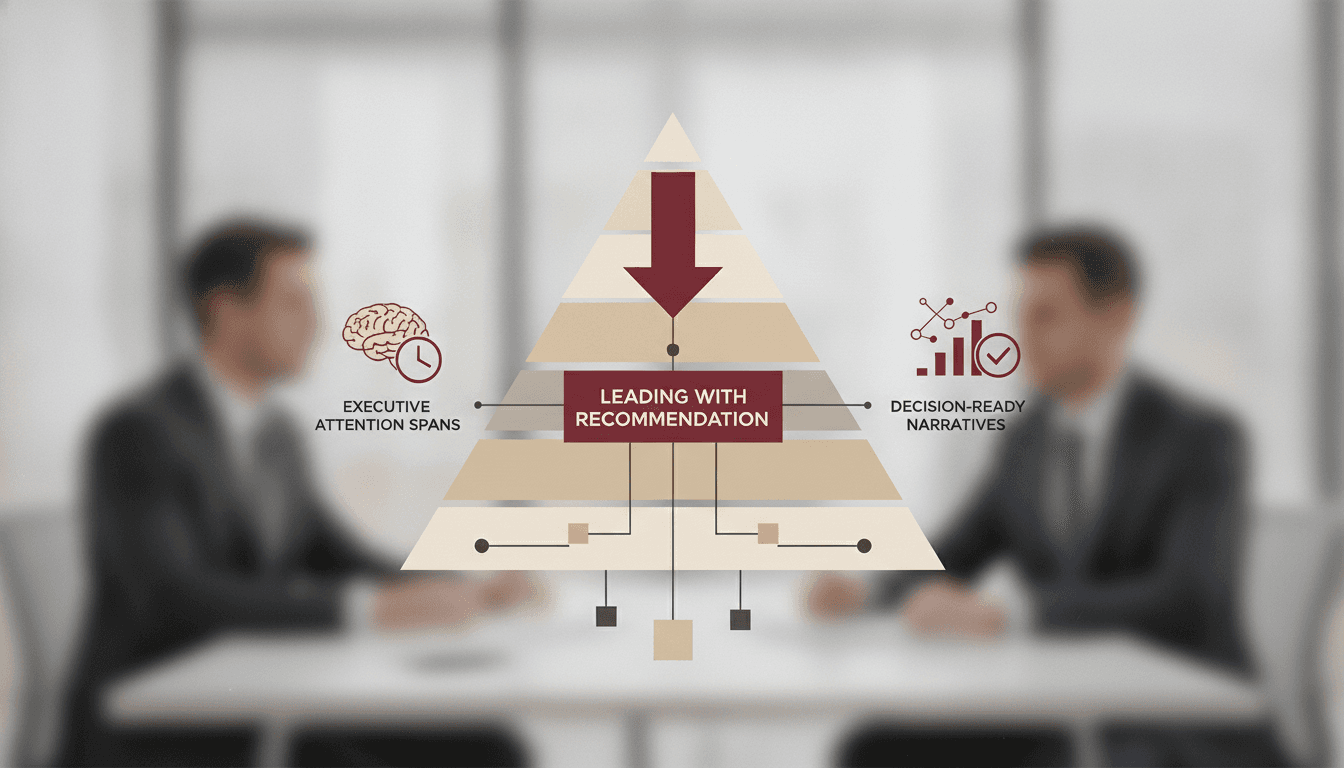
Executives structure presentations differently by leading with the recommendation first, using the pyramid principle to organize supporting evidence, and ruthlessly cutting detail in favor of decision-ready narratives. While mid-level professionals typically build up to a conclusion with data-heavy slides, senior executives flip the structure entirely — stating the answer upfront, then providing only the evidence needed to drive a decision. This approach respects executive attention spans, signa