
How Executives Structure Their Thoughts Before Speaking

Executives structure their thoughts before speaking by leading with the conclusion first, organizing supporting points into two or three clear pillars, and anchoring every statement to a strategic outcome. Most use mental frameworks like the Pyramid Principle or the Bottom-Line-Up-Front (BLUF) method to compress complex ideas into concise, high-impact messages. The difference between sounding like a contributor and sounding like a leader often comes down to those 10 to 30 seconds of mental organization before the first word leaves your mouth.
What Is Structured Thinking in Executive Communication?
Structured thinking in executive communication is the deliberate practice of organizing ideas into a logical, outcome-driven sequence before verbalizing them. Rather than thinking out loud or building toward a point, executives use mental frameworks that place the most important information first, supported by evidence arranged in a clear hierarchy.
This is the skill that separates leaders who command attention from professionals who struggle to land their message. According to a 2023 McKinsey report, executives who communicate with clarity and structure are 1.5 times more likely to be rated as effective leaders by their direct reports. Structured thinking is not about scripting every word — it is about knowing your destination before you start speaking.
If you want to understand the broader patterns behind this skill, explore how executives communicate differently from the rest of the organization.
Why Most Professionals Lose Credibility When They Speak
Before diving into the frameworks, it is worth understanding why structured thinking matters so much. The gap between how most professionals speak and how executives speak is not about vocabulary or charisma. It is about organization.

The "Thinking Out Loud" Trap
Most mid-career professionals process their thoughts while speaking. They start with context, add qualifiers, circle around the point, and finally arrive at their recommendation — if they get there at all. In a meeting with senior leaders, this approach is a credibility killer.
A Harvard Business Review study found that listeners form judgments about a speaker's competence within the first 30 seconds. When you spend those seconds on background or caveats, you have already signaled uncertainty. Executives notice this pattern immediately because it is the opposite of how they operate.
What Executives Actually Listen For
Senior leaders are trained to listen for three things: the point, the evidence, and the ask. When a speaker buries the point under layers of context, executives mentally check out or — worse — interrupt to ask, "What's the bottom line?"
This is not rudeness. It is how leaders process information at scale. They may sit through 10 to 15 meetings a day. They need information delivered in a format they can act on quickly. If you want to communicate with senior executives effectively, you need to match their processing style.
The Confidence-Clarity Connection
Here is what most people miss: structured thinking does not just make you sound clearer. It makes you feel more confident. When you know exactly what you are going to say and in what order, the anxiety that causes rambling, filler words, and hedging language drops significantly.
Research from the University of Wolverhampton's communication studies program found that speakers who used a pre-planned structure reported 40% less speaking anxiety compared to those who spoke spontaneously. Structure is not the enemy of authenticity — it is the foundation of it.
The Pyramid Principle: The Gold Standard Framework
The Pyramid Principle, developed by former McKinsey consultant Barbara Minto, is arguably the most widely used thinking framework in executive communication. It is the backbone of how consultants, investment bankers, and C-suite leaders organize complex ideas.
How the Pyramid Works
The framework follows a simple top-down logic:
- Lead with the answer. State your main conclusion or recommendation first.
- Support with key arguments. Provide two to three supporting reasons, each of which independently strengthens your point.
- Back each argument with evidence. Use data, examples, or logical reasoning under each supporting point.
Think of it as an inverted triangle. The broadest, most important statement sits at the top. Everything below exists only to support it.
Real-World Scenario: The Pyramid in Action
Imagine you are in a quarterly business review and your VP asks, "Should we expand into the Southeast market?"
Without the Pyramid (how most people respond):"Well, we've been looking at some data from Q3, and there are a few markets that show promise. The Southeast has some interesting demographics, though there are concerns about logistics costs. Our competitor launched there last year and they seem to be doing okay, but I'm not sure about their margins..."
With the Pyramid:"Yes, we should enter the Southeast market in Q2. Three reasons. First, customer acquisition costs there are 30% lower than our current markets. Second, our top competitor validated demand by growing 15% year-over-year in the region. Third, our existing distribution partner can cover 80% of the territory with no new infrastructure. I recommend we approve a $200K pilot budget for testing in two metro areas."
The second version takes roughly the same amount of time. But it sounds like it came from someone who has done the thinking, made a decision, and is ready to lead.
For more on delivering this kind of clarity in high-stakes moments, see how to speak with authority in presentations.
When to Use the Pyramid Principle
The Pyramid works best in:
- Executive briefings and status updates
- Written memos and emails to senior leadership
- Presentations where decision-makers need to act quickly
- Any situation where you have more than 60 seconds to make your case
It is less ideal for brainstorming sessions or exploratory conversations where the goal is to think collaboratively rather than deliver a conclusion.
Ready to Communicate Like a Senior Leader? The frameworks in this article are just the beginning. The Credibility Code gives you the complete system for building authority, commanding presence, and structuring your communication like an executive — in every meeting, presentation, and conversation. Discover The Credibility Code
The BLUF Method: Bottom-Line Up Front
If the Pyramid Principle is the gold standard for structured arguments, BLUF is its fast, tactical cousin. Originally developed by the U.S. military for clear communication under pressure, BLUF has become a staple in executive communication across industries.

The BLUF Formula
The formula is deceptively simple:
Bottom Line → Context → Supporting Detail → Next StepYou state the conclusion or request in the first sentence. Then — and only then — you provide the context someone needs to understand or act on it.
How BLUF Sounds in Practice
Scenario: You need to update your director on a project delay. Without BLUF:"So the vendor we've been working with had some supply chain issues, and they let us know last week that the components won't arrive until the 15th. We tried to find an alternative supplier, but the lead times are similar. The team has been adjusting the schedule, and we think we can still hit most of the milestones, but the final delivery will probably slip by about a week."
With BLUF:"The project will deliver one week late — now targeting March 22nd instead of March 15th. The cause is a vendor supply chain delay. We evaluated alternative suppliers but found no faster option. The team has restructured the schedule to protect all milestones except final delivery. I recommend we notify the client today and offer a revised timeline."
Notice how the BLUF version gives the listener the most critical information — the delay and the new date — in the first sentence. Everything that follows supports and contextualizes that headline. This is exactly how executives process information, and it is the format they respect most.
BLUF vs. the Pyramid Principle
Both frameworks share the same core philosophy: lead with the conclusion. The difference is scope and depth.
| Feature | Pyramid Principle | BLUF |
|---|---|---|
| Best for | Complex arguments, presentations | Quick updates, emails, status reports |
| Structure depth | Multi-layered (conclusion → arguments → evidence) | Flat (bottom line → context → next step) |
| Preparation time | 2-5 minutes | 10-30 seconds |
| Ideal length | 2-10 minutes of speaking | 30-90 seconds |
You do not need to choose one over the other. Executives switch between them constantly depending on the situation. The key skill is recognizing which format the moment demands.
To sharpen how you deliver these in written communication, check out how to write like an executive.
The 30-Second Prep Technique: Structuring Thoughts in Real Time
The Pyramid and BLUF work well when you have time to prepare. But what about those moments when you are put on the spot — asked a question in a meeting you didn't expect, pulled into an impromptu hallway conversation with a senior leader, or called on during a town hall?
This is where the 30-Second Prep Technique comes in. It is a rapid mental framework that any professional can use to organize their thoughts before speaking, even under pressure.
The Three-Step Mental Checklist
When you are caught off guard, run through these three questions silently before you open your mouth:
- What is my point? (One sentence. What do I want them to walk away knowing?)
- What are my two supports? (Two reasons, facts, or examples that back up the point.)
- What is the action? (What should happen next, or what am I asking for?)
This takes 10 to 30 seconds. During that time, you can buy yourself space with a natural bridge phrase like "That's a great question — let me give you the key picture" or simply pausing to collect your thoughts.
A study published in the Journal of Applied Psychology found that speakers who paused for even two to three seconds before responding to unexpected questions were perceived as 25% more thoughtful and credible than those who responded immediately. Silence is not weakness. It is the sound of structured thinking in action.
Scenario: Put on the Spot by a CEO
You are in a cross-functional meeting. The CEO turns to you and asks, "What's the biggest risk to this initiative?"
Without the 30-Second Prep:"Um, well, there are a few risks, I think. The timeline is tight, and we're still waiting on some approvals. Also, the budget could be an issue if costs go up. And the team is stretched pretty thin right now..."
With the 30-Second Prep (after a brief pause):"The biggest risk is resource bandwidth. We have three critical workstreams competing for the same senior engineers. If we don't prioritize by end of week, we'll miss the April milestone. I recommend we lock in resource allocation in tomorrow's steering committee."
The first response lists worries. The second response identifies a risk, explains why it matters, and proposes a solution. That is the difference between sounding like a team member and sounding like a leader.
For more frameworks to handle these high-pressure moments, explore how to respond when put on the spot at work.
Building the Habit
The 30-Second Prep is a muscle. It gets faster and more automatic with practice. Here is a simple daily drill:
- Morning exercise (2 minutes): Pick any business topic — a current project, an industry trend, a team challenge. Set a timer for 30 seconds and mentally structure a response using Point → Supports → Action. Then say it out loud.
- Meeting prep (1 minute): Before every meeting, anticipate two questions you might be asked. Run each through the three-step checklist.
- Post-meeting review (1 minute): After a meeting, identify one moment where you spoke without structure. Mentally restructure what you said using the framework.
Within two weeks, most professionals report that the framework begins to feel automatic. Within 30 days, it fundamentally changes how they show up in conversations.
Turn These Frameworks Into a Daily System. The Credibility Code walks you through a complete communication transformation — from structuring your thoughts to projecting authority in every interaction. It is the playbook mid-career professionals use to start communicating like the leaders they want to become. Discover The Credibility Code
Advanced Techniques: How the Best Executives Elevate Their Thinking
The frameworks above will immediately improve how you communicate. But the most effective executives layer additional techniques on top of them to achieve even greater impact.
The "So What?" Filter
Before speaking, top executives run every point through a mental "So what?" filter. For every piece of information, they ask: Why does this matter to the person I'm talking to?
This filter eliminates irrelevant details and forces you to connect your message to what your audience cares about — whether that is revenue, risk, customer impact, or strategic alignment.
Before the filter: "We completed 47 user interviews last quarter." After the filter: "User interviews revealed that 60% of customers want a self-service option — which aligns with our Q3 goal to reduce support costs by 20%."The data is the same. The impact is completely different. This is the shift that separates strategic communication from information dumping.
The Rule of Three
Cognitive science research, including George Miller's foundational work on working memory, consistently shows that people retain information best in groups of three. Executives instinctively use this principle.
Instead of listing five reasons, they choose the three strongest. Instead of presenting seven updates, they group them into three themes. This is not about oversimplifying — it is about respecting the cognitive limits of your audience.
Example: "There are three things driving this recommendation: market timing, competitive positioning, and unit economics."Three pillars. Clean. Memorable. Actionable.
Anchoring to Strategic Context
The most senior executives rarely present an idea in isolation. They anchor it to a broader strategic narrative — the company's goals, the board's priorities, or the market landscape.
This is a subtle but powerful move. It signals that you are not just thinking about your task — you are thinking about the business. According to a 2022 Korn Ferry study, the ability to connect operational details to strategic outcomes is the number one differentiator between managers who get promoted to the executive level and those who plateau.
Example: "This recommendation supports our North Star goal of 30% market share by 2026. Here's how..."For a deeper dive into communicating at this strategic altitude, read how to communicate your strategic value at work.
Frequently Asked Questions
How do executives organize their thoughts so quickly?
Executives organize their thoughts quickly because they have internalized simple frameworks through years of repetition. Most use a variation of leading with the conclusion, supporting it with two or three key points, and ending with a clear action step. This is not natural talent — it is a practiced skill. With consistent use of frameworks like the Pyramid Principle or the 30-Second Prep Technique, most professionals can develop the same speed within 30 days.
What is the difference between the Pyramid Principle and BLUF?
The Pyramid Principle is a multi-layered framework best suited for complex arguments, presentations, and strategic recommendations. It organizes ideas into a conclusion supported by arguments, each backed by evidence. BLUF (Bottom-Line Up Front) is a faster, flatter structure ideal for quick updates, emails, and status reports. Both lead with the conclusion first. The Pyramid goes deeper; BLUF stays concise. Executives use both, choosing based on the situation.
Can introverts learn to structure their thoughts like executives?
Absolutely. Structured thinking actually favors introverts because it rewards preparation and precision over spontaneity and volume. Introverts who use frameworks like the 30-Second Prep Technique often outperform extroverts in meetings because their responses are more focused and less prone to rambling. The key is building the habit through daily practice rather than relying on in-the-moment improvisation.
How do I structure my thoughts when put on the spot?
Use the 30-Second Prep Technique: silently identify your point (one sentence), your two supports (reasons or evidence), and your action step (what should happen next). Buy yourself time with a brief pause or a bridge phrase like "Here's the key takeaway." Research shows that a two-to-three-second pause before responding actually increases your perceived credibility. For more specific scripts, see how to respond when put on the spot at work.
How long does it take to develop structured thinking habits?
Most professionals report noticeable improvement within two weeks of daily practice. The 30-Second Prep Technique becomes semi-automatic within 30 days. Full mastery — where structured thinking feels effortless across presentations, meetings, and impromptu conversations — typically takes 60 to 90 days of consistent use. The key is deliberate daily repetition, not occasional effort.
Does structured thinking make you sound robotic or scripted?
No. Structured thinking provides a skeleton for your message, not a script. It tells you the order in which to present ideas — not the exact words to use. In practice, structured speakers sound more natural because they are not searching for their point mid-sentence. They know where they are going, which frees them to be present, adjust their tone, and engage their audience authentically.
Your Communication Is Your Career Currency. The frameworks in this article can transform how you show up in every meeting, presentation, and conversation. The Credibility Code gives you the full system — structured thinking, executive presence, and the daily habits that build lasting authority. Stop being overlooked. Start being heard. Discover The Credibility Code
Ready to Command Authority in Every Conversation?
Transform your professional communication with proven techniques that build instant credibility. The Credibility Code gives you the frameworks top leaders use to project confidence and authority.
Discover The Credibility CodeRelated Articles
How Executives Structure Presentations Differently
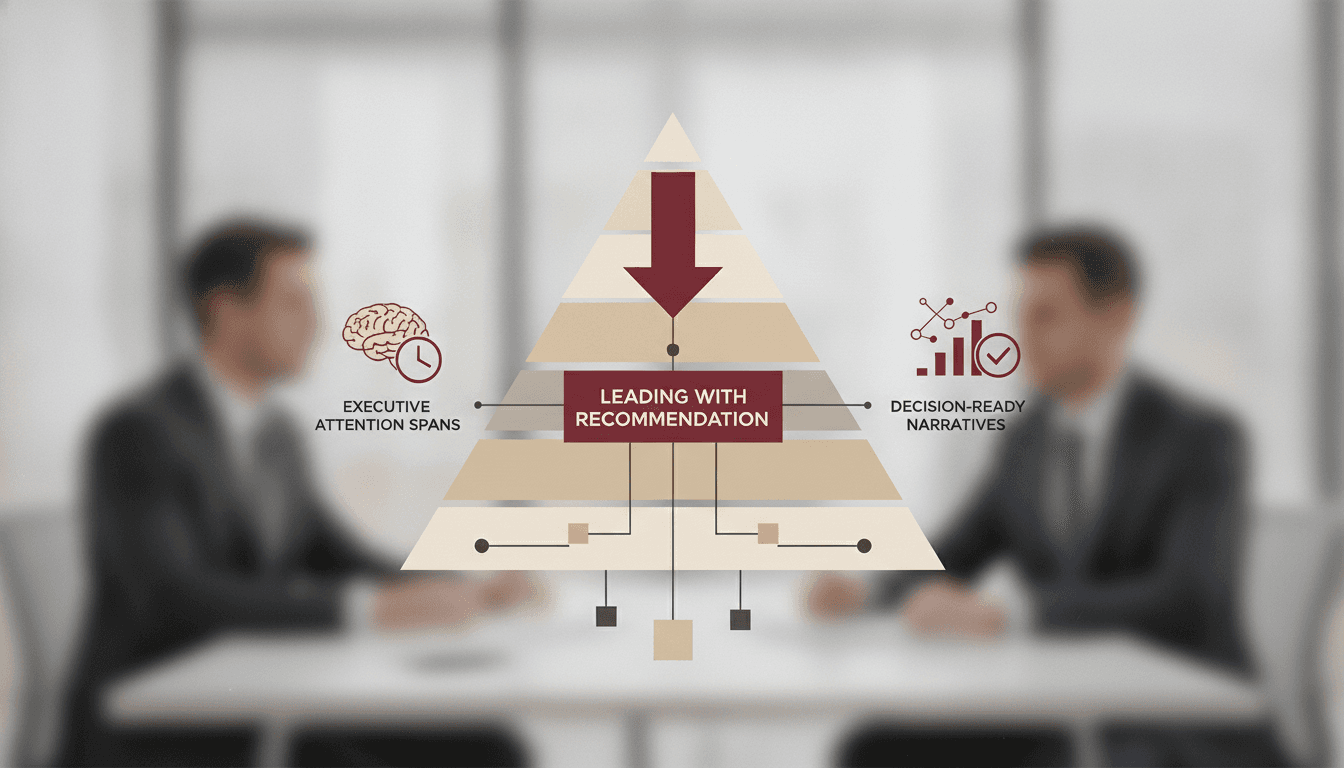
Executives structure presentations differently by leading with the recommendation first, using the pyramid principle to organize supporting evidence, and ruthlessly cutting detail in favor of decision-ready narratives. While mid-level professionals typically build up to a conclusion with data-heavy slides, senior executives flip the structure entirely — stating the answer upfront, then providing only the evidence needed to drive a decision. This approach respects executive attention spans, signa
Executive vs Regular Communication: 10 Key Patterns
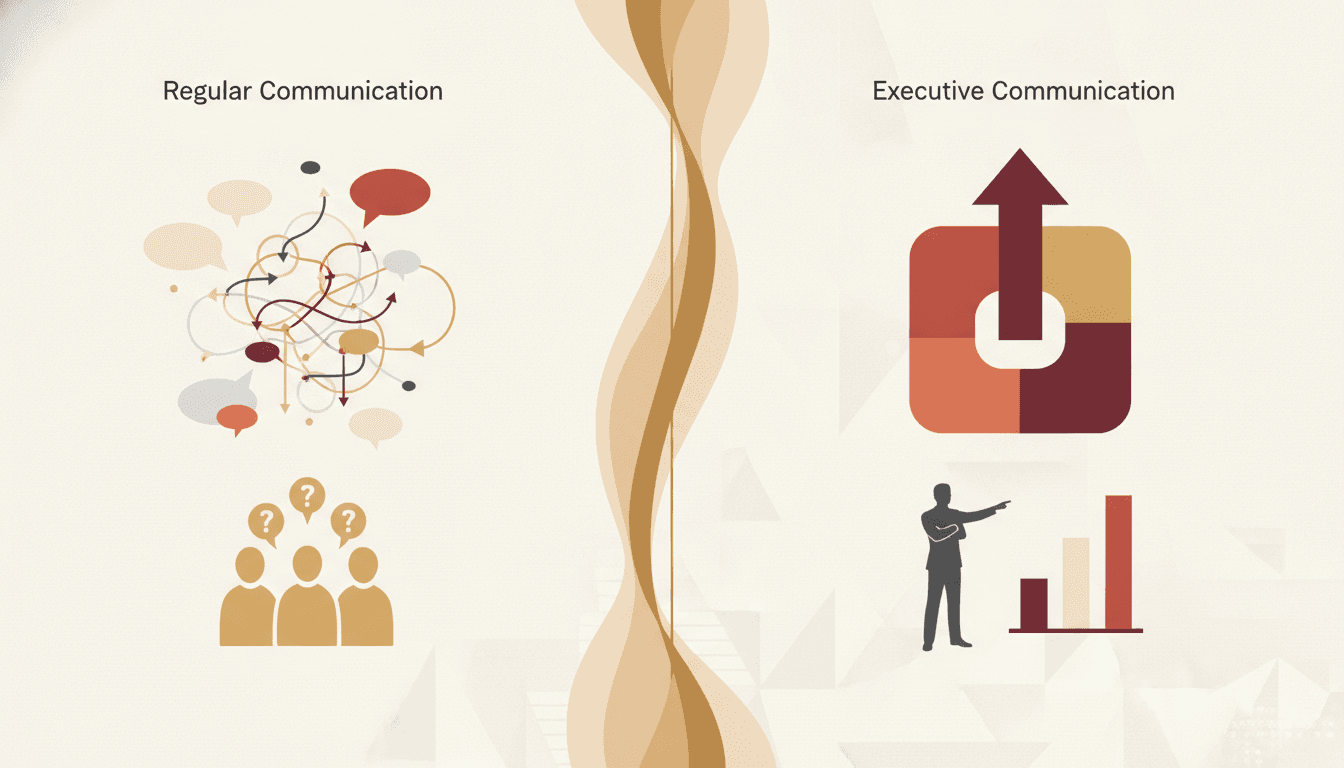
The difference between executive communication and regular communication comes down to ten distinct patterns: executives lead with outcomes instead of details, use decisive language instead of hedging, structure messages top-down instead of chronologically, speak in strategic terms instead of tactical ones, and manage attention rather than just sharing information. They also listen more selectively, frame problems as decisions, use silence deliberately, communicate with consistent brevity, and p

Executive vs Regular Communication: Key Differences
Executive communication differs from regular professional communication in six critical ways: structure, brevity, strategic framing, audience orientation, decision-focus, and authority signaling. While regular communication tends to be detail-heavy, process-oriented, and chronological, executive communication leads with the bottom line, frames everything around business impact, and drives toward decisions. Understanding these differences is the single most important shift mid-career professional