
How to Communicate Bad News to Senior Leadership Well

To communicate bad news to senior leadership effectively, lead with the headline—state the problem clearly in one sentence. Then follow a problem-impact-solution structure: explain what happened, quantify the business impact, and present your recommended path forward with alternatives. Control your delivery by staying calm, owning accountability without over-apologizing, and choosing language that signals competence. The goal is never to soften the truth—it's to deliver it in a way that preserves trust and positions you as someone who can manage the fallout.
What Is Upward Communication of Bad News?
Upward communication of bad news is the process of delivering unfavorable information—missed targets, project failures, budget overruns, client losses, or team issues—to executives and senior leaders in a way that is clear, accountable, and solution-oriented. It is one of the most high-stakes communication skills a professional can develop.
Unlike peer-to-peer conversations, communicating bad news upward requires an understanding of how executives process information, what they need to make decisions, and how your delivery shapes their perception of your competence. Done well, it actually builds credibility. Done poorly, it can damage trust that took years to earn.
Why Most Professionals Get This Wrong
The Instinct to Bury or Buffer

When professionals face the task of delivering bad news, the most common mistake is burying the lead. They open with excessive context, qualifications, or disclaimers—hoping to "ease into" the difficult part. But senior leaders don't want to be eased in. They want clarity.
A 2023 study published in the Journal of Applied Psychology found that leaders rated messengers who delivered bad news directly and with proposed solutions as significantly more trustworthy than those who delayed or softened the message (Bies & Tripp, 2023). The buffer approach backfires because it signals either a lack of confidence or an attempt to manipulate.
Confusing Transparency with Emotional Dumping
Another common error is treating the conversation as a confessional. Professionals unload their stress, frustration, or guilt alongside the facts—turning a business update into an emotional event. Executives don't need to know how you feel about the problem. They need to know what happened, how bad it is, and what you're doing about it.
If you struggle with communicating without being emotional at work, this is a skill worth developing before your next high-stakes conversation.
Waiting Too Long
Timing is everything. According to a 2022 survey by the Project Management Institute, 29% of projects fail due to poor communication, and delayed escalation is one of the leading contributing factors (PMI Pulse of the Profession, 2022). Senior leaders consistently report that late bad news is worse than early bad news—because late news eliminates options.
The rule is simple: if the problem will reach leadership anyway, you want to be the one who brings it there first.
The Problem-Impact-Solution Framework
This is the core structure for delivering bad news upward. It gives executives exactly what they need in the order they need it.
Step 1: State the Problem in One Sentence
Open with a clear, factual headline. No preamble. No softening language.
Weak: "So, I wanted to give you an update on the Henderson account. There have been some challenges, and the team has been working really hard, but we've hit a few bumps..." Strong: "We lost the Henderson account. The client notified us yesterday that they're moving to a competitor."The strong version respects the executive's time, signals your confidence, and establishes that you're someone who can handle difficult truths. This kind of authoritative communication is what separates trusted advisors from nervous reporters.
Step 2: Quantify the Impact
After stating the problem, immediately connect it to business impact. Executives think in terms of revenue, risk, timeline, and strategic position. Translate your bad news into their language.
Example: "This represents $340K in annual recurring revenue. It also affects our Q3 forecast by approximately 4%, and we'll need to reassign two team members currently dedicated to that account."According to research from McKinsey & Company, executives make faster and better decisions when information is presented with quantified impact rather than qualitative descriptions alone (McKinsey, 2021). Numbers ground the conversation and prevent the kind of ambiguity that breeds anxiety.
Step 3: Present Your Recommended Solution (with Alternatives)
This is where most people stop at the problem. Don't. The single most powerful move you can make when delivering bad news is to arrive with a plan.
Example: "I recommend we do three things: First, I'll reach out to Henderson's VP of Operations to understand their specific concerns—there may be a retention opportunity. Second, I've identified two prospects in our pipeline that could offset the revenue gap within 60 days. Third, I'll present a revised Q3 forecast to the finance team by Friday."Notice the structure: specific actions, clear ownership, and a timeline. This is how executives think versus managers—they want to see that you're already operating at a strategic level.
Ready to Communicate Like a Senior Leader? The Credibility Code gives you the exact frameworks, scripts, and mindset shifts that turn difficult conversations into career-defining moments. Discover The Credibility Code
Managing Your Delivery: Voice, Body Language, and Emotional Regulation
Control Your Vocal Tone

Your voice communicates as much as your words. When delivering bad news, the most common vocal mistake is either speaking too fast (signaling anxiety) or adopting an overly apologetic, rising intonation that turns statements into questions.
Aim for a steady pace, a lower pitch than your conversational norm, and deliberate pauses after key statements. Research from the University of California found that speakers who used a measured pace and lower vocal pitch were perceived as 42% more competent during high-stakes communication (Anderson & Klofstad, 2012).
If you tend to rush when nervous, practice the technique of pausing for a full beat after your opening sentence. This gives the executive time to absorb the headline and signals that you're in control. For more on this, explore executive speaking cadence techniques.
Use Grounded Body Language
Sit or stand with a stable posture. Keep your hands visible—on the table or at your sides. Avoid self-soothing gestures like touching your face, crossing your arms, or fidgeting with a pen.
Make steady (not aggressive) eye contact. Lean slightly forward when presenting your solution—this subtly signals engagement and ownership. Your physical presence should communicate: "I have this handled."
For a deeper dive into the physical signals of authority, see our guide on leadership presence body language.
Regulate Your Emotions Before the Conversation
Emotional regulation is not about suppressing feelings—it's about choosing when and how to express them. Before a difficult conversation with senior leadership, use a brief pre-conversation routine:
- Name the emotion you're feeling (anxiety, guilt, fear of judgment)
- Separate the emotion from the facts — the facts are what you'll communicate
- Do 90 seconds of controlled breathing — four counts in, six counts out
- Rehearse your opening sentence out loud at least three times
This preparation prevents the emotional hijack that causes rambling, over-explaining, or defensive behavior. If you want to go deeper on managing nervous energy in high-pressure moments, these nine methods are highly effective.
The Language of Accountability (Without Self-Destruction)
Own It—But Don't Over-Apologize
There's a critical difference between taking accountability and undermining yourself. Senior leaders respect ownership. They lose respect for groveling.
Over-apologizing: "I'm so sorry. This is completely my fault. I should have caught this earlier. I feel terrible about it." Accountable: "This happened on my watch. I take responsibility for the oversight, and here's what I'm doing to correct it."The second version is direct, dignified, and forward-looking. It acknowledges the failure without spiraling into self-flagellation. A 2021 study in Organizational Behavior and Human Decision Processes found that leaders who took responsibility while simultaneously presenting corrective action were rated 31% higher in perceived competence than those who apologized without offering a path forward.
If you've been in the habit of over-apologizing, our guide on how to stop over-apologizing at work offers specific replacement phrases.
Words and Phrases to Use (and Avoid)
Use these:- "Here's what happened."
- "The impact is..."
- "I take responsibility for..."
- "My recommendation is..."
- "Here are the options I see."
- "I'll have an update by [specific date]."
- "I think maybe..." (hedging)
- "It's not that bad..." (minimizing)
- "I just wanted to let you know..." (passive)
- "We might have a small issue..." (euphemistic)
- "I'm not sure, but..." (uncertainty)
These weak phrases are among the words that undermine your credibility at work. Replacing them with direct, decisive language transforms how you're perceived—especially when the news is difficult.
Timing, Channel, and Follow-Up
Choose the Right Moment and Medium
Not all bad news requires a formal meeting. Match the severity to the channel:
| Severity Level | Channel | Timing |
|---|---|---|
| Minor setback | Email with brief update | Within 24 hours |
| Moderate issue | Scheduled 1:1 conversation | Same day or next morning |
| Major crisis | Immediate phone call or in-person | As soon as you have confirmed facts |
Never deliver significant bad news in a group meeting where the executive is hearing it for the first time alongside peers. This puts them in a reactive position and can feel like an ambush. Give them the information privately first, then discuss it in the group if needed.
For more on communicating with senior leadership effectively, these principles apply broadly.
Follow Up in Writing
After the conversation, send a brief follow-up email that documents:
- The problem as discussed
- The agreed-upon action plan
- Your next update date
This does three things: it creates a paper trail, it demonstrates professionalism, and it reinforces that you're managing the situation proactively. Strong written follow-up is a hallmark of executive-level email communication.
The 48-Hour Update Rule
Within 48 hours of delivering bad news, send a progress update—even if there's no major development. A simple message like, "Following up on our conversation Tuesday. I've completed steps one and two of the action plan and will have the revised forecast ready by Thursday as committed," keeps trust intact.
Senior leaders remember who followed through. This is how you turn a bad-news moment into a credibility-building one.
Turn Difficult Moments Into Career-Defining Ones The Credibility Code teaches you the exact communication frameworks that senior leaders use to maintain authority—even when delivering the hardest messages. Discover The Credibility Code
Real-World Scenario: Putting It All Together
Imagine you're a senior product manager. Your team just discovered a critical bug that will delay a product launch by three weeks. Your VP of Product needs to know immediately.
Here's how you'd structure the conversation: Opening (Problem): "Sarah, I need to flag a launch delay. We identified a critical authentication bug yesterday that affects user data integrity. We cannot ship with this issue unresolved." Impact: "This pushes our launch date from March 15 to approximately April 5. The revenue impact is a $180K delay in Q1 bookings, and we'll need to notify three enterprise clients who are expecting the March date." Solution: "Here's my plan: Engineering has already begun the fix—estimated completion is 10 business days. I'll personally call our three enterprise clients today to reset expectations and offer early beta access as a goodwill gesture. I'll also work with marketing to adjust the launch communications timeline. I'll send you a written update by end of day tomorrow." Accountability: "I should have caught this in our last QA cycle. I'm implementing a new pre-launch review checkpoint to prevent this from happening again."This entire delivery takes less than two minutes. It's clear, accountable, solution-oriented, and positions you as someone who can handle tough conversations with poise.
Frequently Asked Questions
How do you deliver bad news to your boss without getting blamed?
Focus on facts, not fault. State what happened clearly, quantify the impact, and immediately present your corrective action plan. Leaders blame people who hide, minimize, or deflect—not people who own problems and bring solutions. Taking proactive accountability actually reduces blame because it signals competence and maturity.
What is the best framework for communicating bad news upward?
The Problem-Impact-Solution (PIS) framework is the most effective structure. State the problem in one sentence, quantify the business impact with specific numbers, then present your recommended solution along with one or two alternatives. This mirrors how executives process information and enables faster decision-making.
Should you deliver bad news in person or via email?
It depends on severity. Minor setbacks can be communicated via email. Moderate issues warrant a private 1:1 conversation—either in person or via video call. Major crises require an immediate phone call or face-to-face meeting. Never deliver significant bad news for the first time in a group setting where the executive hasn't been briefed privately.
Communicating bad news vs. managing up: what's the difference?
Communicating bad news is a specific skill focused on delivering unfavorable information clearly and accountably. Managing up is a broader ongoing practice of aligning your communication style, priorities, and updates with your leader's preferences. Bad news delivery is one critical component of effective managing up, but managing up also includes proactive updates, strategic alignment, and relationship building.
How do you recover credibility after delivering bad news at work?
Follow through on every commitment you made during the conversation. Send a written summary within hours, provide a progress update within 48 hours, and deliver results on or ahead of the timeline you promised. Consistent follow-through after bad news actually builds more credibility than if the problem never occurred. For a deeper guide, see our article on how to recover from losing credibility at work.
What should you never say when delivering bad news to executives?
Avoid minimizing language ("It's not a big deal"), blame-shifting ("The other team dropped the ball"), hedging ("I think maybe we might have an issue"), and excessive apologies without action. These patterns signal insecurity and erode trust. Instead, use direct, factual language paired with clear ownership and a forward-looking plan.
Your Credibility Is Built in the Hardest Moments The professionals who earn lasting trust aren't the ones who never face setbacks—they're the ones who communicate through them with clarity, composure, and conviction. The Credibility Code gives you the complete system for commanding respect in every conversation, especially the difficult ones. Discover The Credibility Code
Ready to Command Authority in Every Conversation?
Transform your professional communication with proven techniques that build instant credibility. The Credibility Code gives you the frameworks top leaders use to project confidence and authority.
Discover The Credibility CodeRelated Articles

How to Communicate With Difficult Executives Effectively
To communicate with difficult executives effectively, first identify the specific behavior pattern—whether they interrupt, dismiss, micromanage, or act unpredictably—then adapt your approach accordingly. Lead with outcomes they care about, keep your message concise and data-driven, and maintain emotional composure regardless of their reaction. The key is not changing who they are, but strategically adjusting how you deliver your message so your credibility stays intact and your ideas get heard.

How to Influence Without Formal Authority at Work
To influence without formal authority at work, focus on five core strategies: build deep credibility through expertise and reliability, map strategic relationships across the organization, communicate with precision and confidence, create coalitions around shared goals, and consistently deliver visible value. Influence without a title isn't about manipulation—it's about earning trust, demonstrating competence, and positioning yourself as someone whose perspective genuinely moves outcomes forward
How to Speak Concisely in Meetings: 6 Clarity Frameworks
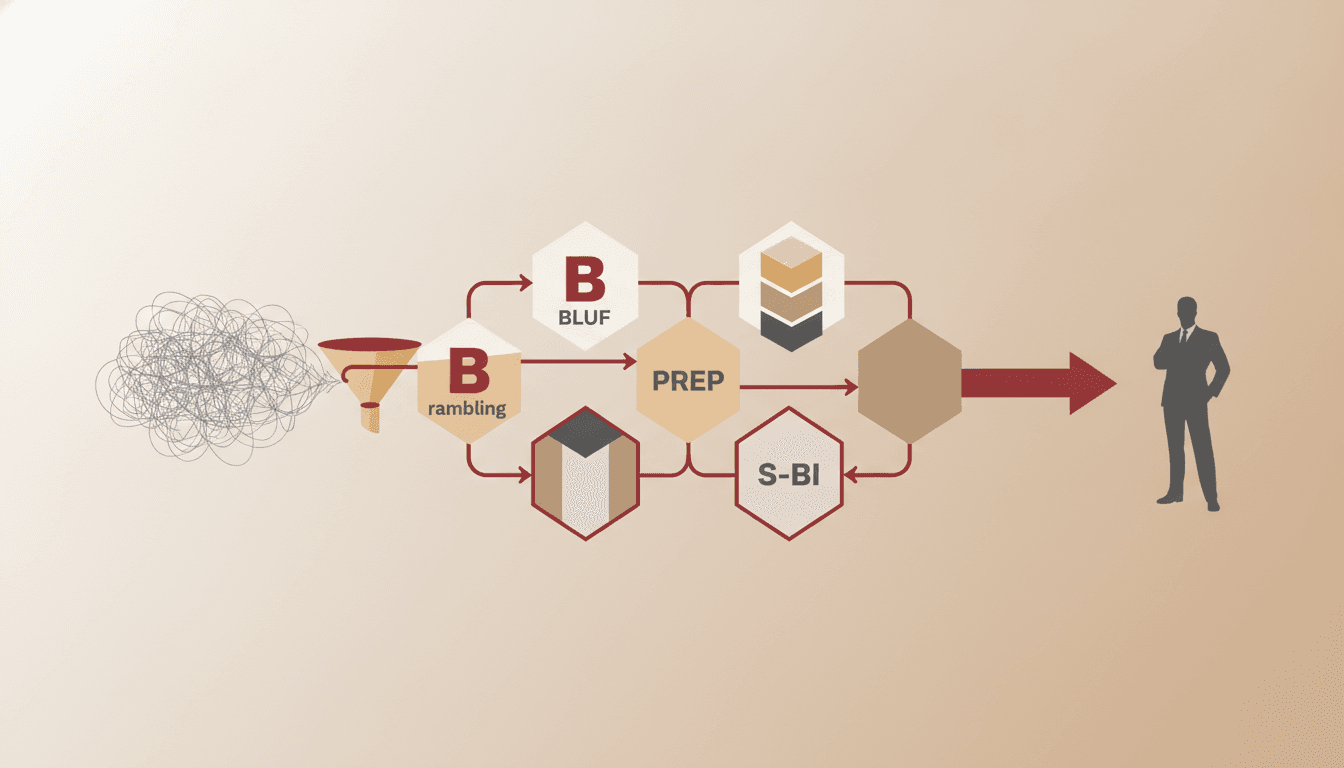
To speak concisely in meetings, use a structured communication framework that forces you to lead with your point and cut filler. The most effective approach is BLUF (Bottom Line Up Front): state your conclusion first, then provide only the supporting evidence your audience needs. Pair this with the PREP, SBI, What-So What-Now What, Rule of Three, and CEO frameworks outlined below to match any meeting scenario—from status updates to executive briefings.