
How Executives Think vs Managers: The Mindset Gap

The core difference between how executives think vs managers comes down to altitude. Managers think in tasks, timelines, and team output. Executives think in systems, trade-offs, and long-term organizational leverage. This isn't about intelligence—it's about mental framing. Managers ask, "How do we execute this well?" Executives ask, "Should we be doing this at all?" Understanding this gap is the single fastest way to change how senior leaders perceive your credibility and readiness for the next level.
What Is the Executive vs Manager Mindset Gap?
The executive vs manager mindset gap is the fundamental difference in how these two levels of leadership process information, make decisions, and communicate priorities. Managers operate within defined boundaries to optimize execution. Executives define the boundaries themselves, constantly recalibrating what matters most based on shifting market conditions, organizational risk, and strategic opportunity.
This gap isn't a flaw in either role—it's a feature of organizational design. But when mid-career professionals don't recognize the gap, they unknowingly communicate in ways that signal "manager" to the people deciding who gets promoted to the executive table.
How Executives Frame Problems Differently Than Managers
Managers Solve Problems. Executives Reframe Them.
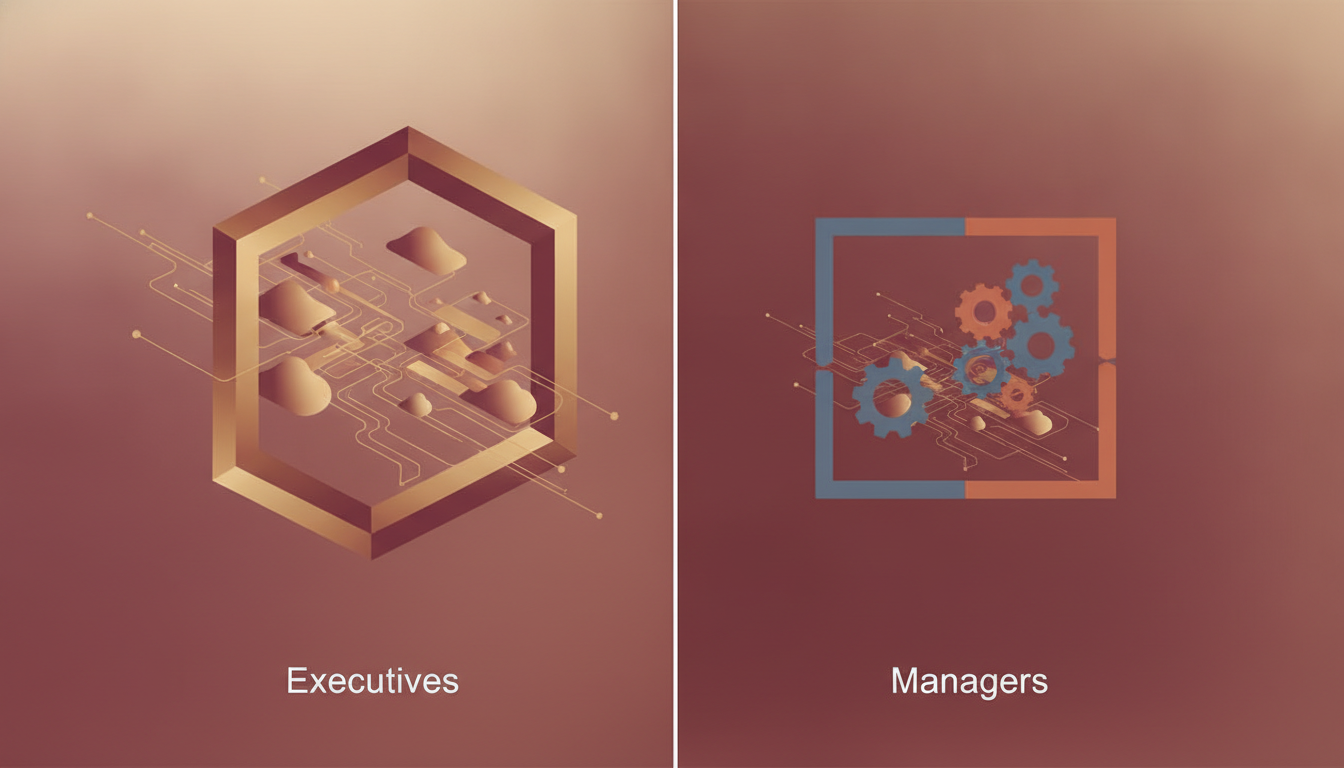
A manager receives a directive—say, "We need to reduce customer churn by 15%"—and immediately begins building a plan. They think about team capacity, tools, timelines, and deliverables. This is valuable work.
An executive hearing the same goal asks a different set of questions first: Why is churn happening? Is churn the real problem, or is it a symptom of a positioning failure? If we reduce churn by 15%, what does that actually do to revenue versus acquiring 15% more customers?
According to a McKinsey study on strategic leadership, executives who consistently reframe problems before solving them are 2.4 times more likely to deliver above-average financial performance for their organizations. The reframing habit is what separates strategic thinkers from operational ones.
The "Zoom Out" Habit
Executives practice what cognitive scientists call "construal level theory"—they default to abstract, high-level thinking before zooming into specifics. Managers default to concrete, ground-level thinking.
Here's what this looks like in practice. Imagine your company is deciding whether to launch a new product feature:
- Manager framing: "Here's the development timeline, resource allocation, and QA plan for shipping this feature by Q3."
- Executive framing: "Before we commit resources, let's ask: does this feature strengthen our competitive moat, or does it just match what competitors already have? What's the opportunity cost of building this versus investing those same resources in retention?"
If you want to be perceived as a strategic thinker, start practicing the zoom-out before you zoom in. This one shift changes how senior leaders evaluate your judgment. For a deeper dive into this skill, see our guide on how to be seen as a strategic thinker at work.
Executives Think in Trade-Offs, Not To-Do Lists
Managers are trained to get everything done. Executives are trained to choose what not to do. This is a fundamentally different cognitive muscle.
A Harvard Business Review analysis found that senior executives spend approximately 40% of their decision-making time evaluating what to deprioritize, compared to just 12% for middle managers. The executive mind is constantly running a trade-off calculus: If we say yes to this, what are we implicitly saying no to?
This is why executives sometimes seem frustratingly non-committal to managers. They're not indecisive—they're weighing second- and third-order consequences that aren't visible from the manager's vantage point.
How Decision-Making Speed Differs at Each Level
Managers Seek Certainty. Executives Act on Sufficiency.
One of the most visible differences between executive and manager thinking is their relationship with incomplete information. Managers tend to gather data until they feel confident. Executives make decisions when they have enough data—typically around 60-70% certainty.
Jeff Bezos famously articulated this as the "70% rule": if you wait for 90% of the information, you're probably too slow. This isn't recklessness. It's a trained instinct for distinguishing between reversible and irreversible decisions.
- Reversible decisions (Type 2): Executives move fast, knowing they can course-correct. Most business decisions fall here.
- Irreversible decisions (Type 1): Executives slow down, seek input, and deliberate carefully. These are rare but high-stakes.
Managers often treat every decision like a Type 1 decision—gathering consensus, running extra analyses, and seeking approval. This signals to executives that you don't yet have the judgment to distinguish what warrants caution from what just needs momentum.
The Speed-to-Conviction Framework
Executives develop what I call "speed to conviction"—the ability to synthesize imperfect information, form a clear point of view, and communicate it with confidence. This doesn't mean they're always right. It means they're always ready to take a position.
Here's a practical framework for building this muscle:
- Gather the available data (set a time limit—15 minutes, one hour, one day depending on stakes)
- Identify the two strongest options (not five, not seven—two)
- Name the risk of each option in one sentence
- State your recommendation and the reasoning behind it
- Specify what would make you change your mind
This is exactly how executives structure their thinking before speaking in high-stakes settings. When you walk into a room and say, "Here's what I recommend and here's why," you sound like someone ready for the next level. When you walk in and say, "I've pulled together some data and I'd love the group's thoughts," you sound like a manager still seeking validation.
For more on structuring your thinking with executive-level clarity, explore how executives structure their thoughts before speaking.
Ready to Close the Mindset Gap? The difference between being seen as a manager and being seen as an executive often comes down to how you communicate your thinking. Discover The Credibility Code to learn the exact frameworks that shift how senior leaders perceive your authority.
How Executives Communicate Risk vs How Managers Report It
Managers Flag Risk. Executives Frame Risk as a Decision Point.
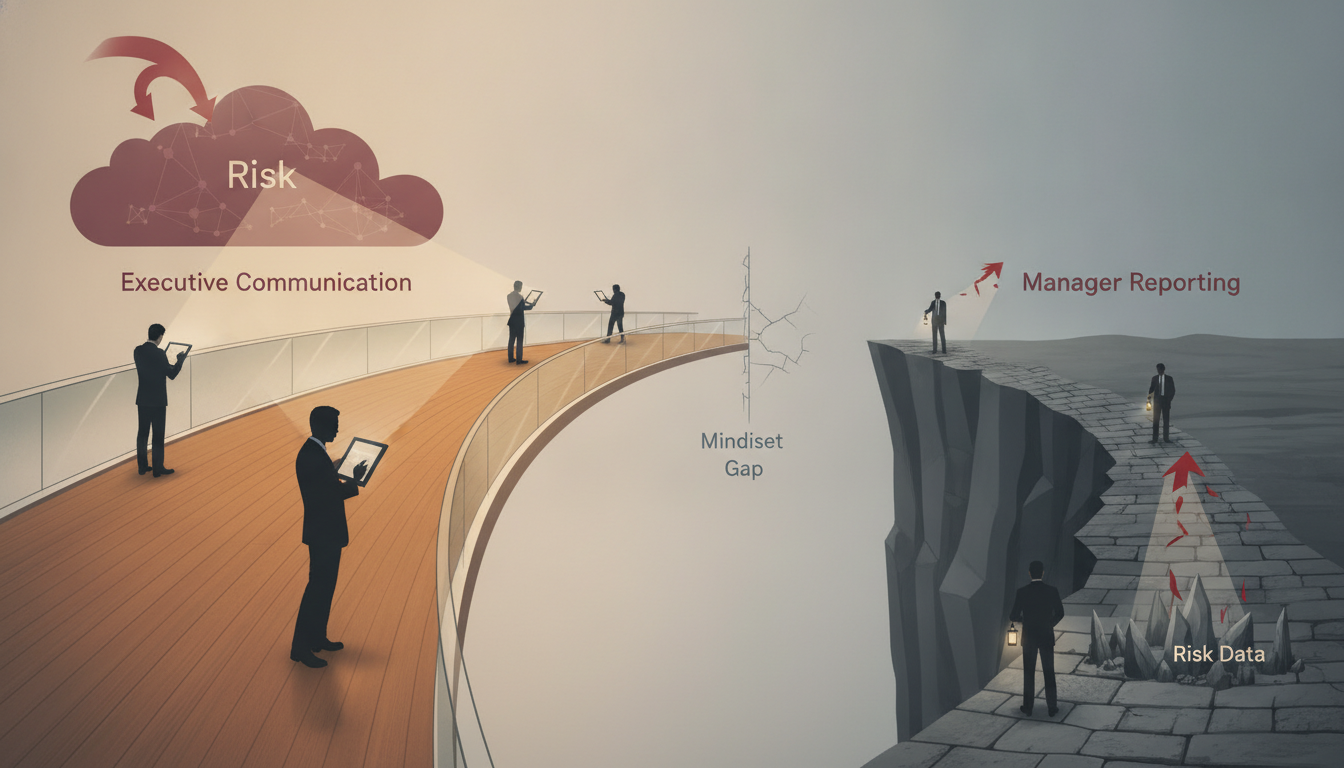
This distinction is critical—and it's where many talented managers accidentally undermine their own credibility.
When a manager encounters a risk, they typically escalate it: "I want to flag that we might miss our Q2 deadline because of vendor delays." This is responsible. But it puts the burden of decision-making on someone else.
When an executive encounters the same risk, they frame it as a decision point with options: "We have a vendor delay that puts Q2 at risk. We have three paths: absorb the delay and push to Q3, bring in a second vendor at higher cost, or descope the deliverable. I recommend option three because it protects our margin while keeping us within two weeks of the original timeline."
A study by the Center for Creative Leadership found that 67% of executives cited "the ability to frame problems as decisions rather than complaints" as a top differentiator when evaluating high-potential leaders.
The Risk Communication Formula
Use this formula to communicate risk like an executive:
Situation → Impact → Options → Recommendation → Trigger for ReassessmentExample: "Our largest client is signaling budget cuts (situation). If they reduce their contract, it impacts 12% of Q4 revenue (impact). We can proactively offer a restructured package, begin pipeline development to replace the revenue, or do both in parallel (options). I recommend the parallel approach (recommendation), and if they confirm renewal by September 15, we can scale back the pipeline effort (trigger)."
This formula works in emails, in meetings, and in executive briefings. It signals that you think in systems, not symptoms. For more on communicating effectively up the chain, read our guide on how to communicate with senior leadership.
The Strategic Narrative Gap: How Executives Tell a Different Story
Managers Report Activity. Executives Narrate Impact.
Listen carefully to how managers and executives describe the same project, and you'll hear a completely different story.
Manager update: "We completed the platform migration on schedule. The team worked weekends to hit the deadline. We're now in the testing phase and expect to go live next month." Executive update: "The platform migration positions us to reduce operational costs by 18% annually and gives us the infrastructure to support the product expansion we're planning for next year. We're on track for a live launch next month."Same project. Entirely different story. The manager describes what happened. The executive describes why it matters.
According to research from Gartner, executives who consistently connect operational updates to strategic outcomes are rated 45% higher in leadership effectiveness by their boards and peers. This isn't spin—it's strategic narrative, and it's one of the most powerful communication differences between executives and managers.
How to Build Your Strategic Narrative Muscle
Every time you prepare an update, presentation, or email to leadership, run it through this filter:
- So what? — Why does this matter to the organization's top three priorities?
- What's next? — What does this enable that wasn't possible before?
- What's the ask? — What decision or support do you need?
Strip out the activity reporting. Senior leaders don't need to know how many hours your team worked. They need to know what changed because of the work and what decisions they need to make next.
If you're preparing to present to senior leaders, our playbook on how to give a presentation to senior leadership that lands breaks down this narrative approach in detail.
The Relationship With Time: Quarterly vs Multi-Year Thinking
Managers Optimize the Quarter. Executives Architect the Year (and Beyond).
One of the most underappreciated mindset differences is the time horizon executives operate in versus managers.
Managers are typically measured on quarterly or monthly results. This creates a natural bias toward short-term optimization: hitting this month's number, shipping this quarter's feature, filling this week's open role.
Executives are measured on annual and multi-year outcomes. Their thinking naturally extends to questions like: Where do we need to be in 18 months? What capabilities do we need to start building now that won't pay off for two years? Which of today's priorities will be irrelevant in six months?
A Deloitte survey of 2,500 global leaders found that executives who demonstrate "future-back thinking"—starting from a desired future state and working backward—are 3.2 times more likely to be identified as high-potential leaders by their organizations.
How to Stretch Your Time Horizon
You don't need an executive title to think on a longer time horizon. Start by asking yourself these questions in your current role:
- What am I doing today that builds a capability we'll need in 12 months?
- Which of my current priorities will matter less in six months, and should I start reallocating energy now?
- If I were my boss's boss, what would I want my function to look like in two years?
When you bring these perspectives into conversations with leadership, you immediately signal executive-level thinking. You're no longer just managing the present—you're shaping the future. This is a cornerstone of building authority in your career.
The Identity Shift: From Doer to Architect
Managers Derive Value From Output. Executives Derive Value From Judgment.
This might be the most psychologically challenging part of the transition. Managers are rewarded for doing—completing tasks, delivering results, solving problems. Over years, their identity becomes fused with their output.
Executives are rewarded for thinking—making the right calls, asking the right questions, allocating resources wisely. Their value isn't in what they produce but in the quality of their judgment.
This shift requires letting go of the dopamine hit that comes from checking things off a list. It means being comfortable in ambiguity, sitting with incomplete information, and trusting that your highest contribution is the decision you make, not the work you do.
Three Signals You're Still Thinking Like a Manager
- You lead with effort, not impact. If your updates focus on how hard the work was rather than what it achieved, you're signaling manager-level thinking.
- You feel uncomfortable delegating high-visibility work. Executives understand that their job is to multiply the output of others, not to be the star performer.
- You wait to be asked for your opinion. Executives offer their perspective proactively. If you're waiting for permission to share your strategic point of view, you're operating in a manager frame.
Shifting this identity is deeply connected to building executive presence as a new manager and learning to communicate your strategic value at work clearly.
Bridge the Gap Between Manager and Executive Thinking Your mindset shapes how people perceive your leadership potential. Discover The Credibility Code — a complete system for communicating with the authority and strategic clarity that gets you noticed by senior leaders.
Frequently Asked Questions
What is the main difference between executive thinking and manager thinking?
The main difference is cognitive altitude. Managers think in tasks, timelines, and team execution—optimizing within defined boundaries. Executives think in systems, trade-offs, and strategic outcomes—defining and redefining the boundaries themselves. This shows up in how each level frames problems, communicates risk, and makes decisions under uncertainty. The shift from manager to executive thinking is less about intelligence and more about learning to operate at a higher level of abstraction.
Can you develop executive-level thinking without being an executive?
Absolutely. Executive thinking is a skill set, not a title. You can start practicing it immediately by reframing problems before solving them, connecting your work to strategic outcomes, communicating risk as decision points rather than complaints, and extending your thinking beyond the current quarter. Leaders who demonstrate these patterns consistently are the ones who get tapped for executive roles.
How do executives make decisions faster than managers?
Executives distinguish between reversible and irreversible decisions. For reversible decisions—which represent the majority—they act on roughly 60-70% of available information rather than waiting for certainty. They develop "speed to conviction" by forming a clear recommendation, naming the risk, and specifying what would change their mind. Managers often over-analyze because they treat every decision as high-stakes.
Executive mindset vs manager mindset: which is better?
Neither is inherently better—they serve different organizational functions. Organizations need strong managers who execute with precision and strong executives who set direction. The problem arises when professionals ready for executive roles continue communicating and thinking like managers, which limits their career trajectory. The key is matching your mindset to your ambition and the level of impact you want to create.
How do I start communicating more like an executive at work?
Start with three shifts: (1) Lead with impact and strategic relevance, not activity reports. (2) Present risks as decision points with options and a recommendation, not as problems to escalate. (3) Connect every update to the organization's top priorities. These communication patterns signal executive-level thinking to the people who decide promotions. For a detailed system, see our guide on how to sound more strategic at work.
What skills do executives have that managers don't?
Executives typically excel at strategic framing, ambiguity tolerance, trade-off analysis, stakeholder influence across functions, and long-range thinking. They're also skilled at communicating concisely to boards and senior peers. Managers typically excel at project execution, team development, process optimization, and operational problem-solving. The transition requires developing the executive skill set while maintaining managerial competence.
Your Thinking Shapes Your Trajectory The gap between executive and manager thinking isn't mysterious—it's a learnable set of mental models and communication patterns. Discover The Credibility Code and start building the strategic mindset and commanding presence that accelerates your career to the next level.
Ready to Command Authority in Every Conversation?
Transform your professional communication with proven techniques that build instant credibility. The Credibility Code gives you the frameworks top leaders use to project confidence and authority.
Discover The Credibility CodeRelated Articles

How Executives Build Credibility Quickly: 7 Patterns
Executives build credibility quickly by deploying seven specific communication patterns: leading with decisive point-of-view statements, demonstrating strategic context before sharing details, using calibrated vulnerability, borrowing credibility through association, controlling conversational pacing, asking high-signal questions, and delivering consistent micro-commitments. These patterns work because they signal competence, confidence, and trustworthiness simultaneously—often within the first

How Executives Build Instant Credibility: 9 Patterns
Executives build instant credibility by combining language precision, strategic brevity, confident body language, and vocal authority within the first 60–90 seconds of any interaction. The nine patterns include leading with outcomes instead of context, using declarative sentence structures, controlling vocal pace and tone, demonstrating strategic listening, signaling status through calm composure, structuring ideas in frameworks, eliminating hedging language, leveraging silence deliberately, and

How to Communicate With Executive Presence: A Guide
Communicating with executive presence means delivering your message with clarity, composure, and conviction so that people trust your judgment and follow your lead. It requires structuring your thoughts before speaking, managing your emotional tone under pressure, eliminating filler and hedging language, and adapting your style to senior audiences. Executive presence isn't about being the loudest voice — it's about being the most intentional one. This guide breaks down the specific communication