
Executive Presence Training: 12 Exercises You Can Do Daily

Executive presence training exercises are structured daily practices that build your vocal authority, body language, strategic thinking, and composure under pressure — without needing a coach. The 12 exercises below range from 2-minute vocal warm-ups to 15-minute scenario rehearsals, each designed for mid-career professionals who want to command more credibility in every interaction. Practice even three of these daily, and you'll notice a measurable shift in how people respond to you within weeks.
What Are Executive Presence Training Exercises?
Executive presence training exercises are deliberate, repeatable drills that develop the specific skills behind commanding professional presence — vocal tone, physical composure, structured thinking, and emotional regulation. Unlike general confidence tips, these exercises target observable behaviors that signal authority and credibility to colleagues, executives, and stakeholders.
Think of them as the professional equivalent of an athlete's practice routine. You don't develop a powerful leadership presence by reading about it. You develop it by rehearsing specific micro-skills until they become automatic. According to a 2023 study by the Center for Talent Innovation (now Coqual), executive presence accounts for 26% of what it takes to get promoted to senior leadership — making it one of the most trainable career accelerators available.
For a deeper breakdown of what executive presence actually involves, see our guide on how to build executive presence using a 5-pillar framework.
Vocal Authority Exercises (Exercises 1–3)
Your voice is the first thing people evaluate — often before they process your words. Research from Quantified Communications found that vocal quality accounts for 23% of listeners' evaluations of a speaker's effectiveness. These three exercises train the mechanics of a voice that commands attention.

Exercise 1: The Resonance Drop
Time required: 3 minutes | Difficulty: Beginner | Best before: Meetings, calls, presentationsMost professionals speak from their throat when nervous, producing a thin, strained sound. This exercise trains you to speak from your chest, where resonance lives.
How to do it:- Stand with your feet shoulder-width apart. Place one hand on your chest.
- Hum at your natural pitch for 10 seconds. Feel the vibration under your hand.
- Gradually lower the hum by two to three notes. You should feel the vibration increase.
- Now say a sentence you'll use in your next meeting — "Here's what I recommend" — at that lower resonance point.
- Repeat five times, each time focusing on keeping the vibration in your chest, not your throat.
Exercise 2: The Pace Reset
Time required: 5 minutes | Difficulty: Intermediate | Best before: Presentations, high-stakes callsRushing signals anxiety. A 2019 study published in the Journal of Nonverbal Behavior found that speakers who used deliberate pauses were rated 32% more competent than fast speakers delivering identical content.
How to do it:- Record yourself reading a one-paragraph summary of your current project (use your phone).
- Play it back. Count how many words you spoke per minute. Most nervous speakers hit 170–190 wpm.
- Re-read the same paragraph, aiming for 130–140 wpm. Insert a full two-second pause after every sentence.
- Play back the slower version. Notice how much more authoritative it sounds.
- Repeat daily for one week with different content.
For more vocal techniques, explore our guide on how to speak with authority at work through 8 daily practices.
Exercise 3: The Downward Inflection Drill
Time required: 2 minutes | Difficulty: Beginner | Best before: Any spoken interactionUpward inflection — ending statements as if they're questions — is one of the most common credibility killers in professional settings. This drill retrains your default pattern.
How to do it:- Write down three statements you frequently make at work: "I think we should move forward with option A." "The data supports this approach." "I'll own that deliverable."
- Say each one aloud, deliberately dropping your pitch on the final two words.
- Exaggerate the drop at first — it should feel almost theatrical.
- Record yourself and listen. What feels exaggerated to you will sound confident to others.
- Practice until the downward inflection feels natural.
Body Language and Physical Presence Exercises (Exercises 4–6)
Your body communicates before you open your mouth. A landmark study by Nalini Ambady at Harvard found that observers formed accurate impressions of a person's competence within just two seconds of watching them — based entirely on nonverbal cues. These exercises train the physical signals that project authority.
Exercise 4: The Stillness Scan
Time required: 3 minutes | Difficulty: Beginner | Best daily: Morning, before your first interactionFidgeting, swaying, and self-touching behaviors (touching your face, adjusting your hair, clicking a pen) broadcast nervousness. Stillness signals control.
How to do it:- Stand in front of a mirror or set up your laptop camera to record.
- Deliver a 60-second summary of something you're working on — as if briefing a senior leader.
- Watch the recording with the sound off. Circle every unnecessary movement: hand-to-face touches, weight shifts, lip biting, pen clicking.
- Deliver the same summary again, this time consciously eliminating one category of movement.
- Repeat until you can deliver 60 seconds with zero unnecessary movements.
Exercise 5: The Power Posture Reset
Time required: 2 minutes | Difficulty: Beginner | Best before: Walking into any roomThis isn't about the debated "power posing" research. It's about correcting the postural collapse that happens when you're stressed — rounded shoulders, forward head, crossed arms.
How to do it:- Stand against a wall with your heels, glutes, shoulder blades, and the back of your head touching the wall.
- Hold for 30 seconds. This is your neutral authority posture.
- Step away from the wall and maintain that alignment for another 30 seconds.
- Walk around the room for 60 seconds, keeping that posture.
- Sit down in a chair and find the seated equivalent: feet flat, spine tall, shoulders back and down, chin level.
For a comprehensive look at authority-signaling body language, read our guide on body language that conveys authority through 12 proven signals.
Exercise 6: The Eye Contact Triangle
Time required: 5 minutes | Difficulty: Intermediate | Best during: Conversations and meetingsSustained eye contact signals confidence. Darting eyes signal uncertainty. But staring feels aggressive. The triangle technique solves this.
How to do it:- Practice with a partner or during a low-stakes video call.
- Imagine a triangle between the other person's two eyes and their mouth.
- Shift your gaze slowly between these three points every 3–5 seconds.
- When making a key point, hold eye contact at the bridge of their nose (it reads as direct eye contact from the other person's perspective).
- Practice maintaining this pattern for a full 2-minute conversation.
Ready to Build a Complete Presence System? These exercises are powerful on their own — but they work best as part of a structured credibility-building framework. Discover The Credibility Code for the full system that ties vocal authority, body language, and strategic communication into one daily practice.
Strategic Thinking Articulation Exercises (Exercises 7–9)
Executive presence isn't just how you look and sound — it's how you think out loud. According to a 2022 survey by Gartner, 69% of HR leaders identified "strategic thinking" as the most critical leadership competency gap in their organizations. These exercises train you to articulate complex ideas with the clarity and structure that senior leaders expect.

Exercise 7: The Bottom-Line-First Rewrite
Time required: 5 minutes | Difficulty: Beginner | Best daily: Before sending any important email or messageMost professionals bury their conclusion under context and backstory. Executives lead with the answer.
How to do it:- Take the last important email or Slack message you wrote.
- Find your actual recommendation or conclusion. It's usually in the last paragraph.
- Rewrite the message with that conclusion as your first sentence.
- Follow it with your two strongest supporting points.
- Cut everything else. If context is needed, add it at the bottom under "Background."
- Before: "I've been looking into the vendor options and there are several factors to consider including pricing, integration timelines, and support quality. After reviewing all three options, I think we should go with Vendor B."
- After: "I recommend Vendor B. They offer the strongest integration timeline (6 weeks vs. 12) and their support SLA exceeds our requirements. Pricing details and full comparison are below."
Exercise 8: The "So What?" Stress Test
Time required: 5 minutes | Difficulty: Intermediate | Best daily: Before any presentation or status updateThis exercise forces you to connect every piece of information to business impact — the hallmark of executive-level communication.
How to do it:- Write down three key points you plan to share in your next meeting or update.
- After each point, ask yourself: "So what? Why does this matter to the business?"
- If you can't answer in one sentence, the point isn't ready for an executive audience.
- Rewrite each point as a "fact + impact" statement.
- Before: "We completed 87% of our sprint tickets this quarter."
- After "So what?" test: "We completed 87% of sprint tickets, which puts us two weeks ahead of the product launch timeline."
Exercise 9: The Three-Point Framework Drill
Time required: 10 minutes | Difficulty: Intermediate | Best daily: During commute or morning routineSenior leaders rarely ramble. They organize their thinking into clear, structured points. This exercise trains that muscle.
How to do it:- Pick a random business topic (a current project, an industry trend, a team challenge).
- Set a timer for 60 seconds.
- Articulate your perspective using exactly three points: "There are three things to consider here. First... Second... Third..."
- Each point should be one to two sentences maximum.
- End with a clear recommendation or conclusion.
Composure-Under-Pressure Exercises (Exercises 10–12)
The truest test of executive presence is what happens when things go sideways. These exercises train your nervous system and your communication patterns for high-pressure moments.
Exercise 10: The Tactical Pause
Time required: 3 minutes to practice, then ongoing | Difficulty: Intermediate | Best during: Any moment you feel reactiveWhen challenged, criticized, or put on the spot, most professionals rush to respond — and that rush produces weak, defensive answers. The tactical pause interrupts that pattern.
How to do it:- Practice with a partner. Have them ask you challenging questions: "Why is this project behind schedule?" "What makes you qualified to lead this?"
- After each question, do three things before responding: take one breath, nod slightly (acknowledging the question), and say nothing for a full two seconds.
- Then respond with a structured answer.
- Repeat until the pause feels natural rather than awkward.
- Start using it in real meetings — begin with low-stakes questions and progress to harder ones.
Exercise 11: The Reframe Rehearsal
Time required: 10 minutes | Difficulty: Advanced | Best daily: Evening reviewThis exercise prepares you for the moments that derail most professionals: unexpected criticism, hostile questions, and public challenges.
How to do it:- Think of a challenging moment from your workday — a tough question, pushback on your idea, or a disagreement.
- Write down what you actually said (or wanted to say).
- Now rewrite your response using one of these reframe patterns:
- The Bridge: "That's an important consideration. And here's how it connects to what I'm recommending..."
- The Acknowledge-and-Redirect: "I hear that concern. Let me address it directly — the data shows..."
- The Elevated Reframe: "If we zoom out, the real question is... And here's my perspective on that."
- Say each reframed response aloud three times.
- Repeat with a different scenario tomorrow.
For more scripts for high-pressure moments, explore our guide on how to respond when put on the spot at work.
Turn These Exercises Into a Complete System Practicing individual exercises builds skill. Combining them into a daily system builds transformation. Discover The Credibility Code — the complete framework for building unshakable professional credibility, one daily practice at a time.
Exercise 12: The Pressure Simulation
Time required: 15 minutes | Difficulty: Advanced | Best weekly: Dedicate one session per weekThis is the most advanced exercise — a full simulation of a high-pressure professional scenario. It combines vocal authority, body language, strategic thinking, and composure into one integrated practice.
How to do it:- Choose a scenario: presenting to the C-suite, defending a budget, leading a difficult team conversation, or negotiating a promotion.
- Set the scene. Stand up (or sit as you would in the real meeting). Set up your laptop camera to record.
- Have a colleague, friend, or even an AI assistant play the role of the challenging stakeholder. Give them permission to interrupt, push back, and ask hard questions.
- Run the scenario for 10 minutes without stopping.
- Review the recording. Score yourself on four dimensions: vocal authority (1–5), physical composure (1–5), structured thinking (1–5), and emotional regulation (1–5).
- Identify your weakest dimension and focus on the corresponding exercises from this list during the following week.
For a deeper dive into composure under pressure, see our guide on leadership presence in difficult conversations.
How to Build a Daily Executive Presence Training Routine
Knowing 12 exercises is useful. Practicing them consistently is transformative. Here's how to build a sustainable routine.
The 15-Minute Daily Stack
You don't need to do all 12 exercises every day. Pick three — one from each category — and rotate weekly.
Sample Monday routine (15 minutes total):- Resonance Drop (3 min) — vocal authority
- Stillness Scan (3 min) — body language
- Bottom-Line-First Rewrite (5 min) — strategic thinking
- Tactical Pause practice during one meeting (ongoing)
- Pace Reset (5 min) — vocal authority
- Eye Contact Triangle during a call (ongoing) — body language
- "So What?" Stress Test before a presentation (5 min) — strategic thinking
Tracking Your Progress
Create a simple tracking sheet with the four dimensions: vocal authority, physical composure, strategic articulation, and composure under pressure. Rate yourself 1–5 each Friday. After four weeks, you'll see which areas have improved and which need more focused practice.
A study by Dr. Gail Matthews at Dominican University found that people who wrote down their goals and tracked weekly progress were 42% more likely to achieve them than those who didn't. Apply that same principle here.
For a complete 30-day roadmap, check out our executive presence self-improvement plan.
Frequently Asked Questions
How long does it take to develop executive presence?
Most professionals notice measurable changes within 2–4 weeks of daily practice. Vocal authority shifts happen fastest (often within days), while composure under pressure takes longer because it requires repeated real-world exposure. Consistent daily practice of 10–15 minutes produces more durable results than occasional intensive sessions. The exercises in this guide are designed for cumulative improvement — each week builds on the last.
Can you develop executive presence without a coach?
Yes. While coaching accelerates development through personalized feedback, the core skills of executive presence — vocal control, body language, structured thinking, and emotional regulation — are all trainable through self-directed practice. Recording yourself and reviewing the footage provides much of the feedback a coach would offer. The key is consistent, deliberate practice with honest self-assessment.
Executive presence vs. confidence: what's the difference?
Confidence is an internal feeling — believing in your own abilities. Executive presence is the external projection of authority, composure, and credibility that others can observe. You can feel confident without projecting presence, and you can project presence even when you don't feel fully confident. Executive presence is a set of learnable behaviors, while confidence is a psychological state. For a full breakdown, read our guide on executive presence vs. confidence.
What are the most important components of executive presence?
Research consistently identifies three core components: gravitas (how you think and act under pressure), communication (how you speak and listen), and appearance (how you carry yourself physically). Of these, gravitas carries the most weight — Coqual's research found that 67% of executives ranked it as the most important element. The exercises in this guide address all three components, with particular emphasis on gravitas through the composure-under-pressure drills.
Can introverts develop strong executive presence?
Absolutely. Executive presence is not about being the loudest person in the room. Many of the most powerful presence signals — stillness, deliberate pausing, structured thinking, and composed body language — actually favor introverts. The exercises in this guide work particularly well for introverts because they emphasize quality of communication over quantity. For more on this, see our guide on how to build presence as a quiet leader.
Which executive presence exercise should I start with first?
Start with the Resonance Drop (Exercise 1) and the Stillness Scan (Exercise 4). These two exercises address the most immediately visible aspects of presence — how you sound and how you carry yourself — and they require only 3 minutes each. Once those feel natural, add the Bottom-Line-First Rewrite (Exercise 7) to sharpen how you structure your thinking. This three-exercise foundation covers vocal, physical, and cognitive presence.
Your Next Step: Build Credibility That Lasts You now have 12 proven exercises to develop executive presence on your own. But exercises are just one piece of the puzzle. To build lasting professional credibility — the kind that earns promotions, commands respect, and opens doors — you need a complete system. Discover The Credibility Code and start building the authority you've been working toward.
Ready to Command Authority in Every Conversation?
Transform your professional communication with proven techniques that build instant credibility. The Credibility Code gives you the frameworks top leaders use to project confidence and authority.
Discover The Credibility CodeRelated Articles

Leadership Presence vs Executive Presence: Key Differences
Leadership presence and executive presence are related but distinct professional competencies. Leadership presence is the ability to inspire, influence, and connect with others at any level—regardless of title. Executive presence is a more specific set of signals—gravitas, communication polish, and appearance—that convey readiness for senior-level roles. Understanding the difference matters because developing the wrong one first can stall your career. This article breaks down both, compares them

Leadership Presence: What It Is and How to Build It
Leadership presence is the ability to project confidence, competence, and composure in a way that inspires trust and commands attention — even before you speak. It combines gravitas, communication skills, professional appearance, and emotional composure into a unified impression that signals authority. Unlike charisma, leadership presence is a learnable set of behaviors, not an innate personality trait. This article defines each component and gives you a practical framework to develop your own.
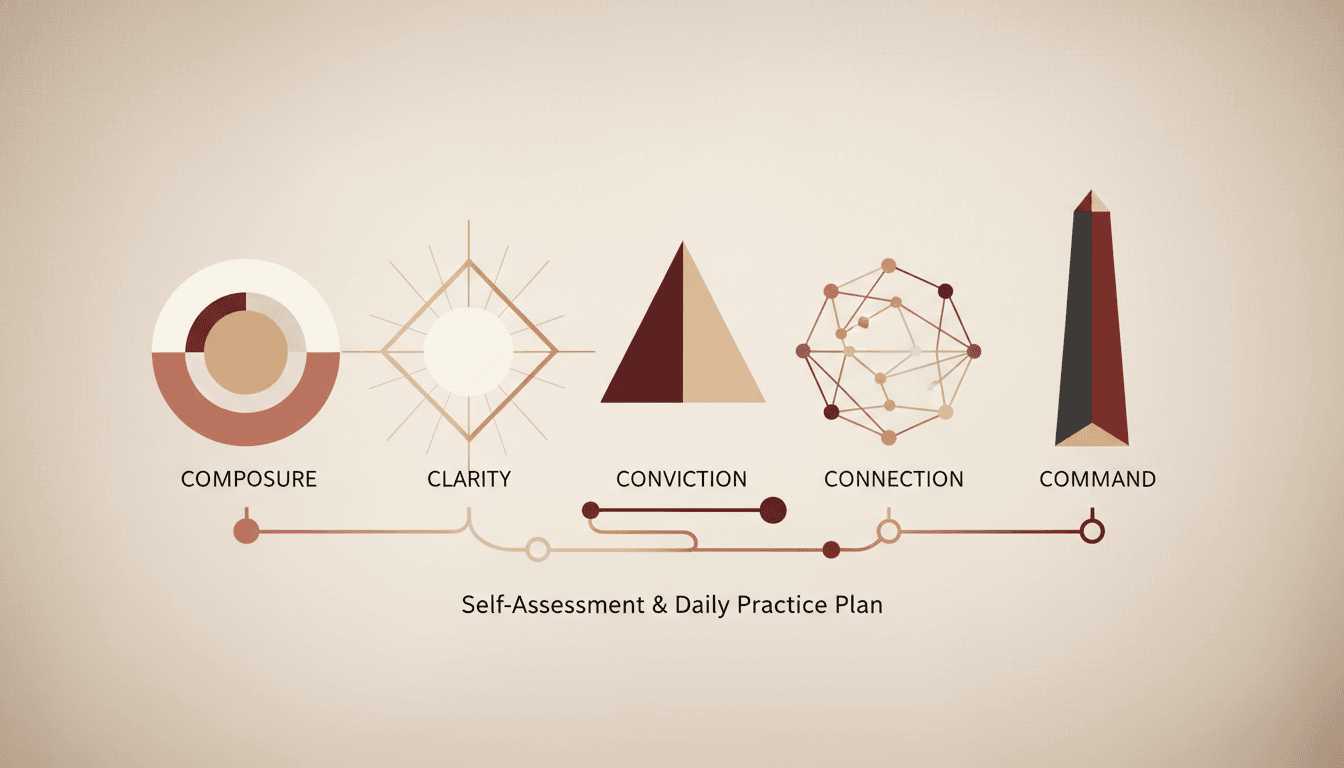
How to Develop Leadership Presence: A 5-Step Framework
To develop leadership presence, build five core dimensions: composure (staying calm under pressure), clarity (communicating with precision), conviction (speaking with certainty), connection (building trust through empathy), and command (directing attention and action). Leadership presence isn't an inborn trait—it's a set of learnable skills. By assessing yourself across these five dimensions and practicing targeted daily habits, you can transform how others perceive your authority, credibility,