
How to Sound Confident in a Presentation: 9 Vocal Secrets
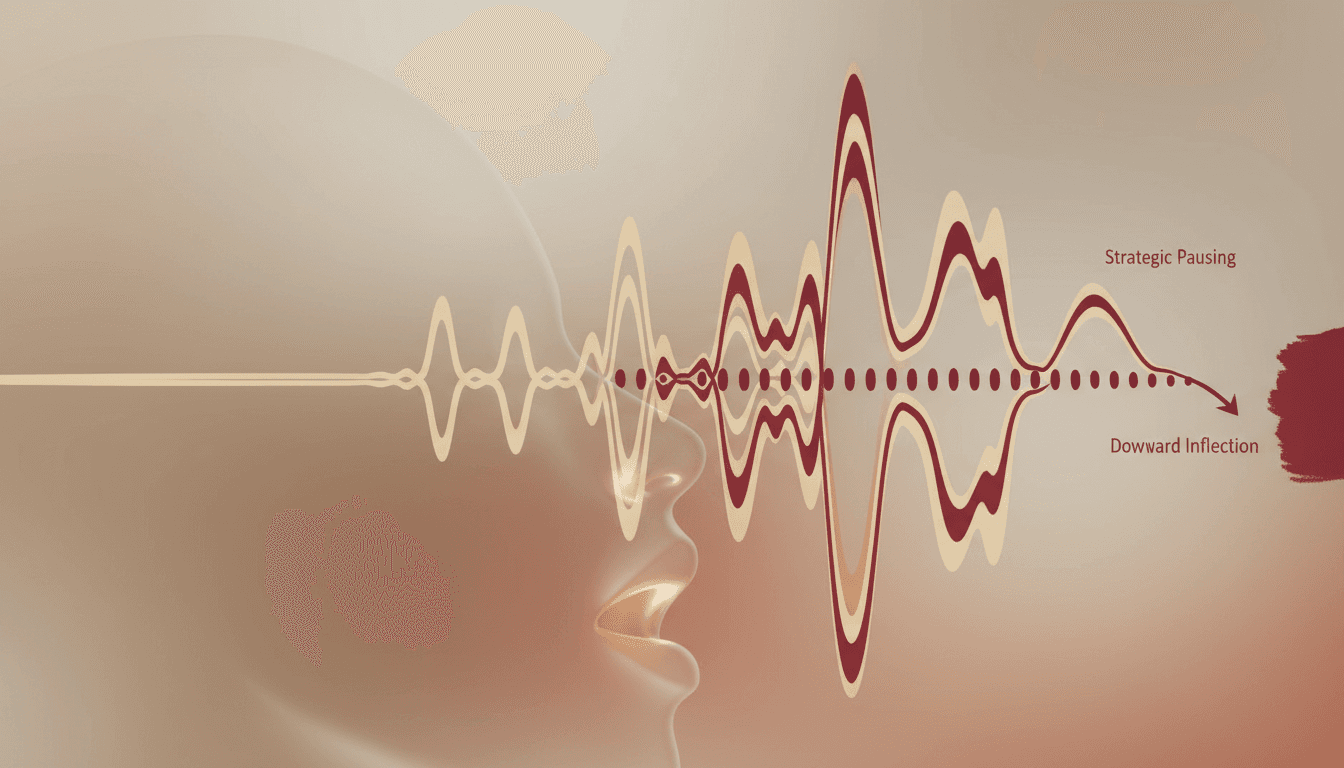
To sound confident in a presentation, focus on nine vocal techniques: use downward inflection at the end of statements, slow your pace by 10–15%, insert strategic 2–3 second pauses, speak from your diaphragm for resonance, eliminate filler words, vary your pitch deliberately, project your voice to the back of the room, lower your vocal register slightly, and land your final words with conviction. These shifts change how audiences perceive your authority—often within the first 30 seconds.
What Is Vocal Confidence in Presentations?
Vocal confidence is the quality of sound, rhythm, and delivery that signals authority and credibility to an audience—independent of the words you choose. It's the difference between a speaker who sounds like they're asking permission and one who sounds like they own the room.
Vocal confidence isn't about being loud or aggressive. It's the combination of pace, pitch, resonance, inflection, and strategic silence that tells listeners: this person knows what they're talking about. Research from UCLA's Albert Mehrabian found that tone of voice accounts for roughly 38% of how people judge a speaker's credibility—more than the actual words spoken.
Why Your Voice Matters More Than Your Slides
The 7-Second Vocal First Impression
Audiences form judgments about a speaker's competence within seconds. A 2017 study published in PLOS ONE found that listeners can assess a speaker's confidence and competence from voice alone in as little as 500 milliseconds. That means your audience has already decided whether to trust you before your second slide appears.
Think about the last presentation you watched. You probably can't remember the exact data on slide three—but you remember whether the speaker sounded certain or shaky. Your voice is the delivery vehicle for every idea in your deck.
What Uncertain Voices Actually Cost You
When you sound unsure, the consequences go beyond one presentation. Colleagues question your expertise. Decision-makers hesitate to champion your proposals. According to a Quantified Communications study analyzing thousands of executive presentations, speakers rated as "confident-sounding" were 1.5 times more likely to have their recommendations approved than those rated as "knowledgeable but uncertain."
If you've noticed that you're being overlooked at work despite doing strong work, your vocal delivery in high-visibility moments may be a contributing factor.
The 9 Vocal Secrets That Make You Sound Instantly Confident
Secret #1: Use Downward Inflection on Key Statements
Upward inflection—ending statements as if they're questions—is the single most common vocal habit that destroys credibility. It signals uncertainty, even when you're stating facts you know cold.
Before: "Our revenue grew by 18% last quarter?" (rising tone) After: "Our revenue grew by 18% last quarter." (falling tone, period energy)Practice this: Read your three most important presentation sentences aloud. Record yourself. Listen for any upward lilt at the end. Then re-record each sentence, deliberately dropping your pitch on the final two words. The difference is immediate.
This is one of the vocal and language shifts that command respect in any professional setting.
Secret #2: Slow Your Pace by 10–15%
Nervous speakers rush. It's a universal tell. The National Communication Association reports that the ideal presentation pace for perceived confidence is 140–160 words per minute—slower than the average conversational speed of 170–190 wpm.
Slowing down does three things: it gives your brain time to choose better words, it signals that you're not afraid of silence, and it forces your audience to lean in rather than tune out.
Try this exercise: Time yourself reading a 200-word passage. If you finish in under 75 seconds, you're speaking too fast for a presentation context. Aim for 80–90 seconds.Secret #3: Insert Strategic 2–3 Second Pauses
The pause is the most underused power tool in public speaking. A well-placed pause before a key point creates anticipation. A pause after a key point lets it land.
Scenario: You're presenting a quarterly strategy update to your leadership team. Instead of saying, "So what we need to do is shift our focus to the enterprise segment," try this: [2-second pause] "Here's what changes everything." [2-second pause] "We shift our focus to the enterprise segment."That silence isn't empty—it's commanding. For a deeper dive into this technique, see our guide on how to pause effectively in public speaking.
Secret #4: Speak From Your Diaphragm for Resonance
Thin, breathy, or throat-based voices sound tentative. Resonant voices—ones that vibrate from the chest and diaphragm—sound authoritative. This isn't about volume; it's about depth.
The Resonance Check: Place your hand flat on your upper chest. Say "Good morning, everyone." If you feel vibration under your hand, you're speaking with chest resonance. If you feel nothing, your voice is sitting too high in your throat. Daily practice: Hum for 30 seconds each morning, feeling the buzz in your chest. Then transition from the hum into speaking a sentence. Over two weeks, this retrains your default vocal placement.Ready to Build Unshakable Vocal Authority? The Credibility Code gives you the complete vocal, verbal, and nonverbal framework for commanding any room. Discover The Credibility Code and start transforming how people perceive you.
Secret #5: Eliminate Filler Words Systematically
"Um," "uh," "like," "so," "you know"—fillers don't just clutter your speech. A University of Michigan study found that speakers who used more than one filler word per minute were rated 25% less credible by listeners.
The fix isn't willpower. It's replacement. Every time you feel an "um" coming, replace it with a pause. Silence where a filler would have been actually increases your perceived confidence.
The Recording Method: Record your next practice run. Tally every filler. Most people are shocked—the average is 5–8 fillers per minute in unrehearsed speech. Set a goal to cut that number in half within two weeks. For a complete system, read our guide on how to stop using filler words in professional speaking.Secret #6: Vary Your Pitch Deliberately
Monotone delivery signals disengagement—both yours and your audience's. But random pitch variation sounds chaotic. The key is deliberate pitch variation tied to your content structure.
The Pitch Map Framework:- Higher pitch for questions, new ideas, and transitions ("Here's where it gets interesting…")
- Lower pitch for conclusions, data, and authority statements ("The results speak for themselves.")
- Your natural middle pitch for narrative and context
Map your presentation into these three zones. Mark your script or notes with arrows (↑ for higher energy, ↓ for grounded authority). This creates vocal variety that sounds natural, not performed.
Secret #7: Project to the Back of the Room
Projection isn't shouting. It's directing your voice with intention so that the person in the last row hears you as clearly as the person in the front. Under-projecting makes you sound like you're apologizing for taking up space.
The Wall Test: Stand 15 feet from a wall. Speak a sentence and imagine your voice hitting that wall and bouncing back. You should feel a slight increase in breath support—not strain. That's your presentation projection level.According to presentation coach Nancy Duarte, speakers who project appropriately are perceived as 30% more passionate and committed to their message.
Secret #8: Lower Your Vocal Register Slightly
When adrenaline hits, your vocal cords tighten, pushing your pitch higher. This is why nervous speakers sound squeaky or strained. Consciously lowering your register by just a few notes counteracts this and grounds your delivery.
Before your presentation: Do three slow, deep breaths. On each exhale, hum at the lowest comfortable pitch you can sustain. Then begin speaking from that grounded place. You're not trying to sound artificially deep—you're returning to your natural, relaxed register.This technique pairs powerfully with the strategies in our guide on how to control your voice when nervous presenting.
Secret #9: Land Your Final Words With Conviction
Most speakers trail off at the end of sentences, paragraphs, and especially at the end of their presentation. The final words fade into mumbling or a rushed "so, yeah, that's it."
Confident speakers do the opposite. They give their last sentence more energy, not less. They maintain volume and downward inflection through the very last syllable.
Practice this closing: "That's why I'm recommending we move forward with this initiative—starting next quarter." Say it five times. Each time, make the words "starting next quarter" louder and more grounded than the words before them. That's how you leave an audience with certainty.How to Practice These Vocal Techniques Before Your Next Presentation
The 10-Minute Daily Vocal Warm-Up
You don't need an hour of practice. You need 10 focused minutes daily for two weeks before a major presentation.
Minutes 1–3: Diaphragmatic breathing and humming for resonance. Minutes 4–6: Read a paragraph aloud at 150 wpm, inserting 2-second pauses after every sentence. Minutes 7–9: Deliver your opening 60 seconds with downward inflection on every statement. Record and review. Minute 10: Deliver your closing sentence five times, landing the final words with full conviction.The Record-Review-Adjust Loop
Recording yourself is uncomfortable. It's also the fastest path to vocal improvement. Research from the Journal of Voice found that speakers who reviewed audio recordings of their own presentations improved their delivery ratings by 22% within three sessions compared to those who only practiced without playback.
Here's the loop:
- Record a 2-minute segment of your presentation
- Review for one specific vocal habit (e.g., upward inflection)
- Adjust by re-recording with the correction
- Compare the two recordings side by side
Do this for a different vocal secret each day. By day nine, you've addressed all of them.
Want the Complete Confidence Communication System? These vocal techniques are just one layer of commanding presence. Discover The Credibility Code for the full framework—including body language, language patterns, and mindset shifts that make authority your default setting.
Before-and-After: What Vocal Confidence Sounds Like in Practice
Scenario: Presenting a Budget Proposal to the C-Suite
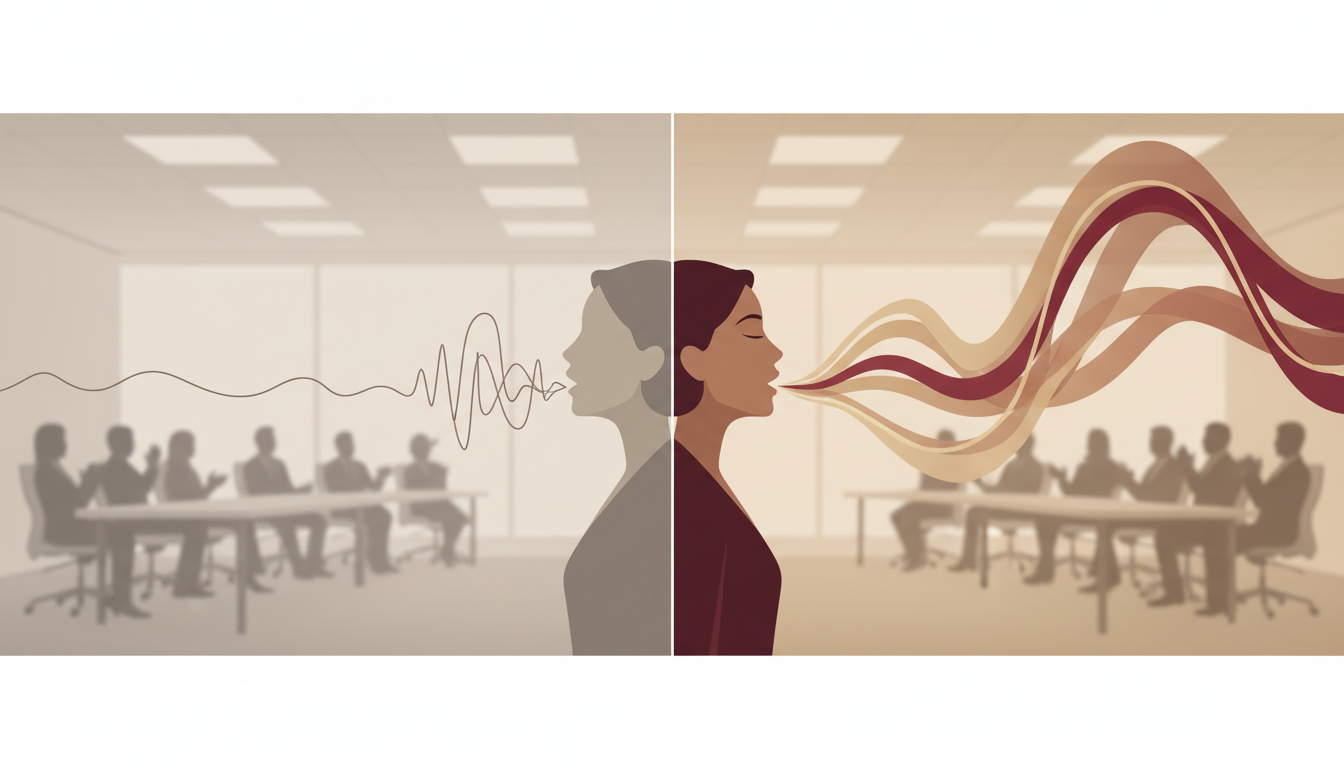
"So, um, we're looking at, like, a 12% increase in the marketing budget? And we think—well, we believe—this could potentially drive better results in Q3... so, yeah."
After (confident delivery): [Pause] "We're requesting a 12% increase in the marketing budget." [Pause] "Here's why." [Lower register, slower pace] "This investment will drive a projected 28% lift in qualified pipeline by Q3. The data supports it. And the timing is right."The content is nearly identical. The vocal delivery transforms it from a request into a recommendation—from uncertainty into authority.
If you want to strengthen how you present ideas to senior management, pairing these vocal shifts with a clear structure is the fastest path to impact.
Frequently Asked Questions
How long does it take to sound more confident in presentations?
Most professionals notice a measurable difference within 5–7 days of focused practice using the record-review-adjust loop. Vocal habits are muscular and neurological—they respond quickly to deliberate repetition. The key is practicing one technique at a time rather than trying to overhaul everything at once. Within two to three weeks of daily 10-minute sessions, the shifts begin to feel automatic.
What's the difference between sounding confident and sounding arrogant?
Confident speakers use steady pacing, downward inflection, and grounded resonance—they sound certain without being dismissive. Arrogant speakers tend to use exaggerated volume, interrupt others, and dismiss questions. The distinction lies in respect: confident delivery invites trust, while arrogance repels it. Focus on calm authority rather than dominance, and you'll stay on the right side of the line.
Can introverts sound confident in presentations?
Absolutely. Vocal confidence is a skill, not a personality trait. Many of the most commanding presenters—including Susan Cain, who popularized the introvert movement—are introverts who mastered specific vocal techniques. Introverts often excel at strategic pausing and deliberate pacing because they naturally think before speaking. Our guide on how to build leadership presence as an introvert covers this in depth.
How do I stop my voice from shaking during a presentation?
Voice shaking is caused by adrenaline tightening your vocal cords and shallow breathing. Counter it with diaphragmatic breathing (inhale for 4 counts, exhale for 6) before you begin. Speak from your chest resonance rather than your throat. Start your first sentence slowly and at a slightly lower pitch than feels natural. The physical grounding calms the shaking within 15–30 seconds. See our full guide on how to calm nerves before a presentation.
Does vocal confidence matter in virtual presentations?
It matters even more. In virtual settings, your voice carries nearly 100% of your presence because body language is limited to a small video frame. Microphones also amplify filler words, upward inflection, and pacing issues that might go unnoticed in a large room. Apply every technique in this guide—and pay extra attention to projection and resonance, since poor audio quality compounds weak vocal delivery.
Should I memorize my presentation to sound more confident?
No. Memorization often backfires because it creates a rigid, robotic delivery and increases panic if you lose your place. Instead, memorize your opening sentence, your closing sentence, and three key transition phrases. Know your content deeply but deliver it conversationally. This approach gives you anchor points of confidence while allowing natural vocal variation throughout the rest of your presentation.
Your Voice Is Your Most Powerful Leadership Tool. The 9 vocal secrets in this article will transform how audiences perceive you—but vocal delivery is just one piece of professional credibility. The Credibility Code gives you the complete system: vocal authority, body language mastery, language frameworks, and the mindset shifts that make confidence your default. Discover The Credibility Code and start commanding every room you walk into.
Ready to Command Authority in Every Conversation?
Transform your professional communication with proven techniques that build instant credibility. The Credibility Code gives you the frameworks top leaders use to project confidence and authority.
Discover The Credibility CodeRelated Articles

How to Speak With Authority in Presentations: A Framework
Speaking with authority in presentations requires five core elements: a commanding opening that establishes credibility within the first 30 seconds, the elimination of hedging language that dilutes your message, strategic pauses that signal confidence and control, a structured approach to Q&A that maintains your expert positioning, and a close that drives action. This framework gives mid-career professionals a repeatable system for projecting authority every time they present.

How to Speak With Authority in Presentations
To speak with authority in presentations, focus on five core areas: slow your speaking pace to 130–150 words per minute, use downward vocal inflections at the end of statements, structure your content with a clear "claim-evidence-action" framework, adopt grounded body language with planted feet and purposeful gestures, and eliminate hedging language like "I think" or "sort of." Authority isn't about volume—it's about vocal control, structural clarity, and unwavering conviction in your message.

Handle Public Speaking Mistakes Gracefully: Pro Recovery
To handle public speaking mistakes gracefully, pause instead of panicking, acknowledge the error briefly without over-apologizing, then redirect your audience's attention forward. The key insight most speakers miss: audiences judge you far more on your *recovery* than on the mistake itself. A composed, even slightly humorous recovery can actually boost your credibility—because it signals confidence, self-awareness, and the kind of poise that audiences instinctively trust. Below, you'll find exac