
How to Control Your Voice When Nervous Presenting

To control your voice when nervous presenting, focus on three fundamentals: diaphragmatic breathing to stabilize airflow, deliberate pacing to prevent rushing, and vocal warm-ups before you speak. Nervousness triggers shallow breathing, which causes a shaky voice, rising pitch, and speed. By anchoring your breath low in your abdomen, pausing intentionally between key points, and warming up your vocal cords, you can sound steady, authoritative, and in control — even when your nerves are firing.
What Is Nervous Voice in Presentations?
Nervous voice is the involuntary change in vocal quality that occurs when your body's stress response activates during a presentation. It typically manifests as a shaky or trembling voice, an unnaturally high pitch, speaking too fast, vocal fry, a tight or "thin" sound, or sudden dryness in the throat.
These changes happen because the fight-or-flight response tightens the muscles around your larynx, restricts your breathing to the upper chest, and diverts blood away from your digestive system — which includes the salivary glands that keep your throat lubricated. Understanding this physiology is the first step to controlling it. Your voice isn't betraying you; your body is doing exactly what it's designed to do under perceived threat. The goal isn't to eliminate nervousness — it's to manage its effect on your voice.
Why Your Voice Changes When You're Nervous
The Physiology Behind a Shaky Voice
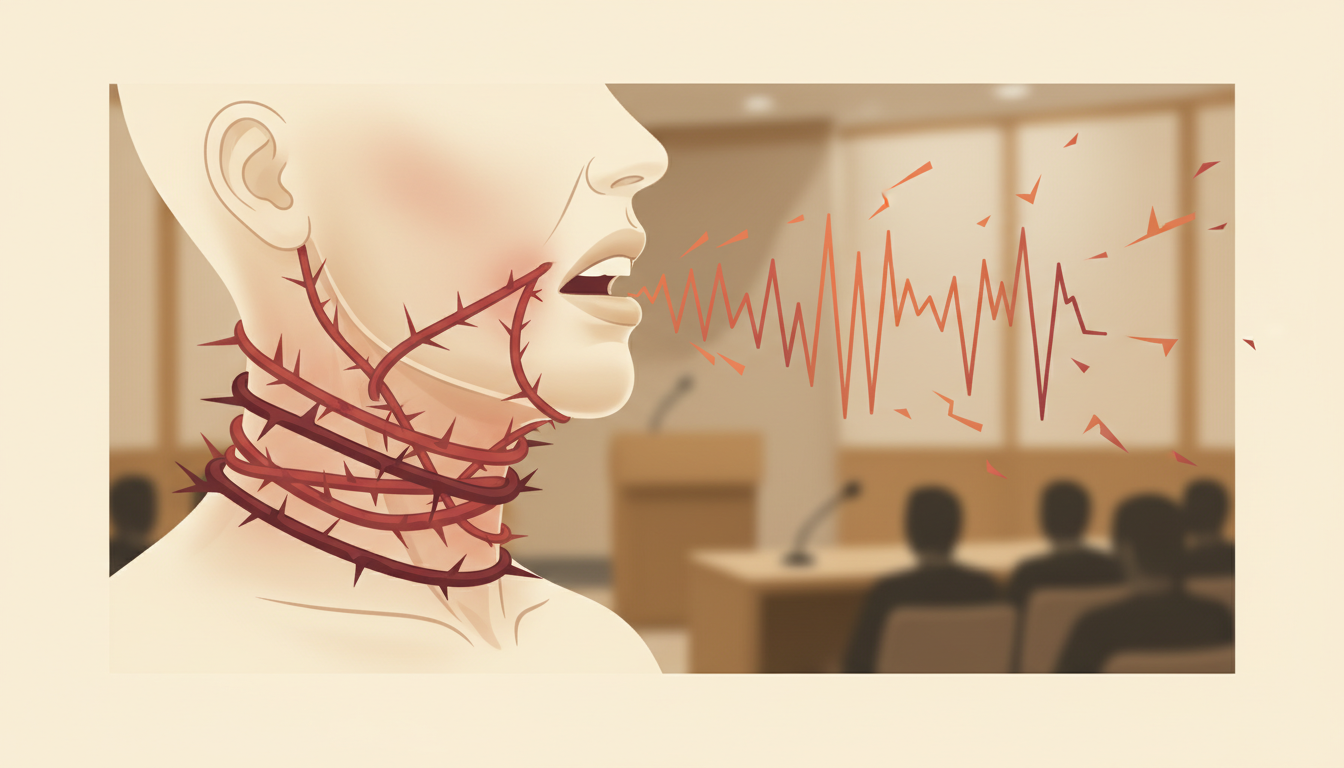
When you perceive a high-stakes situation — presenting to executives, pitching a client, leading a team meeting — your amygdala triggers a cortisol and adrenaline surge. According to Harvard Medical School, this stress response causes muscles throughout the body to tense, including the small muscles of the larynx that control pitch and vibration.
Your vocal cords are only about the size of a thumbnail. When they tighten, your pitch rises. When your breathing shifts to shallow chest breathing, you lose the steady airflow needed for a resonant, grounded voice. The result: you sound higher, thinner, and less authoritative than you actually are.
How Speed and Pitch Undermine Credibility
Research from the University of Michigan found that speakers who varied their pitch and maintained a moderate pace (about 3.5 words per second) were rated as more credible and persuasive than those who spoke quickly or in a monotone. When nerves kick in, most presenters unconsciously accelerate — sometimes by 30-40% above their normal rate.
This speed increase does two things: it signals anxiety to your audience, and it robs you of the pauses that create emphasis and authority. If you've ever felt like people don't take your ideas seriously in presentations, your pacing may be the hidden culprit. For a deeper dive into this dynamic, explore our guide on how to sound confident in a presentation with 9 proven tactics.
The Vocal Fry and Upspeak Trap
Under stress, many professionals default to two patterns that erode authority: vocal fry (a creaky, low rumble at the end of sentences caused by insufficient breath support) and upspeak (ending statements with a rising inflection, as though asking a question). A study published in PLOS ONE found that speakers with vocal fry were perceived as less competent, less educated, and less trustworthy. Both patterns intensify when you're nervous because you're running out of air at the end of sentences and unconsciously seeking validation from the audience.
Pre-Presentation Vocal Warm-Up Routine
The 5-Minute Voice Prep Protocol
Professional singers and actors never perform without warming up. Presenters should adopt the same discipline. Here is a five-minute routine you can do in a restroom, stairwell, or car before any presentation:
- Lip trills (60 seconds): Blow air through loosely closed lips, creating a "brrr" vibration. Slide up and down your pitch range. This relaxes the muscles around your larynx.
- Humming scales (60 seconds): Hum gently from your lowest comfortable note to your highest. Feel the vibration in your chest and face. This warms your resonators.
- Tongue twisters (60 seconds): Repeat "Red leather, yellow leather" and "Unique New York" five times each at increasing speed. This loosens your articulators for crisp diction.
- Open vowel stretches (60 seconds): Say "Mah, may, mee, moh, moo" slowly, exaggerating mouth movement. This opens your jaw and throat.
- Power phrase rehearsal (60 seconds): Speak your opening line three times — once at normal volume, once louder, once at your presentation volume. This calibrates your voice to the room.
This routine takes less time than checking your slides one more time — and it has a far greater impact on how you'll sound.
Hydration and Physical Prep
Vocal cords vibrate best when hydrated. The National Center for Voice and Speech recommends drinking water consistently throughout the day before a presentation — not just right before. Room-temperature water is ideal; cold water can temporarily constrict throat muscles. Avoid caffeine and dairy in the hour before speaking, as both can increase mucus production or dry out your throat.
Also, release physical tension before you present. Roll your shoulders back five times, stretch your neck gently side to side, and shake out your hands. Tension in your neck and shoulders directly transfers to your voice. For more physical techniques that project confidence, see our piece on confident body language for public speaking.
Breathing Techniques That Stabilize Your Voice
Diaphragmatic Breathing: The Foundation
The single most effective technique for controlling a nervous voice is diaphragmatic breathing — breathing from your belly rather than your chest. Here's how to practice it:
- Place one hand on your chest and one on your abdomen.
- Inhale slowly through your nose for four counts. Your belly hand should rise; your chest hand should barely move.
- Exhale through your mouth for six counts, as if blowing through a straw.
- Repeat five cycles.
When you breathe diaphragmatically during a presentation, you maintain steady airflow across your vocal cords. This eliminates the shaky quality, supports a lower and more resonant pitch, and gives you enough air to finish sentences with strength instead of trailing off into vocal fry.
The 4-7-8 Reset for Mid-Presentation Panic
Sometimes nerves spike during a presentation — after a tough question, a technology failure, or a blank-mind moment. The 4-7-8 technique, popularized by Dr. Andrew Weil, is a rapid nervous system reset:
- Inhale through your nose for 4 counts
- Hold for 7 counts
- Exhale slowly through your mouth for 8 counts
You can do a modified version of this during a natural pause or while your audience reads a slide. Even one cycle measurably lowers your heart rate. Pair this with the strategies in our guide on how to speak with poise under pressure for a complete in-the-moment toolkit.
Box Breathing for Pre-Stage Calm
Used by Navy SEALs and emergency responders, box breathing is another powerful option for the minutes before you present:
- Inhale for 4 counts
- Hold for 4 counts
- Exhale for 4 counts
- Hold for 4 counts
Repeat four to six cycles. A 2023 study in Cell Reports Medicine led by Stanford neuroscientist Dr. Andrew Huberman found that cyclic physiological sighing (extended exhales relative to inhales) was the most effective breathwork pattern for reducing real-time stress — even more effective than mindfulness meditation. The key insight: longer exhales calm you faster than longer inhales.
Ready to Command Every Room You Walk Into? Breathing techniques are just the beginning. The Credibility Code gives you the complete system for projecting authority, confidence, and presence in every professional setting — from presentations to high-stakes conversations. Discover The Credibility Code
In-the-Moment Vocal Control Techniques
The Anchor Phrase Method
An anchor phrase is a single sentence you've rehearsed so thoroughly that you can deliver it with perfect vocal control, even under extreme stress. It's your vocal home base.
Choose a sentence from your presentation — ideally your opening line or a key transition — and practice it 20-30 times until it feels automatic. When nerves hit mid-presentation, navigate to your anchor phrase. The muscle memory of saying it grounds your voice and gives your nervous system a moment to recalibrate.
For example, a project manager presenting quarterly results might anchor on: "Here's what the data tells us, and here's what it means for Q3." That single practiced sentence buys time and projects calm authority.
Strategic Pausing to Reset Pitch and Pace
Most nervous presenters fear silence. But pausing effectively in public speaking is one of the most powerful tools for vocal control. A two-to-three-second pause accomplishes several things simultaneously:
- It gives you time to take a diaphragmatic breath
- It lowers your heart rate slightly
- It signals confidence to your audience (only authoritative speakers pause)
- It prevents the runaway-train pacing that makes you sound anxious
Pitch Anchoring: Finding Your Power Register
Your "power register" is the lower third of your natural vocal range — the pitch where your voice sounds most resonant and authoritative. According to research from Duke University and the University of California, San Diego, published in the Journal of Experimental Psychology, speakers with lower-pitched voices are perceived as more dominant, competent, and trustworthy.
To find your power register:
- Hum at your most comfortable, relaxed pitch.
- Drop one or two notes lower. This is your power register.
- Practice your opening three sentences at this pitch.
When nerves cause your pitch to rise during a presentation, consciously return to this register. You don't need to force an unnaturally low voice — just aim for the lower end of your natural range. For a comprehensive approach to vocal authority, read our guide on how to develop a commanding voice at work.
The Volume Lever
Nervous speakers tend to get quieter, which forces the audience to strain and signals uncertainty. Counterintuitively, speaking slightly louder than feels comfortable when nerves hit actually calms your voice. Increased volume requires more air, which forces deeper breathing. It also engages your diaphragm and core muscles, providing physical grounding.
You don't need to shout. Aim for "back of the room" volume — speak as if the person in the last row needs to hear you clearly, even in a small conference room. This single adjustment often resolves shaky voice, rising pitch, and trailing-off sentences simultaneously.
Building Long-Term Vocal Resilience
Daily Practice: The 2-Minute Voice Journal
Long-term vocal confidence comes from daily practice, not just pre-presentation prep. Record yourself speaking for two minutes each morning — summarize yesterday's work, state your priorities, or practice a talking point. Then listen back and evaluate:
- Did my pitch stay steady?
- Did I rush?
- Did I trail off at the end of sentences?
- Did I use filler words?
According to a study by communications researcher Dr. Nick Morgan, professionals who recorded and reviewed their own speaking improved their delivery quality by up to 25% within 30 days. This practice also helps you stop using filler words in professional speaking — another common nervous habit.
Exposure Training: Graduated Presentation Practice
The most effective long-term strategy for nervous voice is systematic exposure. Start with low-stakes situations and gradually increase the pressure:
- Week 1-2: Record yourself presenting alone. Review and adjust.
- Week 3-4: Present to one trusted colleague. Ask for vocal feedback specifically.
- Week 5-6: Volunteer for a small team update (5 minutes or less).
- Week 7-8: Present in a cross-functional meeting or to a larger group.
Each successful experience rewires your brain's threat assessment. Over time, your nervous system learns that presenting is not a survival threat, and the vocal symptoms diminish naturally.
Reframing Nervousness as Energy
Research from Harvard Business School professor Alison Wood Brooks, published in the Journal of Experimental Psychology: General, found that reframing anxiety as excitement ("I am excited" vs. "I am calm") significantly improved speaking performance. Participants who reframed their nerves as excitement were rated as more persuasive, more competent, and more confident by independent evaluators.
This isn't about ignoring your nerves. It's about channeling the adrenaline into vocal energy, dynamic delivery, and genuine enthusiasm — rather than letting it constrict your voice and accelerate your pace.
Your Voice Is Your Most Powerful Leadership Tool. The Credibility Code gives you the frameworks, exercises, and scripts to speak with authority in every professional situation — not just presentations. Discover The Credibility Code
Frequently Asked Questions
Why does my voice shake when I present?
Your voice shakes because the stress response tightens the muscles around your larynx and shifts your breathing to shallow chest breaths. This reduces airflow stability across your vocal cords, creating a tremor. Diaphragmatic breathing is the most direct fix — it restores steady airflow and relaxes the laryngeal muscles. Most people notice improvement within a single practice session.
How do I stop speaking too fast when nervous?
Deliberately insert pauses at three key moments: after your opening, before your main point, and before your conclusion. Mark these pauses in your notes. Also, practice your presentation at 75% of your normal speed — it will feel unnaturally slow to you but sound perfectly natural to your audience. Recording yourself is the fastest way to calibrate. Learn more in our guide on how to calm nerves before a presentation.
Diaphragmatic breathing vs. box breathing: which is better for presentations?
Diaphragmatic breathing is better during a presentation because you can do it invisibly while speaking — simply breathe from your belly between sentences. Box breathing is better before a presentation because the breath holds are noticeable and impractical while talking. Use box breathing in the five minutes before you present, then switch to diaphragmatic breathing once you begin.
Can vocal warm-ups really make a difference in a 10-minute presentation?
Yes. A five-minute vocal warm-up loosens the muscles that tighten under stress, increases blood flow to your vocal cords, and calibrates your voice to the room's acoustics. Professional speakers, broadcasters, and actors warm up before every performance. Even lip trills and humming for 60 seconds each can noticeably reduce vocal tension and improve resonance.
How long does it take to stop sounding nervous when presenting?
Most professionals notice significant improvement within 4-6 weeks of consistent practice using breathing techniques, vocal warm-ups, and graduated exposure. The vocal symptoms (shaking, rushing, high pitch) often improve faster than the subjective feeling of nervousness. You may still feel nervous but sound completely composed — which is the real goal.
How do I recover if my voice cracks during a presentation?
Pause. Take a slow breath from your diaphragm. Then resume at a slightly lower pitch and louder volume. Do not apologize or draw attention to it — most audiences either don't notice or immediately forget. A brief pause after a voice crack actually signals composure and confidence. For more recovery strategies, see our article on how to recover from a bad presentation at work.
Turn Presentation Anxiety Into Professional Authority. The techniques in this article are a powerful starting point. The Credibility Code takes you further — with a complete system for building unshakable vocal presence, commanding body language, and the communication habits that define credible leaders. Discover The Credibility Code
Ready to Command Authority in Every Conversation?
Transform your professional communication with proven techniques that build instant credibility. The Credibility Code gives you the frameworks top leaders use to project confidence and authority.
Discover The Credibility CodeRelated Articles

How to Stop Your Voice Shaking During a Presentation
Your voice shakes during presentations because adrenaline triggers your fight-or-flight response, causing the muscles around your vocal cords to tense and tremble. To stop it immediately, slow your exhale to twice the length of your inhale (4 seconds in, 8 seconds out) for three breath cycles before you speak. Pair this with grounding techniques—pressing your feet firmly into the floor and engaging your core. Long-term, progressive exposure through regular low-stakes speaking builds resilience s

How to Prepare for a High-Stakes Presentation
To prepare for a high-stakes presentation, start 7–10 days out with deep audience analysis, then build a clear message architecture around one core thesis. Rehearse in three phases—content familiarity, delivery refinement, and full simulation—while layering in anxiety management techniques like controlled breathing and power posing. On the day of, follow a pre-performance ritual that anchors your confidence. The goal isn't perfection; it's commanding presence backed by rigorous preparation.

How to Stop Rushing When Presenting: 6 Pro Fixes
You rush through presentations because your nervous system interprets public speaking as a threat, triggering a fight-or-flight response that accelerates your heart rate, breathing, and speech. To stop rushing when presenting, use these six proven fixes: breath anchoring before and during your talk, strategic pausing at key transitions, chunking your content into digestible segments, audience-focused eye contact to regulate pace, mental rehearsal at half-speed, and physical grounding techniques.