
How to Establish Credibility in a Speech: 6 Proven Methods

To establish credibility in a speech, use these six proven methods: (1) lead with a relevance statement that connects your experience to the audience's problem, (2) anchor your claims in specific data, (3) use structured vulnerability to show authenticity, (4) leverage social proof framing, (5) demonstrate mastery through organized structure, and (6) use confident delivery mechanics including vocal authority and deliberate body language. Each method builds trust from the first sentence forward.
What Is Speaker Credibility?
Speaker credibility is the audience's perception that you are trustworthy, knowledgeable, and worth listening to. It is the combination of expertise (what you know), character (who you are), and goodwill (whether you care about the audience's interests).
Aristotle called this concept ethos — and modern communication research confirms it remains the single most important factor in persuasion. A 2020 study published in the Journal of Communication found that perceived speaker credibility accounted for up to 60% of an audience's willingness to accept a message, regardless of argument quality. In practical terms, if your audience doesn't believe you, your content doesn't matter.
Credibility isn't a fixed trait you either have or lack. It's a perception you build — or erode — through specific, repeatable communication choices. The six methods below give you a system for building that perception deliberately, whether you're presenting a quarterly update to your team or delivering a keynote at an industry conference.
Method 1: Lead With a Relevance Statement
The first 30 seconds of your speech determine whether your audience leans in or checks out. Most speakers waste this window on pleasantries, throat-clearing, or a generic "Thank you for having me." Credible speakers use it to answer the audience's unspoken question: Why should I listen to you about this topic?

What a Relevance Statement Looks Like
A relevance statement is a brief, specific connection between your direct experience and the audience's core problem. It is not a recitation of your resume. It's a targeted signal that says, "I've been where you are, and I've found something that works."
Compare these two openings:
Weak: "Hi, I'm Sarah, and I'm the VP of Operations at Meridian Corp. Today I'll be talking about supply chain resilience." Strong: "Eighteen months ago, our supply chain collapsed during a port shutdown. We lost $2.3 million in delayed shipments in eleven days. What I'm going to share today are the three changes we made that cut our disruption losses by 74% — and that you can implement this quarter."The second version establishes credibility in three ways: it proves direct experience, quantifies the stakes, and promises specific value. The audience now has a reason to listen.
How to Build Your Own Relevance Statement
Use this three-part formula:
- The problem you faced (that mirrors the audience's challenge)
- The specific result or insight you gained (with a number if possible)
- The promise of what they'll walk away with
Write it out word for word. Practice it until it sounds natural, not rehearsed. This is your credibility anchor — everything that follows gains or loses power based on how well you set this up.
For more techniques on opening with authority, explore our guide on how to open a presentation with confidence.
The Research Behind First Impressions
According to research from Princeton University psychologist Alexander Todorov, people form judgments about a speaker's competence and trustworthiness within 100 milliseconds of exposure. While those snap judgments are based on visual cues, your first spoken words either confirm or override them. A strong relevance statement overrides doubt. A weak one confirms it.
Method 2: Anchor Your Claims in Specific Data
Vague claims destroy credibility. Specific data builds it. This is one of the most reliable patterns in professional communication, and yet most speakers still default to generalities.
Why Data Anchoring Works
A study from Cornell University found that including specific numerical data in an argument increased perceived credibility by 23% compared to identical arguments without numbers. The mechanism is simple: specificity signals that you've done the work. When you say "revenue increased significantly," the audience wonders if you actually know. When you say "revenue increased 31% quarter over quarter," they believe you were in the room when it happened.
How to Use Data Without Losing Your Audience
Data anchoring doesn't mean drowning your audience in spreadsheets. It means placing one or two precise data points at the moment they matter most — typically when you're making a claim that the audience might otherwise question.
Follow this pattern:
- Make the claim: "Our onboarding process was costing us talent."
- Anchor it: "Exit interviews showed that 42% of new hires who left within six months cited onboarding confusion as a primary factor."
- Interpret it: "That told us the problem wasn't hiring — it was the first 30 days."
The claim-anchor-interpret sequence keeps data in service of your narrative rather than competing with it. Your audience remembers the story. The data makes them believe it.
Citing Sources Live Without Sounding Academic
You don't need footnotes in a speech. But you do need attribution. Use natural phrasing like:
- "A Harvard Business Review analysis found that…"
- "According to our internal data from Q3…"
- "Research from Stanford's communication lab shows…"
This signals rigor without slowing your delivery. For more on projecting authority through structured communication, see our article on how to speak with authority in presentations.
Ready to Build Unshakable Credibility? The methods in this article are drawn from the same evidence-backed frameworks inside The Credibility Code — the complete system for professionals who want to command authority every time they speak. Discover The Credibility Code
Method 3: Use Structured Vulnerability
Counterintuitively, showing what you don't know — or what you got wrong — can dramatically increase your credibility. But only if you do it with structure and intention.

The Difference Between Vulnerability and Weakness
Unstructured vulnerability sounds like this: "I'm really nervous up here, and honestly, I'm not sure I'm the right person to talk about this." That erodes credibility instantly.
Structured vulnerability sounds like this: "When I first took over this division, I made a significant strategic error. I assumed our legacy customers would adopt the new platform without incentives. They didn't — and we lost 18% of renewals in one quarter. That failure taught me the framework I'm about to share with you."
The difference is control. Structured vulnerability follows a pattern: admission → consequence → lesson learned. It demonstrates self-awareness and growth, which research from the University of Mannheim (2019) found increases perceived authenticity by up to 26% in professional settings.
When to Use It (and When Not To)
Use structured vulnerability:
- Early in your speech to humanize yourself after establishing expertise
- When introducing a framework that was born from a real mistake
- When addressing a skeptical audience that might resist polished perfection
Avoid it:
- When you haven't yet established any baseline credibility
- When the vulnerability is unrelated to the topic
- When it's so raw that it shifts the audience's focus to your emotions rather than your message
If you've ever struggled with recovering from a public mistake, our guide on handling public speaking mistakes gracefully offers a detailed recovery framework.
A Script You Can Adapt
Here's a template for structured vulnerability in a workplace presentation:
"I want to be transparent about something. When we first piloted this approach in [context], I underestimated [specific factor]. The result was [specific negative outcome]. That experience is exactly why I'm confident in the revised approach I'm presenting today — because we've already stress-tested it against the failure mode."This positions you as someone who has earned expertise through experience, not just theory.
Method 4: Leverage Social Proof Framing
Social proof — the principle that people look to the actions and endorsements of others to guide their own decisions — is one of the most well-documented phenomena in behavioral science. Robert Cialdini's research at Arizona State University identified it as one of six core principles of influence. In a speech, social proof framing means strategically referencing the credibility of others to reinforce your own.
Three Types of Social Proof for Speeches
1. Borrowed authority: Reference recognized experts, institutions, or research that supports your point. "This aligns with what McKinsey's 2023 organizational health index found — that the top quartile of communicating leaders drove 2.3x higher team engagement." 2. Peer validation: Reference others in the audience's peer group who have adopted your approach. "Three other directors in this region have already implemented this framework, and their teams saw a 19% reduction in project cycle time within 60 days." 3. Track record evidence: Reference your own past results, but frame them as outcomes for others rather than self-promotion. "The last team I coached through this process went from being ranked last in client satisfaction to second in the company within two quarters. The method works — not because of me, but because it addresses the root cause."How to Avoid Sounding Like You're Name-Dropping
The line between social proof and name-dropping is intent. Social proof serves the audience by giving them a reason to trust the method. Name-dropping serves the speaker by signaling status. Keep the focus on outcomes and relevance, not on who you know.
For a deeper dive into how executives build instant credibility using these patterns, read how executives build instant credibility.
Method 5: Demonstrate Mastery Through Organized Structure
Audiences unconsciously equate clear structure with clear thinking. A speaker who meanders signals uncertainty. A speaker who moves through a logical, signposted framework signals mastery.
The "Map, Move, Land" Framework
This is a simple structural technique used by top executive communicators:
- Map: Tell the audience where you're going. ("I'm going to walk you through three shifts that changed how our team handles client escalations.")
- Move: Take them through each point with clear transitions. ("The first shift was… The second shift was… The third — and this is the one most people skip — was…")
- Land: End each section with a concrete takeaway or implication. ("What this means for your team is…")
A 2018 study from the International Journal of Business Communication found that presentations using explicit structural signposting were rated 34% higher in perceived speaker competence than those without — even when the content was identical.
Using Transitions as Credibility Signals
Transitions aren't just organizational tools. They're credibility signals. When you say, "Now that we've covered the data, let me show you what it looks like in practice," you're demonstrating that you've thought carefully about the audience's learning journey. That kind of intentionality builds trust.
Weak transitions ("So, um, moving on…") do the opposite. They signal that you're navigating your own material in real time rather than guiding the audience through a planned experience.
If you want to sharpen your structural skills for high-stakes settings, our guide on how to prepare for a high-stakes presentation provides a complete preparation framework.
Go Beyond Tips — Build a System. These six methods work best when they're part of a complete credibility system, not isolated tactics. The Credibility Code gives you the full framework, with scripts, drills, and real-world scenarios for every professional speaking situation. Discover The Credibility Code
Method 6: Command Credibility Through Delivery Mechanics
Content earns intellectual credibility. Delivery earns emotional credibility. Both are necessary. Research from UCLA psychologist Albert Mehrabian — often oversimplified but directionally valid — suggests that nonverbal elements (tone, pace, body language) significantly influence how a message is received, particularly when content and delivery are incongruent.
Vocal Authority: Three Shifts That Matter
1. End statements on a downward pitch. Upward inflection at the end of declarative sentences (known as "uptalk") signals uncertainty. Practice ending your key claims with a slight vocal drop. This single shift can dramatically change how authoritative you sound. 2. Use strategic pauses. A two-second pause before a key point creates anticipation. A pause after a key point gives the audience time to absorb it. According to research published in the Journal of Nonverbal Behavior, speakers who use deliberate pauses are rated as 30% more confident than those who fill silence with filler words. 3. Slow your pace at high-value moments. When you rush through your most important points, you signal that you're nervous or unsure. When you slow down, you signal that what you're saying matters — and that you trust the audience to stay with you.For a complete system on vocal delivery, explore how to develop a commanding voice at work.
Body Language That Reinforces Credibility
Three body language principles matter most in speeches:
- Grounded stance: Feet shoulder-width apart, weight evenly distributed. No swaying, pacing, or weight-shifting. This signals stability and composure.
- Open gestures: Hands visible, gestures at waist-to-chest height. Avoid crossing arms, gripping the podium, or hands in pockets.
- Deliberate eye contact: Hold eye contact with one person for a full thought (3-5 seconds) before moving to another. Scanning the room rapidly signals anxiety. Sustained contact signals confidence.
Our complete guide on body language that conveys authority covers twelve specific signals you can practice before your next presentation.
Handling Nerves Without Losing Credibility
Every speaker gets nervous. Credible speakers manage that nervousness so it doesn't leak into their delivery. Two practical techniques:
- Box breathing before you speak: Inhale for 4 counts, hold for 4, exhale for 4, hold for 4. Repeat three times. This activates your parasympathetic nervous system and lowers cortisol.
- Reframe anxiety as energy: Research from Harvard Business School's Alison Wood Brooks found that reappraising anxiety as excitement improved speaking performance measurably. Instead of telling yourself "calm down," say "I'm excited about this."
Frequently Asked Questions
How do you establish credibility at the beginning of a speech?
Open with a relevance statement that connects your specific experience to the audience's problem. Avoid generic introductions or resume recitations. Instead, briefly share a result you achieved or a challenge you overcame that directly relates to your topic. Pair this with one specific data point or outcome to signal that your expertise is grounded in real experience, not theory. The first 30 seconds set the credibility tone for everything that follows.
What is the difference between credibility and confidence in public speaking?
Credibility is the audience's perception that you are knowledgeable and trustworthy. Confidence is your internal state and outward composure. You can be confident but lack credibility (speaking boldly about a topic you don't understand), and you can be credible but lack confidence (having deep expertise but delivering it nervously). The strongest speakers combine both — they know their material and deliver it with authority. For a deeper comparison, see our guide on executive presence vs. confidence.
Can you build credibility in a speech if you're not an expert?
Yes. You don't need to be the world's foremost authority. You need to demonstrate that you've done the work, that your claims are grounded in evidence, and that you care about the audience's outcome. Use data anchoring, cite credible sources, share relevant first-hand experience (even if it's limited), and structure your content clearly. Audiences grant credibility to speakers who are honest about the boundaries of their knowledge while being rigorous within those boundaries.
How do you maintain credibility during Q&A?
Handle questions you can answer with specificity and confidence. Handle questions you can't answer with honesty: "I don't have that data in front of me, but I'll follow up by end of day." Never bluff. Audiences can detect evasion, and a single dishonest answer can undo an entire presentation's worth of credibility. For a complete Q&A strategy, see our article on how to handle Q&A after a presentation like a pro.
What are the biggest mistakes that hurt credibility in a speech?
The five most common credibility killers are: (1) over-apologizing or self-deprecating ("I'm no expert, but…"), (2) using vague claims without evidence, (3) reading directly from slides, (4) using filler words excessively ("um," "like," "you know"), and (5) avoiding eye contact. Each of these signals a lack of preparation, confidence, or expertise. Our article on communication mistakes that quietly hurt your credibility covers these in detail with before-and-after fixes.
How long does it take to build credibility with an audience?
Research from Princeton University suggests initial credibility judgments form within milliseconds, but meaningful credibility is built within the first 60-90 seconds of a speech. Your opening, your body language, and your first substantive point create a credibility baseline that the rest of your speech either reinforces or undermines. This is why the relevance statement and data anchoring methods are so critical early on — they front-load your strongest credibility signals.
Your Credibility Is Your Career Currency. Every speech, presentation, and meeting is an opportunity to build — or erode — your professional authority. The Credibility Code gives you the complete system: scripts, frameworks, delivery drills, and real-world scenarios to ensure you command credibility every time you speak. Discover The Credibility Code
Ready to Command Authority in Every Conversation?
Transform your professional communication with proven techniques that build instant credibility. The Credibility Code gives you the frameworks top leaders use to project confidence and authority.
Discover The Credibility CodeRelated Articles
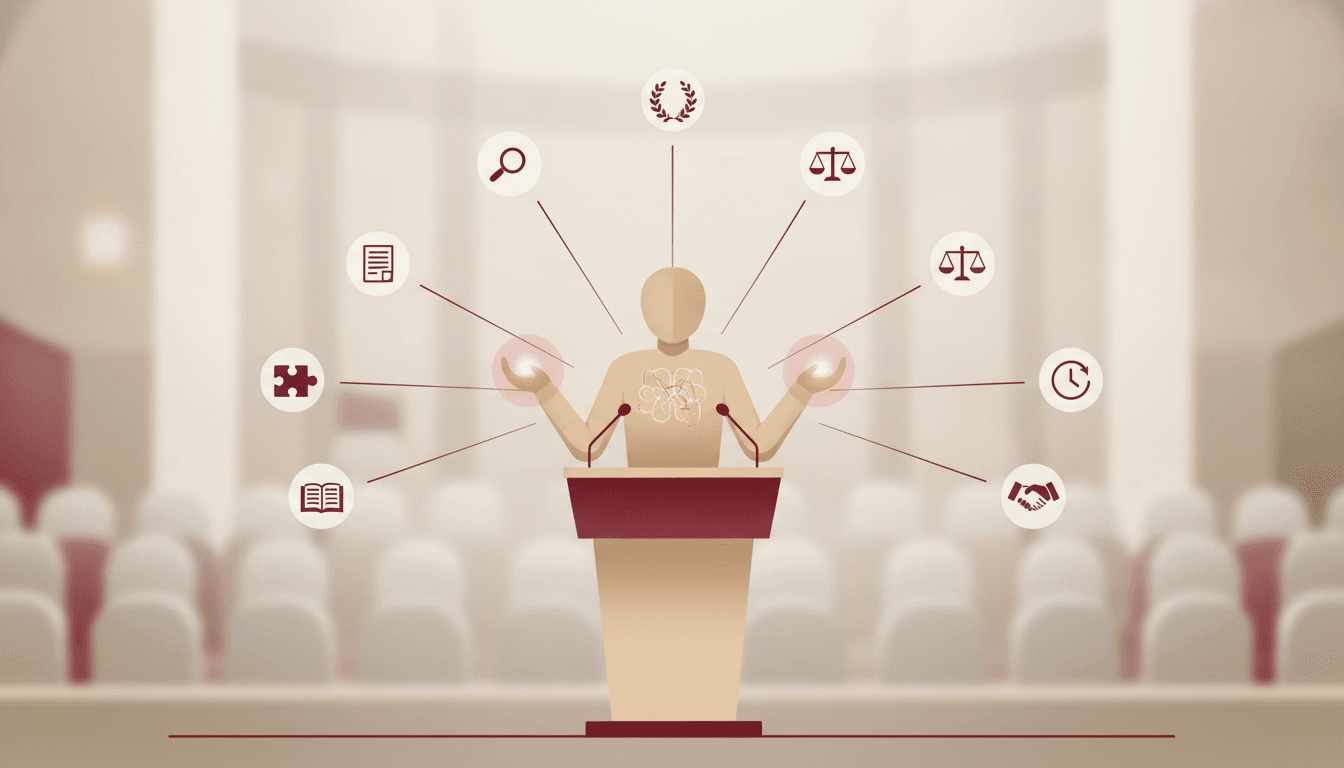
How to Establish Credibility in a Speech: 9 Proven Methods
To establish credibility in a speech, you need to demonstrate expertise, build trust, and signal authority from the moment you begin. The most effective speakers do this by combining strategic self-introduction, evidence-based arguments, audience-centered framing, confident delivery, and structural clarity. Credibility isn't just about what you know — it's about how quickly your audience decides to believe you. These nine methods will help you earn that trust before, during, and after you speak.

How to Sound Confident in a Presentation: 9 Pro Secrets
To sound confident in a presentation, focus on three pillars: vocal delivery, language structure, and psychological preparation. Slow your speaking pace by 10–15%, eliminate hedging phrases like "I think" or "sort of," and anchor your opening with a declarative statement rather than an apology. Use strategic pauses instead of filler words, drop your pitch at the end of sentences, and structure your content around no more than three core points. Confidence is less about feeling fearless and more

How to Sound Confident in a Presentation: 9 Proven Methods
To sound confident in a presentation, focus on these core techniques: lower your vocal pitch slightly, slow your speaking pace to 130–150 words per minute, pause deliberately instead of using filler words, control your breathing from your diaphragm, and open with a strong declarative statement. These methods work even when you feel nervous because confidence is a skill of *delivery*, not a reflection of your internal state. The audience hears your voice — not your heartbeat.