
Communication Mistakes That Quietly Hurt Your Credibility

The most damaging professional communication mistakes that hurt credibility aren't dramatic blunders—they're subtle habits you repeat daily without realizing it. Hedging language ("I just wanted to…"), chronic over-apologizing, weak email structure, uptalk, filler words, and closed-off body language silently signal uncertainty to colleagues and leaders. Over time, these micro-habits train people to see you as less authoritative, even when your ideas are strong. The good news: each one has a specific, learnable fix.
What Are Professional Communication Credibility Killers?
Professional communication credibility killers are the recurring verbal, written, and nonverbal habits that subtly undermine how others perceive your authority, competence, and trustworthiness at work. Unlike a single public mistake, these are patterns—small enough to fly under your own radar, but consistent enough to shape how colleagues, clients, and leaders evaluate your readiness for responsibility.
Think of them as slow leaks in a tire. You don't notice the air escaping until you're running flat. A single "sorry to bother you" email won't end your career. But when hedging, apologizing, and shrinking become your communication default, the cumulative effect is real: people stop listening, stop promoting, and stop trusting your judgment.
Research from the Harvard Business Review confirms that how you communicate accounts for a significant portion of how your competence is judged—sometimes more than the substance of your ideas. That means fixing these habits isn't optional for anyone serious about career growth. It's foundational.
Verbal Mistakes That Undermine Your Authority in Conversations
The words you choose in meetings, presentations, and one-on-one conversations shape perception faster than any performance review. Here are the verbal habits that quietly erode credibility—and exactly how to fix each one.
Hedging Language: The Words That Signal Self-Doubt
Hedging language includes qualifiers like "I think," "sort of," "kind of," "maybe," and "I just wanted to." These words soften your message so much that listeners unconsciously downgrade your confidence level.
Before: "I just think that maybe we should sort of consider a different approach to the timeline." After: "I recommend we adjust the timeline. Here's why."A study published in the Journal of Language and Social Psychology found that speakers who used fewer hedging phrases were rated as significantly more competent and persuasive by listeners. The difference wasn't content—it was delivery.
The fix is straightforward: record yourself in your next meeting (with permission) or review a Zoom transcript. Highlight every hedge. Then practice replacing hedges with direct statements. You don't need to be blunt or rude. You need to be clear. For a deeper dive into the specific words that weaken your impact, see our guide on 12 words that undermine your credibility at work.
Over-Apologizing: When "Sorry" Becomes a Verbal Tic
There's a difference between a genuine apology and a compulsive one. Saying "sorry" when you've made an error is professional. Saying "sorry to bother you" before asking a routine question, or "sorry, but I disagree" before sharing a valid opinion, trains people to see your contributions as intrusions.
According to a 2019 study in the European Journal of Social Psychology, chronic over-apologizers were perceived as less confident and less leader-like, even when their actual performance was strong.
Before: "Sorry, I just have a quick thought on this—sorry if this was already covered." After: "I want to add something to this point."Replace unnecessary apologies with gratitude or neutral transitions. Instead of "Sorry for the delay," try "Thanks for your patience." Instead of "Sorry to interrupt," try "I'd like to build on that." For a complete breakdown and practice scripts, read how to stop over-apologizing at work and what to say instead.
Filler Words and Vocal Fry: The Sound of Uncertainty
"Um," "uh," "like," and "you know" are natural in casual conversation. In professional settings—especially presentations and executive discussions—they create the impression that you're thinking out loud rather than speaking with intention.
Vocal fry (the low, creaky vibration at the end of sentences) and uptalk (ending statements as if they're questions?) compound the problem. A study from Duke University's Fuqua School of Business found that speakers with vocal fry were perceived as less competent and less hirable, particularly in professional contexts.
The fix: Practice the strategic pause. When you feel an "um" coming, pause silently instead. A two-second pause reads as thoughtful. An "um" reads as uncertain. Record a practice run of your next presentation and count filler words—most people are shocked by the number. Our article on how to stop using filler words in professional speaking offers daily drills that work.Ready to Eliminate the Habits That Hold You Back? These verbal mistakes are just the surface. The Credibility Code gives you a complete system for identifying and replacing every communication pattern that undermines your authority—with before-and-after scripts, daily exercises, and frameworks used by senior leaders. Discover The Credibility Code
Written Communication Mistakes That Erode Trust
Your emails, Slack messages, and written updates are often the first—and sometimes only—impression you make on senior stakeholders. Written communication mistakes are especially dangerous because they're permanent, forwardable, and re-readable.
Weak Email Structure: Burying the Lead
The single most common email mistake among mid-career professionals is burying the key point under context, backstory, or qualifications. Senior leaders scan emails in seconds. If your request or recommendation isn't in the first two sentences, it may never be read.
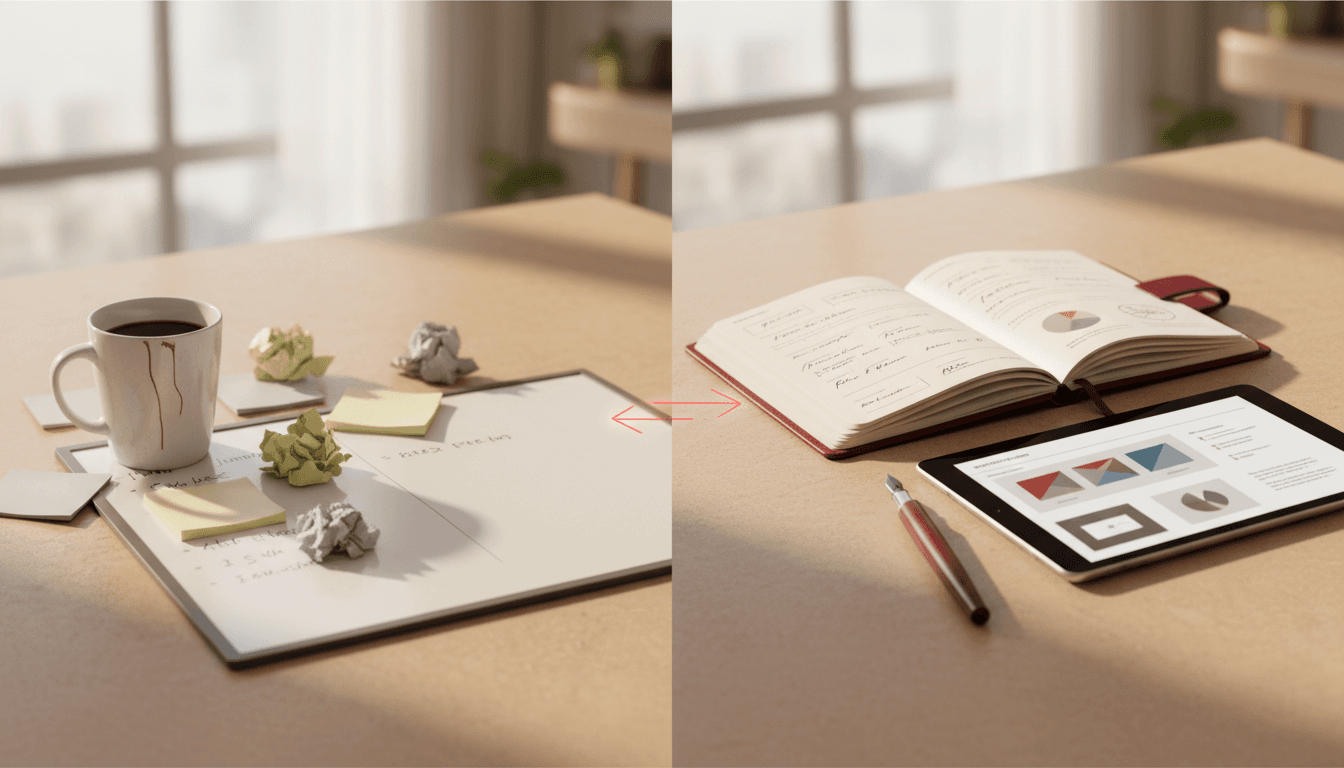
Before:"Hi Sarah, I hope you had a great weekend. I wanted to follow up on the conversation we had last Thursday about the Q3 budget. I've been thinking about it and looking at some numbers, and I think there might be some room to reallocate some funds. Would you be open to discussing this at some point?"
After:"Hi Sarah, I'm recommending we reallocate $15K from the Q3 events budget to digital acquisition. Here's the rationale: [two bullet points]. Can we discuss Thursday at 2pm?"
According to a Boomerang study analyzing over 300,000 emails, messages between 50 and 125 words received the highest response rates. Shorter and more structured wins. Learn the full framework in our guide on how to sound authoritative in emails.
Passive and Tentative Language in Writing
Written hedging is just as damaging as verbal hedging—arguably more so, because the reader can't hear your tone or see your confidence. Phrases like "I was wondering if maybe," "I'm not sure but," and "Does that make sense?" in professional emails signal deference when you should be signaling competence.
Before: "I was just wondering if it might be possible to get access to the dashboard? No worries if not." After: "Please grant me access to the Q3 dashboard by Thursday. I need it for the leadership review."The shift isn't about being demanding. It's about being direct. Direct requests get faster responses, earn more respect, and position you as someone who operates with clarity. For more examples of this transformation, see how to be more assertive in professional emails with examples.
Overusing Exclamation Points and Emoji in Professional Contexts
This one is nuanced. In team Slack channels and peer-to-peer messages, exclamation points and emoji can build rapport. But in emails to senior leadership, client communications, and formal updates, excessive enthusiasm markers ("Thanks so much!!!" or "Great idea! 😊") can undermine perceived seriousness.
A CareerBuilder survey found that 39% of hiring managers said that poor written communication was a top reason they didn't consider a candidate credible for advancement. While the study focused on hiring, the principle applies to daily workplace writing: how you write shapes how seriously people take you.
The rule of thumb: Match the formality of the person you're writing to. If your VP writes in crisp, punctuation-appropriate sentences, mirror that register. Save the emoji for peer channels where informality is the norm.Body Language and Nonverbal Mistakes That Sabotage Presence
Research by Albert Mehrabian—often cited, sometimes oversimplified—established that nonverbal cues carry enormous weight in how messages are received, particularly when verbal and nonverbal signals conflict. When your words say "I'm confident" but your body says "I'm not sure I belong here," people believe the body.
Closed Posture and Physical Shrinking
Crossing your arms, hunching your shoulders, pulling your elbows tight to your sides, and making yourself physically smaller all signal defensiveness or discomfort. In meetings, these habits are especially visible—and especially costly.
The fix: Before entering a high-stakes meeting, do a quick posture reset. Stand tall, roll your shoulders back, and plant your feet shoulder-width apart. When seated, keep your hands visible on the table (not in your lap or crossed), maintain an open chest, and take up your fair share of space. You're not trying to dominate—you're trying to signal that you belong.For a comprehensive breakdown of authority-building body language, see body language that conveys authority: 12 proven signals.
Avoiding Eye Contact and Nervous Scanning
Inconsistent eye contact—looking down, scanning the room nervously, or staring at your notes—breaks the connection between you and your audience. Whether it's a one-on-one with your manager or a presentation to 50 people, eye contact is one of the strongest credibility signals available.
The technique: In one-on-one conversations, hold eye contact for 3-5 seconds before naturally breaking and returning. In group settings, use the "triangle method"—pick three people in different parts of the room and rotate your gaze among them. This creates the impression of confident, inclusive engagement.Fidgeting, Self-Touching, and Nervous Movement
Playing with a pen, touching your face, adjusting your hair, bouncing your leg, or swaying while presenting are all self-soothing behaviors that broadcast anxiety. A study from the University of Chicago found that speakers who minimized unnecessary movement were rated as more authoritative and more persuasive than those who fidgeted, even when delivering identical content.
The fix: Give your hands a job. When presenting, use deliberate, open-palm gestures to emphasize points. When seated in a meeting, rest your hands on the table in a relaxed steeple or open position. The goal isn't rigidity—it's intentional stillness that reads as composure.Conversational Habits That Quietly Damage Your Reputation
Beyond individual word choices and body language, there are broader conversational patterns that erode credibility over time. These are harder to spot because they feel like personality traits rather than fixable habits.
Rambling and Failing to Land the Point
When you take three minutes to make a point that could be made in thirty seconds, you don't sound thorough—you sound unprepared. Senior leaders, in particular, are trained to communicate concisely. When they hear rambling, they mentally categorize the speaker as someone who hasn't organized their thinking.
The framework: Use the "Bottom Line Up Front" (BLUF) method borrowed from military communication. State your conclusion or recommendation first, then provide supporting evidence. If your listener wants more detail, they'll ask. Before: "So I've been looking at the data from the last few quarters, and there are some interesting trends, and I talked to a few people on the team, and it seems like there might be an issue with our onboarding process, specifically around the first two weeks, and I think we should probably look into it." After: "Our onboarding process has a retention problem in the first two weeks. I've identified three contributing factors and have a recommendation. Want me to walk through it?"For a complete conciseness framework, read how to speak concisely in meetings.
Not Speaking Up—Then Resenting Being Overlooked
One of the most self-defeating credibility patterns is staying silent in meetings, then feeling frustrated that your ideas aren't heard. Silence in professional settings doesn't read as "thoughtful" to most people—it reads as "disengaged" or "lacking perspective."
According to a study by Catalyst, professionals who spoke up in meetings were 20% more likely to be identified as "high potential" by their managers, regardless of the quality of their individual contributions. Visibility matters.
If speaking up feels risky, start small. Prepare one comment or question before each meeting. Deliver it in the first 10 minutes, when the psychological barrier is lowest. Over time, the habit builds momentum. For a deeper strategy, see how to speak up in meetings as an introvert.
Undermining Your Own Ideas After Sharing Them
This is the habit of saying something smart, then immediately discounting it: "But I could be wrong," "That's probably a dumb idea," or "I don't know, maybe that doesn't make sense."
This post-statement discounting is one of the most damaging credibility habits because it teaches people to dismiss you at the exact moment they were about to take you seriously. You've done the hard part—you spoke up. Then you pulled the rug out from under yourself.
The fix: After making a statement, stop talking. Let a beat of silence land. If someone has a question or pushback, they'll offer it. You don't need to preemptively invalidate your own contribution. For a comprehensive look at self-undermining habits, see how to stop undermining yourself at work.Build the Communication Habits That Command Respect Every mistake in this article has a specific, proven fix. The Credibility Code walks you through each one—with daily exercises, before-and-after scripts, and a 30-day system for transforming how people perceive your authority. Discover The Credibility Code
How to Audit and Fix Your Own Credibility Leaks
Knowing these mistakes exist isn't enough. You need a system for finding and fixing the ones you specifically make. Here's a practical audit process you can start this week.
Step 1: Record and Review
Record yourself in a meeting, presentation, or practice run (video if possible, audio at minimum). Watch or listen with a checklist:
- Verbal: Count hedges, fillers, apologies, and self-discounting statements.
- Vocal: Note uptalk, vocal fry, rushing, and monotone delivery.
- Nonverbal: Watch for closed posture, fidgeting, eye contact avoidance, and physical shrinking.
- Written: Pull your last 10 emails to senior stakeholders. Check for buried leads, passive language, and unnecessary apologies.
Step 2: Prioritize One Fix at a Time
Trying to fix everything at once leads to paralysis. Pick the single habit that appears most frequently or that you believe has the highest credibility cost. Work on it exclusively for two weeks before adding another.
Step 3: Get External Feedback
Ask a trusted colleague or mentor: "When I communicate in meetings, is there anything that makes me come across as less confident than I actually am?" Most people have never been asked this question, and the answers are often revealing.
Step 4: Build a Practice Loop
Use low-stakes situations—team standups, internal syncs, casual check-ins—to practice your new habits before deploying them in high-stakes settings. Confidence in communication is a skill, and skills improve with repetition.
For a structured daily practice system, explore how to communicate with confidence at work: a daily guide.
Frequently Asked Questions
What are the most common communication mistakes that hurt credibility at work?
The most common credibility-damaging communication mistakes are hedging language ("I just think maybe…"), chronic over-apologizing, filler words (um, uh, like), weak email structure that buries the main point, closed body language, uptalk, and self-discounting statements after sharing ideas. These habits are subtle individually but create a cumulative impression of uncertainty that affects how colleagues and leaders evaluate your competence and readiness for advancement.
How do I know if my communication is hurting my credibility?
The clearest signs are being frequently interrupted, having your ideas attributed to others, being passed over for visible projects or promotions despite strong performance, and receiving feedback like "you need more executive presence." Record yourself in meetings and review your recent emails to senior leaders. Count hedges, apologies, filler words, and passive phrases. If you find more than two or three per interaction, your communication habits are likely undermining your perceived authority.
Hedging language vs. being collaborative: what's the difference?
Hedging language weakens your position by signaling personal uncertainty ("I'm not sure, but maybe…"). Collaborative language invites input while maintaining your authority ("Here's my recommendation—I'd welcome your perspective"). The difference is ownership. Hedging disclaims your own ideas before others can evaluate them. Collaboration shares your position clearly and then opens the floor. You can be both confident and collaborative—they aren't opposites.
Can body language alone hurt your professional credibility?
Yes. Research consistently shows that when verbal and nonverbal signals conflict, people trust the nonverbal message. If you deliver a strong recommendation while hunching, avoiding eye contact, and fidgeting, listeners will register uncertainty—not confidence. A University of Chicago study found that speakers who minimized unnecessary movement were rated significantly more authoritative, even when their content was identical to fidgeting speakers.
How long does it take to fix communication habits that hurt credibility?
Most professionals see noticeable improvement within two to four weeks of focused practice on a single habit. Eliminating filler words, for example, typically requires 10-15 days of conscious practice before the new pattern feels natural. The key is working on one habit at a time, practicing in low-stakes situations first, and using recording or feedback to track progress. Complete communication transformation—across verbal, written, and nonverbal channels—typically takes 60 to 90 days of consistent effort.
Do these communication mistakes affect men and women differently?
Research suggests that women are more frequently penalized for hedging, over-apologizing, and uptalk, while men are more often penalized for rambling and poor listening. However, the underlying principle is the same for everyone: communication habits that signal uncertainty erode credibility regardless of gender. The specific habits you need to fix may differ, but the audit process—record, review, prioritize, practice—works universally.
Your Credibility Is Built in Every Conversation The mistakes in this article aren't character flaws—they're habits. And habits can be changed. The Credibility Code gives you the complete system: identify your specific credibility leaks, replace them with authority-building patterns, and transform how people perceive you in every meeting, email, and conversation. Discover The Credibility Code
Ready to Command Authority in Every Conversation?
Transform your professional communication with proven techniques that build instant credibility. The Credibility Code gives you the frameworks top leaders use to project confidence and authority.
Discover The Credibility CodeRelated Articles

Words That Make You Sound Less Confident at Work
The words you choose in meetings, emails, and presentations either build your credibility or quietly dismantle it. Certain filler phrases — like "just," "I think," "sorry, but," "does that make sense?" and "I'm no expert, but" — signal uncertainty and invite others to question your authority. These linguistic hedges soften your message, shrink your presence, and train colleagues to overlook your contributions. Below, you'll find the most common confidence-killing words, why they undermine you, a
How to Sound More Senior at Work: 9 Language Shifts
To sound more senior at work, replace tentative, permission-seeking language with decisive, outcome-oriented communication. Senior-level professionals speak in solutions rather than problems, own their recommendations instead of hedging, and frame contributions around business impact rather than task completion. The nine language shifts below—covering emails, meetings, status updates, and negotiations—will immediately elevate how colleagues and leaders perceive your seniority and credibility.

12 Weak Communication Habits That Undermine Your Credibility
Weak communication habits at work — like hedging language, upspeak, over-apologizing, and passive phrasing — silently erode your professional credibility even when your ideas are strong. Research from the Harvard Business Review shows that how you communicate accounts for a significant portion of how competent others perceive you to be. The good news: these habits are fixable. Below, you'll find the 12 most damaging weak communication habits at work, why each one undermines your authority, and t