
Handle Public Speaking Mistakes Gracefully: Pro Recovery

What Is Graceful Mistake Recovery in Public Speaking?
Graceful mistake recovery is the ability to acknowledge a public speaking error—losing your place, mispronouncing a word, facing a technical failure, or saying something incorrect—without losing composure, credibility, or audience trust. It's a deliberate skill, not a personality trait.
Unlike simply "pushing through" an error (which audiences notice and find awkward), graceful recovery involves a brief, confident acknowledgment followed by a smooth redirect. Research from the University of Michigan's communication studies program found that speakers who acknowledged mistakes openly were rated as more trustworthy and likable than those who either ignored errors or over-apologized for them.
Think of it this way: graceful recovery is the professional equivalent of a jazz musician turning a wrong note into an improvisation. It transforms a vulnerability into a demonstration of mastery.
Why Speaking Mistakes Can Actually Increase Your Credibility
Before diving into specific recovery techniques, it's worth understanding a counterintuitive truth: mistakes, handled well, can make you more credible, not less.

The Pratfall Effect in Professional Settings
Social psychologist Elliot Aronson's landmark research on the "pratfall effect" demonstrated that competent individuals who make a minor blunder are perceived as more likable and relatable than those who appear flawless. This effect has been replicated across multiple studies and holds particularly true in professional speaking contexts.
Here's what this means for you: when you stumble during a quarterly presentation and recover with composure, your audience doesn't think less of you. They think, "This person is human and capable." That combination is the foundation of authentic leadership presence.
What Audiences Actually Remember
A 2023 study published in the Journal of Applied Communication Research found that audience members recalled a speaker's emotional state and confidence level six times more vividly than the specific content of any mistake. In other words, your audience will forget that you skipped slide 14. They will remember whether you looked panicked or poised.
This is why the recovery matters infinitely more than the mistake. According to the National Communication Association, up to 76% of audience perception is shaped by nonverbal cues—tone, posture, facial expression—rather than the words themselves. Your recovery signals are the message.
The Credibility Paradox
Here's the paradox that separates average speakers from commanding ones: trying to appear perfect actually reduces your credibility. Audiences are sophisticated. They sense when someone is performing rather than communicating. A flawless, robotic delivery creates distance. A human moment, handled with grace, creates connection.
The professionals who sound authoritative aren't the ones who never make mistakes. They're the ones whose mistakes don't rattle them.
The PAUSE Framework: A 5-Step Recovery System
When a mistake happens mid-presentation, your brain's fight-or-flight response kicks in. You need a system—not willpower—to override that panic. The PAUSE framework gives you a repeatable process for any speaking error.
P — Pause Physically and Vocally
The moment you realize you've made a mistake, stop talking. Take one full breath. This feels like an eternity to you, but to your audience, it reads as composure. Research from Stanford University's communication program shows that strategic pauses of 2-3 seconds are perceived as confident and intentional by audiences.
Do not fill the silence with "um," "sorry," or nervous laughter. Simply stop. Plant your feet. Breathe. This single action separates amateurs from professionals. For more on mastering this skill, explore techniques for pausing effectively in public speaking.
A — Acknowledge Briefly (or Don't)
Not every mistake requires acknowledgment. Here's your decision filter:
- Acknowledge if the audience clearly noticed (e.g., you said the wrong name, your slides crashed, you contradicted yourself).
- Don't acknowledge if it was minor and the audience likely missed it (e.g., you skipped a point, mispronounced a low-stakes word, lost your train of thought briefly).
When you do acknowledge, use one short sentence. Not three. Not a paragraph of apology. One sentence.
U — Use a Recovery Phrase
This is where preparation pays off. Have 2-3 recovery phrases memorized so you don't have to improvise under stress. (Specific phrases for every scenario are in the next section.)
S — Steer Back to Your Message
Immediately redirect to your next point or restate your core message. Use a bridge phrase like "The key point here is..." or "What matters most is..." This gives your audience a clear signal that you're back on track.
E — Energize Forward
Increase your vocal energy slightly on the next sentence. Not dramatically—just enough to signal momentum and confidence. This subtle shift tells your audience's subconscious: "We're moving forward. Everything is fine."
Ready to Build Unshakeable Speaking Confidence? The PAUSE framework is just one tool in a comprehensive system for commanding any room. Discover The Credibility Code to master the full toolkit of professional presence and authority.
Recovery Phrases for Every Common Mistake
Generic advice like "just be yourself" doesn't help when you're standing in front of 200 people and your mind goes blank. Here are exact phrases, organized by mistake type, that you can memorize and deploy.

When You Lose Your Place or Go Blank
This is the most common speaking mistake, and according to a 2022 survey by Toastmasters International, approximately 45% of speakers report experiencing it regularly. Here are your recovery options:
Option 1 — The Recap Redirect:"Let me take a step back and emphasize what matters most here..." (Then restate your last clear point, which will usually trigger your memory of what comes next.)
Option 2 — The Audience Engagement Pivot:"Before I continue, let me check in—what questions are coming up for you so far?" (This buys you time while appearing audience-focused.)
Option 3 — The Honest Reset:"I want to make sure I give you the right information here. Let me refer to my notes for a moment." (Then calmly check your notes. No apology needed.)
The key is delivering these with the same vocal authority you'd use for any other part of your presentation. If you struggle with this, practice the techniques in our guide on how to sound confident in a presentation even when nervous.
When You Say Something Incorrect
Correcting factual errors actually builds trust—if you do it cleanly.
In the moment (if you catch it immediately):"Let me correct that—the actual figure is [X]. I want to make sure you have the right data."
If you catch it later in the presentation:"I want to circle back to something I said earlier. I stated [wrong thing]—the accurate information is [right thing]. Precision matters here, so I wanted to flag that."
If an audience member corrects you:"Thank you for that correction. You're right—it's [correct information]. I appreciate you keeping me honest."
Notice the pattern: brief acknowledgment, correct information, forward momentum. No groveling, no lengthy explanation of how the mistake happened.
When Technology Fails
Technical failures are inevitable. A 2021 Prezi survey found that 68% of presenters have experienced a significant technical malfunction during a presentation. Your response to tech failure reveals your leadership presence more than almost any other moment.
Slides won't advance:"Well, the slides have decided to take a break. Fortunately, I know this material. Let me walk you through the key points directly." (Then present without slides. This is why you should never rely on slides as a script—see our guide on presenting to executives without slides.)
Audio/video won't play:"We'll skip the video for now—let me describe what you would have seen and why it matters."
Microphone cuts out:Project your voice, move closer to the audience, and say: "Looks like we're going acoustic. Can everyone hear me?" Then continue with increased vocal projection.
When You Face a Hostile or Difficult Audience Reaction
Tough audience moments—interruptions, skeptical pushback, visible disengagement—aren't "mistakes" you made, but they require the same graceful recovery skills.
When someone openly disagrees:"That's a fair challenge. Here's why I see it differently..." (Then present your reasoning without being defensive.)
When the audience seems disengaged:"I can see I might be losing some of you on this point. Let me cut to the bottom line of why this matters to your work directly." (Then shift to the most relevant, practical takeaway.)
When someone asks a question you can't answer:"That's a great question, and I want to give you an accurate answer rather than speculate. Let me follow up with you after this session with the specifics." For a deeper dive, read our full guide on how to answer questions you don't know without faking.
Body Language and Vocal Recovery Techniques
What you say during a recovery matters. How you say it matters more. Your body language and vocal tone during the 5-10 seconds after a mistake will determine whether your audience perceives the moment as a crisis or a non-event.
The Physical Reset
When a mistake happens, your body instinctively contracts—shoulders rise, gestures shrink, you may step backward. Counter this deliberately:
- Drop your shoulders one inch. This releases tension and signals calm.
- Plant both feet hip-width apart. Grounded stance communicates stability.
- Open your palms briefly. This universal gesture signals honesty and openness.
- Maintain eye contact with a friendly face in the audience. Don't look at the ceiling, the floor, or your notes while speaking your recovery phrase.
These physical adjustments take less than two seconds but completely transform how your recovery is perceived. For a comprehensive approach, explore our guide on confident body language for public speaking.
Vocal Authority During Recovery
Your voice is your most powerful recovery tool. Here's what to control:
Pace: Slow down by about 20%. Nervous speakers speed up after mistakes. Deliberately slowing your pace signals control. According to research from the University of Houston, speakers who slowed their pace after errors were rated 32% more confident than those who sped up. Pitch: Keep your pitch steady or slightly lower than normal. When stressed, your pitch rises. Consciously lowering it by a small amount projects calm authority. Volume: Maintain or slightly increase your volume. Do not get quieter. Getting quieter after a mistake is the vocal equivalent of shrinking—and audiences read it as a loss of confidence. Filler words: This is the highest-risk moment for "um," "uh," and "sorry." Replace these with silence. A two-second pause is always more powerful than a filler word. If filler words are a persistent challenge, check out our strategies for stopping filler words in professional speaking.The 3-Second Rule
Here's a practical technique used by professional speakers and media-trained executives: after any mistake, count silently to three before speaking your recovery phrase. During those three seconds:
- Second 1: Breathe in through your nose.
- Second 2: Drop your shoulders and plant your feet.
- Second 3: Make eye contact with one person.
Then deliver your recovery phrase with full vocal authority. This three-second ritual prevents the panicked, rushed response that makes small mistakes look like big ones.
Turn Every Speaking Moment Into a Leadership Opportunity. Graceful recovery is one piece of a larger system for projecting confidence and authority in every professional interaction. Discover The Credibility Code and build the kind of presence that commands respect—even when things don't go as planned.
How to Practice Mistake Recovery Before It Happens
The best recovery feels effortless because it was rehearsed. You can't predict exactly what will go wrong, but you can train your brain and body to respond with composure instead of panic.
Deliberate Disruption Drills
Practice your next presentation with intentional disruptions built in. Ask a colleague to:
- Turn off your slides at a random point
- Interrupt you with a challenging question
- Make a distracting noise
- Signal you to skip ahead two sections
Each time, practice your PAUSE framework and a recovery phrase. After 5-6 repetitions, your nervous system begins to treat disruptions as normal rather than threatening.
The "Worst Case" Rehearsal
Before any high-stakes presentation, spend five minutes mentally rehearsing your three worst-case scenarios. For each one, visualize yourself executing a calm recovery. This technique, drawn from sports psychology and used by Olympic athletes, has been shown to reduce performance anxiety by up to 35% (Journal of Applied Sport Psychology, 2019).
For example, if you're presenting quarterly results to the executive team, your worst cases might be: (1) the CFO challenges your numbers, (2) your slides freeze, (3) you forget a key data point. Mentally rehearse a composed recovery for each. When you walk into that room, your brain has already "been there," and the fear response is significantly reduced. Pair this with the techniques in our guide on how to calm nerves before a presentation.
Building a Personal Recovery Phrase Library
Create a document with 5-10 recovery phrases that feel natural in your voice. Not every phrase works for every speaker. "Let me circle back to what matters most" might feel natural to you, while "Good catch—let me correct that" might feel forced.
Test phrases in low-stakes settings first: team meetings, casual presentations, even conversations. By the time you need them in a high-stakes moment, they'll feel like second nature rather than scripted lines.
Frequently Asked Questions
How do you recover from saying the wrong thing in a presentation?
Pause briefly, then correct yourself with a simple, confident statement: "Let me rephrase that—what I mean is..." or "Actually, the correct figure is..." Avoid lengthy apologies or explanations about why you misspoke. Research shows audiences respect quick, clean corrections far more than elaborate justifications. The key is maintaining your vocal authority and forward momentum after the correction.
Is it better to acknowledge a speaking mistake or ignore it?
It depends on whether the audience noticed. If the error was obvious—wrong name, contradictory statement, visible technical failure—acknowledge it briefly and move on. If it was subtle, like skipping a minor point or a slight mispronunciation, ignoring it is usually the stronger choice. Over-acknowledging small errors draws attention to mistakes your audience would have otherwise missed entirely.
What is the difference between recovering from a mistake and apologizing for one?
Recovery focuses on moving forward with confidence: correct, redirect, continue. Apologizing focuses on the mistake itself and often invites the audience to dwell on it. A brief "Let me correct that" is recovery. Saying "I'm so sorry, I can't believe I said that, this is embarrassing" is an apology that undermines your credibility. Effective speakers recover; they rarely apologize at length from the stage.
How can introverts handle public speaking mistakes without freezing?
Introverts often freeze because they internalize the audience's perceived judgment. The antidote is preparation: memorize 2-3 recovery phrases and practice the 3-Second Rule (breathe, ground, eye contact, then speak). Having a rehearsed response eliminates the need to think on the spot, which is where freezing happens. Many introverts actually excel at graceful recovery because their natural tendency toward thoughtfulness reads as composure. See also our guide on speaking up in meetings as an introvert.
How do you handle a technical failure during a presentation?
First, don't narrate the problem ("Oh no, the slides aren't working, let me try clicking again..."). Instead, pause, then pivot: "Let me walk you through this directly while we sort out the tech." Continue presenting from memory or notes. If the issue resolves, smoothly reintegrate the technology. If it doesn't, finish without it. Your ability to present without a tech crutch is one of the strongest authority signals you can send.
How do you stop over-apologizing after a public speaking mistake?
Replace the apology reflex with a redirect reflex. Instead of "Sorry about that," say "Here's the key point." Practice this substitution in everyday conversations first—meetings, phone calls, casual interactions. Over time, your default response to any error shifts from self-deprecation to forward momentum. This single change can dramatically improve how others perceive your confidence and competence at work.
Your Next Speaking Moment Is a Leadership Opportunity. Every technique in this article—the PAUSE framework, recovery phrases, body language resets—is part of a larger system for building unshakeable professional credibility. Discover The Credibility Code and transform the way you communicate, present, and lead—starting today.
Ready to Command Authority in Every Conversation?
Transform your professional communication with proven techniques that build instant credibility. The Credibility Code gives you the frameworks top leaders use to project confidence and authority.
Discover The Credibility CodeRelated Articles

How to Speak Confidently in Front of Executives
Speaking confidently in front of executives requires a shift in how you prepare, structure, and deliver your message. Lead with the conclusion first, keep your points concise and data-driven, and project calm authority through steady pacing and deliberate pauses. Manage nerves by reframing the conversation as a strategic exchange — not a performance. Executives respect clarity, brevity, and conviction far more than polish or perfection.

How to Sound Confident in a Presentation (Even When Nervous)
To sound confident in a presentation when nervous, focus on three controllable elements: slow your speaking pace by 20%, drop your vocal pitch at the end of sentences, and use deliberate pauses instead of filler words. Nervousness is invisible to your audience when you manage your voice, body, and breathing. The techniques below give you a tactical system to project authority — even when your heart is pounding and your hands are shaking.
How to Sound Confident in a Presentation: 9 Vocal Secrets
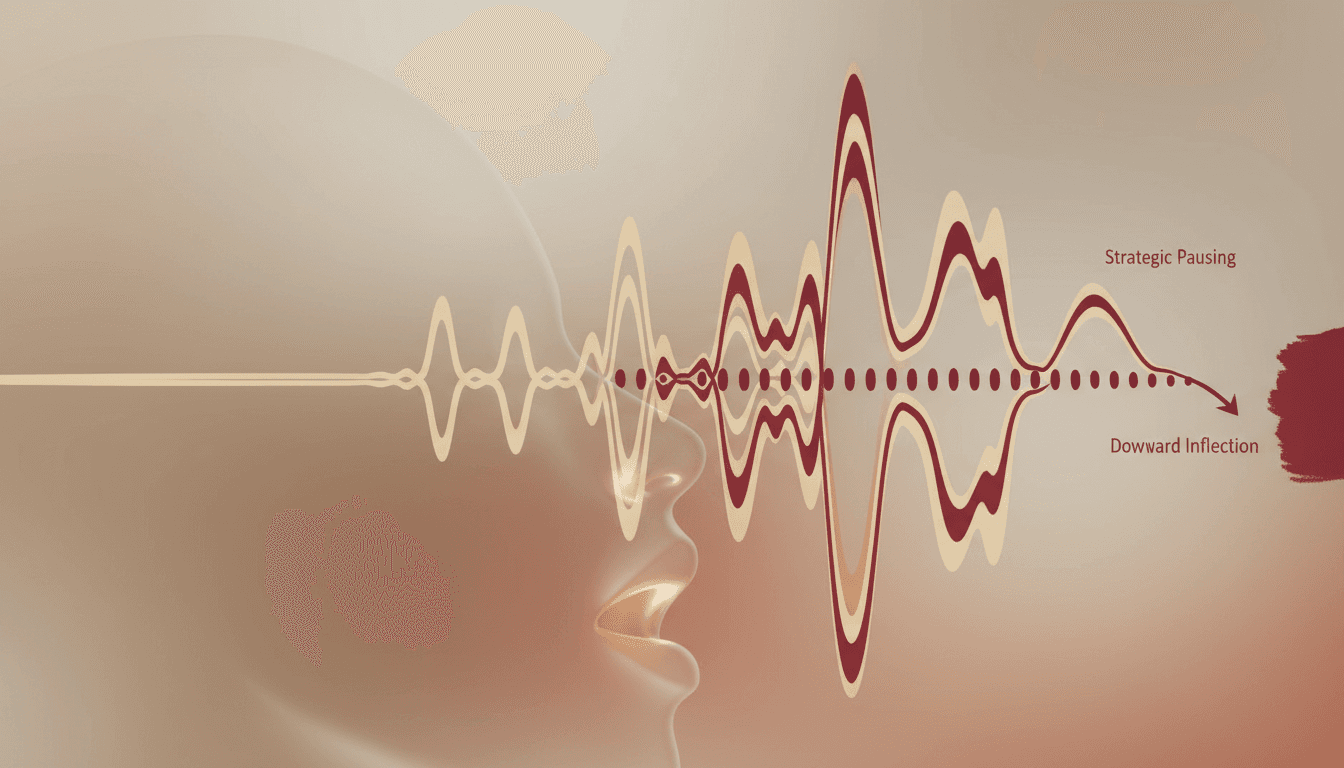
To sound confident in a presentation, focus on nine vocal techniques: use downward inflection at the end of statements, slow your pace by 10–15%, insert strategic 2–3 second pauses, speak from your diaphragm for resonance, eliminate filler words, vary your pitch deliberately, project your voice to the back of the room, lower your vocal register slightly, and land your final words with conviction. These shifts change how audiences perceive your authority—often within the first 30 seconds.