
How to Develop Executive Gravitas Quietly (No Bravado)

What Is Executive Gravitas?
Executive gravitas is the quality that makes people listen to you, trust your judgment, and follow your lead—without you needing to demand attention. It's the combination of presence, credibility, and weight that causes others to take your words seriously the moment you speak.
Unlike charisma, which draws people in through energy and personality, gravitas draws people in through substance and composure. It's the difference between being entertaining and being trusted. You can learn more about this distinction in our guide on leadership presence vs. charisma.
Gravitas doesn't require a corner office or a commanding voice. It requires behavioral consistency—showing up the same way whether you're in a one-on-one or a boardroom, whether the news is good or bad.
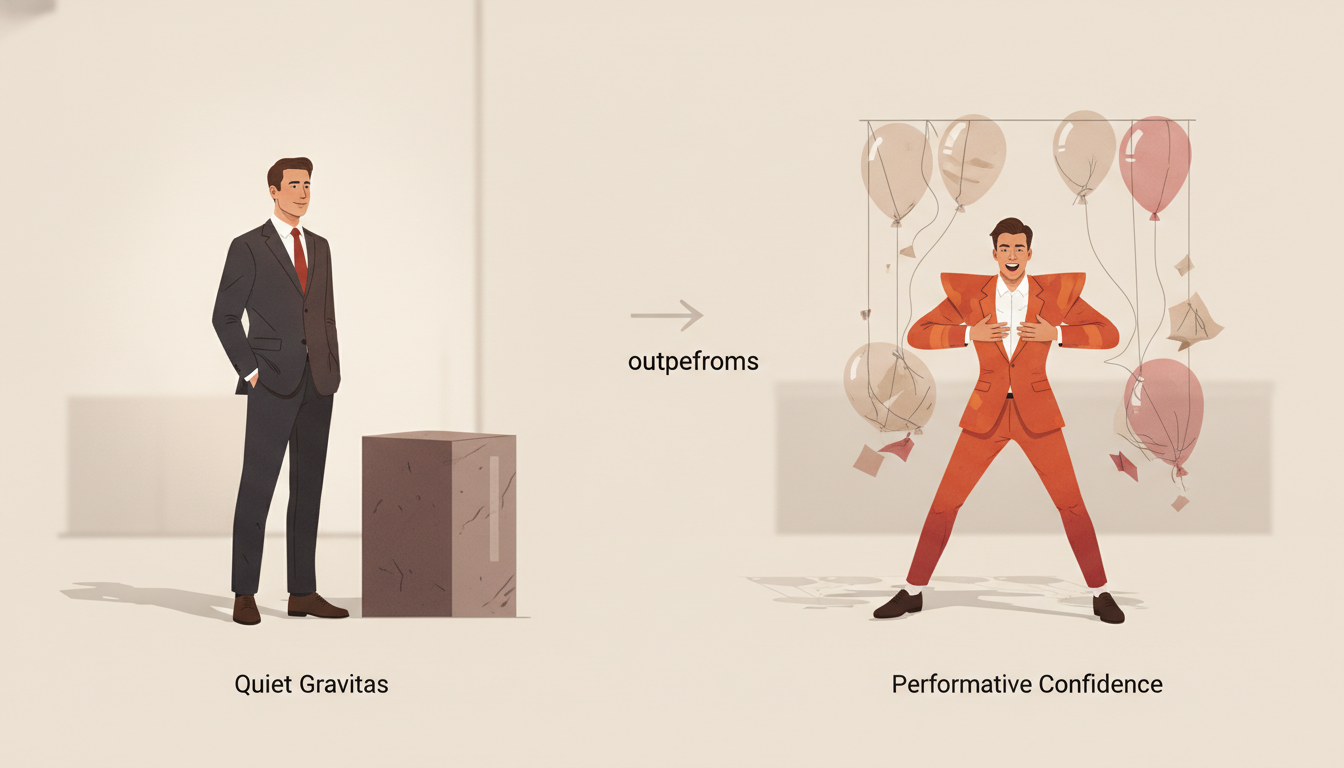
Why Quiet Gravitas Outperforms Performative Confidence
There's a persistent myth in professional culture that authority requires volume. That leaders must be bold, loud, and dominating. But research consistently tells a different story.
The Data Behind Quiet Authority
A 2012 study published in the Academy of Management Journal found that introverted leaders often produce better outcomes than extroverted ones, particularly when leading proactive teams. The researchers (Francesca Gino, Adam Grant, and David Hofmann) found that introverted leaders were more likely to listen to and implement suggestions, which led to higher group performance.
Additionally, a 2023 survey by the Center for Creative Leadership found that "composure" and "substance" ranked among the top three traits associated with executive presence—above "energy" and "assertiveness." People don't remember who talked the most. They remember who said the thing that mattered.
Why Bravado Backfires
Performative confidence—speaking first, speaking loudest, dominating airtime—often signals insecurity rather than authority. When you watch seasoned executives in meetings, you'll notice a pattern: they listen longer, speak later, and say less. Their words carry weight precisely because they don't waste them.
Consider two directors in the same leadership meeting. Director A jumps in early, offers opinions on every topic, and fills every silence. Director B listens, takes notes, and speaks once—offering a precise observation that reframes the entire conversation. Who leaves the room with more credibility?
If you've been defaulting to the Director A approach, you're not alone. Our guide on how to stop undermining yourself at work covers the hidden habits that chip away at your authority.
Quiet Gravitas Is a Skill, Not a Personality Trait
This is critical: you don't have to be an introvert to develop quiet gravitas. Quiet gravitas is a set of deliberate behaviors, not a temperament. Extroverts can learn to deploy silence strategically. Introverts can learn to project composure instead of withdrawal. The key is intentionality.
The 5 Pillars of Quiet Executive Gravitas
Building gravitas without bravado requires mastering five interconnected behavioral pillars. Each one reinforces the others. Together, they create the perception of someone who is deeply competent, emotionally steady, and worth listening to.
Pillar 1: Physical Stillness
Fidgeting, shifting weight, touching your face, adjusting your glasses—these micro-movements signal nervousness and undermine authority. Leaders with gravitas are physically still. They occupy space without apology and move with deliberation.
How to practice this:- In meetings: Plant both feet flat on the floor. Rest your hands on the table or in your lap. Resist the urge to fidget with a pen or phone.
- When standing: Stand with feet shoulder-width apart, weight evenly distributed. Keep your hands at your sides or lightly clasped in front of you.
- When listening: Maintain steady eye contact. Nod slowly and sparingly—not rapidly.
A 2020 study from Princeton University's psychology department found that people form judgments about competence and trustworthiness within 100 milliseconds of seeing someone's face and posture. Your body speaks before your mouth opens.
For a deeper dive into these physical cues, see our guide on leadership presence body language: 11 cues that signal power.
Pillar 2: Strategic Silence
Most professionals fear silence. They fill pauses with filler words, rush to respond, and over-explain. Leaders with quiet gravitas do the opposite—they use silence as a tool.
Three types of strategic silence:- The listening pause. When someone finishes speaking, wait two full seconds before responding. This signals that you're actually processing their words, not just waiting for your turn.
- The weight pause. Before delivering a key point, pause for one to two seconds. This creates anticipation and signals importance.
- The composure pause. When asked a difficult or provocative question, pause before answering. This signals that you're thoughtful, not reactive.
Learn more about mastering this in our article on how to pause effectively in public speaking.
Pillar 3: Deliberate Word Choice
People with gravitas don't ramble. They select words with precision, speak in complete thoughts, and eliminate verbal clutter. According to a 2019 analysis by Quantified Communications, executives who used fewer words per statement were rated 28% more credible by audiences than those who over-explained.
Practical shifts:| Instead of... | Say... |
|---|---|
| "I kind of think we should maybe consider..." | "I recommend we..." |
| "Sorry, but I just wanted to add..." | "One factor we haven't discussed..." |
| "Does that make sense?" | [Pause. Let your statement stand.] |
| "I'm not sure, but possibly..." | "Based on the data, my assessment is..." |
The pattern is clear: remove hedging language, eliminate unnecessary qualifiers, and let your statements land with full weight. Our article on 12 words that undermine your credibility at work provides a comprehensive list of phrases to eliminate.
Ready to Communicate with More Authority? The Credibility Code gives you the exact frameworks, scripts, and daily practices to build commanding presence—without faking confidence. Discover The Credibility Code
How to Build Gravitas in Everyday Professional Situations
The pillars above are the foundation. But gravitas is built in daily moments, not grand gestures. Here's how to apply these principles in the situations where they matter most.

In Meetings: Be the Last to Speak
There's a reason the most senior person in a meeting often speaks last. Speaking last allows you to synthesize what others have said, add a perspective no one has offered, and position yourself as the person who sees the full picture.
Framework: The 3-Step Last Word Method- Listen and note patterns. While others talk, identify what's being missed or what theme connects the various points.
- Acknowledge before you add. Start with a brief synthesis: "Several strong points have been raised about timeline risk."
- Deliver your unique angle. Then add: "What I haven't heard us address is the client retention impact. That's where I'd focus our next step."
This approach works whether you're a senior VP or a mid-level manager. It signals strategic thinking and composure. For more on this, explore our guide on how to be seen as a strategic thinker at work.
In Emails: Write with Density, Not Length
Gravitas in written communication means every sentence earns its place. Leaders with quiet authority write shorter emails with higher information density.
Before (low gravitas): "Hi team, I just wanted to touch base and share a few thoughts on the project. I've been thinking about this a lot and I feel like we might want to consider adjusting our timeline slightly because of some of the challenges we've been facing lately. Let me know your thoughts when you get a chance!" After (high gravitas): "Team—based on the supply chain delays reported last week, I'm recommending we extend Phase 2 by two weeks. I'll present the revised timeline in Thursday's sync. Questions before then, reach out directly."The second version is shorter, more decisive, and communicates clear ownership. For more techniques, see how to write like an executive.
Under Pressure: Stay Composed When Others React
This is the ultimate test of gravitas. When a project fails, when a client escalates, when a colleague challenges you publicly—your response in that moment defines your credibility for months to come.
The Composure Protocol:- Breathe before you respond. One slow breath buys you two to three seconds of clarity.
- Lower your vocal register slightly. Stress pushes your voice higher. Consciously bring it down.
- Slow your speaking pace by 20%. Rushed speech signals panic. Measured speech signals control.
- Name the situation without dramatizing it. "We have a problem with the vendor timeline. Here's what I'm proposing." Not: "This is a disaster and we need to figure out what went wrong."
A 2021 Harvard Business Review article on executive presence found that the ability to remain calm under pressure was the single most cited attribute that senior leaders associated with "gravitas." It outranked intelligence, communication skills, and decisiveness.
Our framework on projecting calm authority under pressure goes deeper into these techniques.
The Quiet Gravitas Daily Practice System
Gravitas isn't something you switch on for big moments. It's built through daily micro-practices that rewire your default behaviors over time.
Morning Intention Setting (2 Minutes)
Before your first meeting or interaction, set one gravitas intention for the day. Examples:
- "Today I will pause for two seconds before responding to any question."
- "Today I will eliminate 'just' and 'sorry' from my vocabulary."
- "Today I will speak 20% slower in my first meeting."
This single practice creates awareness. Awareness creates change.
The Daily Debrief (3 Minutes)
At the end of your workday, review three moments:
- A moment I showed composure. Reinforce what worked.
- A moment I undermined myself. Identify the trigger and plan a different response.
- A moment I could have spoken with more precision. Rewrite what you said into a tighter, more deliberate version.
Over 30 days, this debrief practice rewires your communication habits at a fundamental level. If you want a structured version of this, our executive presence 30-day self-improvement plan provides a day-by-day roadmap.
The Weekly Calibration
Once a week, ask yourself:
- Am I being perceived as thoughtful or as disengaged? (Quiet gravitas requires visible engagement—eye contact, nodding, leaning in—not withdrawal.)
- Am I adding value when I speak, or am I speaking to be heard?
- Am I following through on commitments consistently?
That last point matters enormously. According to a 2022 survey by the Edelman Trust Barometer, "delivering on promises" was rated the most important factor in building professional trust—above expertise, communication skill, or likability. Gravitas without follow-through is just performance.
Build Your Quiet Authority Systematically. The Credibility Code provides the complete framework for developing gravitas, presence, and professional credibility—designed for leaders who lead with substance, not noise. Discover The Credibility Code
Common Mistakes That Undermine Quiet Gravitas
Even well-intentioned professionals sabotage their own gravitas through habits they don't recognize. Here are the most common traps—and how to avoid them.
Confusing Quiet with Invisible
Quiet gravitas is not about disappearing. If you never speak up, never share your perspective, and never take a visible stance, you won't be perceived as having gravitas—you'll be perceived as having nothing to say.
The goal is strategic visibility: speaking less but with more impact. Every contribution should be intentional and substantive. If you're struggling with being overlooked, our guide on being overlooked at work: 9 strategies to get noticed provides specific fixes.
Over-Qualifying Every Statement
Phrases like "I could be wrong, but..." or "This might not be the right way to think about it, but..." destroy gravitas instantly. They signal that you don't trust your own judgment—so why should anyone else?
State your perspective. If you're uncertain, say: "I need more data to be definitive, but my current read is X." That's honest without being self-undermining.
Reacting to Provocation
Nothing erodes gravitas faster than losing your composure in public. When a colleague challenges you aggressively, when a stakeholder dismisses your recommendation, when someone takes credit for your idea—your response is your reputation.
The gravitas response: acknowledge, redirect, hold your ground. "I hear your concern. Here's why I stand by this recommendation." No defensiveness. No counter-attack. Just steady, grounded authority.
Frequently Asked Questions
What is executive gravitas and why does it matter?
Executive gravitas is the quality of being taken seriously as a leader based on your composure, substance, and behavioral consistency—not your title or volume. It matters because it directly influences whether people trust your judgment, follow your lead, and advocate for your advancement. Research from the Center for Creative Leadership consistently ranks gravitas as a top component of executive presence.
Can introverts develop executive gravitas?
Absolutely. In fact, introverts often have a natural advantage. The core behaviors of quiet gravitas—listening deeply, speaking with precision, maintaining composure—align naturally with introverted tendencies. The key is ensuring that quiet doesn't become invisible. Introverts need to practice strategic visibility: choosing fewer moments to speak but making each one count. Our guide on how to build leadership presence as an introvert covers this in detail.
Executive gravitas vs. charisma: what's the difference?
Charisma attracts attention through energy, warmth, and expressiveness. Gravitas commands respect through substance, composure, and credibility. Charismatic leaders make you feel inspired. Leaders with gravitas make you feel confident in their judgment. You can have both, but gravitas is more durable—it doesn't depend on mood, energy level, or social context. It's built on consistent behavior, not performance.
How long does it take to develop executive gravitas?
Most professionals notice a shift in how they're perceived within 30 to 60 days of deliberate practice. The behavioral changes—pausing before speaking, eliminating hedging language, maintaining physical stillness—are simple to understand but require daily repetition to become automatic. Full integration, where these behaviors feel natural rather than effortful, typically takes three to six months of consistent practice.
Can you develop gravitas without being in a leadership role?
Yes. Gravitas is not role-dependent. You can demonstrate it as an individual contributor, a project lead, or a mid-level manager. In fact, developing gravitas before you have a leadership title is one of the most effective ways to be seen as a leader before the promotion. Decision-makers notice people who carry themselves with composure and substance—regardless of their org chart position.
What's the fastest way to undermine your own gravitas?
Over-apologizing, hedging every statement, reacting emotionally to criticism, and failing to follow through on commitments. These four behaviors will erode gravitas faster than anything else. The fix is awareness: track how often you apologize unnecessarily, qualify your opinions, or let emotion drive your responses. Then systematically replace those habits with the gravitas behaviors outlined in this article.
Your Credibility Is Your Career Currency. The Credibility Code gives you the complete system for building executive presence, communicating with authority, and earning the respect your expertise deserves—without pretending to be someone you're not. Discover The Credibility Code
Ready to Command Authority in Every Conversation?
Transform your professional communication with proven techniques that build instant credibility. The Credibility Code gives you the frameworks top leaders use to project confidence and authority.
Discover The Credibility CodeRelated Articles

How to Build Leadership Presence Quietly (Without Being Loud)
Building leadership presence quietly starts with mastering five core disciplines: strategic silence, deliberate body language, controlled vocal delivery, precise word choice, and consistent follow-through. You don't need to dominate conversations or adopt an extroverted persona. The most commanding leaders in any room often speak the least — but when they do, every word lands. This guide gives you a complete framework for developing quiet authority that earns respect without raising your volume.

Leadership Presence Without Authority: 9 Proven Moves
Leadership presence without authority is the ability to influence outcomes, command respect, and shape decisions in professional settings — even when you have no formal title, direct reports, or positional power. You build it through strategic communication, consistent credibility signals, and deliberate relationship-building. The nine moves below give you a concrete framework: from how you speak in meetings to how you position yourself on cross-functional teams. Each move is backed by research

Leadership Presence in Your First Meeting: A Playbook
Leadership presence in your first meeting comes down to five controllable elements: intentional preparation, confident body language, a calibrated vocal tone, strategic listening, and a purposeful follow-up. Research from Harvard Business School shows that people form lasting judgments within the first seven seconds of meeting you—and those impressions are remarkably sticky. This playbook gives you a step-by-step system to command credibility and authority the moment you walk into any new room.