
How to Stop Undermining Yourself at Work: 12 Hidden Habits

You stop undermining yourself at work by identifying and replacing the subtle communication habits that silently erode your credibility. The most damaging self-sabotage isn't dramatic—it's the hedging language, upspeak, chronic over-apologizing, praise deflection, and over-explaining that signal uncertainty to colleagues and leaders. By swapping these 12 hidden habits for specific authority-building alternatives, you project confidence and earn the professional respect your expertise deserves.
What Does It Mean to Undermine Yourself at Work?
Self-undermining at work is the pattern of unconscious communication habits—verbal, written, and nonverbal—that diminish your perceived competence and authority, even when your actual skills and knowledge are strong. It's the gap between what you know and how others experience you.
Unlike external obstacles like a difficult boss or a toxic culture, self-undermining comes from within. It's the linguistic and behavioral equivalent of pulling the rug out from under your own feet. According to a 2023 study published in the Journal of Experimental Social Psychology, listeners form judgments about a speaker's competence within the first 30 seconds, largely based on vocal confidence and language certainty—meaning your hidden habits shape your reputation before your ideas even land.
The 6 Verbal Habits That Quietly Destroy Your Credibility
Language is the most common vehicle for self-sabotage at work. These six verbal habits are so normalized that most professionals don't realize they're doing them—or the damage they cause.
Habit #1: Hedging Language ("I just think maybe…")
Hedging is the use of qualifiers that soften your statements to the point of irrelevance. Words like "just," "maybe," "sort of," "I think," and "kind of" tell your audience you don't fully stand behind your own idea.
Scenario: In a strategy meeting, you say, "I just think maybe we should sort of consider shifting the timeline." Your manager hears hesitation. A colleague who says, "I recommend we shift the timeline by two weeks—here's why," gets the credit for the same idea. The fix: State your position, then support it. Replace "I just think maybe" with "I recommend" or "Based on the data, my recommendation is." For a deeper dive into language patterns that build authority, explore our guide on how to stop sounding unsure when you speak at work.Habit #2: Upspeak (Turning Statements Into Questions?)
Upspeak—raising your intonation at the end of a declarative sentence—transforms confident assertions into what sounds like requests for approval. Research from Pearson Institute of Higher Education found that professionals who use upspeak are rated 35% less authoritative by listeners, regardless of the quality of their content.
The fix: Record yourself in your next meeting or practice session. Listen for rising intonation on statements. Practice landing your sentences with a downward inflection, especially on your final word. Think of a period, not a question mark.Habit #3: Over-Apologizing for Existing
There's a difference between a genuine apology and a reflexive "sorry" that functions as a verbal tic. Saying "Sorry, can I add something?" or "Sorry to bother you" before sharing a relevant insight tells everyone in the room that your contribution is an imposition.
Scenario: You email a VP: "Sorry to bother you, but I just wanted to flag a potential issue with the Q3 projections." Compare that to: "I've identified a risk in the Q3 projections that needs your attention." Same message. Completely different credibility signal. We break down this pattern further in our post on how to stop over-apologizing at work and what to say instead. The fix: Replace "sorry" with purpose-driven openers:- Instead of "Sorry to interrupt" → Say "I want to add to that"
- Instead of "Sorry, quick question" → Say "I have a question about…"
- Instead of "Sorry for the late reply" → Say "Thanks for your patience"
Habit #4: Deflecting Praise and Credit
When someone compliments your work and you respond with "Oh, it was nothing" or "I got lucky" or "The team did everything," you're actively training people to undervalue your contributions. A 2022 survey by Catalyst found that 54% of women and 38% of men in professional roles regularly minimize their accomplishments when acknowledged.
The fix: Use the Accept and Anchor method. Accept the praise, then anchor it to a specific skill or effort:- "Thank you—I put a lot of thought into that analysis."
- "I appreciate that. The research phase was intensive, and I'm glad it paid off."
Habit #5: Asking Permission to Have an Opinion
Phrases like "Can I say something?" or "Is it okay if I push back?" or "I don't know if this is the right place, but…" frame your professional input as something that requires approval. You were invited to the meeting. Your role includes contributing.
The fix: Replace permission-seeking with contribution-framing:- Instead of "Can I say something?" → Say "I'd like to build on that."
- Instead of "Is it okay if I disagree?" → Say "I see it differently. Here's why."
For more scripts that help you speak up with authority, see our guide on how to speak up in meetings with senior leaders confidently.
Habit #6: Ending with "Does That Make Sense?"
This phrase, often used as a verbal safety net, implies that your communication was unclear—or that you doubt your audience's ability to follow. Either way, it undermines the message you just delivered.
The fix: Replace it with a forward-moving prompt:- "What questions do you have?"
- "I'd welcome your thoughts on this."
- "How does this align with what you're seeing?"
Ready to Replace Self-Sabotage With Authority? These verbal habits are just the surface. The Credibility Code gives you the complete system—scripts, frameworks, and daily practices—to communicate with commanding confidence. Discover The Credibility Code
The 3 Written Communication Habits That Weaken Your Authority
Your emails, Slack messages, and reports speak for you when you're not in the room. And for many professionals, written communication is where self-undermining habits are most visible—and most permanent.
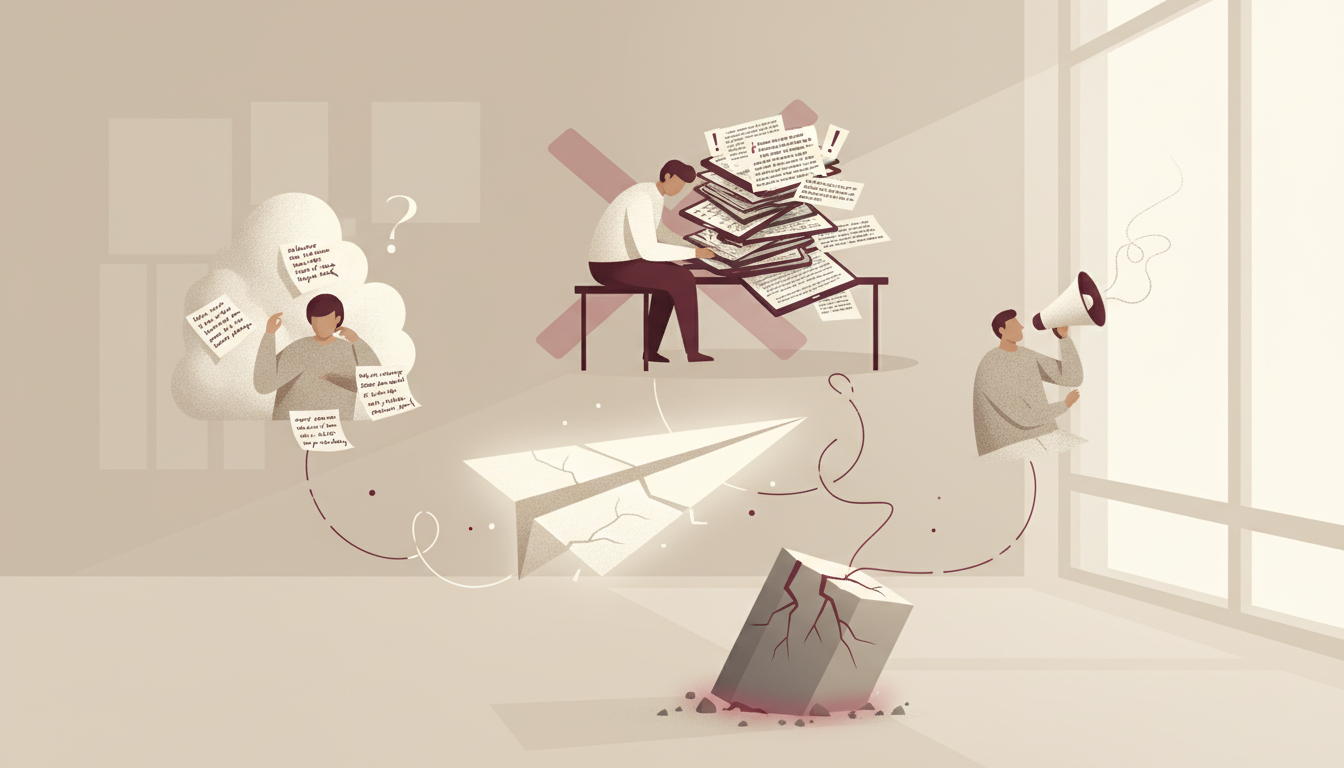
Habit #7: The Excessive Disclaimer Email
Starting emails with "I could be wrong, but…" or "This might be a dumb question…" or "I'm no expert, but…" preemptively discredits your message. According to a 2021 analysis by Grammarly's internal research team, emails containing self-deprecating disclaimers received 25% fewer follow-up actions than direct equivalents.
Scenario: You write to your director: "I'm probably overthinking this, but I noticed a discrepancy in the vendor contract." Now try: "I've identified a discrepancy in the vendor contract that may affect our Q4 budget. Details below." The second version gets read, forwarded, and acted on. The fix: Before hitting send, search your draft for disclaimer phrases. Delete every one. If your point is valid—and it almost certainly is—let it stand on its own. Our article on how to sound authoritative in emails covers nine specific shifts to strengthen your written presence.Habit #8: Over-Explaining and Over-Justifying
When you write three paragraphs to justify a simple request, you signal insecurity. Over-explaining says, "I'm worried you'll say no, so let me preemptively defend myself." Senior leaders, in particular, read this as a lack of confidence in your own judgment.
The fix: Use the Bottom Line Up Front (BLUF) method. State your request or recommendation in the first sentence. Provide supporting context in two to three bullet points. Stop.Habit #9: Burying Your Point in Passive Language
"It was thought that the deadline might need to be adjusted" is a masterclass in self-erasure. Who thought it? You did. Say so. Passive voice in professional writing often stems from a desire to avoid ownership—which is the exact opposite of what credible communicators do.
The fix: Rewrite passive constructions in the active voice. "I recommend adjusting the deadline to March 15 based on the revised scope." You can learn more about writing with executive-level clarity in our guide on how to write like a senior leader.The 3 Nonverbal and Behavioral Habits That Signal Self-Doubt
What you do with your body, your timing, and your physical presence communicates as loudly as your words. These three behavioral habits are the ones most professionals never think to examine.
Habit #10: Making Yourself Physically Smaller
Crossing your arms, hunching your shoulders, pulling your elbows tight against your body, looking down when speaking—these postures signal submission and uncertainty. Research by Amy Cuddy at Harvard Business School demonstrated that expansive postures are correlated with increased feelings of confidence and are perceived as more authoritative by observers.
The fix: Before high-stakes interactions, do a quick posture reset. Feet shoulder-width apart. Shoulders back and down. Hands visible—on the table or at your sides. When seated, take up the space your chair offers. Don't perch on the edge.Habit #11: Waiting Too Long to Contribute
If you consistently wait until the "safe" moment to speak—after everyone else has weighed in, after the decision is essentially made—you're training your team to make decisions without you. The longer you wait, the less your input matters, and the more invisible you become.
Scenario: In a project kickoff meeting, you have a critical insight about a technical risk. You wait 20 minutes for a "natural opening." By then, the conversation has moved on. You either stay silent or awkwardly backtrack. Either way, your insight is lost. The fix: Aim to contribute within the first third of any meeting. Even a brief, well-placed comment—"Before we move forward, I want to flag a risk I've identified"—establishes you as an active participant. For a practical framework, read our guide on how to stop shrinking in meetings.Habit #12: Nodding Excessively and Smiling Through Disagreement
Constant nodding—especially when you disagree—sends a confusing signal. It tells the speaker you agree when you don't, and it tells observers you lack conviction. A study published in the Journal of Nonverbal Behavior (2019) found that excessive head nodding during disagreement reduced the nodder's perceived leadership potential by 28%.
The fix: Use deliberate, slow nods to signal active listening—not rapid-fire bobbing. When you disagree, keep your head still, maintain eye contact, and use a neutral expression before stating your position. This nonverbal reset gives your words significantly more weight.Your Habits Are Your Reputation. Every meeting, email, and conversation is building—or eroding—your professional credibility. The Credibility Code gives you the exact replacement behaviors, scripts, and daily practices to project authority consistently. Discover The Credibility Code
How to Build a Habit Replacement System That Sticks
Knowing the 12 habits isn't enough. You need a system to catch them in real time and replace them consistently. Here's a proven three-step approach.

Step 1: Audit Your Current Patterns
Spend one week tracking your self-undermining habits. Use a simple tally sheet or notes app. After every meeting, email, or presentation, note which habits appeared. Most professionals find that two to three habits account for 80% of their self-undermining behavior.
Step 2: Choose One Replacement Behavior at a Time
Don't try to fix all 12 at once. Pick the habit that shows up most frequently and practice its replacement for two weeks. For example, if you over-apologize, commit to replacing every reflexive "sorry" with a direct opener for 14 consecutive days. Research on habit formation from University College London (2009) found that it takes an average of 66 days to automate a new behavior—but noticeable improvement begins within the first two weeks.
Step 3: Create Accountability Checkpoints
Ask a trusted colleague to flag your habit when they notice it. Review your sent emails weekly for hedging language. Record yourself in practice presentations and listen for upspeak. The goal isn't perfection—it's awareness followed by consistent correction.
For a comprehensive framework that ties all of these communication shifts together, our post on building professional credibility fast provides a structured five-step plan.
Why Self-Undermining Habits Persist (and Why Awareness Alone Won't Fix Them)
Most self-undermining habits are rooted in social conditioning, not incompetence. Many professionals—especially women and people from underrepresented groups—have been implicitly taught that softening their communication is polite, collaborative, or necessary for likability.
The Likability-Credibility Tension
Research from Georgetown University's Center on Education and the Workforce shows that professionals who communicate with direct authority are rated as 40% more competent but sometimes initially perceived as less "warm." This creates a real tension—especially for those who've been penalized for directness in the past.
The solution isn't to become cold or aggressive. It's to develop what we call calibrated authority: the ability to be direct and clear while remaining respectful and composed. This is the core skill that separates professionals who are liked from professionals who are liked and respected.
The Cost of Doing Nothing
Every day you continue these habits, you're compounding a credibility deficit. Promotions go to people who communicate with certainty. High-visibility projects are assigned to people who project confidence. Raises are negotiated by people who state their value without hedging. The habits in this article aren't minor quirks—they're career-limiting patterns.
Frequently Asked Questions
What is the most common way people undermine themselves at work?
The most common self-undermining habit is hedging language—using qualifiers like "just," "maybe," "sort of," and "I think" that weaken otherwise strong statements. It's so pervasive because it feels polite and low-risk. But over time, it trains colleagues and leaders to view your contributions as uncertain and optional rather than authoritative and essential.
How do I stop undermining myself vs. being more assertive—what's the difference?
Stopping self-undermining is about removing habits that diminish your existing credibility—like over-apologizing or deflecting praise. Being more assertive is about adding behaviors that project confidence—like stating your position clearly or holding boundaries. They're complementary skills. You need to stop the leaks before you can build pressure. Our guide on being assertive at work without being aggressive covers the assertiveness side in depth.
Can self-undermining habits actually affect my chances of getting promoted?
Absolutely. A 2023 McKinsey & Company report on workplace advancement found that "executive presence"—which includes confident communication, decisive language, and authoritative body language—is cited as a top factor in promotion decisions by 72% of senior leaders surveyed. Self-undermining habits directly erode every component of executive presence.
How long does it take to stop undermining yourself at work?
Most professionals notice meaningful improvement within two to four weeks of focused practice on a single habit. Full behavioral change—where the new pattern becomes automatic—typically takes 60 to 90 days, consistent with habit formation research from University College London. The key is targeting one habit at a time rather than attempting to overhaul your entire communication style at once.
Is self-undermining the same as imposter syndrome?
They're related but distinct. Imposter syndrome is an internal feeling of fraudulence—believing you don't deserve your success. Self-undermining is the external behavior that often results from those feelings—the hedging, apologizing, and deflecting that others can see and hear. You can experience imposter syndrome without undermining yourself if you learn to manage the behavioral output. Our guide on overcoming imposter syndrome at work addresses the mindset side.
Do men and women undermine themselves differently at work?
Research suggests that while both men and women engage in self-undermining behaviors, the patterns differ. Women are more likely to over-apologize, deflect praise, and use hedging language, while men are more likely to over-explain or use filler words to maintain conversational control. The Catalyst 2022 survey found that women minimize accomplishments at a rate 42% higher than male peers. Both groups benefit equally from targeted habit replacement.
Stop Letting Hidden Habits Hold You Back. You've now identified the 12 patterns that silently erode professional credibility. The Credibility Code gives you the complete playbook—replacement scripts, daily confidence practices, and a proven authority-building framework—to communicate like the leader you already are. Discover The Credibility Code
Ready to Command Authority in Every Conversation?
Transform your professional communication with proven techniques that build instant credibility. The Credibility Code gives you the frameworks top leaders use to project confidence and authority.
Discover The Credibility CodeRelated Articles

How to Communicate With Confidence at Work: Daily Guide
Communicating with confidence at work requires a daily system, not a one-time effort. Start each morning with a two-minute intention-setting ritual, then apply specific techniques throughout the day—using direct language in emails, structured frameworks in meetings, and steady vocal pacing in conversations. End with a brief reflection to identify what worked. Research shows that professionals who practice confident communication habits daily are perceived as more competent and promotable. This g

How to Handle Being Interrupted in Meetings Professionally
When you're interrupted in a meeting, pause briefly, maintain open body language, and use a calm redirect phrase such as "I'd like to finish my point" or "Let me complete this thought." The key is responding without escalating—combining assertive language with composed delivery signals confidence and commands respect. Chronic interrupters can be managed through proactive strategies like pre-framing your contributions, building alliances, and addressing the pattern directly in private.

How to Stop Sounding Uncertain at Work: 11 Quick Fixes
To stop sounding uncertain at work, eliminate these eleven habits immediately: uptalk (rising intonation on statements), qualifier words like "just" and "kind of," apologetic openers, hedging phrases, filler words, weak email language, tentative body language, over-explaining, permission-seeking phrasing, vocal fry trailing off, and deflecting compliments. Replace each one with a direct, confident alternative—specific before-and-after swaps are provided below.