
How to Communicate with Gravitas: A Practical Guide

Communicating with gravitas means speaking with a combination of authority, composure, and intentional weight that makes people stop and listen. To develop it, focus on five core areas: choose precise, confident language; control your vocal delivery (pace, tone, pauses); regulate your emotions under pressure; use strategic silence instead of filling space; and anchor every statement in substance over style. Gravitas isn't about being loud—it's about being unmistakably credible every time you speak.
What Is Gravitas in Professional Communication?
Gravitas is the quality that makes your words land with weight and authority in professional settings. It's the combination of composure, substance, and deliberate delivery that signals to others, "This person knows what they're talking about, and they mean what they say."
Unlike charisma—which draws people in through warmth and energy—gravitas commands respect through steadiness, depth, and restraint. A 2012 study by the Center for Talent Innovation (now Coqual) found that gravitas was cited by 67% of senior executives as the most important component of executive presence, outranking communication skills and appearance combined.
Gravitas isn't a personality trait you're born with. It's a communication skill you build through deliberate practice in how you choose words, control your voice, manage your body, and handle pressure. For a deeper exploration of how gravitas fits into the broader picture of leadership presence, it helps to understand it as one pillar of a larger system.
The Five Pillars of Communicating with Gravitas
Gravitas isn't a single behavior—it's the convergence of five distinct communication skills working together. Master each one individually, and they compound into a presence that's hard to ignore.
Pillar 1: Substance Over Filler
People with gravitas say less but mean more. Every sentence carries informational or strategic weight. They don't pad their contributions with qualifiers, disclaimers, or unnecessary context.
Without gravitas: "I'm not sure if this is the right time to bring this up, but I was kind of thinking maybe we should look at the Q3 numbers because they seem a little off to me, if that makes sense?" With gravitas: "The Q3 numbers show a 12% deviation from forecast. I recommend we investigate the supply chain delays before finalizing the annual plan."The difference isn't confidence alone—it's preparation. People who communicate with gravitas have done the thinking before they open their mouths. Research from Harvard Business Review shows that executives spend an average of 2-3 minutes structuring their thoughts before contributing in high-stakes meetings. If you want to learn how top leaders organize their ideas before speaking, explore how executives structure their thoughts before speaking.
Pillar 2: Vocal Authority
Your voice is the delivery mechanism for gravitas. A strong message delivered in a thin, rushed, or upward-inflecting voice loses its power instantly.
Three vocal elements matter most:
- Pace: Slow down by 10-15%. Rushed speech signals anxiety. Measured speech signals control.
- Pitch: Speak from your chest, not your throat. A study published in the Journal of Experimental Psychology (2014) found that speakers with lower vocal pitch were perceived as more dominant, competent, and trustworthy.
- Pauses: A deliberate two-second pause before a key statement creates anticipation and signals that what follows matters.
Record yourself in your next meeting or presentation. Listen for upspeak (ending statements like questions), filler words, and speed. These are the first things to correct. For a complete vocal training approach, see our guide on how to sound authoritative through vocal and language shifts.
Pillar 3: Emotional Regulation
Nothing destroys gravitas faster than visible emotional reactivity. When you get defensive, flustered, or visibly anxious, you hand your credibility to whoever triggered the reaction.
Emotional regulation doesn't mean suppressing emotions. It means creating a gap between stimulus and response. Here's a practical method:
- Notice the trigger. Someone challenges your idea, interrupts you, or asks a question you can't answer.
- Pause physically. Take one breath. Place your hands flat on the table or clasp them in front of you.
- Respond from position, not emotion. Ask yourself: "What does the most credible version of me say right now?"
The second response demonstrates composure, intellectual confidence, and a willingness to engage without defensiveness. That's gravitas in action. For more on maintaining composure under fire, read our piece on how to stop shrinking in high-stakes conversations.
Ready to Build Unshakeable Professional Presence? The principles in this article are the foundation—but gravitas is built through daily practice and systematic habit change. Discover The Credibility Code for a complete framework that transforms how you communicate, lead, and show up in every professional interaction.
Strategic Silence: The Most Underused Gravitas Tool
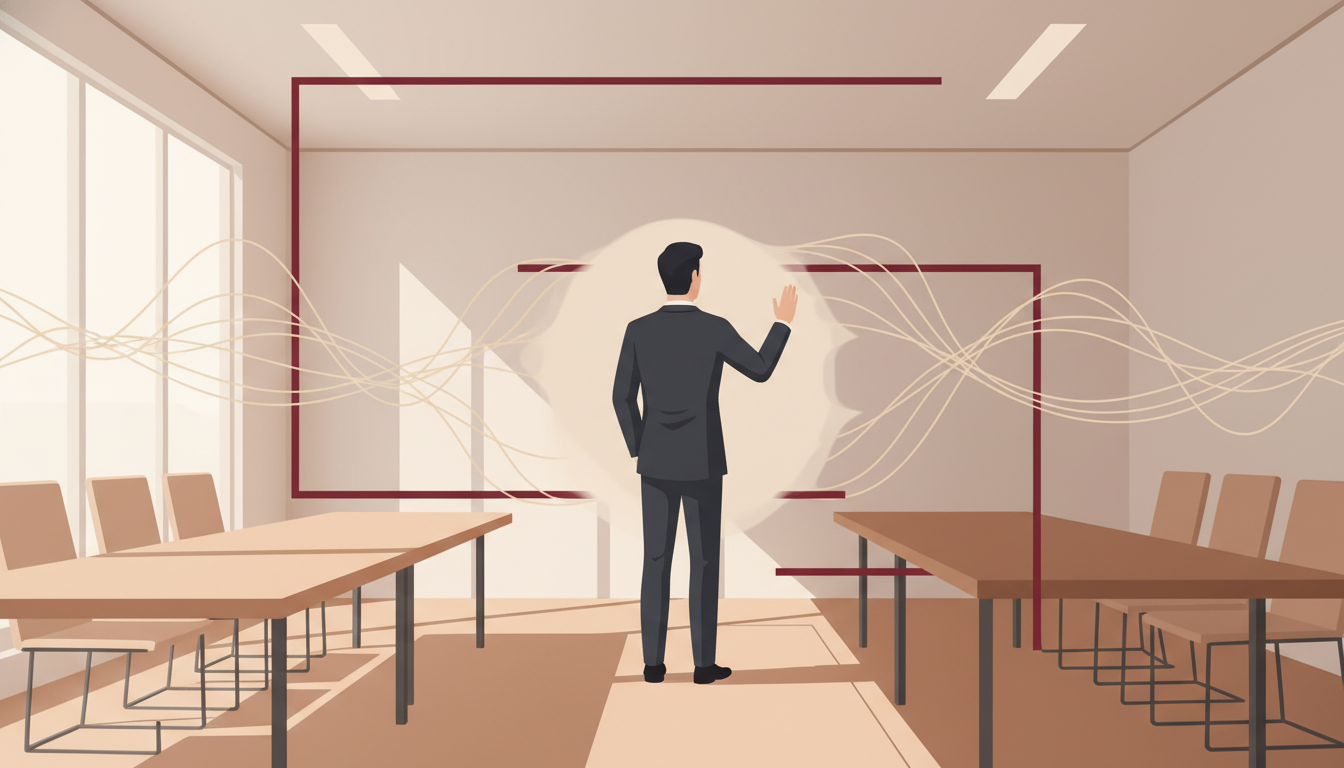
Most professionals treat silence as a void to fill. Communicators with gravitas treat it as a weapon.
Why Silence Signals Power
Research from the MIT Human Dynamics Lab found that the most influential communicators in group settings spoke less than their peers but with greater impact per contribution. Silence communicates three things simultaneously: you're listening, you're thinking, and you don't need to perform to prove your value.
Consider two leaders in the same meeting. One speaks six times, offering reactions and opinions on every topic. The other speaks twice—once to reframe the core problem, once to propose a path forward. Who carries more weight? Almost always, the second.
How to Use Silence Tactically
Before answering a question: Pause for 2-3 seconds. This signals that you're considering the question seriously rather than reacting reflexively. It also prevents you from blurting out a half-formed answer. After making a key point: Stop talking. Don't dilute your statement with "Does that make sense?" or "So, yeah." Let the point breathe. The silence after a strong statement amplifies it. During a negotiation: When someone makes an offer or a demand, resist the urge to respond immediately. A 2019 study in the Journal of Applied Psychology found that negotiators who used deliberate pauses achieved outcomes 9% more favorable than those who responded immediately. Silence creates productive discomfort that often leads the other party to concede, clarify, or improve their position. If you're working on your negotiation presence, our guide on negotiation tone of voice covers this in depth. When someone is being provocative: Silence is the most powerful response to someone trying to bait you. A calm, steady gaze followed by a measured response communicates that you're in control of the conversation—not them.Word Choice: The Language Architecture of Gravitas
The specific words you choose either build or erode gravitas. This isn't about using big words—it's about using precise, decisive, and unhedged language.
Words and Phrases That Undermine Gravitas
Hedging language is the silent killer of professional credibility. These phrases signal uncertainty, deference, or a need for approval:
| Undermining Language | Gravitas Alternative |
|---|---|
| "I just wanted to..." | "I'm reaching out to..." |
| "I think maybe we should..." | "I recommend we..." |
| "Sorry, but..." | "To clarify..." |
| "Does that make sense?" | "Here's the key takeaway." |
| "I'm no expert, but..." | (State your point directly.) |
| "Hopefully this works." | "This approach addresses the core issue." |
A study by Grammarly's communication research team (2023) found that professionals who frequently used hedging language in written communication were 35% less likely to receive responses from senior leaders. Your words are your credibility. For a complete breakdown of language patterns that weaken your impact, see our guide on words that make you sound less confident at work.
Structuring Your Message for Maximum Weight
Gravitas isn't just about individual words—it's about how you structure your message. Use this three-part framework for any high-stakes contribution:
- Lead with the conclusion. State your position or recommendation first. Don't bury it under context and caveats.
- Support with evidence. Provide 2-3 data points, examples, or logical reasons.
- Close with implication. Explain what this means for the team, project, or organization.
"We need to delay the product launch by three weeks. (Conclusion.) Our beta testing revealed two critical usability issues that affect 40% of user workflows, and engineering needs 15 business days to resolve them. (Evidence.) Launching on schedule with these issues would risk a 20% increase in customer support tickets and damage our credibility with early adopters. (Implication.)"
This structure forces you to lead with substance and close with stakes—two hallmarks of communication with gravitas.
Body Language and Physical Presence
Your body communicates before your mouth opens. Research by Albert Mehrabian, while often oversimplified, correctly identified that nonverbal cues heavily influence how messages are received—particularly in ambiguous or high-stakes situations.
The Gravitas Posture
Three physical habits signal gravitas immediately:
- Stillness. Reduce fidgeting, swaying, and unnecessary hand movements. Controlled stillness communicates composure. People who are anxious move more; people who are confident move with intention.
- Eye contact. Hold eye contact for 3-5 seconds at a time when making a point. In group settings, deliver one complete thought to one person before moving your gaze to the next. This creates a sense of direct, personal authority.
- Space ownership. Take up appropriate physical space. Plant your feet shoulder-width apart. Use open hand gestures at waist height. Don't cross your arms or shrink into your chair.
Virtual Gravitas
In virtual meetings, physical presence is compressed into a small rectangle on screen. Adjust accordingly:
- Camera at eye level. Looking down at a laptop camera makes you appear smaller and less authoritative.
- Lean slightly forward. This signals engagement and intention.
- Minimize background distractions. A clean, professional background removes visual noise and keeps attention on you.
- Pause before unmuting. This micro-moment of preparation prevents rushed, disorganized contributions.
For a deeper dive into commanding presence on camera, explore our guide on leadership presence in virtual meetings.
Turn These Principles Into Daily Practice. Gravitas isn't built in a single conversation—it's developed through consistent, deliberate shifts in how you communicate every day. Discover The Credibility Code and get the complete system for building authority, credibility, and commanding presence in every professional interaction.
Real-World Scenarios: With and Without Gravitas
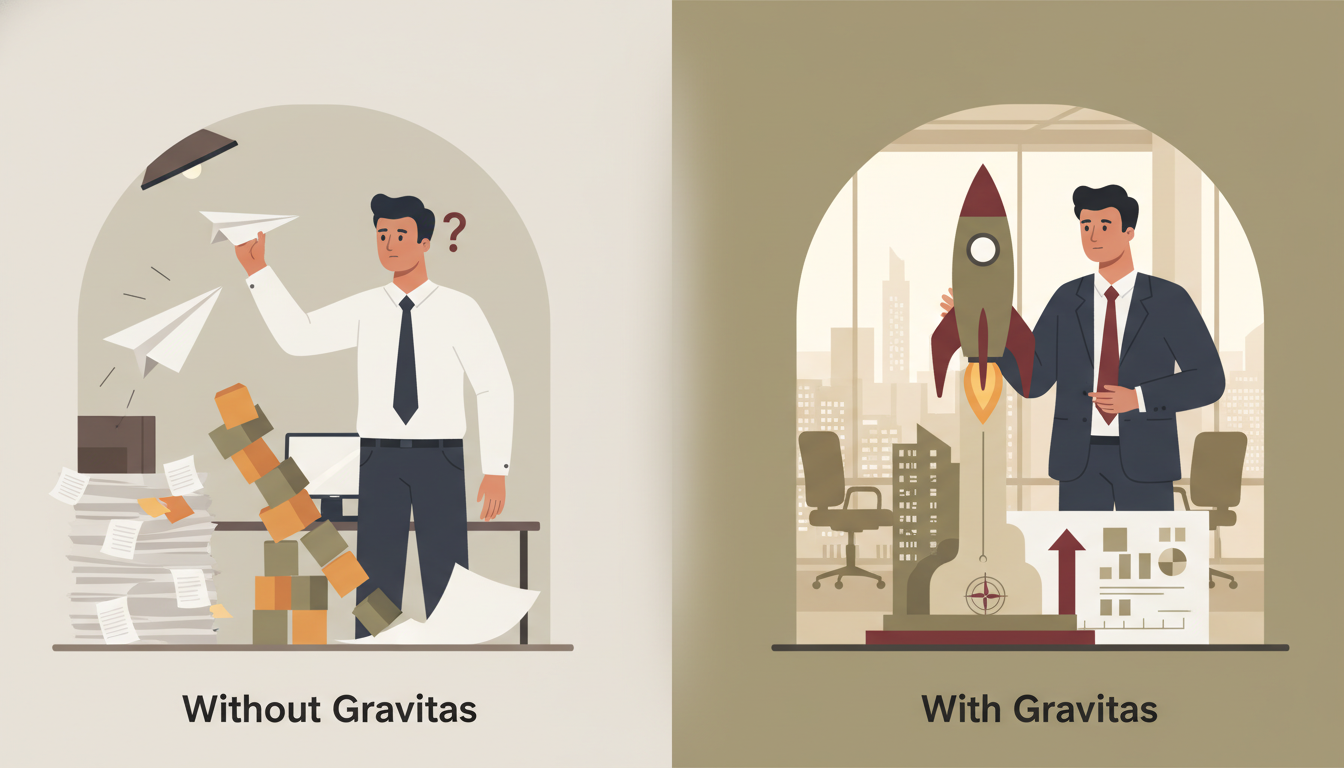
Theory matters, but application is everything. Here are three common professional situations showing the concrete difference gravitas makes.
Scenario 1: Presenting a Recommendation to Senior Leaders
Without gravitas: "So, um, I've been looking at some data and I think—well, it's possible—that we might want to consider shifting our approach to the European market. There are some numbers that suggest it could be worth exploring, but I know there are a lot of factors at play." With gravitas: "I'm recommending we shift our European market strategy from broad distribution to targeted partnerships in three key markets. Our data from the last two quarters shows that concentrated efforts in Germany, France, and the Netherlands generated 3x the ROI of our spread approach. I'd like to walk you through the implementation plan." What changed: Direct recommendation upfront. Specific data. Clear next step. No hedging.Scenario 2: Responding to a Challenge in a Meeting
Without gravitas: "Well, I mean, I see your point, and yeah, maybe I didn't think about it that way. I guess we could look at other options too." With gravitas: "I appreciate that perspective. The approach I've outlined accounts for the risk you're raising—specifically in the contingency modeling on slide seven. But I'm open to hearing an alternative if you have one in mind." What changed: Acknowledged the challenge without conceding ground. Referenced specific evidence. Invited productive dialogue rather than retreating.Scenario 3: Delivering Difficult News to Your Team
Without gravitas: "So, I have some bad news, and I'm really sorry about this. The project timeline is being moved up, and I know that's going to be hard for everyone. I tried to push back, but leadership wants what they want, you know?" With gravitas: "Our timeline has been accelerated by two weeks. I understand the pressure this creates, and I want to be transparent about why: the client's board meeting moved forward, and delivering on this new timeline positions us for the contract renewal. Here's how I'm proposing we adjust workstreams to make this achievable." What changed: No apology for circumstances beyond control. Transparent reasoning. Immediate pivot to solutions. Ownership of the path forward.Frequently Asked Questions
What is the difference between gravitas and arrogance?
Gravitas is grounded in substance, composure, and respect for others. It draws authority from expertise and emotional steadiness. Arrogance is rooted in ego and dismissiveness—it demands respect rather than earning it. A person with gravitas listens carefully and responds with weight. An arrogant person talks over others and assumes superiority. The key test: does the person make others feel respected or diminished? For more on this distinction, read our guide on projecting authority without arrogance.
Can introverts develop gravitas?
Absolutely. In fact, introverts often have natural advantages in developing gravitas. Their tendency toward thoughtful observation, measured responses, and deep listening aligns perfectly with the core components of gravitas. Introverts don't need to become louder—they need to become more intentional about when and how they contribute. Strategic, well-timed contributions carry more weight than constant participation.
How long does it take to develop gravitas?
Most professionals notice a meaningful shift within 30-60 days of deliberate practice. Specific changes—like eliminating hedging language, slowing your speaking pace, and using strategic pauses—can produce visible results within the first week. Deeper shifts in emotional regulation and physical presence take longer because they require rewiring habitual responses. Consistency matters more than intensity.
Gravitas vs. charisma: what's the difference?
Charisma attracts through warmth, energy, and personal magnetism. Gravitas commands through composure, substance, and weight. Charismatic leaders make you feel excited; leaders with gravitas make you feel certain. The most effective communicators develop both, but gravitas is more learnable and more durable. Charisma can fluctuate with mood and energy; gravitas is built on habits and discipline.
How do I communicate with gravitas in emails?
Apply the same principles: lead with your key point, eliminate hedging language, use short and direct sentences, and close with a clear action or implication. Avoid excessive exclamation points, unnecessary apologies, and phrases like "Just checking in" or "Hope this finds you well." Every sentence should earn its place. For a complete email framework, see our guide on how to project authority in emails.
Can you have gravitas without being a senior leader?
Yes. Gravitas is not tied to title or tenure—it's tied to how you communicate. Junior professionals who speak with precision, listen with intention, and respond with composure are often perceived as more credible than senior leaders who ramble or react emotionally. Building gravitas early in your career accelerates your trajectory toward leadership roles.
Your Communication Is Your Career Currency. Every meeting, presentation, and conversation is an opportunity to build—or erode—your professional credibility. Discover The Credibility Code gives you the complete system for communicating with gravitas, authority, and presence that earns trust and drives your career forward.
Ready to Command Authority in Every Conversation?
Transform your professional communication with proven techniques that build instant credibility. The Credibility Code gives you the frameworks top leaders use to project confidence and authority.
Discover The Credibility CodeRelated Articles

How to Communicate With Gravitas at Work: 8 Key Shifts
Communicating with gravitas at work means speaking with a deliberate blend of authority, composure, and substance that makes people stop and listen. It requires eight specific shifts: leading with your conclusion, eliminating hedging language, slowing your delivery, grounding your body language, using strategic silence, choosing precise words, anchoring claims in evidence, and holding your ground under pressure. These shifts transform you from someone who shares ideas into someone whose ideas sh
How to Communicate with Gravitas: 10 Daily Practices
Gravitas isn't a personality trait you're born with—it's a communication skill you build through deliberate daily practice. To communicate with gravitas, focus on ten core habits: choosing precise words over filler, slowing your pace, using strategic pauses, listening before responding, grounding your body language, leading with evidence, structuring your thoughts before speaking, managing your vocal tone, asking powerful questions, and closing conversations with clarity. These practices, repeat

How to Communicate With Gravitas at Work: 8 Shifts
To communicate with gravitas at work, make eight deliberate shifts: replace hedging language with direct statements, slow your speaking pace, lead with conclusions instead of backstory, use strategic pauses, ground your body language, speak in shorter sentences, anchor claims in evidence, and hold your composure under pressure. Gravitas isn't about being the loudest voice—it's about carrying weight in every word you choose.