
Professional Communication Skills: 15 Before-and-After Examples

Professional communication skills examples boil down to one pattern: replacing vague, hesitant, or unfocused language with clear, confident, and structured phrasing. Below, you'll find fifteen side-by-side before-and-after transformations across emails, meetings, presentations, and negotiations — each showing exactly how small wording shifts build authority, earn trust, and position you as a credible professional others want to follow.
What Are Professional Communication Skills?
Professional communication skills are the specific verbal, written, and nonverbal abilities you use to convey ideas, influence decisions, and build credibility in the workplace. They include how you structure an email, how you speak up in a meeting, how you deliver a presentation, and how you navigate difficult conversations.
Unlike casual communication, professional communication carries an implicit requirement: every word either builds or erodes your perceived competence. According to a 2024 Harris Poll commissioned by Grammarly, poor workplace communication costs U.S. businesses an estimated $1.2 trillion annually — roughly $12,506 per employee per year. The professionals who master these skills don't just communicate better; they get promoted faster, close more deals, and command more respect in every room they enter.
Email Communication: 5 Before-and-After Examples
Email is where most professionals first reveal — or undermine — their credibility. A study published in the Journal of Personality and Social Psychology (Kruger et al., 2005) found that people overestimate how well their tone and intent come across in email by nearly 50%. That means your phrasing has to do the heavy lifting.
Example 1: Requesting a Decision from a Senior Leader
Before: "Hi Sarah, I just wanted to check in and see if you maybe had a chance to look at the proposal I sent over? No rush at all, but it would be great to get your thoughts whenever you get a chance. Thanks so much!" After: "Hi Sarah, the Q3 vendor proposal needs your approval by Friday to meet the March 1 launch date. I've attached a one-page summary with my recommendation. Could you confirm your decision by Thursday EOD?" What changed: The "after" version removes hedging language ("just," "maybe," "no rush"), states the business consequence, and gives a specific deadline. It respects the reader's time and positions you as someone who drives outcomes, not someone who waits passively. For more on this pattern, see our guide on how to sound confident in emails.Example 2: Pushing Back on an Unrealistic Deadline
Before: "I'm not sure we can really do that in two weeks? It seems like a lot. I'll try my best though." After: "To deliver this at the quality level the client expects, we need three weeks. Here's why: the design phase alone requires five business days for stakeholder review. I can hit a two-week timeline if we reduce scope to Phase 1 only. Which approach do you prefer?" What changed: The "after" version replaces uncertainty with a clear rationale, offers an alternative, and ends with a decision point — not a complaint.Example 3: Following Up Without Sounding Desperate
Before: "Just following up again on my last email. Sorry to bother you! I know you're super busy." After: "Circling back on the budget approval from my April 3 email. The vendor discount expires April 15, so I'd like to finalize by April 10. Let me know if you need additional data to decide." What changed: No apology, no self-diminishing language. The "after" version adds urgency through a business reason, not emotional pressure. If you catch yourself over-apologizing in emails, our article on how to stop undermining yourself at work breaks down twelve habits to eliminate.Example 4: Introducing Yourself to a New Stakeholder
Before: "Hi, I'm Tom. I'm sort of new to the project team. I'll be helping out with some of the analytics stuff." After: "Hi, I'm Tom Chen, the analytics lead for Project Atlas. I'll be owning the data strategy and reporting cadence for your team. I'd like to schedule a 20-minute call this week to align on your top three reporting priorities." What changed: Specific title, clear ownership, and an immediate next step. This positions you as a peer, not an afterthought.Example 5: Delivering Bad News to a Client
Before: "Unfortunately, we ran into some issues and things are going to be a bit delayed. Really sorry about this." After: "The integration testing revealed a data migration error that impacts report accuracy. We've identified the root cause and are implementing a fix. The revised delivery date is May 5 — two business days past our original target. I'll send a progress update on May 3." What changed: The "after" version names the problem, explains the fix, provides a new timeline, and commits to a follow-up. According to a PwC survey, 73% of consumers and business clients say experience — including transparent communication during setbacks — is a key factor in purchasing decisions. Credibility isn't built by avoiding mistakes; it's built by how you communicate through them. Learn more in our guide on how to deliver bad news professionally and with poise.Ready to Transform Your Professional Communication? These email examples are just the surface. The Credibility Code gives you a complete system for writing, speaking, and presenting with authority — so you're never overlooked again. Discover The Credibility Code
Meeting Communication: 5 Before-and-After Examples
Meetings are where reputations are built or broken in real time. A Harvard Business Review study found that executives form impressions of a colleague's competence within the first few minutes of a meeting interaction. You rarely get a second chance to reshape that perception.
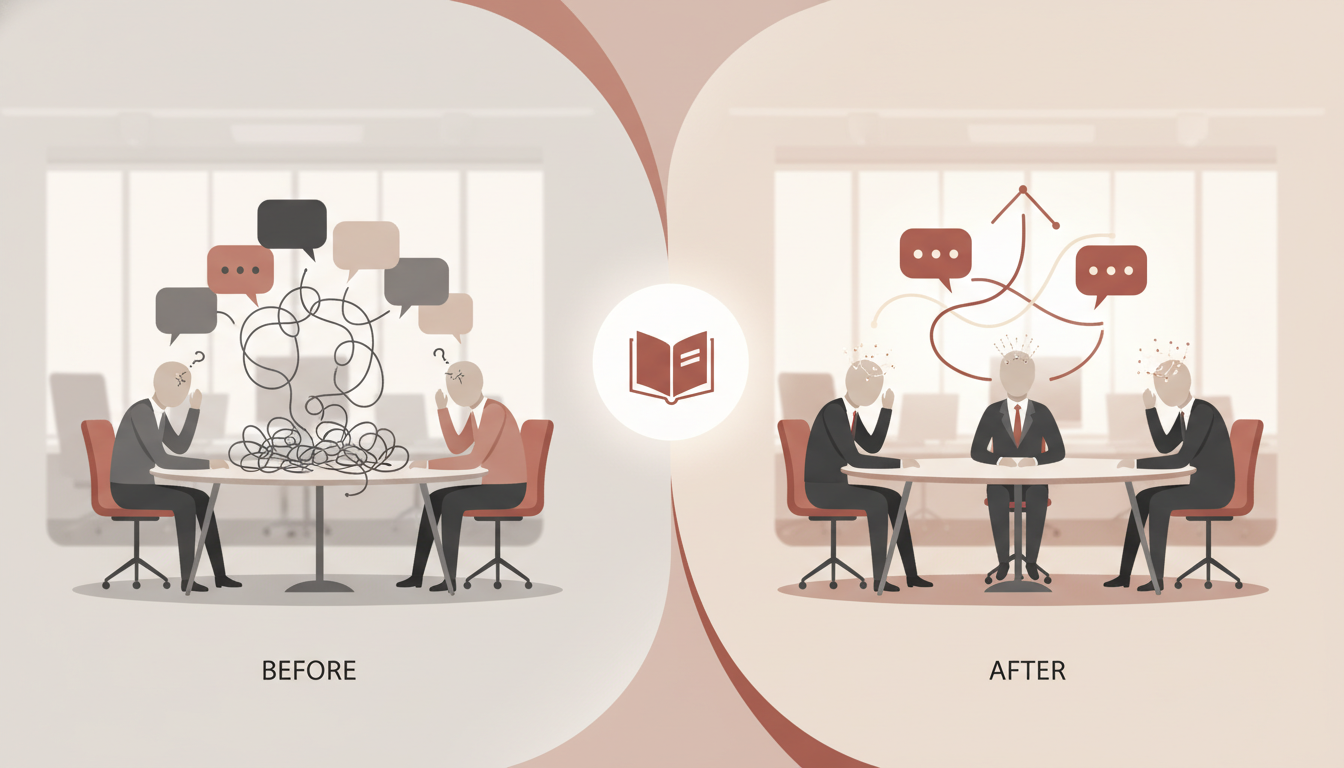
Example 6: Sharing an Opinion in a Strategy Meeting
Before: "I don't know, this might be a dumb idea, but what if we maybe tried a different approach? I could be wrong though." After: "I'd like to propose an alternative approach. Based on last quarter's conversion data, shifting budget from paid search to content marketing could reduce our cost-per-lead by 18%. Here's the data." What changed: The "before" version pre-apologizes, signals low confidence, and buries the idea. The "after" version leads with a clear statement, backs it with data, and invites discussion from a position of strength. If speaking up in meetings feels hard, our framework for how to speak up in meetings with senior leaders can help.Example 7: Responding When Put on the Spot
Before: "Oh, um, I didn't really prepare for that question. I'm not sure... let me think... I guess maybe the numbers are somewhere around... I'd have to check." After: "That's an important question. I want to give you an accurate answer rather than estimate. I'll pull the exact figures and send them to you by 3 PM today. What I can tell you right now is that the trend has been consistently upward for three consecutive quarters." What changed: The "after" version acknowledges the question, commits to a specific follow-up, and shares what you do know — all without faking an answer. This is the hallmark of someone with genuine gravitas.Example 8: Disagreeing with a Senior Leader
Before: "I mean, I guess that could work, but I kind of feel like there might be some issues with it? I don't know." After: "I see the logic in that direction, and I want to flag a risk. When we took a similar approach in Q2, we saw a 14% drop in retention. I'd recommend we pilot this with one region before a full rollout. That way, we protect the upside while limiting exposure." What changed: The "after" version validates the leader's thinking, introduces data-backed risk, and offers a constructive alternative. You disagree without creating conflict — you elevate the conversation.Example 9: Redirecting a Meeting That's Gone Off Track
Before: "Sorry, but I think we might be getting a little off topic? Maybe we should get back to the agenda? Just a thought." After: "This is a valuable discussion, and I want to make sure we give it the time it deserves. For today, we have two decisions to finalize before noon. I'd suggest we table this topic for Thursday's working session and refocus on the budget approval. Agreed?" What changed: No apology. The "after" version frames the redirect as serving the group's interest, names the specific priority, and proposes a clear next step.Example 10: Presenting Your Team's Work to Leadership
Before: "So our team has been working really hard on this, and we've done a lot of stuff. Here are some of the things we've been up to." After: "In Q1, my team delivered three outcomes worth highlighting. First, we reduced customer onboarding time by 22%. Second, we launched the self-service portal, which is now handling 40% of Tier 1 support tickets. Third, we completed the CRM migration two weeks ahead of schedule. Here's what's next for Q2." What changed: Specific results replace vague effort descriptions. Leadership doesn't care how hard you worked — they care what you delivered. For a complete framework on presenting to senior leaders, see our guide on how to present to senior leadership.Presentation & Public Speaking: 3 Before-and-After Examples
Presentations amplify every communication strength and weakness. Research by Dr. Albert Mehrabian, often cited in communication studies, found that when verbal and nonverbal signals conflict, audiences rely on tone of voice (38%) and body language (55%) far more than words alone (7%). Your delivery has to match your content.
Example 11: Opening a Presentation
Before: "Hi everyone, thanks for coming. So, um, I'm going to talk about our marketing strategy today. I have a lot of slides, so hopefully I'll get through them all. Let me just find my first slide..." After: "Last quarter, we left $340,000 in pipeline revenue on the table because our lead nurturing sequence had a 68% drop-off rate. Today, I'll show you exactly how we fix that — and the three changes that will recover that revenue by Q3." What changed: The "after" version opens with a specific, consequential number that creates urgency. It tells the audience exactly what they'll gain by listening. No throat-clearing, no apologies.Example 12: Handling a Tough Q&A Question
Before: "That's a really good question. Hmm, I'm not really sure about that. I think maybe it could be because of several factors? Let me get back to you." After: "Great question. The primary driver is our 34% increase in raw material costs since January. We've offset roughly half of that through supplier renegotiation. The remaining gap is what this proposal addresses. I'm happy to walk through the cost breakdown after the session if you'd like the full picture." What changed: A direct answer, supported by data, with an offer to go deeper. This signals competence and composure — two pillars of executive presence.Example 13: Closing a Presentation
Before: "So, yeah, that's basically it. Does anyone have any questions? Thanks for listening." After: "To summarize: we have a $340,000 revenue gap, a proven three-step fix, and a 90-day implementation window. I need two things from this room — budget approval by Friday and a project sponsor from the sales leadership team. Who's in?" What changed: The "after" version restates the core message, names the specific ask, and ends with a direct call to action. Strong closers don't trail off — they land.Your Words Are Your Career Currency Every email, meeting comment, and presentation either builds or erodes your professional credibility. The Credibility Code gives you the exact scripts, frameworks, and daily practices to communicate with authority — starting today. Discover The Credibility Code
Negotiation & Difficult Conversations: 2 Before-and-After Examples
Negotiation and high-stakes conversations are where professional communication skills matter most — and where most people revert to their weakest habits. A study from Columbia Business School found that professionals who use structured communication frameworks in negotiations achieve outcomes 12-18% better than those who wing it.
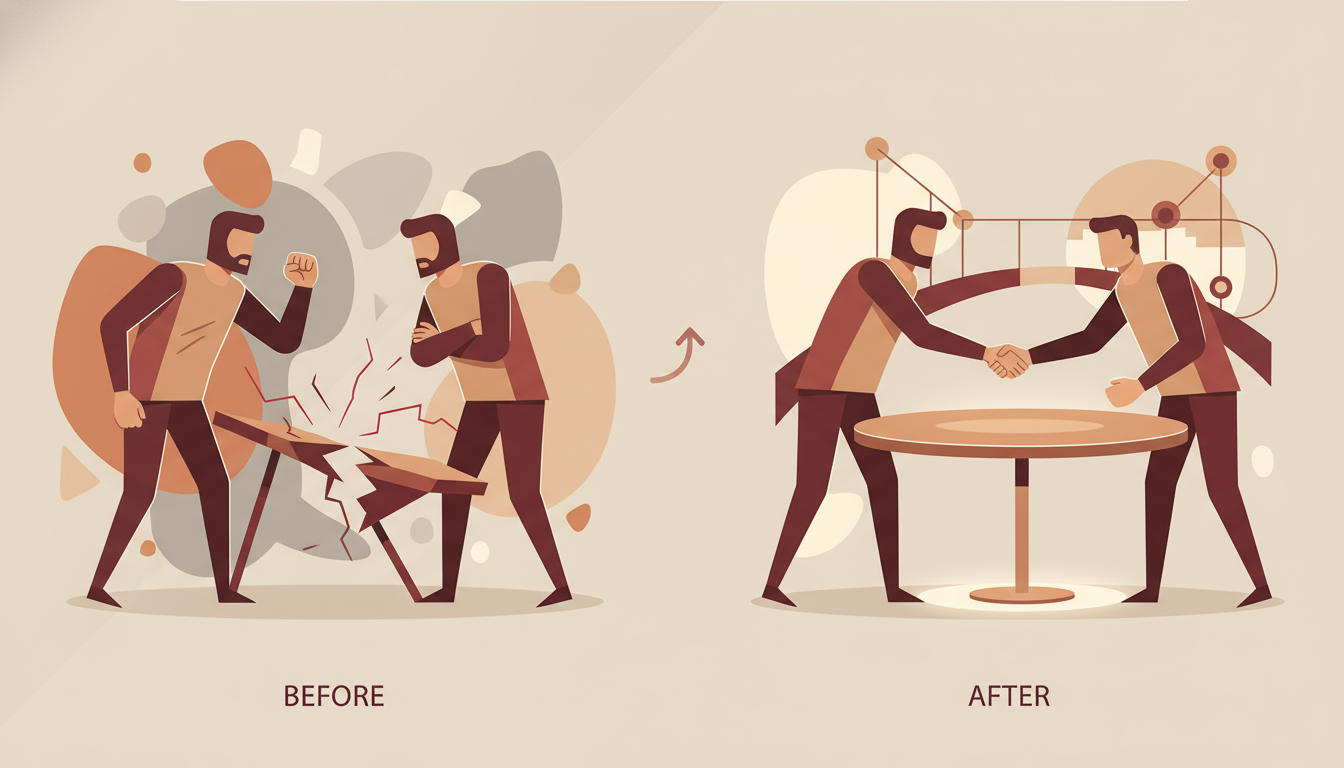
Example 14: Negotiating a Salary Increase
Before: "I was kind of hoping we could maybe talk about my salary? I've been here for a while and I feel like I've been doing a pretty good job. I was wondering if there was any chance of a raise?" After: "I'd like to discuss a compensation adjustment based on three factors. First, I've exceeded my revenue target by 23% for two consecutive quarters. Second, I've taken on the client success portfolio, which was previously a separate role. Third, market data from Glassdoor and Payscale shows my current compensation is 15% below the median for this role in our market. Based on these factors, I'm requesting a salary adjustment to $95,000." What changed: The "after" version presents evidence, references external data, and names a specific number. It frames the request as a business case, not a personal plea. For complete salary negotiation scripts, visit our guide on salary negotiation confidence scripts that command respect.Example 15: Addressing Underperformance with a Direct Report
Before: "Hey, so I just wanted to chat. Things have been a little off lately and I was just wondering if everything's okay? No big deal, I just thought we should maybe touch base." After: "I want to discuss your project delivery over the past 30 days. Three of your last five deliverables missed their deadlines, and two required significant revision. I value your work on this team, and I want to understand what's creating the gap. Let's identify the root cause together and build a plan to get back on track by month-end." What changed: The "after" version states specific observations (not feelings), communicates care without softening the message into meaninglessness, and proposes a collaborative solution with a deadline.The Pattern Behind All 15 Examples
If you study the transformations above, a clear framework emerges. Every "after" example follows the same four principles:
1. Lead with specifics, not feelings. Numbers, dates, and concrete outcomes replace "I feel like" and "sort of." 2. Remove hedging language. Words like "just," "maybe," "sort of," "kind of," and "I think" dilute your authority. Cut them ruthlessly. Our article on how to sound more professional covers twelve immediate changes you can make today. 3. End with a clear next step. Every strong communication closes with an action item, a decision point, or a specific ask. 4. Frame everything through the listener's interest. The "after" examples consistently answer the unspoken question: Why should I care?This isn't about being aggressive or domineering. It's about being clear, prepared, and intentional — which is exactly what credible professionals do.
Frequently Asked Questions
What are the most important professional communication skills?
The most important professional communication skills include clarity (saying exactly what you mean), conciseness (removing unnecessary words), active listening, confident body language, and structured messaging. Written skills — especially email — matter as much as verbal skills because most workplace communication happens digitally. The professionals who stand out master all channels, not just one.
How can I improve my professional communication skills quickly?
Start with elimination, not addition. Remove hedging words ("just," "maybe," "I think") from your emails and speech for one week. Then add structure: lead every message with the key point, support it with evidence, and close with a next step. These two changes alone can transform how others perceive your competence within days.
Professional communication skills vs. interpersonal skills: what's the difference?
Professional communication skills focus specifically on workplace contexts — emails, presentations, meetings, negotiations — where clarity, credibility, and influence are the goals. Interpersonal skills are broader and include empathy, relationship-building, and social awareness in any setting. Strong professional communicators use interpersonal skills as a foundation, but layer on structure, precision, and strategic framing that casual conversation doesn't require.
What are examples of poor professional communication?
Common examples include over-apologizing ("Sorry to bother you"), hedging ("I might be wrong, but..."), burying the main point at the end of a long email, using vague language instead of specific data, and failing to include a clear call to action. Each of these habits signals uncertainty and erodes credibility over time. See our full breakdown of professional communication mistakes hurting your career.
How do I communicate more confidently in meetings?
Prepare one key point before every meeting and commit to sharing it within the first ten minutes. Use the "Point-Evidence-Recommendation" structure: state your position, back it with one data point, and suggest a next step. Avoid filler words by pausing instead. Over time, this pattern becomes automatic — and your colleagues will begin turning to you as a voice of authority.
Can professional communication skills help me get promoted?
Yes. A LinkedIn Workplace Learning Report found that communication is consistently ranked among the top five skills employers look for when promoting internally. Promotions go to people who are visible, clear, and persuasive — not just technically competent. Strengthening how you communicate is one of the highest-leverage career moves you can make.
Turn These Examples Into Your Daily Communication Style You've seen what authoritative communication looks like across fifteen real-world scenarios. Now it's time to build these patterns into your daily habits. The Credibility Code gives you the complete system — scripts, frameworks, and daily practices — to communicate with confidence and authority in every professional interaction. Discover The Credibility Code
Featured image alt text: Side-by-side comparison of weak and strong professional communication examples in email, meeting, and presentation settings.
Ready to Command Authority in Every Conversation?
Transform your professional communication with proven techniques that build instant credibility. The Credibility Code gives you the frameworks top leaders use to project confidence and authority.
Discover The Credibility CodeRelated Articles

How to Communicate With Gravitas at Work: 8 Key Shifts
Communicating with gravitas at work means speaking with a deliberate blend of authority, composure, and substance that makes people stop and listen. It requires eight specific shifts: leading with your conclusion, eliminating hedging language, slowing your delivery, grounding your body language, using strategic silence, choosing precise words, anchoring claims in evidence, and holding your ground under pressure. These shifts transform you from someone who shares ideas into someone whose ideas sh

How to Communicate With Confidence at Work: A Full Guide
Communicating with confidence at work requires deliberate shifts in your language, vocal delivery, body language, and mindset. Start by eliminating hedging phrases ("I just think," "I'm not sure, but..."), replacing them with direct statements. Ground your voice by breathing from your diaphragm, slowing your pace, and pausing before key points. Prepare talking points before meetings so you speak with structure, not stream-of-consciousness. Practice daily in low-stakes conversations, and build up

How to Communicate with Gravitas: A Practical Guide
Communicating with gravitas means speaking with a combination of authority, composure, and intentional weight that makes people stop and listen. To develop it, focus on five core areas: choose precise, confident language; control your vocal delivery (pace, tone, pauses); regulate your emotions under pressure; use strategic silence instead of filling space; and anchor every statement in substance over style. Gravitas isn't about being loud—it's about being unmistakably credible every time you spe