
How to Speak Without Notes: A Professional's Guide

What Is Speaking Without Notes?
Speaking without notes is the ability to deliver a professional message—whether in a meeting, presentation, or conversation—without relying on written scripts, bullet points, or teleprompters. It means you've internalized your key points so deeply that you can communicate them naturally, adapting to your audience in real time.
This isn't about memorizing a speech word-for-word. It's about owning your message so completely that the words flow from understanding, not recitation. The result is a speaker who appears more confident, more credible, and more connected to the room.
Why Speaking Without Notes Builds Professional Credibility
The Perception Gap Between Scripted and Unscripted Speakers

When you glance down at notes, something subtle happens: your audience's trust dips. Research from the University of Wolverhampton found that speakers who maintained consistent eye contact were rated 23% more credible and 21% more competent than those who frequently broke gaze to reference materials (Beattie & Ellis, 2017). Every glance at your notes is a micro-signal that says, "I'm not sure enough to say this from my own authority."
Consider two scenarios. A director presents quarterly results by reading from a slide deck, pausing to find the next bullet point. Another director walks to the front, makes eye contact, and delivers the same data conversationally—pausing for emphasis, not for reference. The information is identical. The perception is not.
How Note-Free Speaking Signals Leadership Presence
Leaders who speak without notes project what executive coaches call "command of the room." They signal three things simultaneously: deep knowledge of the subject, confidence in their perspective, and respect for the audience's time. These are core components of leadership presence that separate emerging leaders from those who plateau.
According to a 2023 survey by Prezi, 70% of professionals agreed that presentation skills are critical for career success, yet only a small fraction feel confident presenting without a script. This gap represents a significant opportunity. If you can master note-free delivery, you immediately stand apart from the majority of your peers.
When Notes Are Appropriate (and When They're Not)
Let's be clear: there are situations where notes are expected and even wise. Reading exact figures during a financial review, quoting policy language in a compliance briefing, or referencing technical specifications—all perfectly appropriate. The goal isn't to never use notes. It's to never need them as a crutch.
The real credibility risk comes in settings where you should know your material: team updates, project pitches, strategy discussions, and leadership presentations. In these moments, notes signal under-preparation. Speaking freely signals mastery.
The Three-Point Anchor Framework for Note-Free Speaking
How the Framework Works
The Three-Point Anchor is a simple mental structure that replaces memorization with organized thinking. Here's the structure:
- Anchor Statement — Your one-sentence thesis or key message
- Three Supporting Points — The core ideas that support your anchor
- Landing Statement — Your closing call to action or summary
This mirrors how executives naturally structure their communication. As explored in our guide on how executives structure their thoughts before speaking, top leaders rarely memorize—they organize. They know their destination and three roads to get there.
Building Your Anchor in Practice
Imagine you're presenting a proposal to adopt a new project management tool. Here's how you'd build your anchor:
- Anchor Statement: "We need to switch to Asana because our current system is costing us time, visibility, and accountability."
- Point 1: Time — "We're spending 6 hours per week on manual status updates."
- Point 2: Visibility — "Leadership has no real-time view into project health."
- Point 3: Accountability — "Task ownership is unclear, and deadlines slip without consequence."
- Landing Statement: "I'm proposing a 30-day pilot with the marketing team. Here's what I need from this group to make that happen."
You don't need to memorize the words. You need to know the structure. The words will come because you understand the logic.
Why Three Points (Not Five or Seven)
Cognitive psychologist Nelson Cowan's research, published in Behavioral and Brain Sciences, established that working memory holds approximately 3-5 chunks of information reliably (Cowan, 2010). Three points hit the sweet spot: enough depth to be substantive, few enough to be memorable—for both you and your audience.
When you try to deliver seven points without notes, you'll inevitably forget one, stumble, and lose momentum. Three points give you a structure you can hold in your mind under pressure, even when your heart rate spikes and adrenaline narrows your focus.
Ready to Build Unshakeable Speaking Confidence? The Credibility Code gives you proven frameworks for commanding any room—without scripts, without notes, and without second-guessing yourself. Discover The Credibility Code
Memory Techniques That Replace Written Notes
The Method of Loci (Memory Palace)

The Method of Loci is a 2,500-year-old technique used by ancient Greek orators—speakers who delivered hours-long arguments in the Senate without a single written word. Here's how to adapt it for professional use:
- Choose a familiar location — your home, your commute route, your office hallway
- Assign each key point to a specific spot — Point 1 is at your front door, Point 2 is at the kitchen counter, Point 3 is at your desk
- Visualize each point vividly at its location — See the data, hear the phrase, feel the emphasis
- Walk through the location mentally before you speak
A 2023 study in Memory & Cognition found that participants using the Method of Loci recalled 62% more information than those using rote rehearsal (Dresler et al., 2017, replicated in subsequent studies). For a 10-minute leadership presentation, this technique is remarkably effective.
Chunking: Grouping Ideas Into Memorable Clusters
Chunking means grouping related ideas into categories so your brain processes them as single units rather than individual facts. Instead of remembering eight separate data points, you remember three categories, each containing two or three supporting details.
For example, if you're delivering a quarterly business review, chunk your content:
- Revenue (total, growth rate, top client)
- Operations (efficiency metric, headcount, key initiative)
- Outlook (risks, opportunities, one ask)
Each chunk becomes a mental "folder." When you open the folder during your talk, the details inside are readily available because they're contextually linked.
Retrieval Practice: The Most Underused Rehearsal Method
Most people prepare for a presentation by reading their notes over and over. This feels productive but builds a false sense of readiness. You're practicing recognition (seeing familiar words), not recall (producing ideas from memory).
Retrieval practice flips this. Instead of reading your notes, close them and try to deliver your talk from memory. Every time you struggle to recall a point, you strengthen the neural pathway for that information. Research published by Karpicke and Blunt in Science (2011) demonstrated that retrieval practice produced 50% better long-term retention than repeated study.
Here's a practical routine:
- Day 1: Build your Three-Point Anchor. Read through it twice, then close it and deliver aloud.
- Day 2: Without looking at notes, deliver your talk. Check afterward for gaps.
- Day 3: Deliver in front of a mirror or record yourself. Refine transitions.
- Day 4 (presentation day): One final retrieval run in the morning. Trust the structure.
Delivery Techniques That Make Note-Free Speaking Look Effortless
Strategic Pausing Instead of Filler Words
The biggest fear professionals have about speaking without notes is the dreaded blank moment—that terrifying second when the next word doesn't come. Here's the reframe: that moment is a pause, and pauses are powerful.
Research from the Max Planck Institute for Psycholinguistics found that strategic pauses of 2-3 seconds increase audience perception of speaker confidence and thoughtfulness (Bosker et al., 2020). The audience doesn't know you're searching for your next point. They think you're letting your last point land.
When you feel a blank coming, do three things: stop talking, take a breath, and mentally walk to the next room in your memory palace or the next point in your anchor. For more on this, explore our guide on how to pause effectively in public speaking.
To further eliminate filler words like "um" and "uh," practice the technique described in our article on how to stop using filler words in professional speaking.
Conversational Delivery Over Performance
Speaking without notes doesn't mean delivering a TED Talk. For most professional settings—meetings, updates, pitches—the goal is conversational authority. You're not performing. You're communicating.
This means:
- Use natural language, not rehearsed phrases
- Respond to the room — if someone nods, build on that point; if they look confused, clarify
- Vary your pace — slow down for key points, speed up for context
- Maintain eye contact with specific people, not the back wall
When you sound confident in a presentation, it's rarely because of perfect word choice. It's because of natural, connected delivery that makes the audience feel like you're talking with them, not at them.
Using Your Body as an Anchor
Your body can serve as a physical note system. Experienced speakers use movement and gesture to anchor different parts of their message:
- Step left when discussing the current problem
- Step right when presenting the solution
- Use hand gestures to enumerate points (literally counting on your fingers is more effective than you'd think)
- Return to center for your landing statement
This technique, rooted in the spatial anchoring methods taught in presentation coaching, gives your body something purposeful to do—which reduces nervous energy—and helps your brain track where you are in your message. For a deeper dive into physical presence, see our guide on body language for leadership presence.
A 7-Day Practice Routine for Speaking Without Notes
Days 1-2: Low-Stakes Retrieval
Start with situations that carry no professional risk:
- Explain a recent project to a friend without referencing any materials
- Summarize a book or article you read this week in three points
- Describe your role to someone outside your industry in 60 seconds
The goal isn't perfection. It's building the habit of organized, unscripted speech. You're training your brain to structure thoughts in real time.
Days 3-5: Moderate-Stakes Application
Move into your professional environment:
- Deliver your next team update from memory (prepare your Three-Point Anchor beforehand)
- Answer one question in a meeting with a structured response instead of a stream-of-consciousness reply
- Practice the "60-second brief" — summarize any topic in under a minute using the anchor framework
If you're nervous about speaking up in meetings, start with a single prepared comment. One confident, note-free contribution is worth more than ten scripted ones.
Days 6-7: High-Stakes Simulation
Now simulate the real thing:
- Record yourself delivering a 5-minute presentation without notes. Watch it back. Note where you lost structure.
- Present to a trusted colleague and ask for feedback on clarity, not content.
- Practice handling interruptions — have someone ask you a question mid-presentation, then return to your structure seamlessly.
By day seven, you'll notice something shift. You won't feel like you're performing a feat of memory. You'll feel like you're simply talking about something you know well—because you are.
Build the Communication Skills That Get You Noticed The Credibility Code is a complete system for professionals who want to speak with authority, lead with presence, and advance with confidence. Discover The Credibility Code
Common Mistakes That Derail Note-Free Speakers
Mistake #1: Memorizing a Script Instead of a Structure
When you memorize word-for-word, you create a fragile system. One forgotten word can cascade into total derailment. Worse, memorized speeches sound memorized—flat, rehearsed, disconnected.
Instead, memorize your structure and let the words be fresh each time. Your Three-Point Anchor gives you the skeleton. Your knowledge fills in the muscle. Each delivery will be slightly different, and that's what makes it sound authentic.
Mistake #2: Skipping the Out-Loud Rehearsal
Thinking through your talk in your head is not the same as saying it out loud. Silent rehearsal skips the most critical step: activating the motor pathways for speech. You need to hear yourself form the sentences, feel the transitions, and practice the pauses.
A study from the University of Waterloo (MacLeod et al., 2010) found that saying information aloud during study—what researchers call the "production effect"—improved recall by 15-20% compared to silent reading. Speak your presentation out loud at least three times before delivering it live.
Mistake #3: Trying to Cover Too Much
The most common reason professionals cling to notes is that they're trying to deliver too much information. When you have 47 data points to share, of course you need a reference sheet.
The solution is ruthless editing. Ask yourself: If my audience remembers only three things from this talk, what should those three things be? Build your presentation around those three points. Everything else is supporting detail that you can reference if asked but don't need to deliver proactively.
Frequently Asked Questions
How long does it take to learn to speak without notes?
Most professionals can deliver a 5-10 minute talk without notes after 5-7 days of deliberate practice using structured frameworks like the Three-Point Anchor. The key is practicing retrieval (recalling from memory) rather than passive review. Within 2-3 weeks of consistent practice, note-free speaking starts to feel natural in everyday professional settings like meetings and updates.
Is it better to speak without notes or use note cards?
It depends on the context. For high-stakes presentations with precise data, note cards are appropriate. For leadership communications, team updates, strategy discussions, and most meetings, speaking without notes signals greater command and credibility. The ideal approach is to prepare thoroughly enough that note cards become a safety net you rarely glance at, not a lifeline you depend on.
How do I remember my key points during a presentation?
Use a mental framework rather than memorization. The Three-Point Anchor (one thesis, three supporting points, one closing action) gives you a simple structure to hold in working memory. Reinforce it with the Method of Loci—assigning each point to a familiar physical location—and rehearse using retrieval practice. These techniques, backed by cognitive science, are far more reliable than rote memorization under pressure.
What if I forget what to say in the middle of a presentation?
Pause. Take a breath. This feels like an eternity to you but reads as confidence to your audience. Mentally walk through your structure to locate the next point. If needed, briefly summarize what you've covered ("So we've discussed the timeline and the budget—now let's talk about implementation"). This transition buys you time and keeps the audience oriented. For more techniques, see our guide on how to respond when put on the spot at work.
How do executives speak so confidently without notes?
Executives typically use structured thinking frameworks rather than scripts. They know their three key messages, they've internalized supporting evidence through experience, and they've practiced delivery in dozens of similar settings. They also leverage techniques like strategic pausing and conversational delivery that mask any uncertainty. This is a learnable skill, not an innate talent—learn more about how executives communicate differently.
Can introverts learn to speak without notes effectively?
Absolutely. In fact, introverts often excel at note-free speaking because they tend to prepare more thoroughly and think before they speak. The Three-Point Anchor framework plays to introverted strengths: deep preparation, structured thinking, and intentional delivery. The key is building confidence through low-stakes practice before moving to high-pressure settings.
From Uncertain to Unstoppable in Every Conversation This article gave you the frameworks. The Credibility Code gives you the complete system—structured techniques, daily practices, and proven methods to speak with authority, lead with presence, and build the professional credibility that opens doors. Discover The Credibility Code
Ready to Command Authority in Every Conversation?
Transform your professional communication with proven techniques that build instant credibility. The Credibility Code gives you the frameworks top leaders use to project confidence and authority.
Discover The Credibility CodeRelated Articles

How to Stop Rushing When Presenting: 6 Pro Fixes
You rush through presentations because your nervous system interprets public speaking as a threat, triggering a fight-or-flight response that accelerates your heart rate, breathing, and speech. To stop rushing when presenting, use these six proven fixes: breath anchoring before and during your talk, strategic pausing at key transitions, chunking your content into digestible segments, audience-focused eye contact to regulate pace, mental rehearsal at half-speed, and physical grounding techniques.

Present to Senior Leadership Confidently: Complete Method
To present to senior leadership confidently, prepare by structuring your content around decisions rather than data, leading with your recommendation in the first 60 seconds. Anticipate the three toughest questions executives will ask and rehearse concise answers. On delivery day, slow your pace by 20%, ground your body language, and use strategic pauses to project calm authority. Confidence with executives comes from preparation depth, not personality type.
How to Speak With Authority in Presentations
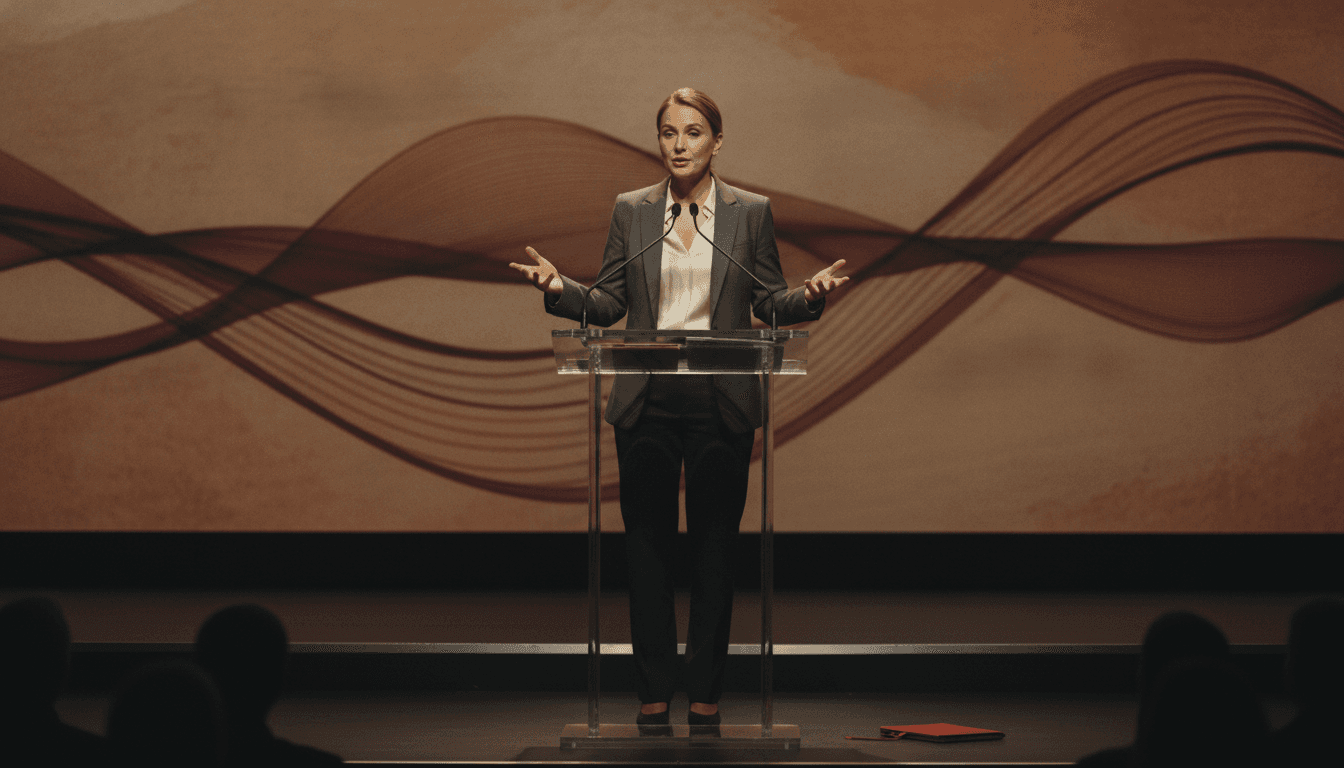
To speak with authority in presentations, focus on five core areas: slow your speaking pace to 130–150 words per minute, use downward vocal inflections at the end of statements, structure your content with a clear "claim-evidence-action" framework, adopt grounded body language with planted feet and purposeful gestures, and eliminate hedging language like "I think" or "sort of." Authority isn't about volume—it's about vocal control, structural clarity, and unwavering conviction in your message.