
How to Sound Confident in a Phone Interview: Pro Tips

What Is Phone Interview Confidence?
Phone interview confidence is the ability to communicate authority, competence, and composure using only your voice and word choice—without relying on eye contact, body language, or visual presence. It's the vocal and verbal version of leadership presence in a job interview.
Unlike in-person interviews, where a firm handshake and professional appearance do heavy lifting, phone interviews strip communication down to its most essential elements: what you say, how you say it, and the silence between your words. Mastering this skill means learning to project a three-dimensional impression through a single channel.
Why Phone Interviews Require a Different Confidence Strategy
The Visual Cue Gap

Research from UCLA professor Albert Mehrabian found that up to 55% of communication impact comes from visual cues like facial expression and body language. In a phone interview, that entire channel disappears. The interviewer can't see you nodding thoughtfully, maintaining eye contact, or sitting with an open posture.
This means your voice must carry the full weight of your confidence. Every hesitation, every trailing sentence, and every rushed answer gets amplified. What might go unnoticed in person—a brief "um" or a nervous laugh—becomes a defining impression on the phone.
The First 30 Seconds Set the Tone
A study published in the Journal of Applied Psychology found that interviewers form initial impressions within the first few minutes of an interview, and those impressions strongly predict final hiring decisions. On the phone, this window narrows further because the interviewer has fewer data points to work with.
Your greeting, your energy level, and the clarity of your first answer establish whether you'll be perceived as a confident professional or an uncertain candidate. There are no second chances to reset a vocal first impression.
Common Mistakes That Signal Insecurity
Most candidates don't realize how much their phone habits undermine them. Here are the most damaging patterns:
- Upspeak — ending statements as if they're questions, which signals uncertainty
- Speed-talking — rushing through answers out of nervousness, which sounds panicked
- Over-qualifying — saying "I think," "I guess," or "sort of" before every claim
- Verbal clutter — filling silence with "um," "uh," "like," and "you know"
- Trailing off — letting sentences fade instead of landing with conviction
If you recognize these habits in yourself, you're not alone. Check out our guide on how to stop using filler words in professional speaking for targeted drills.
Master Your Vocal Presence: The 4 Levers of Phone Confidence
Lever 1: Pace — Slow Down to Sound in Control
Nervous speakers average 170–190 words per minute. Confident speakers in professional settings land between 140–160 words per minute, according to research from the University of Michigan's Institute for Social Research. That study also found that moderately-paced speakers were rated as more credible and competent.
Try this: Record yourself answering the question "Tell me about yourself" and time it. If your 60-second answer crams in more than 170 words, you're rushing. Practice delivering the same content in 10 additional seconds. That small adjustment creates the perception of someone who is composed and deliberate.Lever 2: Pitch — Use Your Lower Register
When anxiety kicks in, your vocal cords tighten, pushing your pitch higher. Higher pitch is unconsciously associated with nervousness and lower status. A study from Quantified Communications found that speakers with lower vocal pitch were perceived as more authoritative and trustworthy.
You don't need a deep voice—you need your lower register. Before the call, do a simple warm-up: hum at a comfortable low pitch for 30 seconds, then speak your opening greeting at that same level. This anchors your voice in its natural power range. For a deeper dive, explore our guide on developing a confident speaking voice with daily drills.
Lever 3: Volume — Project, Don't Shout
Underprojecting is one of the most common phone interview mistakes. When you speak too softly, the interviewer strains to hear you—and unconsciously associates that effort with your lack of confidence.
The test: Call a friend and ask them to rate your volume on a 1–10 scale. Most people land at a 5 or 6 in conversation. For a phone interview, aim for a 7. You should feel like you're speaking slightly louder than normal. Use a headset so your hands are free and your mouth stays a consistent distance from the microphone.Lever 4: Strategic Pausing — Silence Is Your Power Move
Most candidates fear silence on a phone call. They fill every gap with filler words or rush to respond before the interviewer finishes speaking. But strategic pausing communicates the opposite of what you fear—it signals that you're thoughtful, composed, and confident enough to take your time.
The 2-Second Rule: After the interviewer finishes a question, pause for a full two seconds before responding. It feels like an eternity to you. To the interviewer, it sounds like someone who thinks before they speak—exactly the trait they're hiring for.Ready to Command Every Conversation? The techniques in this article are just the beginning. Discover The Credibility Code — a complete playbook for building unshakable authority in every professional interaction, from phone screens to boardroom presentations.
Structure Your Answers Like an Executive
The "Lead-Expand-Land" Framework

Rambling is the number-one confidence killer on phone interviews. Without visual feedback, you can't tell if the interviewer is engaged, confused, or checking email. The solution: structure every answer so it has a clear beginning, middle, and end.
Lead — Start with your headline. State your main point in one sentence. Expand — Support it with one specific example, metric, or story. Land — Close with a sentence that connects your answer back to the role. Example question: "What's your greatest strength?" Weak answer: "Um, I think I'm probably a good communicator? Like, people say I'm easy to work with, and I'm pretty organized too, I guess." Strong answer: "My greatest strength is translating complex projects into clear action plans for cross-functional teams. At my last company, I led a product launch involving six departments and delivered it two weeks ahead of schedule. That's the kind of clarity and execution I'd bring to this role."Notice the difference. The strong answer leads with a claim, expands with proof, and lands with relevance. This is how executives communicate—and it's a skill you can learn. See our breakdown of how executives structure their thoughts before speaking.
Eliminate Credibility-Killing Language
Certain words and phrases instantly undermine your authority on a phone call. According to a LinkedIn Talent Solutions survey, 63% of hiring managers say that how a candidate communicates is as important as what they communicate.
Replace these phrases immediately:| Instead of... | Say... |
|---|---|
| "I just wanted to..." | "I'm calling to..." |
| "I think I could probably..." | "I'm confident I can..." |
| "Sorry, does that make sense?" | "Here's what that means in practice." |
| "I'm not sure, but maybe..." | "Based on my experience..." |
| "Hopefully that answers your question" | "To summarize..." |
For a comprehensive list of language patterns that erode credibility, read 12 words that undermine your credibility at work.
Use Numbers and Specifics to Sound Authoritative
Vague answers sound uncertain. Specific answers sound credible. Compare:
Vague: "I managed a big team and we improved sales a lot." Specific: "I managed a team of 12 and increased quarterly revenue by 23% over eight months."On the phone, specificity replaces the visual cues that normally build trust. Numbers, timelines, and concrete outcomes signal that you know your work and can articulate its impact. Before your interview, prepare five key metrics from your career and weave them into your answers naturally.
Physical Preparation: What Your Body Does Affects What Your Voice Does
Stand Up (or Power Sit)
Your posture directly affects your vocal quality—even when no one can see you. Standing during a phone interview opens your diaphragm, increases lung capacity, and naturally projects your voice with more energy and resonance.
If standing isn't practical, use a "power sit": sit on the front third of your chair, feet flat on the floor, shoulders back, chin slightly lifted. Research from Harvard Business School professor Amy Cuddy found that expansive postures increase testosterone and decrease cortisol, shifting your hormonal profile toward confidence. Whether or not you buy the full "power pose" thesis, the vocal benefits of upright posture are well-documented in speech science.
For more on how physical positioning shapes perception, see our guide on body language for leadership presence.
Smile — It Changes Your Sound
This isn't motivational advice—it's acoustics. Smiling widens the vocal tract and lifts the soft palate, producing a warmer, more energetic tone. Call center research from the University of Portsmouth confirmed that listeners can reliably detect whether a speaker is smiling, even without visual cues.
Practical tip: Place a small mirror near your phone during the interview. Glance at it before answering each question. If you're not smiling, adjust. You'll hear the difference immediately.Create a Confidence-Boosting Environment
Your physical environment shapes your mental state. Before the call:
- Clear your desk of clutter—visual chaos creates mental noise
- Close all browser tabs except your notes—eliminate distractions
- Have water nearby—a dry mouth tightens your vocal cords
- Print your resume and the job description—so you never fumble for details
- Put a "Do Not Disturb" sign on your door—interruptions destroy composure
Build Unshakable Confidence for Every Professional Moment. Phone interviews are just one scenario where vocal authority matters. Discover The Credibility Code and learn the complete system for projecting confidence in any high-stakes conversation.
Advanced Tactics: How Top Candidates Stand Out on the Phone
The "Mirror and Elevate" Technique
Match the interviewer's energy level for the first 60 seconds, then subtly elevate it. If they're calm and measured, start calm and measured—then gradually increase your enthusiasm and pace when discussing your accomplishments. This creates rapport first, then positions you as someone who brings energy and conviction to the table.
Handle the "Tell Me About Yourself" Question Like a Pro
This question trips up more phone interview candidates than any other because it's open-ended and easy to ramble through. Use the Present-Past-Future structure:
Present: "I'm currently a senior project manager at [Company], where I lead a portfolio of digital transformation initiatives worth $4M annually." Past: "Before this, I spent five years in consulting, where I developed my ability to translate technical complexity into executive-ready recommendations." Future: "I'm now looking to bring that strategic and operational experience to a director-level role where I can drive enterprise-wide impact—which is exactly what drew me to this position."Total time: 30–45 seconds. Clear, confident, and forward-looking.
Manage Tough Questions Without Panic
When you're hit with a question you didn't prepare for, resist the urge to fill the silence with verbal clutter. Instead, use a bridge phrase to buy yourself thinking time while sounding composed:
- "That's a great question. Let me give you a specific example."
- "There are several dimensions to that. The most relevant one is..."
- "I'd approach that from two angles."
These phrases signal thoughtfulness, not stalling. For more frameworks on handling unexpected questions, see our guide on how to respond when put on the spot at work.
Close the Call with Confidence
How you end the call matters as much as how you begin it. Most candidates trail off with a weak "Thanks for your time, I hope to hear from you." Instead, close with three elements:
- Summarize your fit in one sentence: "Based on our conversation, I'm confident my experience in [X] directly aligns with what you need for this role."
- Express genuine enthusiasm: "I'm genuinely excited about this opportunity and the team's direction."
- Ask a forward-looking question: "What does the next step in the process look like?"
This closing sequence projects confidence, clarity, and initiative—three qualities every interviewer remembers.
Frequently Asked Questions
How can I stop saying "um" and "uh" during a phone interview?
Replace filler words with silence. Practice answering common interview questions while recording yourself, and every time you catch a filler, pause instead. Over time, your brain learns that silence is acceptable. The 2-second pause technique—waiting two full seconds before answering—also reduces fillers by giving your brain time to formulate a complete thought before you speak. For targeted exercises, read our guide on how to stop using filler words in professional speaking.
Does standing up during a phone interview actually help?
Yes. Standing opens your diaphragm, increases breath support, and naturally raises your vocal energy. Speech coaches and call center trainers have recommended standing for decades because it produces a measurably more dynamic and confident-sounding voice. If you can't stand, sit at the front edge of your chair with your back straight and feet flat on the floor.
Phone interview confidence vs. in-person interview confidence: what's different?
In-person confidence relies heavily on visual cues—eye contact, posture, handshake, facial expressions. Phone interview confidence depends entirely on vocal qualities (pace, pitch, volume, pausing) and verbal precision (word choice, answer structure, eliminating hedging language). Both require preparation, but phone confidence demands more deliberate vocal control because you have fewer channels to communicate through.
How long should my answers be in a phone interview?
Aim for 45–90 seconds per answer. Shorter than 30 seconds sounds underprepared. Longer than two minutes risks losing the interviewer's attention—especially without visual engagement cues. Use the Lead-Expand-Land framework to keep answers focused and impactful. If you're unsure whether you've answered fully, say: "I can go deeper on that if it's helpful"—which shows confidence and respect for their time.
What should I do if there's an awkward silence during the phone interview?
Don't panic or rush to fill it. The interviewer may be taking notes, reviewing your resume, or formulating their next question. If silence lasts more than five seconds, you can say calmly: "Would it be helpful if I elaborated on that?" or "I'm happy to share another example." These responses demonstrate composure rather than anxiety—a key marker of communicating with gravitas.
How do I prepare my voice before a phone interview?
Warm up your voice 10–15 minutes before the call. Hum at a low pitch for 30 seconds, do lip trills, drink warm water (not cold), and read a paragraph aloud at your target pace. Avoid dairy and caffeine, which can dry out or coat your vocal cords. Practice your opening greeting three times until it sounds natural, warm, and energized.
Your Voice Is Your Most Powerful Professional Tool. Every technique in this article comes from the same system that helps professionals command authority in meetings, negotiations, and high-stakes conversations. Ready to build a complete confidence toolkit? Discover The Credibility Code and transform how you communicate—starting today.
Ready to Command Authority in Every Conversation?
Transform your professional communication with proven techniques that build instant credibility. The Credibility Code gives you the frameworks top leaders use to project confidence and authority.
Discover The Credibility CodeRelated Articles
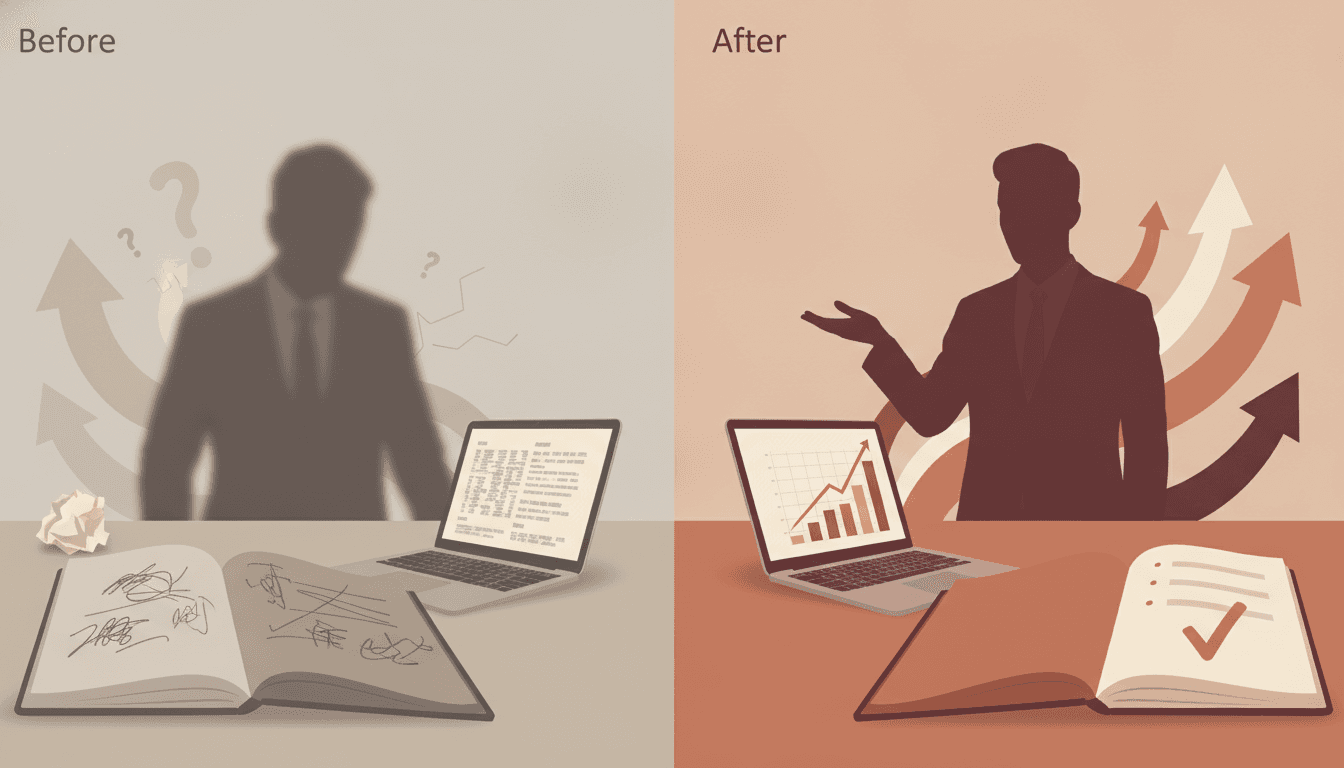
Confident Communication at Work: 15 Before & After Examples
Confident communication at work means replacing hedging, apologetic, and uncertain language with clear, direct, and authoritative phrasing — without becoming aggressive. The most impactful shifts are often small: swapping "I just wanted to check" for "Following up on," or replacing "I think maybe we could" with "I recommend." Below, you'll find 15 real-world before-and-after examples across emails, meetings, presentations, and one-on-ones that show exactly how to make these transformations — and

Communicate Confidence in Conflict at Work: Scripts
To communicate confidence in conflict at work, use structured language that separates the issue from the person, states your position clearly without hedging, and invites resolution. The key is preparation: have go-to phrases ready so you don't default to defensiveness, aggression, or silence. Confident communicators in conflict use neutral tone, specific language, and composure-preserving frameworks—scripts you can practice and deploy in real time when tensions rise.

Confident Communication in Performance Reviews: Scripts
Performance reviews don't have to feel like an ambush. Confident communication in performance reviews means presenting your accomplishments with clarity, responding to criticism with composure, and steering the conversation toward advancement—all without sounding arrogant or defensive. This article gives you word-for-word scripts, proven frameworks, and specific techniques so you walk into your next review prepared to advocate for yourself and walk out with clear next steps for your career.