
Confident Communication at Work: 15 Before & After Examples
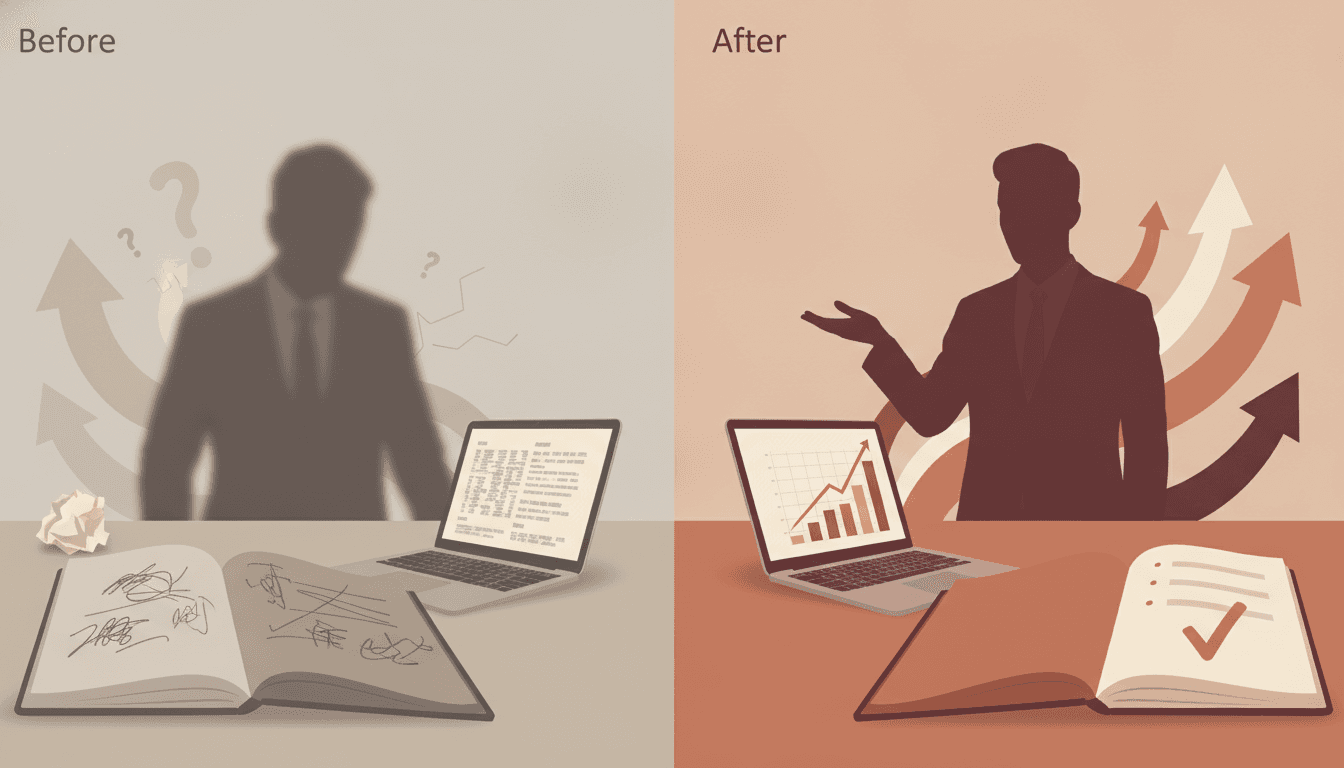
Confident communication at work means replacing hedging, apologetic, and uncertain language with clear, direct, and authoritative phrasing — without becoming aggressive. The most impactful shifts are often small: swapping "I just wanted to check" for "Following up on," or replacing "I think maybe we could" with "I recommend." Below, you'll find 15 real-world before-and-after examples across emails, meetings, presentations, and one-on-ones that show exactly how to make these transformations — and the psychology behind why each one works.
What Is Confident Communication at Work?
Confident communication at work is the ability to express ideas, set boundaries, make requests, and share opinions using language that signals competence, conviction, and authority. It doesn't mean being loud or domineering. It means choosing words, tone, and structure that convey clarity and self-assurance.
According to a 2023 study published in the Journal of Experimental Social Psychology, listeners form judgments about a speaker's competence within the first seven seconds of hearing them — and hedging language ("I'm not sure, but…") significantly lowers perceived expertise, even when the content itself is accurate.
Confident communication spans four key domains: written communication (emails, messages), verbal communication (meetings, calls), presentational communication (pitches, updates), and interpersonal communication (one-on-ones, negotiations). The examples below cover all four.
Email Communication: 5 Before & After Examples
Email is where most professionals unknowingly undermine their own credibility. Because we can't rely on vocal tone or body language, word choice carries outsized weight. Research from Boomerang's analysis of over 300,000 emails found that messages written with a confident, slightly formal tone received 36% more responses than those with a casual or tentative tone.
Example 1: Following Up on a Deliverable
Before: "Hey, just wanted to check in and see if you maybe had a chance to look at the report I sent over? No rush at all, just whenever you get a chance!" After: "Following up on the Q3 report I sent Tuesday. I'd like to finalize it by Friday — could you share your feedback by end of day Thursday?" Why it works: The "before" version uses five minimizers in two sentences: "just," "maybe," "no rush," "whenever," and "just" again. Each one signals that your request isn't important. The "after" version states the context, provides a clear timeline, and makes a specific ask. It respects both your time and theirs.Example 2: Proposing a New Idea
Before: "I'm not sure if this is a good idea or not, but I was kind of thinking maybe we could try A/B testing the landing page? Sorry if this has already been discussed." After: "I recommend we A/B test the landing page. Based on last quarter's conversion data, even a 5% improvement would add $40K in revenue. I can have a test plan ready by Monday." Why it works: The "before" version pre-apologizes and invites dismissal. The "after" version uses the high-authority phrase "I recommend," backs the recommendation with data, and offers a next step. This structure — recommendation + evidence + action — is one of the core patterns executives use in email communication.Example 3: Declining a Request
Before: "I'm so sorry, I really wish I could help, but I'm kind of swamped right now. I feel terrible about this. Maybe I could try to squeeze it in later?" After: "I'm not able to take this on this week. My current priorities are the client launch and the board deck. I'd suggest asking Maria, or I can look at it next Tuesday." Why it works: Over-apologizing signals that saying no is something you need forgiveness for. The confident version states the boundary clearly, explains the reason (current priorities, not personal failing), and offers an alternative. According to a 2022 Harvard Business Review article, professionals who explain what they're prioritizing — rather than just saying they're "busy" — are perceived as more strategic and reliable.Example 4: Requesting a Meeting with a Senior Leader
Before: "Hi, sorry to bother you. I know you're super busy, but I was wondering if there's any possible way I could maybe get 15 minutes of your time sometime?" After: "I'd like to schedule 15 minutes with you this week to discuss the product roadmap alignment. Would Wednesday at 2 PM or Thursday at 10 AM work?" Why it works: The "before" version positions you as an interruption. The "after" version positions you as a professional with a clear agenda. Offering specific time slots shows you've thought about their schedule and eliminates the back-and-forth.Example 5: Sharing a Concern
Before: "This might be a dumb question, but is anyone else kind of worried about the timeline? I don't know, maybe it's just me." After: "I have a concern about the timeline. Based on the current scope, we're looking at a two-week gap between testing and launch. I'd like to discuss options for closing that gap." Why it works: Calling your own concern "dumb" or attributing it to personal anxiety strips it of legitimacy. The confident version names the concern, quantifies the risk, and proposes a discussion. This is the difference between sounding uncertain and sounding credible in meetings.Your language shapes how people see your leadership potential. The Credibility Code gives you a complete system for eliminating weak language patterns and replacing them with communication that commands respect — in emails, meetings, and every professional interaction. Discover The Credibility Code
Meeting Communication: 4 Before & After Examples
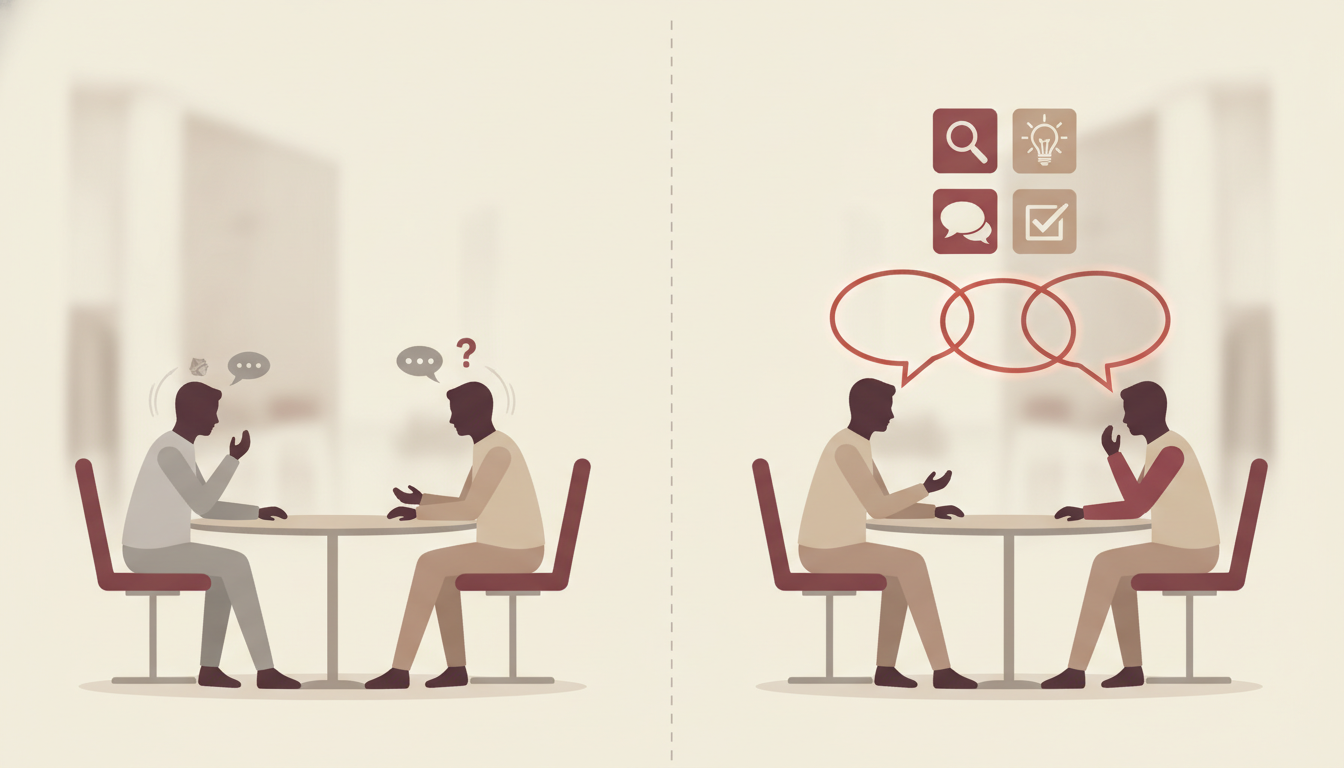
Meetings are the highest-visibility arena for your communication skills. A study by Catalyst found that professionals who speak with clarity and confidence in meetings are 2.5 times more likely to be identified as "high-potential" by senior leadership. Yet meetings are also where hedging, rambling, and self-minimizing habits show up most.
Example 6: Sharing Your Opinion
Before: "I don't know, I guess I sort of feel like maybe we should consider looking at the data before making a decision? But I could be wrong." After: "I'd like us to review the data before making a decision. Specifically, I want to see the customer churn numbers from Q2 before we commit to this pricing change." Why it works: Vague hedging ("sort of feel like maybe") buries your point under layers of uncertainty. The confident version leads with a clear position and specifies what data matters and why. This is a core shift covered in our guide on how to speak with authority in meetings.Example 7: Pushing Back on an Idea
Before: "That's a great idea! I totally agree. But, um, I guess I just wonder if maybe there might be some potential challenges with the budget part? I don't know." After: "I see the strategic value of this approach. My concern is the budget impact — we'd be $120K over our quarterly allocation. Can we explore a phased rollout that stays within budget?" Why it works: The "before" version contradicts itself — agreeing and then vaguely disagreeing — which signals that you're afraid to own your perspective. The "after" version acknowledges the idea's merit, names the specific concern with a number, and proposes an alternative. This is assertive communication without creating conflict.Example 8: Volunteering for a Visible Project
Before: "I mean, I could maybe try to take that on, if nobody else wants it? I'm not sure I'm the best person, but I could give it a shot." After: "I'd like to lead that initiative. I managed a similar project last quarter that came in 10% under budget, and I already have relationships with the key stakeholders." Why it works: The "before" version positions you as the last resort. The "after" version positions you as the best candidate by citing relevant experience and specific results. According to McKinsey's 2023 Women in the Workplace report, professionals who advocate for themselves using evidence-based statements are 40% more likely to receive stretch assignments.Example 9: Responding When You Don't Know the Answer
Before: "Oh, um, I'm sorry, I don't know. I should probably know that. Let me, um, I'll try to find out." After: "I don't have that figure in front of me. I'll confirm the exact number and send it to the group by 3 PM today." Why it works: Not knowing something isn't a credibility killer — apologizing for it excessively is. The confident version acknowledges the gap without shame, commits to a specific follow-up, and includes a deadline. This is exactly the approach outlined in our piece on how to answer questions you don't know without faking.Presentation Communication: 3 Before & After Examples
Presentations magnify every communication habit — good or bad. Your language choices on stage or in a conference room shape how your ideas are received and whether your audience trusts your expertise.
Example 10: Opening a Presentation
Before: "Hi everyone, sorry, is this thing on? Okay, um, so I'm going to try to talk about our marketing results. I hope this isn't too boring. Bear with me." After: "Last quarter, our marketing team generated 2,400 qualified leads — a 34% increase over Q1. Today, I'll walk you through what drove those results and how we plan to accelerate growth in Q3." Why it works: The "before" version starts with apology and self-deprecation, which primes the audience to expect a weak presentation. The "after" version opens with a compelling result, then previews the structure. Research from Quantified Communications found that speakers who open with a specific data point or outcome are rated 32% more credible than those who open with pleasantries or apologies. For more on this, see our guide on how to open a presentation with confidence.Example 11: Handling a Tough Question During Q&A
Before: "Oh, that's a really good question. Wow. Um, I'm not really sure. I guess maybe the answer is something like… I'll have to think about that one." After: "That's an important question. The short answer is that we haven't finalized the vendor selection. Here's what I can share: we've narrowed it to two finalists and expect a decision by March 15." Why it works: Flattering the questioner ("That's a really good question") is a stalling tactic that audiences see through. The confident version acknowledges the question's importance, provides what information is available, and gives a clear timeline. This maintains credibility even when you don't have the full answer.Example 12: Transitioning Between Sections
Before: "Okay, so, um, I guess we can move on now? Sorry, I know that was a lot. Anyway, the next part is about, let me find it… okay, so the next thing is budget." After: "That covers our strategic priorities. Now let's look at how we're funding them. The budget breaks into three areas." Why it works: Fumbling transitions erode the authority you've built. Clean transitions use a bridging structure: summarize what you just covered, preview what's next, and provide a structural cue (like "three areas") that helps your audience follow along.One-on-One and Interpersonal Communication: 3 Before & After Examples
One-on-one conversations — with your manager, direct reports, or peers — are where relationships and reputations are built daily. These interactions require a blend of directness and warmth that many professionals struggle to balance.
Example 13: Asking for a Raise
Before: "So, I was kind of wondering, and I totally understand if the answer is no, but do you think there's any chance I could maybe get a raise at some point? I know budgets are tight." After: "I'd like to discuss a compensation adjustment. Over the past year, I've taken on three additional accounts, exceeded my revenue target by 18%, and mentored two new hires. Based on market data and my contributions, I'm requesting a 12% increase." Why it works: The "before" version negotiates against yourself before the conversation even starts. The "after" version leads with specific accomplishments, cites market data, and makes a clear request. This approach is covered in depth in our salary negotiation scripts and strategy guide.Example 14: Giving Upward Feedback
Before: "I don't want to overstep or anything, and this might not be my place to say, but I was just kind of thinking that maybe the team meetings could possibly be a little more structured? But it's totally fine if not." After: "I have a suggestion about our team meetings. When we have a clear agenda distributed in advance, I've noticed we finish 15 minutes faster and leave with clearer action items. Would you be open to trying that for the next month?" Why it works: The "before" version undermines the feedback before delivering it. The "after" version frames the suggestion around observed outcomes, proposes a specific change, and includes a low-risk trial period. This makes it easy for your manager to say yes.Example 15: Setting a Boundary with a Colleague
Before: "Hey, so, I'm really sorry, but would it be okay if maybe I didn't take your late-night calls anymore? I mean, it's totally fine if it's urgent, and I don't want to be difficult." After: "I want to be clear about my availability. I'm fully responsive during business hours, 8 AM to 6 PM. For anything after hours, please send an email and I'll address it first thing the next morning. If there's a true emergency, text me." Why it works: The "before" version frames a reasonable boundary as a personal favor you're requesting. The "after" version states availability clearly, provides an alternative process, and includes an exception for genuine emergencies. It's professional, direct, and respectful — the hallmark of communicating with confidence in every workplace interaction.Ready to overhaul your communication patterns for good? These 15 examples are just the beginning. The Credibility Code provides a complete framework for identifying and replacing every weak communication habit — with scripts, exercises, and daily practices that make confident communication automatic. Discover The Credibility Code
The Psychology Behind Confident Language
Understanding why these shifts work helps you apply the principles to any situation, not just the 15 examples above.

The Certainty Principle
Research from the University of Michigan's Ross School of Business shows that people assign more weight to advice delivered with confidence — even when the confident advisor and the uncertain advisor have identical track records. This isn't about deception. It's about removing the linguistic noise that obscures your actual competence.
When you say "I think maybe we should consider possibly looking into this," your listener's brain processes five uncertainty markers before reaching your actual idea. When you say "I recommend we do this," they process zero.
The Authority-Warmth Balance
A common fear is that confident communication will make you seem cold or arrogant. But research from Harvard social psychologist Amy Cuddy shows that the most influential communicators project both competence and warmth. The examples above achieve this by being direct about the content while remaining collaborative in tone — using phrases like "Would you be open to" and "I'd like to discuss" rather than demands.
This balance is what separates confident communication from aggressive communication, and it's a core principle in building authority at work without being arrogant.
The Specificity Effect
Notice that every "after" example includes specific numbers, dates, or outcomes. This isn't accidental. A 2021 study in Organizational Behavior and Human Decision Processes found that specific claims ("We increased retention by 14%") are perceived as 23% more credible than general claims ("We significantly improved retention") — even when listeners can't verify the numbers in the moment.
Specificity signals that you've done the work, you know your domain, and you're not guessing.
How to Start Shifting Your Communication Today
Knowing these examples is one thing. Applying them consistently is another. Here's a three-step daily practice:
Step 1: Audit One Communication Per Day
Before you send your next email or walk into your next meeting, scan for words that undermine your credibility: "just," "sorry," "I think maybe," "does that make sense?", "I'm no expert, but." Remove or replace each one.
Step 2: Apply the Recommend-Evidence-Action Framework
For any idea, suggestion, or request, structure it as:
- Recommend: State your position clearly ("I recommend…")
- Evidence: Back it with one specific data point or example
- Action: Propose a concrete next step with a timeline
Step 3: Record and Review
Record yourself in one meeting per week (with appropriate permissions). Listen for hedging patterns, filler words, and uptalk. Track your progress over 30 days. Most professionals see a dramatic shift within two to three weeks of conscious practice.
Frequently Asked Questions
What is the difference between confident communication and aggressive communication?
Confident communication states your position clearly while remaining open to dialogue. Aggressive communication imposes your position while shutting others down. The key distinction is collaboration: confident communicators say "I recommend X — here's why" and invite discussion. Aggressive communicators say "We're doing X" and dismiss pushback. Confident communication builds respect; aggressive communication builds resentment.
How do I sound confident in emails without seeming rude?
Focus on three shifts: replace hedging words ("just," "maybe," "kind of") with direct language, lead with your main point instead of burying it in context, and use specific timelines instead of vague phrases like "whenever you get a chance." Adding a collaborative close — "Let me know if you have questions" — maintains warmth while keeping the overall tone authoritative. For a deeper dive, see our guide on assertive communication in emails with before-and-after examples.
Can introverts communicate with confidence at work?
Absolutely. Confident communication is about language precision, not volume or extroversion. Introverts often excel at written communication and one-on-one conversations — two of the four key communication domains. The key is preparation: scripting key phrases in advance, using the recommend-evidence-action framework, and leveraging quiet leadership strengths rather than trying to mimic extroverted styles.
How long does it take to change communication habits at work?
Most professionals notice meaningful changes within two to four weeks of deliberate practice. Research on habit formation from University College London suggests that automatic behaviors take an average of 66 days to become ingrained. Start with one domain — emails are the easiest because you can edit before sending — then expand to meetings and presentations as the new patterns become natural.
What are the most common words that make you sound less confident?
The top credibility-killers are: "just" ("I just wanted to…"), "sorry" (when no apology is needed), "I think" (before a recommendation), "does that make sense?" (after explaining something), "kind of/sort of," "actually" (used as a surprise qualifier), and "I'm no expert, but." Eliminating these six patterns alone can transform how colleagues perceive your authority. Our full list covers 12 words that undermine your credibility at work.
How is confident communication different from executive presence?
Confident communication is one component of executive presence, but executive presence is broader. It also includes body language, strategic thinking, emotional composure, and the ability to command a room. Think of confident communication as the verbal foundation that executive presence is built on. You can learn more about the full picture in our breakdown of executive presence vs. confidence.
These 15 examples are your starting point — The Credibility Code is your complete system. Inside, you'll get the frameworks, scripts, and daily practices to make confident communication your default mode in every professional interaction. Stop hedging. Start leading. Discover The Credibility Code
Ready to Command Authority in Every Conversation?
Transform your professional communication with proven techniques that build instant credibility. The Credibility Code gives you the frameworks top leaders use to project confidence and authority.
Discover The Credibility CodeRelated Articles

Communicate Confidence in Conflict at Work: Scripts
To communicate confidence in conflict at work, use structured language that separates the issue from the person, states your position clearly without hedging, and invites resolution. The key is preparation: have go-to phrases ready so you don't default to defensiveness, aggression, or silence. Confident communicators in conflict use neutral tone, specific language, and composure-preserving frameworks—scripts you can practice and deploy in real time when tensions rise.

How to Stop Sounding Uncertain at Work: 11 Quick Fixes
To stop sounding uncertain at work, eliminate these eleven habits immediately: uptalk (rising intonation on statements), qualifier words like "just" and "kind of," apologetic openers, hedging phrases, filler words, weak email language, tentative body language, over-explaining, permission-seeking phrasing, vocal fry trailing off, and deflecting compliments. Replace each one with a direct, confident alternative—specific before-and-after swaps are provided below.

How to Sound Confident in Meetings When You Feel Anxious
Your palms are damp. Your heart is racing. And in three minutes, you need to present your quarterly update to a room full of senior leaders. Sound familiar? You're not alone — and you're not stuck.