
How to Communicate with Senior Leadership: Unwritten Rules

Communicating with senior leadership requires a fundamentally different approach than communicating with peers or direct reports. To communicate effectively with VPs, SVPs, and C-suite leaders, you need to lead with the conclusion first, frame everything through business impact, be concise and structured in your delivery, anticipate their questions before they ask, and demonstrate strategic thinking rather than tactical detail. The professionals who master these unwritten rules don't just get heard—they get trusted, promoted, and invited back to the table.
What Is Senior Leadership Communication?
Senior leadership communication is the practice of structuring your messages, updates, and recommendations specifically for executive-level audiences—VPs, SVPs, and C-suite leaders—who operate under extreme time pressure and make decisions at a strategic level. It goes beyond general workplace communication by requiring brevity, business-impact framing, and a solution-oriented mindset.
Unlike peer-to-peer communication, where you can share context gradually and think out loud, communicating with senior leadership demands that you arrive at the point immediately and back it up with evidence. It's a skill set that separates mid-career professionals who plateau from those who accelerate into leadership roles.
Why Communicating with Senior Leadership Is a Different Game
How Executives Actually Process Information

Senior leaders consume information differently than everyone else in the organization. According to a 2023 study by Microsoft, executives spend an average of just 30 seconds scanning an email before deciding whether to read, delegate, or delete it. Their cognitive bandwidth is allocated toward decisions that affect the entire organization—not the details of your project.
This means the communication habits that work with your manager or peers will actively work against you with senior leadership. Lengthy backstories, excessive caveats, and bottom-up reasoning all signal that you haven't done the work of distilling your thinking.
Understanding how executives communicate differently is the first step toward adapting your own style to match their expectations.
The Trust Equation at the Executive Level
Research from the Harvard Business Review shows that 69% of executives say they would promote someone who communicates with clarity and confidence over someone with slightly stronger technical skills. At the senior leadership level, trust is built through three things: reliability (you deliver what you say), competence (your recommendations are sound), and communication quality (you respect their time and frame things strategically).
Every interaction with a senior leader is an audition. They're not just evaluating your message—they're evaluating whether you think at their level.
The Cost of Getting It Wrong
Poor upward communication doesn't just mean a bad meeting. It means being excluded from future conversations, losing sponsorship, and stalling your career trajectory. A study by the Center for Creative Leadership found that communication failure is the number one reason high-potential employees derail in their careers. The stakes are real, and the feedback is often silent—you simply stop getting invited.
The 5 Unwritten Rules of Communicating with Senior Leadership
Rule 1: Lead with the Answer, Not the Journey
The single most important shift you can make is inverting your communication structure. Most professionals build up to their conclusion: background → analysis → findings → recommendation. Senior leaders want the opposite: recommendation → supporting evidence → context (if asked).
Use the BLUF framework: Bottom Line Up Front.Instead of: "We've been analyzing customer churn data for the past six weeks, looking at multiple cohorts, and after reviewing the patterns we've noticed some interesting trends that suggest..."
Say: "We need to invest $200K in onboarding improvements. Customer churn in the first 90 days is costing us $1.2M annually, and our analysis shows a redesigned onboarding flow would reduce that churn by 35%."
The BLUF approach shows respect for their time and demonstrates that you've already done the thinking. If they want the journey, they'll ask.
Rule 2: Frame Everything Through Business Impact
Senior leaders don't care about activities. They care about outcomes. Every update, request, or recommendation you deliver should answer one question: "So what?"
Here's a simple reframing exercise:
- Activity-focused: "We completed 47 user interviews this quarter."
- Impact-focused: "User interviews revealed a pricing perception gap that's contributing to 22% of lost deals. We have three options to address it."
This shift from activity reporting to impact framing is what separates tactical communicators from strategic ones. If you want to deepen this skill, explore our guide on how to communicate your strategic value at work clearly.
Rule 3: Anticipate Questions and Pre-Answer Them
Senior leaders are trained to stress-test ideas. Before any interaction with a VP or C-suite leader, run your message through these five filters:
- What's the financial impact? (Revenue, cost, margin)
- What's the risk? (What could go wrong, and what's the mitigation?)
- What's the timeline? (When will results be visible?)
- What are the alternatives? (What else did you consider?)
- What do you need from me? (Decision, resources, air cover?)
If you can't answer these five questions, you're not ready for the conversation. Preparation is what creates the appearance of effortless confidence—and it's the foundation of how to influence senior stakeholders.
Ready to command every executive conversation? The Credibility Code gives you the exact frameworks, scripts, and strategies that professionals use to communicate with authority at every level. Discover The Credibility Code
Rule 4: Be Concise—Ruthlessly
According to a 2022 Grammarly and Harris Poll workplace communication report, professionals spend an average of 25 hours per week communicating at work, and executives report that nearly half of that communication is inefficient. Being concise isn't just polite—it's a competitive advantage.
Apply the "Half It" rule: Write your update or talking points. Then cut them in half. Then review what's left and ask, "Would a senior leader need this to make a decision?" If not, cut it again.
For verbal communication, practice the 60-second framework: You should be able to deliver any update or recommendation in 60 seconds or less. If the executive wants more, they'll ask. For a deeper dive into this technique, read our guide on how to brief executives quickly.
Rule 5: State Your Recommendation with Conviction
Senior leaders are allergic to ambiguity. Hedging language—"I think maybe we could potentially consider..."—signals that you haven't done enough analysis or that you don't trust your own judgment.
Compare these two approaches:
- Weak: "I was thinking that it might be worth looking into possibly reallocating some of the Q3 budget."
- Strong: "I recommend we reallocate 15% of the Q3 marketing budget from paid social to content marketing. Here's why."
This doesn't mean being inflexible. It means arriving with a clear point of view and being willing to adjust based on new information. That's the difference between confidence and arrogance. If stating your position clearly feels uncomfortable, our guide on how to be more assertive at work without being rude can help.
How to Structure Updates for Senior Leadership
The SCR Framework: Situation, Complication, Resolution
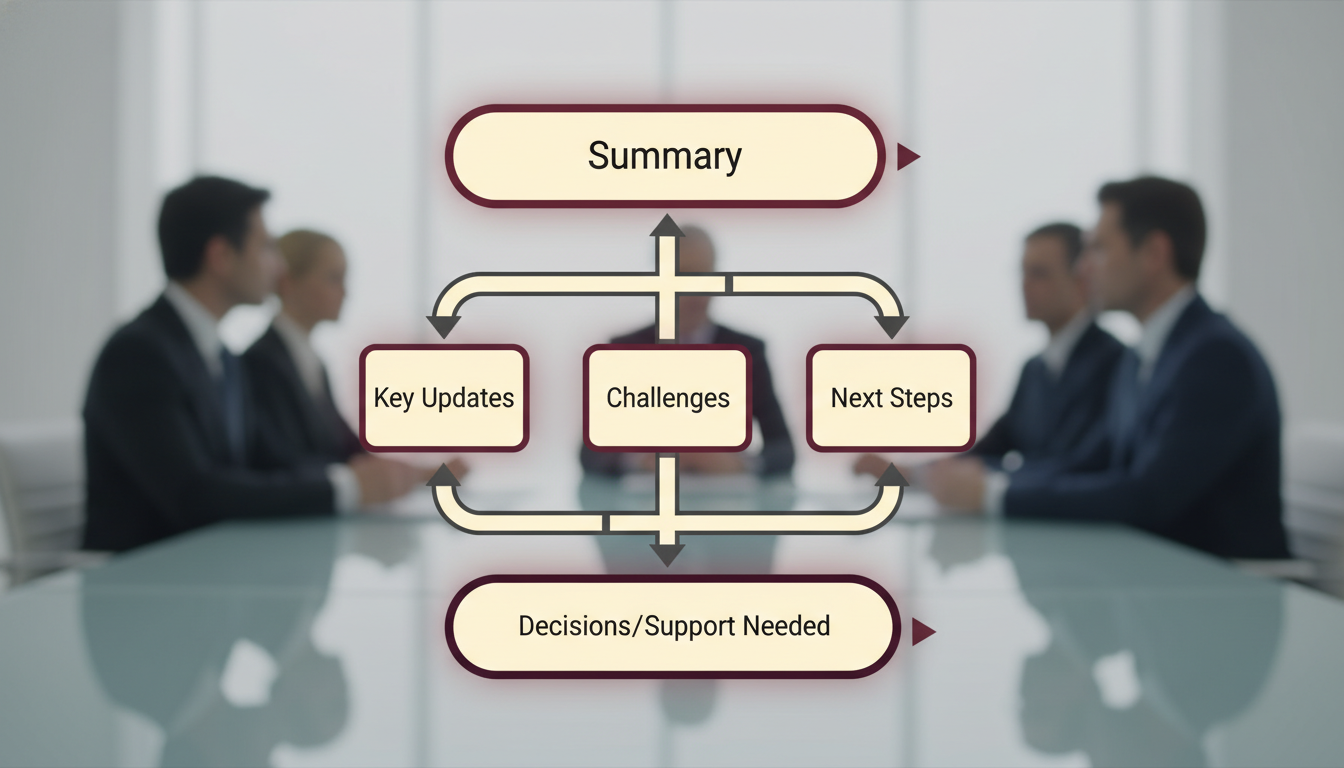
One of the most effective frameworks for structuring executive updates comes from Barbara Minto's work at McKinsey. The SCR (Situation, Complication, Resolution) framework gives senior leaders exactly what they need in the right order:
- Situation: The relevant context they already know (1-2 sentences)
- Complication: What's changed, what's at risk, or what needs attention
- Resolution: Your recommendation and the action you need from them
- Situation: "We launched the new customer portal on schedule last month."
- Complication: "Adoption is at 23%, well below our 50% target, primarily because the onboarding emails are going to spam folders."
- Resolution: "I recommend we switch to in-app onboarding tutorials and pause the email sequence. I need your approval to redirect $30K from the email vendor budget."
This framework works for verbal updates, written reports, and even Slack messages. It's one of several professional communication frameworks leaders use daily.
Formatting Written Updates for Executive Eyes
When sending written updates to senior leadership, format matters as much as content. Executives scan—they don't read. Structure your written communications with these principles:
- Subject line = headline: Make it specific and action-oriented. Not "Q3 Update" but "Q3 Revenue Tracking 8% Above Target—One Risk to Flag."
- First sentence = the ask or the headline: Don't bury the lead.
- Bullet points over paragraphs: Three to five bullets maximum.
- Bold the key numbers: Make financial figures and deadlines impossible to miss.
- End with a clear next step: "I'll proceed unless I hear otherwise by Friday" is better than "Let me know your thoughts."
For more on this, explore how to write like a senior leader.
Tailoring Your Message to Different Executive Styles
Not all senior leaders process information the same way. Some are data-driven and want numbers before narrative. Others are vision-oriented and want to understand the strategic "why" before the tactical "what." A 2021 study published in the Journal of Business Communication found that message-recipient alignment increases persuasion effectiveness by up to 40%.
Before communicating with a specific executive, ask yourself—or ask their direct reports:
- Do they prefer emails or in-person conversations?
- Do they want options or a single recommendation?
- Are they detail-oriented or big-picture thinkers?
- Do they like to be consulted early or only when you have a final proposal?
Adapting your style to their preference isn't being inauthentic. It's being strategic.
Managing Expectations and Delivering Bad News Upward
The "No Surprises" Principle
The fastest way to lose credibility with senior leadership is to surprise them—especially with bad news. According to a 2020 PwC CEO Survey, 55% of CEOs said that the quality and timeliness of information they receive from their teams is a top concern.
Adopt the "no surprises" principle: If something is off track, communicate it early, with a plan. Senior leaders can handle bad news. What they can't handle is finding out too late to do anything about it.
Template for delivering bad news upward:- State the issue directly: "The product launch will be delayed by three weeks."
- Explain the cause briefly: "We discovered a compliance issue during final testing."
- Present your mitigation plan: "We've already engaged legal and have a revised timeline. Here are two options."
- State what you need: "I need your decision on which option to pursue by Wednesday."
This approach demonstrates ownership, foresight, and problem-solving—all qualities that build credibility with senior leadership fast.
How to Push Back Without Burning Bridges
There will be times when a senior leader asks for something unrealistic—an impossible deadline, an under-resourced initiative, or a strategy you believe is flawed. Pushing back effectively is one of the highest-value communication skills you can develop.
Use the "Yes, and here's what that requires" approach:
- Instead of: "That's not possible in two weeks."
- Say: "We can hit a two-week timeline. To do that, we'd need to deprioritize the client migration and bring in two contractors. Alternatively, we can deliver a phased approach—Phase 1 in two weeks, full delivery in four. Which do you prefer?"
This approach respects their authority while giving them the information they need to make a realistic decision. For more scripts and strategies, see our guide on how to disagree with your boss in a meeting respectfully.
Master the art of executive communication. The Credibility Code includes word-for-word scripts for managing up, delivering bad news, and building trust with C-suite leaders—so you never second-guess yourself in high-stakes conversations again. Discover The Credibility Code
Building Long-Term Trust with Senior Leaders
Consistency Over Brilliance
Trust with senior leadership isn't built through one impressive presentation. It's built through consistent, reliable communication over time. Show up prepared. Follow through on commitments. Communicate proactively.
A practical system for building this consistency:
- After every executive interaction, send a brief follow-up email summarizing decisions, action items, and timelines.
- Before every executive interaction, review your last communication with them. What did you commit to? What's the status?
- Weekly or biweekly, send a proactive 3-bullet update even when you're not asked. This keeps you visible and demonstrates ownership.
This kind of disciplined communication is a cornerstone of leadership presence—and it compounds over time.
Becoming a Trusted Advisor, Not Just a Reporter
The ultimate goal of communicating with senior leadership isn't just to inform—it's to be sought out for your perspective. You transition from "reporter" to "trusted advisor" when you consistently do three things:
- Connect dots across the organization that they might not see from their vantage point.
- Bring forward-looking insights, not just backward-looking reports. ("Here's what I'm seeing that could become a problem in Q4.")
- Demonstrate judgment by recommending a course of action and explaining your reasoning—not just presenting data.
When senior leaders start asking for your opinion rather than just your updates, you've crossed the threshold. That's when career acceleration happens.
Frequently Asked Questions
How do I communicate with senior leadership if I'm nervous?
Nervousness with senior leaders is normal and manageable. Prepare thoroughly using the SCR framework so you have a clear structure to follow. Practice your key points out loud beforehand. Focus on delivering value rather than performing perfectly. Remember that executives are evaluating your thinking, not your polish. The more prepared you are, the less nervous you'll feel. For specific techniques, see our guide on how to speak up in meetings with senior leaders confidently.
What's the difference between communicating with a VP vs. a C-suite executive?
VPs typically want more operational detail and are closer to execution. They'll often ask "how" questions and want to understand methodology. C-suite executives operate at a higher altitude—they want strategic impact, financial implications, and competitive context. With a VP, you might present three options with analysis. With a CEO, you'd present your recommendation and the business case, keeping alternatives in your back pocket. Adjust your altitude accordingly.
How often should I communicate with senior leadership?
Frequency depends on your role and their expectations, but a good rule of thumb is: proactively share a brief update every one to two weeks, even when not asked. Keep it to three to five bullet points covering progress, risks, and decisions needed. Over-communicating is better than under-communicating, as long as each message is concise and adds value. Ask their EA or direct reports about preferred cadence if you're unsure.
How do I communicate bad news to senior leadership without damaging my credibility?
Deliver bad news early, directly, and with a plan. Never hide problems or wait until they escalate. Use this structure: state the issue in one sentence, explain the cause briefly, present your mitigation options, and state what you need from them. Leaders respect people who surface problems proactively and arrive with solutions. Hiding bad news until it explodes is what actually destroys credibility.
How do I get more face time with senior leaders?
Earn face time by making every current interaction count—be concise, bring insights, and follow through. Volunteer for cross-functional initiatives that have executive visibility. Offer to prepare briefing materials for executive meetings. Ask your manager to include you in relevant leadership discussions. Build relationships with their direct reports and executive assistants. Visibility comes from value, not from asking for meetings.
Should I communicate differently with senior leadership over email vs. in person?
Yes. In email, lead with the subject line as your headline, keep the body under 150 words, use bullets, and bold key figures. End with a clear ask or next step. In person, lead with your recommendation, maintain confident body language, pause after key points, and be prepared for rapid-fire questions. Email is for updates and documentation. In-person or video is for decisions, sensitive topics, and relationship building.
Your next executive conversation could change your career trajectory. The Credibility Code gives you the complete system for communicating with authority, building trust with senior leaders, and positioning yourself as someone who belongs at the table. Discover The Credibility Code
Ready to Command Authority in Every Conversation?
Transform your professional communication with proven techniques that build instant credibility. The Credibility Code gives you the frameworks top leaders use to project confidence and authority.
Discover The Credibility CodeRelated Articles

Communicate With Difficult Senior Leaders: A Playbook
To communicate with difficult senior leaders, first identify their leadership archetype—dismissive, impatient, micromanaging, or intimidating—then adapt your approach accordingly. Lead with outcomes over process, use concise framing techniques like the "Bottom Line Up Front" method, and manage your emotional state before entering the conversation. The key is not changing who they are, but strategically adjusting how you deliver your message so it lands with impact and earns respect.

Executive vs Regular Communication: Key Differences Explained
Executive communication differs from regular professional communication in five critical ways: structure, intent, language economy, audience orientation, and strategic framing. Where mid-level professionals tend to share information and explain processes, executives lead with outcomes, eliminate filler, and frame every message around business impact. Understanding these differences—and modeling them—is the fastest way to build credibility and advance your career authority.

How to Communicate With Senior Leadership: 8 Key Rules
Communicating with senior leadership effectively means structuring your message around outcomes, not activities. Lead with the bottom line, keep it concise, frame everything in terms of business impact, and come prepared with a clear recommendation. The professionals who get noticed by VPs and C-suite executives aren't the ones with the most information—they're the ones who distill complexity into clarity, speak with conviction, and respect the decision-making lens that senior leaders operate fr