
How to Be More Assertive at Work Without Being Rude

Being more assertive at work without being rude comes down to one shift: express your needs, boundaries, and opinions with clarity and calm confidence — not aggression. The key is replacing passive or apologetic language with direct, respectful statements that honor both your position and the other person's. Assertiveness isn't about winning or dominating. It's about communicating honestly while preserving professional relationships. The strategies below give you exact scripts, frameworks, and daily habits to make this shift starting today.
What Is Assertive Communication at Work?
Assertive communication is the ability to express your thoughts, needs, and boundaries clearly and respectfully — without being passive, aggressive, or passive-aggressive. It sits at the midpoint of the communication spectrum: you advocate for yourself while also acknowledging the other person's perspective.
In a workplace context, assertive communication means saying what you mean without hedging, apologizing unnecessarily, or steamrolling others. It's the difference between "Sorry, but I kind of think maybe we should consider another approach..." and "I'd recommend a different approach. Here's why." One signals uncertainty. The other signals confident communication grounded in respect.
The Assertiveness Spectrum: Where Most Professionals Get Stuck
Passive, Assertive, and Aggressive — Know the Difference
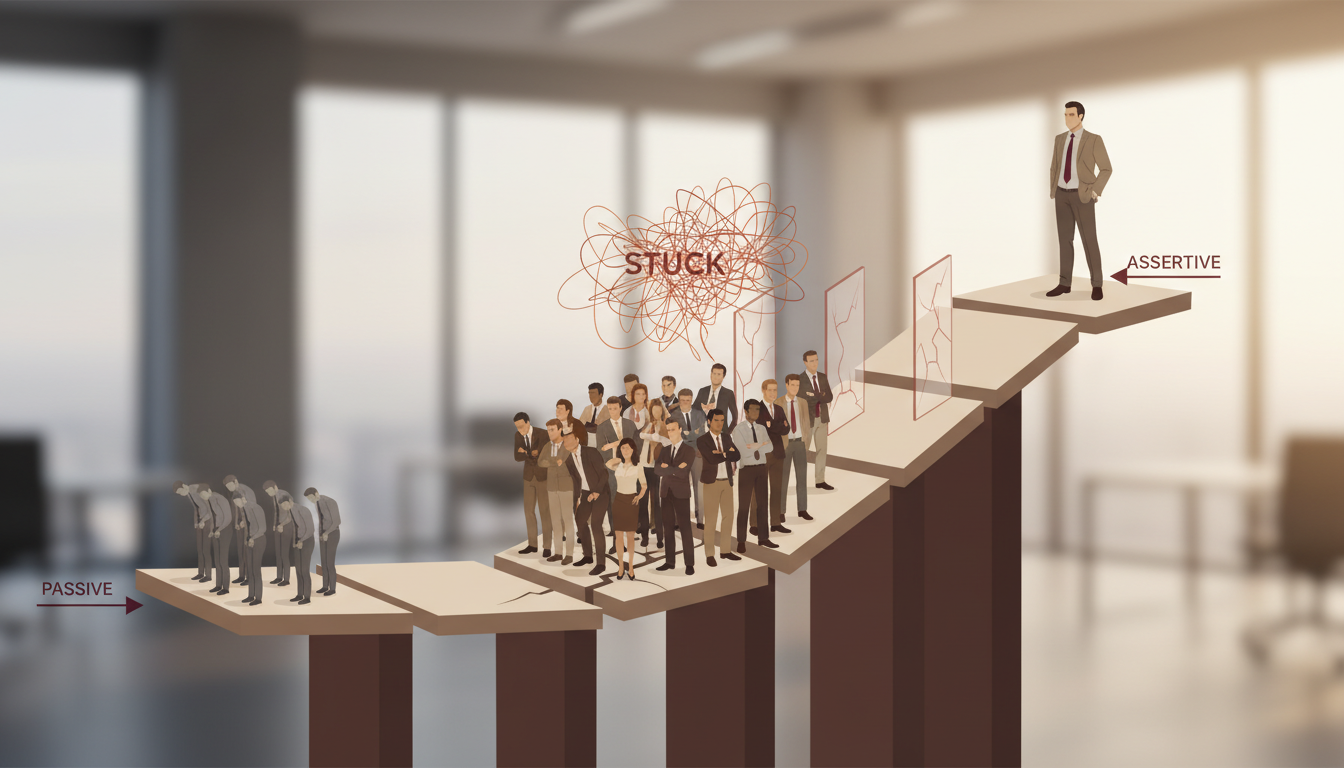
Most professionals don't struggle with assertiveness because they lack opinions. They struggle because they confuse assertiveness with aggression — and default to passivity to avoid conflict.
Here's how the three styles compare in practice:
- Passive: "Whatever you decide is fine with me." (Your needs are invisible.)
- Aggressive: "That's a terrible idea and we're not doing it." (The other person's needs are invisible.)
- Assertive: "I see the value in that approach. I have a different perspective I'd like to share." (Both people's needs are visible.)
According to a 2023 study published in the Journal of Occupational Health Psychology, employees who consistently used assertive communication reported 32% higher job satisfaction and significantly lower levels of workplace burnout compared to those who defaulted to passive or aggressive styles.
Why "Being Nice" Backfires
Many professionals — especially those early in leadership — equate niceness with professionalism. But chronic niceness often leads to resentment, overwork, and being overlooked.
When you always say yes, people don't think you're generous. They think you have no boundaries. Over time, this erodes your credibility. You become the person who absorbs extra work, tolerates interruptions, and never pushes back — and your career stalls because of it.
If this pattern sounds familiar, you may also want to explore how to stop undermining yourself at work through subtle habits you might not even realize you have.
The Fear Behind the Hesitation
The real reason most people avoid assertiveness isn't a lack of skill. It's fear — fear of being labeled difficult, aggressive, or not a team player.
A 2022 survey by VitalSmarts (now Crucial Learning) found that 70% of employees avoid difficult conversations at work because they fear negative consequences. This avoidance doesn't protect relationships. It weakens them, because unspoken frustrations build until they explode — or until you disengage entirely.
Five Frameworks for Being Assertive Without Being Rude
The DESC Method for Difficult Conversations
DESC is a proven four-step assertiveness framework developed by Sharon and Gordon Bower. It works in nearly any professional scenario:
- Describe the situation objectively. ("In our last three meetings, I've been interrupted before finishing my point.")
- Express how it affects you. ("It makes it difficult for me to contribute fully.")
- Specify what you'd like. ("I'd appreciate the chance to finish my thought before we move on.")
- Consequences — share the positive outcome. ("That way, the team gets the full picture before making a decision.")
Notice what's absent: blame, accusations, and emotional language. The DESC method keeps your message factual, forward-looking, and impossible to dismiss as "rude."
The "I" Statement Reframe
Aggressive statements start with "you." ("You always dump last-minute work on me.") Assertive statements start with "I." ("I need more lead time on requests to deliver my best work.")
This isn't just a communication trick. Research from the Gottman Institute — originally applied to relationships but widely adopted in organizational psychology — shows that "I" statements reduce defensiveness in the listener by up to 40%, making productive outcomes far more likely.
Here's a workplace example:
- Before: "You never listen to my input in planning meetings."
- After: "I'd like to contribute more during planning meetings. Can we build in a moment for my updates?"
The second version is just as direct. But it invites collaboration instead of triggering defensiveness.
The Broken Record Technique for Persistent Pushback
Sometimes, being assertive once isn't enough. A colleague keeps asking you to take on their work. A manager repeatedly schedules meetings during your focused work block. In these situations, the Broken Record technique is your best tool.
It works like this: calmly repeat your boundary using the same or similar language, without escalating, justifying, or apologizing.
Example:- Colleague: "Can you just handle the client deck this one time?"
- You: "I'm not able to take that on right now. My plate is full with the Q3 deliverables."
- Colleague: "But it won't take long."
- You: "I understand. I'm not able to take it on right now."
No new arguments. No over-explaining. Just calm repetition. This approach is especially powerful when combined with strategies for handling being undermined in meetings.
Ready to Communicate With More Authority? These frameworks are just the starting point. The Credibility Code gives you a complete system for building assertive, authoritative communication habits that stick. Discover The Credibility Code
The Sandwich Alternative: The "Respect + Direct + Forward" Model
You've probably heard of the feedback sandwich — positive, negative, positive. Most people see through it, and it dilutes your message. A better approach for assertive communication is the Respect + Direct + Forward model:
- Respect — Acknowledge the other person's position genuinely. ("I appreciate you thinking of me for this project.")
- Direct — State your position clearly. ("I'm not the right fit for this timeline given my current commitments.")
- Forward — Offer an alternative or next step. ("I'd suggest reaching out to the operations team, or I could contribute in a limited capacity next quarter.")
This model works because it shows you're not dismissing the other person — you're simply being honest about what you can deliver.
The Pause-and-Respond Protocol
Reactive responses are where assertiveness most often tips into aggression. Someone criticizes your work in a meeting. Your instinct is to fire back or shut down. Neither response serves you.
Instead, use a deliberate pause:
- Pause for 2-3 seconds. (This feels long but signals composure, not weakness.)
- Acknowledge what was said. ("That's an interesting point.")
- Respond with your perspective. ("My data shows a different trend. Let me walk through it.")
According to research from Columbia University's neuroscience department, even a brief pause before responding activates the prefrontal cortex — the brain's center for rational decision-making — reducing the likelihood of an emotional reaction by a significant margin. This is a core skill of leadership presence in conflict.
Scripts for Common Assertiveness Scenarios at Work
Pushing Back on Unreasonable Requests

This script works because it frames your boundary as a quality commitment, not a refusal. You're not saying no — you're asking your manager to make a prioritization decision.
Stating Your Opinion When You Disagree
Scenario: In a strategy meeting, the team is leaning toward an approach you believe is flawed. Script: "I see the reasoning behind this direction. I want to raise a concern before we commit. Based on [specific data or experience], I think we may face [specific risk]. Could we explore [alternative] as a comparison?"For more on this, see our guide on how to disagree with leadership without losing credibility. The key principle: lead with data, not emotion.
Setting Boundaries Around Your Time
Scenario: A colleague habitually drops by your desk for long, unstructured conversations during your most productive hours. Script: "I enjoy our conversations. Mornings are when I do my deepest work, so I'm going to protect that block. Can we catch up at lunch or after 2 PM instead?"Notice the structure: genuine warmth, clear boundary, concrete alternative. No apology. No over-explanation.
Responding to Condescending Comments
Scenario: A senior colleague says, "That's a cute idea, but let me explain how things actually work here." Script: "I'd appreciate us keeping the discussion focused on the merits of the proposal. I'm happy to walk through my reasoning in detail."This response is assertive without being combative. It redirects the conversation to substance and signals that you expect professional respect. If condescension is a recurring pattern, our article on how to be taken seriously at work offers a deeper playbook.
Body Language That Signals Assertiveness, Not Aggression
The Physical Foundations of Assertive Presence
Your words only account for part of the message. Albert Mehrabian's widely cited (and often misapplied) communication research suggests that nonverbal cues — tone, posture, facial expression — carry enormous weight in how your message is received, especially in emotionally charged conversations.
Assertive body language includes:
- Steady eye contact (not staring — aim for 60-70% of the conversation)
- Open posture (uncrossed arms, shoulders back, feet planted)
- Controlled gestures (purposeful hand movements, not fidgeting)
- Level head position (chin parallel to the floor — not tilted up, which reads as arrogant, or down, which reads as submissive)
A 2021 study in Psychological Science found that individuals who adopted open, expansive postures during negotiations achieved 20% better outcomes than those who used closed or contracted body language — regardless of their actual negotiation skill.
Voice: The Most Underrated Assertiveness Tool
Assertive communication falls apart if your voice undermines your words. Common vocal pitfalls include:
- Upspeak (ending statements as if they're questions)
- Trailing off at the end of sentences
- Speaking too fast (which signals nervousness, not confidence)
- Vocal fry or mumbling
The fix is straightforward: slow down, drop your pitch slightly at the end of statements, and project from your diaphragm rather than your throat. For a deeper dive, explore our guide on how to develop a commanding voice at work.
Build Unshakable Communication Confidence The Credibility Code walks you through the exact vocal, verbal, and nonverbal shifts that make assertiveness feel natural — not forced. Discover The Credibility Code
Building an Assertiveness Habit: Daily Practices That Stick
Start With Low-Stakes Situations
You don't build assertiveness by jumping into a salary negotiation. You build it through daily micro-practices:
- Order exactly what you want at lunch without hedging.
- State a preference when someone asks "Where should we eat?" or "What should we work on first?"
- Decline one unnecessary meeting this week with a clear, one-sentence reason.
- Replace one apology with a thank-you. ("Thanks for your patience" instead of "Sorry for the delay.")
That last habit alone can reshape how others perceive your confidence. Our article on how to stop over-apologizing at work provides 12 specific swaps you can implement immediately.
Track Your Assertiveness Wins
Confidence is built on evidence. At the end of each workday, write down one moment where you were assertive — even if it was small. Over 30 days, you'll have a record of progress that rewires your self-perception.
Research from Dominican University of California found that people who wrote down their goals and tracked weekly progress were 42% more likely to achieve them. The same principle applies to behavior change: tracking creates accountability and momentum.
Prepare for the Discomfort
Assertiveness will feel uncomfortable at first — especially if you've spent years being passive. That discomfort isn't a sign you're doing it wrong. It's a sign you're growing.
Expect some pushback from people who benefited from your old patterns. A colleague who always delegated their overflow to you may resist your new boundaries. A manager who never heard you disagree may seem surprised. This is normal. Stay consistent. Within weeks, people recalibrate their expectations — and your professional reputation strengthens as a result. For a complete system to build this kind of daily confidence, explore our guide on how to communicate with confidence at work.
Frequently Asked Questions
How can I be assertive at work without being seen as aggressive?
The key difference is respect. Aggressive communication dismisses or attacks others. Assertive communication clearly states your position while acknowledging the other person's perspective. Use "I" statements, maintain a calm tone, and always offer a path forward. When you combine directness with genuine respect, people perceive confidence — not hostility.
What is the difference between assertiveness and rudeness at work?
Assertiveness is about honest, respectful self-expression. Rudeness is about disregarding others' feelings or dignity. An assertive person says, "I disagree, and here's my reasoning." A rude person says, "That's a stupid idea." The content may overlap — both involve disagreement — but the delivery and intent are completely different. Assertiveness builds relationships; rudeness damages them.
How do I set boundaries at work without making people angry?
You can't control others' emotions, but you can control your delivery. State your boundary clearly, explain the reason briefly, and offer an alternative when possible. For example: "I can't take on this task by Friday, but I can deliver it by next Wednesday." Most people respect boundaries when they're communicated with clarity and consistency rather than hostility or guilt.
Is assertiveness harder for women in the workplace?
Research suggests yes. A 2022 study in The Leadership Quarterly found that women who display assertive behavior are often rated as less likable than men exhibiting identical behavior — a phenomenon known as the "backlash effect." However, women who pair assertiveness with warmth cues (such as collaborative language and genuine acknowledgment) can mitigate this bias. Our guide on executive presence for women in leadership explores this in depth.
How do I become more assertive in meetings specifically?
Start by preparing one clear point you want to make before each meeting. Speak early — the longer you wait, the harder it becomes. Use declarative sentences ("I recommend..." rather than "Maybe we could..."). If interrupted, calmly say, "I'd like to finish my point." These small shifts compound quickly into a more authoritative meeting presence.
Can you be assertive and still be a team player?
Absolutely. In fact, assertiveness makes you a better team player. Teams function best when every member contributes honestly. Withholding your perspective to avoid conflict actually harms the team. Assertive team members raise concerns early, set realistic expectations, and prevent the resentment that passive behavior creates over time.
Your Assertiveness Breakthrough Starts Here You've just learned the frameworks, scripts, and daily habits that separate confident professionals from those who get overlooked. The Credibility Code gives you the complete system — from vocal authority to boundary-setting to executive-level communication — so you can show up with confidence in every conversation. Discover The Credibility Code
Ready to Command Authority in Every Conversation?
Transform your professional communication with proven techniques that build instant credibility. The Credibility Code gives you the frameworks top leaders use to project confidence and authority.
Discover The Credibility CodeRelated Articles

Talked Over in Meetings? 8 Professional Responses That Work
When you're talked over in a meeting, respond immediately with a calm, assertive reclaim. Use phrases like "I'd like to finish my point," paired with steady eye contact and a hand gesture that signals you're not done. The key is acting within two to three seconds — before the interrupter gains momentum. Don't raise your voice or show frustration. Instead, use a measured tone that signals authority. The eight responses below give you exact scripts and body language cues for every common interrupt

How to Handle Being Talked Down to at Work Professionally
To handle being talked down to at work, stay calm and address the behavior directly using neutral, assertive language. Name the specific behavior without attacking the person by saying something like, "I'd appreciate it if we could discuss this as equals—I have relevant expertise here." Set clear boundaries, document patterns of condescension, and escalate to HR if the behavior continues. The goal is to protect your credibility and professional standing without matching their tone or becoming re

Be More Assertive in Meetings Without Being Aggressive
To be more assertive in meetings without being aggressive, focus on three pillars: speak with clear intent using "I" statements, anchor your contributions in data and evidence rather than emotion, and use confident body language—steady eye contact, open posture, and a measured vocal pace. Assertiveness is about advocating for your perspective while respecting others. Aggression shuts people down; assertiveness opens doors. The difference lies in your delivery, timing, and the language frameworks