
How to Communicate With Confidence at Work as a Woman

To communicate with confidence at work as a woman, focus on five core strategies: own your expertise without hedging, use direct language free of qualifiers and apologies, manage interruptions with calm assertiveness, leverage strategic body language and vocal authority, and build alliances that amplify your voice. These research-backed approaches help you project credibility while navigating the double-bind bias that penalizes women for being "too assertive" or "too soft."
What Is Confident Communication for Women at Work?
Confident communication for women at work is the ability to express ideas, advocate for yourself, and lead conversations with clarity and authority — while strategically navigating the gendered expectations that shape how women's communication is received. It goes beyond generic "speak up" advice.
Unlike general confidence tips, this approach accounts for documented workplace biases: women are interrupted more often, judged more harshly for assertiveness, and held to a narrower band of "acceptable" communication styles. Confident communication for women means building genuine authority and understanding the dynamics at play so you can respond to them effectively.
It's a skill set — not a personality trait — and it can be developed systematically. For a foundational overview of how credibility works in professional settings, see our guide on the 5 pillars of authority in communication.
Why Confident Communication Is Different for Women (The Double-Bind Problem)
The Research Behind the Double Bind

Women in the workplace face a well-documented paradox: they're expected to be warm and collaborative, yet they need to be assertive and direct to be seen as leaders. When women communicate with the same directness as male peers, they're often perceived as "aggressive" or "abrasive." When they soften their language, they're seen as lacking confidence.
A 2022 study published in The Leadership Quarterly found that women who displayed dominant communication behaviors were rated as less likable than men who displayed identical behaviors — even when rated as equally competent. This isn't a perception problem you created. It's a systemic bias you can learn to navigate.
How Bias Shows Up in Everyday Interactions
This double bind doesn't just appear in performance reviews. It shows up in daily moments:
- Meetings: Research from George Washington University found that men interrupted women 33% more often than they interrupted other men. Your ideas get cut short before they land.
- Email: Women who write direct, concise emails are more likely to be perceived as "cold" compared to men using the same language.
- Presentations: A study by VitalSmarts found that women's perceived competence dropped by 35% and their perceived worth by $15,088 when they were seen as "forceful" — a penalty men did not face.
What This Means for Your Strategy
Understanding the double bind isn't about accepting it — it's about being strategic. The most effective women communicators don't choose between warmth and authority. They combine both, deliberately. They use what researchers call "tempered assertiveness": leading with competence while signaling collaboration.
This means your communication strategy needs to be more intentional, not less authentic. The frameworks below give you specific tools to project confidence in ways that land well regardless of bias. For a deeper dive into this topic, explore our full guide on executive presence for women in leadership.
Strategy 1: Eliminate Language That Undermines Your Authority
The Hidden Habits That Shrink Your Credibility
Most women have been socialized to soften their language. The result is a collection of verbal habits that quietly erode credibility in every meeting, email, and presentation. These aren't personality flaws — they're patterns you can identify and replace.
Here are the most common credibility-draining habits:
- Over-apologizing: "Sorry, but I think we should consider…"
- Hedging: "I might be wrong, but…" or "This is just my opinion…"
- Uptalk: Ending statements with a rising intonation that turns them into questions.
- Permission-seeking: "Can I add something?" instead of simply adding it.
- Minimizing: "I just wanted to mention…" or "This is a small point, but…"
A study by language analytics firm Textio found that women used hedging language 2.5 times more frequently than men in workplace communications — and that this correlated with lower perceived authority in peer evaluations.
The Replacement Framework: CLEAR Language
Instead of simply telling you to "stop apologizing," use this CLEAR framework to replace weak language with confident alternatives:
- C – Cut qualifiers. Remove "just," "kind of," "sort of," "a little bit." Say "I recommend" not "I just think maybe."
- L – Lead with your point. State your conclusion first, then support it. Don't bury your insight under three minutes of context.
- E – Eliminate unnecessary apologies. Replace "Sorry to bother you" with "I have a quick question." Replace "Sorry, I disagree" with "I see it differently."
- A – Assert with data. Back your statements with evidence. "The Q3 data shows a 12% decline" is harder to dismiss than "I feel like things are slowing down."
- R – Replace questions with statements. Instead of "Don't you think we should look at this?" say "I recommend we look at this. Here's why."
The second version is specific, evidence-based, and authoritative. For a complete list of language swaps you can use immediately, check out our post on how to stop undermining yourself at work.
Ready to Overhaul Your Communication Patterns? The Credibility Code gives you a complete system for replacing weak language habits with authority-building communication — with scripts, frameworks, and daily exercises designed specifically for professionals navigating credibility challenges. Discover The Credibility Code
Strategy 2: Handle Interruptions and Idea Theft With Poise
Why Interruptions Hit Women Harder
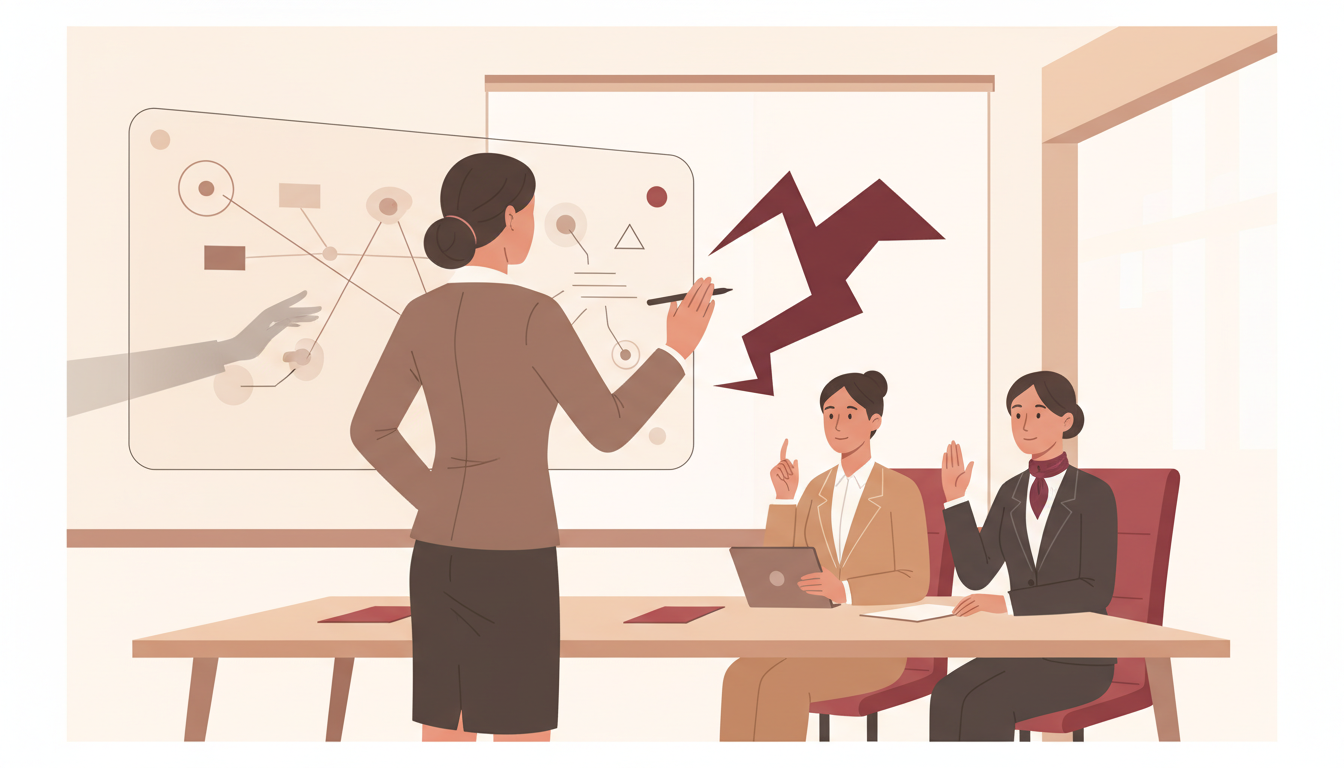
Getting interrupted isn't just annoying — it signals to everyone in the room that your contribution isn't valued. And it happens to women disproportionately. A landmark study from Northwestern University's Pritzker School of Law analyzing U.S. Supreme Court oral arguments found that female justices were interrupted approximately three times more often than their male colleagues — even at the highest levels of professional authority.
In everyday meetings, the pattern is even more pronounced. When you're consistently cut off, others begin to unconsciously view you as less authoritative. Breaking this cycle requires specific techniques.
The 3-Part Interruption Response System
1. The Continuation MethodWhen interrupted, don't stop speaking. Maintain your volume, keep your eye contact steady, and continue your sentence. A brief pause followed by "I'd like to finish my point" is calm, professional, and effective. You don't need to raise your voice. Steady pacing and a composed tone signal more authority than volume ever will.
2. The Reclaim TechniqueIf someone talks over you and takes the floor, wait for a natural pause, then say: "Going back to what I was saying about [topic] —" and complete your point. This reanchors the room's attention to your contribution without creating conflict.
3. The Alliance Amplification StrategyThis technique, famously used by women staffers in the Obama White House, works like this: when a colleague makes a strong point, another woman in the room repeats it and attributes it by name. "I want to build on what Sarah said about the timeline risk — I think her point about the vendor delay is critical."
This does two things: it prevents idea theft (where someone else restates your idea and gets credit) and it creates a culture of mutual amplification.
When Someone Takes Credit for Your Idea
If your idea resurfaces in someone else's mouth, respond immediately and calmly: "I'm glad you're building on the point I raised earlier. Let me add to it." This reclaims ownership without accusation. For more scripts on handling these situations, see our guide on how to handle being undermined in meetings.
Strategy 3: Build Vocal and Physical Authority
The Vocal Confidence Gap
Your voice is one of the most powerful credibility signals you have — and it's one of the first things bias affects. Research from Quantified Communications found that vocal quality accounts for 23% of listeners' evaluations of a speaker's effectiveness. Yet women are frequently coached to be "softer" or "less intense," which directly undermines vocal authority.
Here are three vocal shifts that project confidence:
1. Lower your pitch at the end of sentences. Statements that trail upward sound like questions. Practice ending declarative sentences with a downward inflection. Record yourself in a practice session and listen for unintentional uptalk. 2. Slow down by 10-15%. Nervous speakers rush. Confident speakers pace themselves. Pausing before key points — even for two seconds — signals that you expect attention. It also gives your words more weight. 3. Increase your volume by one notch. Many women unconsciously speak at a lower volume in group settings. You don't need to shout. But speaking at a volume that fills the room signals you expect to be heard. For a complete vocal authority system, see our post on how to develop a commanding voice at work.Body Language That Commands Respect
According to research by Amy Cuddy at Harvard Business School, expansive body language — taking up space, keeping arms uncrossed, maintaining steady eye contact — increases both perceived confidence and actual hormonal markers of confidence (higher testosterone, lower cortisol).
For women specifically, these body language shifts make the biggest impact:
- Claim physical space. Spread your materials on the table. Use the armrests. Don't shrink into your chair.
- Plant your feet. Whether standing or seated, grounded feet signal stability. Avoid crossing your ankles or tucking your feet under your chair.
- Use deliberate hand gestures. Research from the University of Manchester found that speakers who used purposeful hand gestures were rated as more competent and persuasive. Keep gestures at waist-to-chest level and avoid self-soothing movements like touching your hair or face.
- Hold eye contact for 3-5 seconds per person. This builds connection without intensity. Scan the room methodically rather than looking down at your notes.
Strategy 4: Own Your Expertise Without Apology
The Expertise Discount Problem
Women are more likely to discount their own expertise. A well-known study from Hewlett-Packard found that women applied for promotions only when they met 100% of the qualifications, while men applied when they met just 60%. This same pattern shows up in communication: women qualify their knowledge ("I'm not an expert, but…") while men state opinions as facts.
The cost is real. When you discount your expertise, you train others to discount it too.
The Authority Positioning Framework
Use this three-step method to communicate your expertise without hedging and without triggering the "too aggressive" backlash:
Step 1: Lead with evidence, not opinion.Instead of "I think we should change our approach," say "The data from our last three campaigns shows diminishing returns. I recommend we shift to a targeted strategy."
Step 2: Use "I recommend" language."I recommend" is one of the most powerful phrases in professional communication. It positions you as an advisor — someone with expertise worth listening to — rather than someone offering a tentative suggestion.
Step 3: Reference your track record when relevant.This isn't bragging — it's establishing credibility. "Based on the supply chain restructuring I led last year, I'd recommend we…" or "In my experience managing accounts of this size…" These phrases anchor your authority in demonstrated results.
Scenario: You're presenting a quarterly strategy to senior leadership. Hedged version: "I'm not sure if this is the right direction, but maybe we could try focusing more on retention? I think it might help." Authority version: "Our acquisition costs have increased 22% over two quarters while retention rates have dropped. I recommend we reallocate 30% of our acquisition budget to retention initiatives. Based on the retention program I implemented in Q1, we can expect a 15% improvement in lifetime customer value."The second version uses data, states a clear recommendation, and references relevant experience. It's assertive without being aggressive. For more on positioning yourself as a credible authority, explore our guide on how to present yourself as an expert at work.
Build Unshakable Professional Authority The Credibility Code provides a complete system for developing the communication habits, language patterns, and presence that make people listen — and take you seriously. Discover The Credibility Code
Strategy 5: Navigate High-Stakes Conversations Strategically
Salary Negotiations and the Gender Pay Gap
The gender pay gap persists partly because women face real penalties for negotiating the same way men do. A 2023 Pew Research Center analysis found that women earned approximately 82 cents for every dollar earned by men. Research by Hannah Riley Bowles at Harvard Kennedy School found that women who negotiated assertively were penalized in likability ratings — but women who didn't negotiate fell further behind in compensation.
The solution isn't to avoid negotiating. It's to negotiate strategically.
The Collaborative Negotiation Framework for Women
Research shows that women achieve better negotiation outcomes when they frame requests in terms of shared benefit. This isn't about being "nice" — it's about using a strategy that's proven to work within existing bias structures while you also work to change those structures.
Step 1: Anchor in market data. "Based on my research, the market rate for this role with my experience level is $X-$Y." Step 2: Connect your ask to organizational value. "Given the revenue growth I've driven this year, I believe a compensation adjustment to $X reflects my contribution to the team's goals." Step 3: Use relational language strategically. "I want to make sure we find something that works for both of us" isn't weakness — it's a negotiation tactic that research shows reduces backlash while maintaining your position.For complete negotiation scripts designed for women, see our dedicated guide on negotiation confidence for women.
Speaking Up to Senior Leadership
Communicating with senior leaders requires a specific approach. According to a McKinsey & Company Women in the Workplace 2023 report, women are still significantly underrepresented in senior leadership, making up only 28% of C-suite positions. This means that when you speak up, you're often one of few women in the room — which amplifies both the opportunity and the scrutiny.
Use the Bottom-Line-Up-Front (BLUF) method: state your recommendation first, then provide supporting evidence. Senior leaders process information differently, and leading with context instead of conclusions can cause you to lose their attention. Our guide on how to speak up with senior leaders without rambling breaks this down in detail.
Building a Long-Term Confidence System
Daily Practices That Compound
Confident communication isn't built in a single workshop. It's built through daily repetition. Here are three practices to integrate into your routine:
1. The Morning Language Audit (2 minutes). Before your first meeting, review your agenda and mentally rehearse one key point you want to make. Phrase it without qualifiers. Say it out loud once. 2. The Post-Meeting Review (3 minutes). After each significant meeting, note: Did I hedge? Did I get interrupted? Did I state my point clearly? Track patterns over two weeks and you'll see exactly where to focus. 3. The Weekly Visibility Action. Once per week, take one action that makes your expertise visible: share an insight in a team channel, volunteer to present a finding, or send a concise summary of your work to your manager. Visibility compounds into credibility.Building Your Support Network
Research from the Center for Creative Leadership shows that women who have strong professional networks advance faster and report higher confidence levels. Seek out:
- Sponsors (not just mentors) who advocate for you in rooms you're not in.
- Peer allies who will amplify your contributions in meetings.
- Communication accountability partners who will give you honest feedback on your presence and language habits.
Confidence at work isn't a solo project. The most authoritative communicators build systems and relationships that reinforce their credibility over time.
Frequently Asked Questions
How can I be more assertive at work without being seen as aggressive?
Use what researchers call "tempered assertiveness" — combine direct, evidence-based language with collaborative framing. Lead with data rather than opinion, use "I recommend" instead of "I think," and pair your directness with inclusive language like "Here's what I see working for the team." This approach projects authority while maintaining warmth. For a complete framework, see our guide on being assertive without being aggressive.
Assertiveness vs. confidence at work: what's the difference?
Confidence is an internal belief in your competence and value. Assertiveness is the external behavior of expressing your needs, opinions, and boundaries clearly. You can be confident but not assertive (knowing your worth but staying silent) or assertive but not confident (speaking up while feeling uncertain inside). The goal is to build both: internal confidence that fuels consistent assertive communication.
How do I stop apologizing so much at work?
Start by tracking your apologies for one week. Note each "sorry" and categorize it: was it a genuine apology for an actual mistake, or a reflexive softener? For reflexive apologies, create specific replacements. "Sorry to bother you" becomes "I have a quick question." "Sorry, I disagree" becomes "I see it differently." Practice the replacements until they become automatic. Our article on how to stop over-apologizing at work provides a complete replacement guide.
How do I speak up in meetings when I keep getting interrupted?
Use the Continuation Method: when interrupted, maintain your volume and say "I'd like to finish my point" without raising your voice. If you lose the floor, use the Reclaim Technique: wait for a pause, then say "Going back to what I was saying about [topic]." Building alliances with colleagues who will amplify and credit your contributions also reduces interruptions over time.
How do I communicate with confidence in virtual meetings as a woman?
Virtual meetings present unique challenges: it's harder to read body language, easier to be muted or overlooked, and interruptions are more disruptive. Position your camera at eye level, speak within the first five minutes to establish presence, use the chat function to reinforce key points, and address people by name to command attention. For a complete virtual presence system, see our guide on leadership presence in virtual meetings.
Does confident communication actually affect career advancement for women?
Yes. A 2023 McKinsey and LeanIn.Org Women in the Workplace study found that women who actively advocated for themselves and communicated their achievements were more likely to be promoted. Separately, research from Catalyst found that women who had high "visibility" — meaning their contributions were known by decision-makers — advanced at rates comparable to their male peers. Communication is the mechanism through which your competence becomes visible.
Your Confidence System Starts Here. You've just learned the strategies that help women communicate with more authority, handle bias, and own their expertise at work. The Credibility Code gives you the complete system — with daily frameworks, scripts, and exercises — to make these shifts permanent. Discover The Credibility Code
Ready to Command Authority in Every Conversation?
Transform your professional communication with proven techniques that build instant credibility. The Credibility Code gives you the frameworks top leaders use to project confidence and authority.
Discover The Credibility CodeRelated Articles

How to Sound Confident in Meetings When You Feel Anxious
Your palms are damp. Your heart is racing. And in three minutes, you need to present your quarterly update to a room full of senior leaders. Sound familiar? You're not alone — and you're not stuck.

Build Workplace Confidence After Being Micromanaged
Rebuilding workplace confidence after being micromanaged starts with recognizing that the damage is real — and reversible. Prolonged micromanagement erodes your self-trust, decision-making instincts, and professional identity. To recover, you need to systematically rebuild your internal authority by reclaiming small decisions, retraining your communication patterns, and reestablishing your professional identity. This article gives you a concrete recovery plan to move from hesitant and second-gue

How to Stop Undermining Yourself at Work: 12 Habits
You undermine yourself at work every time you soften your language, shrink your body, or defer credit you've earned. To stop, you need to identify the specific habits—linguistic hedges, apologetic emails, passive body language, and deferential meeting behaviors—that silently erode your credibility. Then replace each one with a concrete alternative. This article breaks down 12 of the most common self-undermining habits and gives you exact scripts and replacement behaviors for each.