
How to Communicate With Confidence at Work: A Complete System
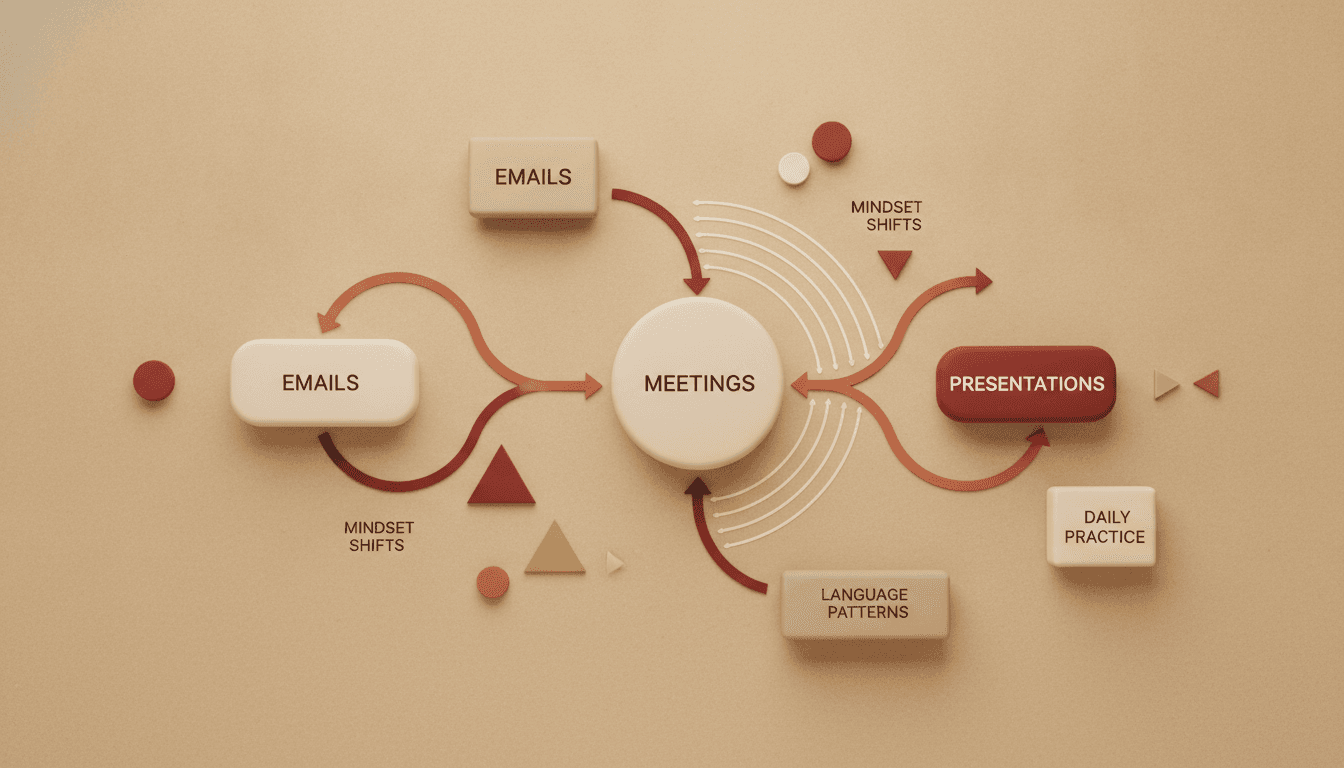
Communicating with confidence at work requires a systematic approach across four dimensions: mindset, language, delivery, and daily practice. Start by eliminating hedging words ("I just think," "sorry, but") from your vocabulary. Then adopt structured speaking frameworks like the Point-Reason-Example-Point method for meetings and presentations. Build a daily practice routine that includes vocal warm-ups, pre-meeting preparation, and post-interaction reflection. Confidence isn't a personality trait—it's a communication skill you can train.
What Is Confident Communication at Work?
Confident communication at work is the ability to express your ideas, opinions, and expertise clearly, directly, and credibly—without over-qualifying, apologizing unnecessarily, or undermining your own authority. It's not about being the loudest voice in the room. It's about being the clearest.
Confident communicators share three traits: they speak with intentional structure, they choose precise language over vague hedging, and they maintain composed delivery under pressure. Whether you're writing an email to a VP, presenting quarterly results, or navigating a difficult one-on-one, confident communication means your message lands with the weight it deserves.
This is distinct from arrogance or aggression. As research from the Harvard Business Review has shown, professionals who communicate with clarity and composure are perceived as 35% more competent than equally qualified peers who hedge or ramble. Confidence is a credibility multiplier.
The Mindset Foundation: Why Confidence Starts Before You Speak
Most professionals treat confident communication as a performance problem—something to fix in the moment. That's backwards. Confidence is a preparation problem. The mental work you do before you open your mouth determines 80% of how you come across.

Reframe Confidence as Competence, Not Personality
The biggest myth about workplace confidence is that some people "just have it." Research from the University of Melbourne found that confident individuals earn up to 20% more over their careers than less confident peers with identical skills. But here's the key insight: the study measured displayed confidence, not innate personality. Confidence is a behavior, not a birthright.
Start by separating your identity from your communication habits. You're not "an unconfident person." You're a capable professional who has developed a few communication patterns that undermine your credibility. That's fixable.
If you've ever felt like you're not qualified enough to speak up, you're experiencing a pattern that affects roughly 70% of professionals at some point in their careers, according to a study published in the International Journal of Behavioral Science. You can learn how to reframe that feeling with our guide on how to stop feeling like a fraud at work.
The Pre-Communication Preparation Protocol
Before any important interaction—meeting, presentation, email to leadership, performance review—run through this three-step mental prep:
- Clarify your one key point. What is the single most important thing you want the other person to walk away knowing? If you can't state it in one sentence, you're not ready.
- Anticipate the "so what?" question. Why should your audience care? Connect your point to a business outcome, a shared priority, or a decision that needs to be made.
- Decide your opening line. Don't wing your first sentence. Script it. The first 10 seconds set the tone for how people perceive your confidence.
This protocol takes 90 seconds. It transforms your communication from reactive to intentional.
Build an Evidence Bank
Confident communicators draw on specific evidence—data, results, examples—rather than vague assertions. Create a running document (a simple note on your phone works) where you log:
- Projects you've led and their outcomes
- Positive feedback from peers, managers, or clients
- Problems you've solved and the impact they had
- Skills you've developed in the last 12 months
When you have concrete evidence at your fingertips, you stop hedging. Instead of saying "I think this might work," you say "Based on the results we saw in Q2, this approach should increase retention by 12%." That's the difference between uncertain and authoritative.
The Language System: Words That Build or Destroy Credibility
The specific words you choose account for a disproportionate amount of how confident you sound. A study by Quantified Communications found that language patterns—independent of content quality—account for up to 30% of a speaker's perceived credibility. Small word changes create enormous perception shifts.
Eliminate the Credibility Killers
Certain phrases actively undermine your authority. They've become so habitual that most professionals don't even notice them. Here are the most damaging patterns and their confident replacements:
| Undermining Phrase | Confident Alternative |
|---|---|
| "I just wanted to check in..." | "I'm following up on..." |
| "Sorry, but I disagree." | "I see it differently." |
| "Does that make sense?" | "Here's what I'd recommend as a next step." |
| "I'm no expert, but..." | "Based on my experience..." |
| "I think maybe we should..." | "I recommend we..." |
| "This might be a dumb question..." | "I want to clarify something." |
For a deeper dive into language patterns that erode your credibility, read our breakdown of 12 words that undermine your credibility at work. And if email is your primary communication channel, explore our guide on assertive communication in emails with 15 before-and-after examples.
The PREP Framework for Structured Speaking
Rambling is the enemy of confident communication. When you speak without structure, you sound uncertain—even if your ideas are brilliant. Use the PREP framework to organize any response in seconds:
- P – Point: State your main idea first.
- R – Reason: Give one clear reason why.
- E – Example: Provide a specific example or data point.
- P – Point: Restate your main idea to close.
Same person. Same knowledge. Radically different perception.
Power Language Patterns for Specific Situations
Different workplace scenarios require different language strategies:
In meetings when you're challenged: Replace defensive responses ("Well, what I was trying to say was...") with grounded ones ("That's a fair question. Here's the data behind my recommendation..."). For more on this, see our guide on how to handle tough questions in meetings. In negotiations: Use anchoring language. Instead of "I was hoping for something around..." say "Based on the market data and my contributions, the appropriate range is..." Our full breakdown of negotiation language patterns that project confidence covers this in depth. When you don't know the answer: Confident communicators don't fake expertise. They say, "I don't have that data in front of me. I'll have a clear answer by end of day." That's more credible than a vague guess.Ready to Overhaul Your Communication Patterns? The Credibility Code gives you the exact scripts, frameworks, and daily drills to eliminate weak language and replace it with authority-building communication habits. Discover The Credibility Code
The Delivery System: How You Say It Matters as Much as What You Say
Research from UCLA professor Albert Mehrabian—while often oversimplified—established a foundational insight: when verbal and nonverbal signals conflict, people trust the nonverbal. You can have the perfect words, but if your delivery signals uncertainty, your message loses impact.

Vocal Delivery: The Three Levers
Your voice communicates confidence or uncertainty through three controllable elements:
1. Pace. Nervous speakers rush. Confident speakers use deliberate pacing. Aim for 140-160 words per minute in presentations (the average conversational pace is about 150 wpm). The key technique: pause for a full beat after making a key point. Silence signals confidence. Rushing signals anxiety. 2. Tone. Avoid "upspeak"—the habit of ending declarative statements with a rising intonation, as if asking a question. "We should launch in Q3?" sounds uncertain. "We should launch in Q3." sounds decided. Record yourself in a meeting (with permission) and listen for this pattern. 3. Volume. Speaking too softly forces people to strain to hear you, which unconsciously codes your message as unimportant. Project enough that the person farthest from you can hear clearly without effort. You don't need to shout—you need to commit to your volume.For a complete vocal training system, explore our guide on how to develop a commanding voice at work.
Body Language: The Silent Authority Signals
According to a study published in Psychological Science, expansive postures (open chest, uncrossed arms, taking up appropriate space) increase testosterone and decrease cortisol—literally shifting your body chemistry toward confidence. Here are the body language habits that signal authority:
- Steepling hands (fingertips together) when listening or making a point signals thoughtfulness and control.
- Planting your feet shoulder-width apart (when standing) grounds your presence. Swaying or shifting weight signals nervousness.
- Making deliberate eye contact for 3-5 seconds per person in a group setting builds connection without intimidation.
- Keeping gestures within the "power zone" (between your waist and shoulders) looks controlled. Gestures above the shoulders or below the waist look erratic or defensive.
Managing Nervous Energy in Real Time
Even experienced communicators feel nervous before high-stakes interactions. The goal isn't to eliminate nerves—it's to channel them. A study from Harvard Business School by Alison Wood Brooks found that reappraising anxiety as excitement ("I'm excited" vs. "I'm calm") improved performance in public speaking, math tasks, and karaoke. The technique works because excitement and anxiety are physiologically similar—both involve high arousal.
Before your next big meeting or presentation:
- Box breathe for 60 seconds: inhale 4 counts, hold 4, exhale 4, hold 4.
- Reframe: Say to yourself, "I'm excited to share this" rather than "I need to calm down."
- Power pose for two minutes in a private space (bathroom, hallway, your car).
- Rehearse your opening line out loud three times.
This four-step routine takes under five minutes and measurably shifts your delivery.
The Channel-Specific Playbook: Emails, Meetings, Presentations, and One-on-Ones
Confident communication isn't one-size-fits-all. Each workplace channel has its own rules, expectations, and pitfalls. Here's how to adapt your approach.
Emails: Write With Authority
Email is where many professionals unconsciously undermine themselves most. Every unnecessary "just," "sorry," or passive construction chips away at your perceived authority.
Rules for confident emails:- Lead with the ask or the key information. Don't bury your point under three paragraphs of context.
- Use direct subject lines. "Decision Needed: Q4 Budget Allocation by Friday" outperforms "Quick question about the budget."
- Cut qualifiers. Before sending, search your draft for "just," "actually," "I think," "sorry," and "maybe." Delete or replace each one.
- Close with a clear next step. "Please confirm by Thursday at 3 PM" is confident. "Let me know your thoughts whenever you get a chance" is not.
For a complete system on writing emails that command attention, see our guide on how to write emails that get taken seriously at work.
Meetings: Contribute With Impact
The biggest confidence challenge in meetings isn't knowing what to say—it's knowing when to say it and how to hold the floor once you do.
The 3-Minute Rule: In any meeting, aim to make your first substantive contribution within the first three minutes. Research on primacy effects shows that early contributors are perceived as more engaged and more influential. Even a brief, well-structured comment establishes your presence. Hold the floor technique: If you're interrupted, use the "acknowledge and redirect" method: "I appreciate that point, and I want to finish this thought first." Say it calmly, without apology. For introverts: You don't need to speak the most. You need to speak with the most structure. One well-organized comment using the PREP framework outweighs ten scattered reactions. Our guide on how to speak up in meetings as an introvert covers eight specific methods for making your voice heard without forcing extroversion.Presentations: Command the Room
Presentations are the highest-visibility confidence test in most workplaces. They're also the most trainable.
The Confident Presentation Formula:- Open with a hook, not a disclaimer. Never start with "Sorry, I'm a little nervous" or "I know this is a lot of slides." Start with a provocative question, a surprising statistic, or a bold statement.
- Use the "Tell-Show-Tell" structure. Tell them what you'll cover. Show them the evidence. Tell them what it means.
- End with a clear call to action. "Based on this data, I'm recommending we approve the Phase 2 budget by next Friday" is infinitely more confident than "So yeah, that's what I've got. Any questions?"
For a deeper dive into presentation authority, explore our framework on how to command a room when presenting.
One-on-Ones: Build Credibility Quietly
One-on-one conversations with your manager, peers, or direct reports are where lasting credibility is built. These interactions are lower-pressure than presentations but higher-impact over time.
Confident one-on-one habits:- Come with an agenda. Even for informal check-ins, having two or three prepared talking points signals professionalism.
- Share your perspective before asking for theirs. Instead of "What do you think we should do?" try "Here's what I'd recommend, and I'd value your input."
- Use data to support your observations. "I've noticed our sprint velocity has dropped 15% over the last three cycles" is more credible than "Things feel slower lately."
Build Unshakeable Confidence Across Every Channel The Credibility Code provides channel-specific scripts for emails, meetings, presentations, and difficult conversations—plus the daily practice system to make confident communication automatic. Discover The Credibility Code
The Daily Practice System: Making Confidence Automatic
Confident communication isn't something you "learn once." It's a skill you build through deliberate daily practice. Like any skill, it requires repetition, feedback, and progressive challenge.
The 15-Minute Daily Confidence Routine
This routine is designed for mid-career professionals who don't have hours to spare but want measurable improvement within 30 days.
Morning (5 minutes):- Review your calendar. Identify the highest-stakes interaction of the day.
- Script your opening line for that interaction.
- Identify one hedging habit you'll consciously avoid today (e.g., "just," upspeak, apologizing before contributing).
- After your most important interaction, do a quick debrief: What did you say well? Where did you hedge? What would you change?
- Write one sentence capturing what worked. This builds your confidence evidence bank.
- Read one article or framework on communication (from this blog or another trusted source).
- Identify one technique to try tomorrow.
This 15-minute investment compounds dramatically. Within 30 days, you'll notice fewer hedging words, more structured responses, and more invitations to contribute in high-visibility settings. For a full 30-day system, explore our executive presence self-improvement plan.
Track Your Progress With the Confidence Scorecard
Create a simple weekly scorecard tracking five metrics:
- Hedging frequency: How often did you catch yourself using undermining language? (Goal: decreasing trend)
- Preparation rate: What percentage of important interactions did you prepare for? (Goal: 80%+)
- First-three-minutes contributions: In how many meetings did you speak within the first three minutes? (Goal: 75%+)
- Structured responses: How often did you use PREP or another framework? (Goal: increasing trend)
- Positive feedback received: Did anyone comment on your clarity, confidence, or leadership? (Track these as evidence)
Progressive Challenges for Growth
Once the basics feel natural, push yourself with escalating challenges:
- Week 1-2: Eliminate "just" and "sorry" from all emails.
- Week 3-4: Use the PREP framework in every meeting contribution.
- Week 5-6: Volunteer to present in a meeting you'd normally stay silent in.
- Week 7-8: Lead a cross-functional discussion or facilitate a brainstorm.
- Week 9-10: Request a skip-level meeting with a senior leader and come prepared with a strategic perspective.
Each challenge builds on the last. By week 10, you're operating at a level of visible confidence that most professionals never reach—not because they can't, but because they never built the system.
Frequently Asked Questions
How long does it take to build confident communication at work?
Most professionals notice meaningful improvement within 2-4 weeks of deliberate practice. The first shift—eliminating hedging language from emails—can happen in days. Vocal delivery and meeting presence take longer, typically 4-8 weeks of consistent effort. The key is daily repetition, not occasional effort. Building a daily confidence habit system accelerates results significantly.
What's the difference between confident communication and aggressive communication?
Confident communication is direct, clear, and respectful. Aggressive communication is forceful, dismissive, and disrespectful. The distinction lies in intent and delivery. Confident communicators state their position without attacking others. They say "I disagree because the data shows X" rather than "That's a terrible idea." Assertiveness sits between passivity and aggression—it's the productive middle ground where credibility lives.
How can introverts communicate with confidence at work?
Introverts often have a natural advantage in confident communication: they tend to think before speaking, which leads to more structured, substantive contributions. The challenge is visibility, not capability. Focus on preparing one high-quality comment per meeting rather than speaking frequently. Use written channels (email, Slack) where you can craft your message deliberately. Read our guide on how to build leadership presence as an introvert for a tailored strategy.
How do I stop sounding uncertain when I speak at work?
Start with three immediate fixes: eliminate upspeak (rising intonation on statements), cut filler words ("um," "like," "you know"), and pause instead of filling silence. Then address language patterns—replace "I think maybe" with "I recommend," and "does that make sense?" with a clear next step. These changes are mechanical, not personality-based, and they create an immediate shift in how others perceive your authority. Our guide on how to stop sounding uncertain at work covers 11 specific fixes.
Can confident communication help me get promoted?
Yes—directly. A study by Personnel Psychology found that communication competence is one of the strongest predictors of leadership advancement, independent of technical skill. Promotions go to people who are perceived as leaders, and perception is shaped primarily through communication. When you speak with structure, write with clarity, and present with composure, decision-makers see you as someone ready for the next level.
How do I communicate with confidence in virtual meetings?
Virtual meetings require exaggerated confidence signals because the medium flattens your presence. Keep your camera on and position it at eye level. Look directly into the camera (not the screen) when making key points. Use a stronger vocal projection than feels natural—screens dampen energy. Eliminate visual distractions behind you. And use the chat function strategically: drop a key data point or summary in chat to reinforce your verbal contribution. Our guide on leadership presence in virtual meetings covers nine essential habits.
Your Communication Is Your Career Currency Every email, meeting, and presentation is either building your credibility or eroding it. The Credibility Code gives you the complete system—scripts, frameworks, daily drills, and mindset shifts—to communicate with authority in every professional interaction. Stop hoping confidence will "just come." Build it systematically. Discover The Credibility Code
Ready to Command Authority in Every Conversation?
Transform your professional communication with proven techniques that build instant credibility. The Credibility Code gives you the frameworks top leaders use to project confidence and authority.
Discover The Credibility CodeRelated Articles

How to Communicate With Confidence at Work: A Full Guide
Communicating with confidence at work requires deliberate shifts in your language, vocal delivery, body language, and mindset. Start by eliminating hedging phrases ("I just think," "I'm not sure, but..."), replacing them with direct statements. Ground your voice by breathing from your diaphragm, slowing your pace, and pausing before key points. Prepare talking points before meetings so you speak with structure, not stream-of-consciousness. Practice daily in low-stakes conversations, and build up

How to Communicate With Confidence at Work: Daily Habits
To communicate with confidence at work, build daily habits that reshape how you speak, write, and show up. Start by eliminating undermining language ("just," "sorry," "I think"), replacing hedge phrases with direct statements, and using structured responses in meetings. Pair these language shifts with intentional body language—steady eye contact, deliberate pauses, and open posture. Confidence at work isn't a personality trait; it's a set of repeatable communication behaviors you practice every

How to Sound Credible at Work: 9 Daily Shifts
To sound credible at work, focus on nine daily shifts across three dimensions: what you say (verbal precision), how you say it (vocal authority), and what you do while saying it (behavioral signals). Replace hedging language with direct statements, slow your speaking pace by 10–15%, lead with conclusions before details, and use grounded body language. These small, repeatable shifts compound over time, transforming how colleagues, managers, and executives perceive your competence and authority.