
Negotiate a Promotion: Conversation Scripts That Work

To negotiate a promotion successfully, open with a clear statement of intent, present evidence of your impact, and propose a specific role or title. A proven conversation script follows this structure: (1) Set the context — "I'd like to discuss my career trajectory based on my contributions this year." (2) Present your case — cite measurable results. (3) Make the ask — name the role. (4) Handle objections with prepared responses. Below, you'll find complete word-for-word scripts for every stage.
What Is a Promotion Negotiation Conversation Script?
A promotion negotiation conversation script is a pre-planned, adaptable framework of specific phrases and responses designed to guide you through requesting, justifying, and securing a promotion from your manager. Unlike casual career conversations, these scripts give you exact language for initiating the discussion, presenting evidence, handling objections, and closing with clear next steps.
The best scripts aren't robotic — they're flexible structures that keep you confident and on-message when the pressure rises. Think of them as guardrails that prevent you from underselling yourself, over-apologizing, or losing control of the conversation.
Why You Need a Script (Not Just Talking Points)
The Confidence Gap in Promotion Conversations

Most professionals know they deserve a promotion long before they ask for one. According to a 2023 survey by Robert Half, 46% of workers feel they are underpaid or under-titled for the work they do — yet fewer than half ever initiate a formal promotion conversation. The gap isn't a knowledge problem. It's a confidence and preparation problem.
When you walk into a high-stakes conversation without specific language prepared, your brain defaults to hedging. You say things like "I was kind of hoping" or "I'm not sure if this is the right time, but..." These phrases instantly undermine your credibility. A script eliminates that risk.
If you tend to soften your language under pressure, you'll benefit from learning how to ask for what you want at work without apology.
What Research Says About Preparation and Outcomes
A study published in the Journal of Organizational Behavior found that employees who prepared specific talking points before a negotiation achieved outcomes 12-18% better than those who "winged it." Preparation doesn't just help you feel better — it changes the result.
Scripts also protect you from a well-documented psychological phenomenon: the "backfire effect" in self-advocacy. Research from Harvard Business School shows that when people advocate for themselves without structure, they're more likely to trigger negative evaluations from the other party. A script helps you frame your request in terms of organizational value rather than personal desire — which is exactly what decision-makers respond to.
Scripts vs. Memorized Speeches
Let's be clear: a script is not a monologue you recite. It's a set of key phrases, transition sentences, and response templates you internalize. You should sound natural, not rehearsed. The goal is to have your strongest language ready so you don't have to invent it under stress.
The Pre-Conversation Framework: What to Do Before You Sit Down
Build Your Evidence Portfolio
Before you write a single word of your script, you need ammunition. Gather these four categories of evidence:
- Quantifiable results — Revenue generated, costs saved, projects delivered, metrics improved
- Scope expansion — Responsibilities you've taken on beyond your current role
- Leadership moments — Times you led initiatives, mentored others, or influenced decisions
- External validation — Client feedback, peer recognition, stakeholder praise
Be specific. "I improved team efficiency" is weak. "I redesigned our onboarding workflow, reducing new-hire ramp time from 12 weeks to 7 weeks, saving approximately $40,000 annually" is undeniable.
For a deeper system on positioning your contributions strategically, read our guide on how to communicate your strategic value at work clearly.
Choose Your Timing Strategically
Timing matters more than most people realize. According to PayScale's 2023 Compensation Best Practices Report, 72% of successful promotion requests happen during formal review cycles or immediately after a major project win — not at random.
The best windows for a promotion conversation:
- After delivering a high-visibility result (within 2 weeks)
- During performance review season (schedule it separately from the review itself)
- When your manager is planning next quarter or next year's team structure
- After your manager has publicly praised your work
Avoid Mondays, Fridays, and any week your manager is visibly stressed or dealing with a crisis.
Set the Meeting Properly
Don't ambush your manager. Send a brief, professional meeting request:
Script — Meeting Request Email:"Hi [Manager's Name], I'd like to schedule 30 minutes to discuss my career development and how my role is evolving. I have some specific ideas I'd like to share. Would [date/time] work for you?"
This signals seriousness without creating alarm. It gives your manager time to mentally prepare, which actually works in your favor — they'll arrive expecting a substantive conversation.
Ready to communicate with more authority in every career conversation? The Credibility Code gives you the frameworks, language, and presence strategies that make people take notice. Discover The Credibility Code
Complete Promotion Conversation Scripts: Phase by Phase
Phase 1: The Opening (First 2 Minutes)
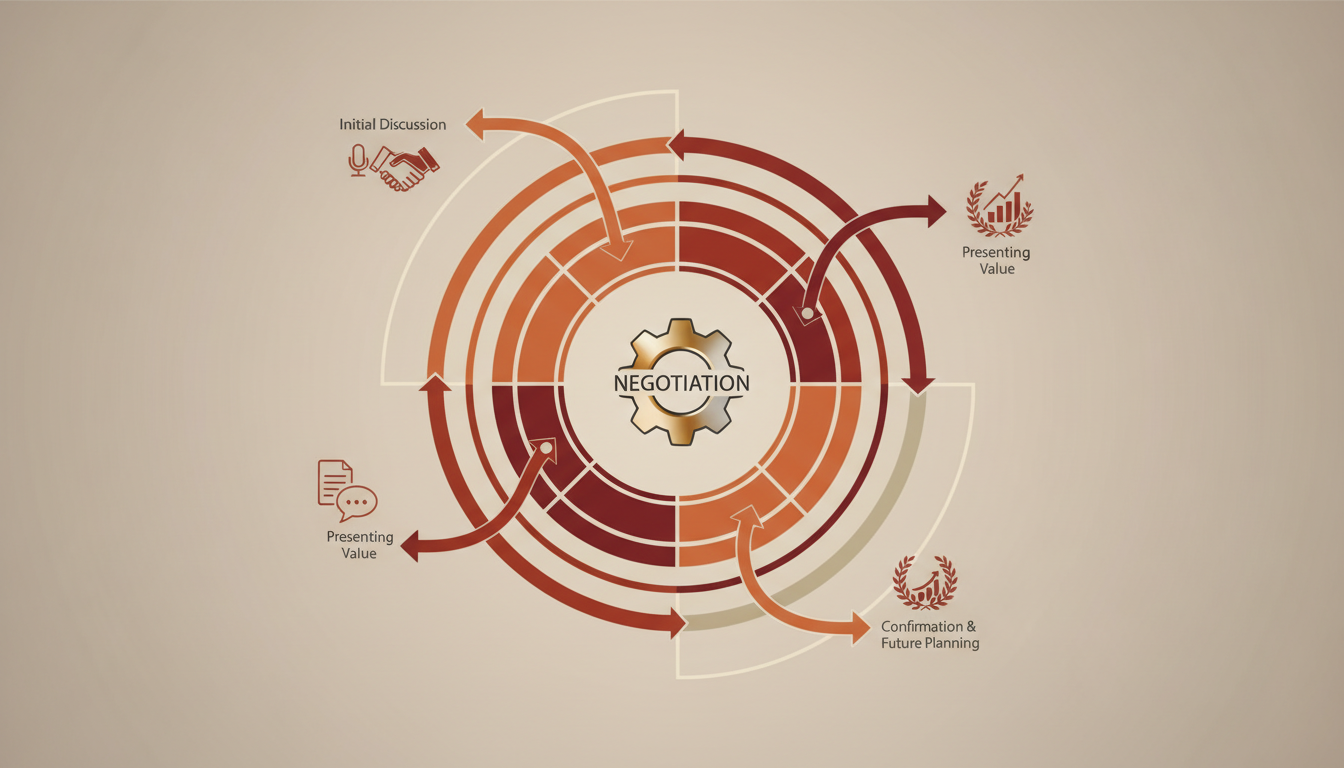
The opening sets the tone for everything that follows. Your goal is to establish that this is a serious, professional discussion — not a casual wish or complaint.
Script — The Confident Opener:"Thank you for making time for this. I want to talk about my trajectory here because I'm genuinely invested in this team's success and I want to make sure my role reflects the level I'm contributing at. I've put some thought into this, so let me walk you through what I'm seeing."Why this works: It's direct without being aggressive. It frames the conversation around contribution, not entitlement. The phrase "the level I'm contributing at" subtly signals that you're already performing above your current role. What NOT to say:
- ❌ "I hope this is okay to bring up..."
- ❌ "I know this might not be the best time..."
- ❌ "I don't want to seem pushy, but..."
These hedging phrases immediately signal uncertainty. If you struggle with self-undermining language, our guide on how to stop undermining yourself at work covers 12 hidden habits to fix.
Phase 2: Presenting Your Case (3-5 Minutes)
This is where your evidence portfolio becomes your script. Use the I-R-A Framework: Impact → Role Evolution → Ask.
Script — The Evidence Presentation:"Over the past [timeframe], I've taken on responsibilities that go well beyond my current title. Let me give you three specific examples.
>
First, [specific achievement with numbers]. This directly contributed to [business outcome].
>
Second, I've been leading [initiative/team/project] — which is typically a [senior title] responsibility. The result was [measurable outcome].
>
Third, I've received feedback from [stakeholders/clients/peers] recognizing [specific contribution]. I can share those emails if helpful.
>
When I look at this objectively, the work I'm doing aligns with a [target title] role. I'd like to formalize that."Real-world example: Sarah, a marketing manager at a mid-size SaaS company, used this exact framework. She said: "Over the past 14 months, I've led the rebrand initiative that increased qualified leads by 34%. I've been managing two direct reports — which isn't in my job description — and I led the cross-functional launch team for our enterprise product. This is director-level work, and I'd like my title and compensation to reflect that."
Her manager approved the promotion within three weeks.
Phase 3: The Direct Ask (30 Seconds)
Many people build a great case and then fail to actually ask. Don't leave it implied. Be explicit.
Script — The Clear Ask:"Based on what I've shared, I'm requesting a promotion to [specific title], with compensation aligned to that level. I've looked at internal benchmarks and market data, and I believe a range of [salary range] is appropriate. What are your thoughts?"Key elements:
- Name the exact title
- Name a specific compensation range (based on research)
- End with an open question that invites dialogue, not a yes/no
According to Glassdoor's 2024 Employment Confidence Survey, candidates who name a specific number in negotiations earn 7% more on average than those who let the employer make the first offer. The same principle applies to internal promotions.
Handling the Five Most Common Objections
Objection 1: "The Budget Isn't There Right Now"
This is the most frequent deflection. It may be true — or it may be a test of your persistence.
Script — Budget Objection Response:"I understand budget constraints are real. What I'd like to do is separate two things: the title change and the compensation adjustment. Can we move forward with the title and role change now, and agree on a specific timeline — say 90 days — to revisit the compensation piece? I'd like to document that plan so we're both aligned."Why this works: You're showing flexibility without surrendering. You're also creating accountability by requesting documentation. Managers respect professionals who negotiate with structure. For more on holding your ground in difficult negotiations, see our guide on negotiation confidence exercises that build it fast.
Objection 2: "You Need More Experience in [Area]"
Script — Experience Gap Response:"That's helpful feedback. Can you be specific about what 'more experience' looks like? I want to understand exactly what milestones would make this a clear yes. And can we set a timeline for me to demonstrate that — with a follow-up meeting in [60-90 days] to reassess?"Critical move: Always pin down vague feedback. "More experience" is meaningless unless it's tied to specific, measurable criteria. If your manager can't articulate it, the objection isn't real — it's a delay tactic.
Objection 3: "Let's Revisit This at Your Next Review"
Script — Delay Response:"I appreciate that, and I want to work within the process. At the same time, I want to make sure this doesn't get lost. Can we document what we've discussed today, agree on the specific criteria I need to meet, and schedule a dedicated follow-up before the formal review cycle? I'd suggest [specific date]."
Objection 4: "I Need to Check with [Senior Leadership/HR]"
Script — Escalation Response:"Of course. Would it be helpful if I put together a one-page summary of my contributions and the business case for this promotion? That way you have something concrete to share. And can we set a date by which you'll have an answer — even if it's preliminary?"
This is a power move. You're making your manager's job easier while maintaining momentum. If you want to strengthen your ability to influence senior stakeholders, that skill directly supports this moment.
Objection 5: "Other People on the Team Also Want Promotions"
Script — Competition Response:"I respect that, and I'm not asking you to compare me to my colleagues. I'm asking you to evaluate whether my specific contributions and performance justify this move. Based on the evidence I've shared, do you agree that the work I'm doing is at the [target title] level?"
This redirects the conversation from scarcity ("there's only one promotion to give") back to merit — which is exactly where you want it.
Master the art of commanding conversations at every level. The Credibility Code gives you the complete system for communicating with authority — in negotiations, presentations, and every high-stakes moment. Discover The Credibility Code
Closing the Conversation: Scripts for Every Outcome
If They Say Yes
Script — Accepting the Promotion:"Thank you — I'm glad we're aligned. I want to make sure we're on the same page about the details. Can we document the new title, compensation, start date, and any changes to my responsibilities? I'd like to have that in writing within [timeframe]."
Don't just celebrate — formalize. A verbal yes without documentation is not a promotion. According to SHRM (Society for Human Resource Management), 23% of verbally agreed promotions are delayed or modified when not documented promptly.
If They Say "Not Yet"
Script — Responding to a Delay:"I understand. Here's what I'd like to do: let's agree on three to five specific criteria that would make this a definitive yes. I'll document those, and I'd like to schedule a follow-up in [60-90 days] to review my progress. Does that work?"
Then follow up. In writing. On the agreed date. Most people who get delayed never follow up — and the promotion quietly dies. Don't let that happen.
If They Say No
Script — Responding to a Rejection:"I appreciate your honesty. Can you help me understand the specific reasons? I want to know whether this is about timing, performance, budget, or role availability — because my approach will be different depending on the answer. And I'd like to understand what path to promotion does exist for me here."
This is the moment that separates professionals who stall from those who position themselves for promotion strategically. Even a no gives you information you can use.
Body Language and Delivery: How to Sound as Strong as Your Script
Vocal Authority During the Conversation
Your words are only half the message. A 2022 study from the University of Chicago found that listeners judge a speaker's competence based on vocal confidence as much as content quality.
During your promotion conversation:
- Speak at a measured pace. Rushing signals nervousness. Pause after key statements.
- Lower your pitch slightly at the end of sentences. Upward inflections turn statements into questions.
- Use silence strategically. After making your ask, stop talking. Let your manager respond.
For a complete system on how to speak with authority, our guide covers eight specific techniques you can practice before your meeting.
Physical Presence
- Sit upright, leaning slightly forward (signals engagement, not aggression)
- Maintain steady eye contact — especially when making your ask
- Keep your hands visible and still (no fidgeting, no crossed arms)
- Nod when your manager speaks to signal active listening
Managing Nerves in the Moment
If you feel anxiety rising mid-conversation, use the 3-3-3 grounding technique: notice three things you can see, three you can hear, and move three parts of your body. This takes seconds and resets your nervous system without your manager noticing.
Frequently Asked Questions
How far in advance should I prepare for a promotion conversation?
Start building your evidence portfolio at least four to six weeks before the conversation. Spend two weeks gathering data, one week drafting and rehearsing your scripts, and one week refining based on practice. The meeting request itself should go out five to seven business days before your preferred date, giving your manager time to prepare without creating unnecessary anticipation.
What's the difference between a promotion negotiation and a salary negotiation?
A promotion negotiation focuses on title, role scope, and career level — with compensation as one component. A salary negotiation focuses primarily on compensation within your current role. Promotion conversations require you to prove you're already operating at the next level, while salary negotiations center on market value for your existing position. The scripts and evidence differ significantly.
Should I mention competing job offers during a promotion conversation?
Only if you genuinely have one and are prepared to leave. Bluffing with a fake offer destroys trust permanently. If you do have a legitimate offer, frame it carefully: "I've been approached by another organization, and while I'd prefer to grow here, I want to make sure my trajectory reflects my contributions." Never use it as a threat — present it as context.
How do I negotiate a promotion when I have no direct reports?
Individual contributors earn promotions by demonstrating expanded impact, not headcount. Focus your script on influence scope, technical leadership, cross-functional contributions, and strategic thinking. Many organizations have parallel IC and management tracks. Ask your manager: "What does senior-level contribution look like for an individual contributor on this team?" Then align your evidence to that definition.
What if my manager agrees verbally but nothing happens afterward?
Follow up within 48 hours with a written summary: "Thank you for our conversation. To confirm, we agreed on [title, timeline, compensation]. Please let me know if I've captured anything incorrectly." If nothing progresses within two weeks, schedule a brief check-in. If the pattern continues beyond 30 days, escalate to HR or your skip-level manager — professionally and with documentation.
How many times can I ask for a promotion before it becomes counterproductive?
If you've been told no with specific criteria, you can ask again once those criteria are met — typically every six to twelve months. If you've asked twice with no clear path forward, it may signal a structural ceiling. At that point, have a candid conversation: "I want to understand honestly whether there's a promotion path for me here, and if so, what it looks like." The answer will tell you whether to stay or explore external options.
Your next career conversation could change everything. The Credibility Code gives you the complete communication system — scripts, frameworks, and presence strategies — that transforms how people see you at work. Stop waiting to be noticed. Start commanding the room. Discover The Credibility Code
Ready to Command Authority in Every Conversation?
Transform your professional communication with proven techniques that build instant credibility. The Credibility Code gives you the frameworks top leaders use to project confidence and authority.
Discover The Credibility CodeRelated Articles

How to Negotiate Salary Mid-Career: Scripts & Strategy
To negotiate salary mid-career, start by anchoring your ask to market data and quantified impact—not tenure or loyalty. Research your market value using tools like Glassdoor, Levels.fyi, or Payscale. Prepare a one-page "value brief" documenting your measurable contributions. Then use a collaborative framing script: *"Based on my research and the results I've delivered, I'd like to discuss aligning my compensation with [specific range]."* Mid-career negotiation requires a different playbook than

How to Negotiate a Promotion: A Step-by-Step Guide
To negotiate a promotion successfully, build an evidence portfolio of measurable results, choose your timing strategically (after a major win or during review cycles), and frame the conversation around the value you bring to the organization — not personal need. Use confident, specific language: state what role you're targeting, present your track record, and propose a transition plan. Prepare for objections in advance, and always follow up in writing with clear next steps and a timeline.

How to Negotiate Salary as a Woman: Scripts That Work
Women earn 84 cents for every dollar men earn, according to the Pew Research Center (2024). But the gap isn't just about systemic bias — it's also about negotiation. To negotiate salary as a woman, you need to combine market research with strategic language that projects authority while neutralizing the social penalties women uniquely face. This article gives you research-backed frameworks, exact word-for-word scripts, and reframing techniques so you walk into your next negotiation prepared, con