
How to Sound Confident in a Presentation: 9 Expert Tips
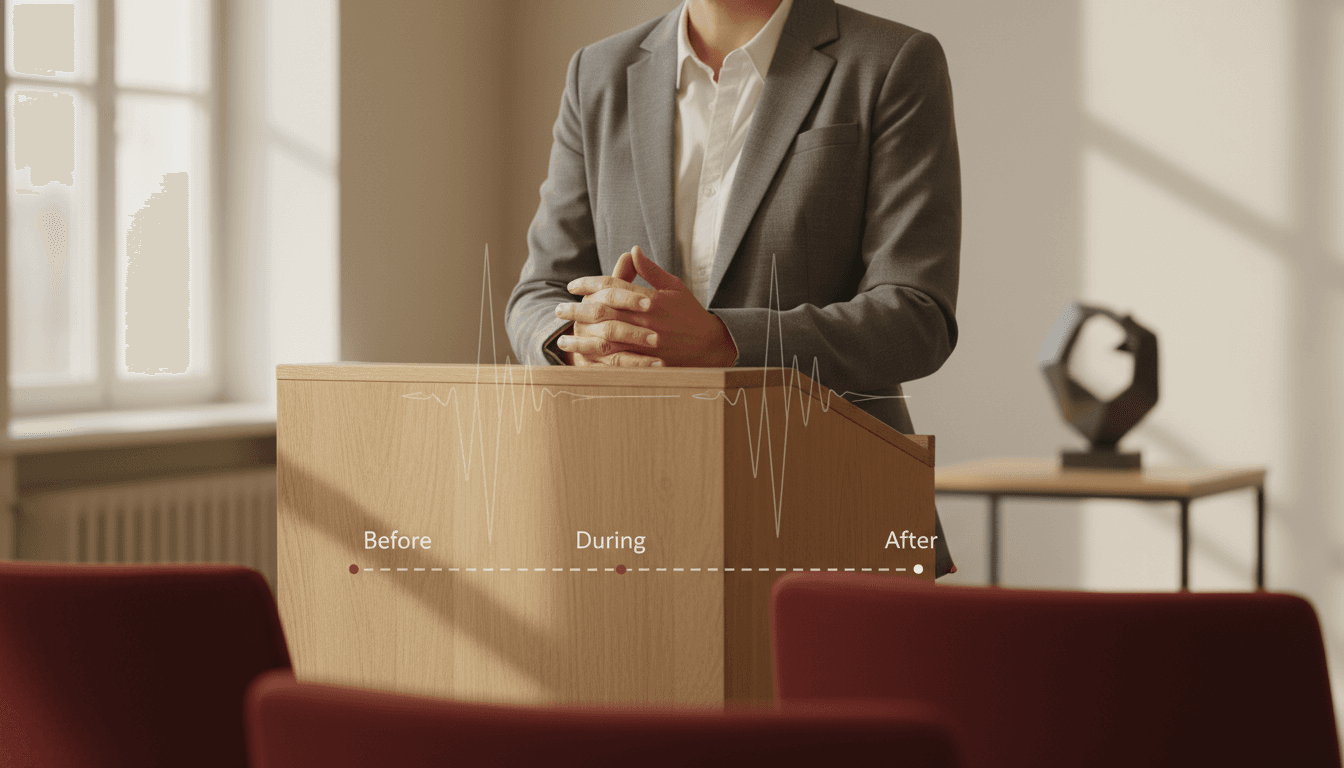
To sound confident in a presentation, focus on three pillars: vocal delivery, strategic language, and physical presence. Slow your speaking pace to 130–150 words per minute, eliminate filler words like "um" and "just," replace hedging phrases with declarative statements, and use intentional pauses to signal authority. These techniques work even when you feel nervous—because sounding confident is a skill you practice, not a personality trait you're born with.
What Does It Mean to Sound Confident in a Presentation?
Sounding confident in a presentation means your voice, language, and delivery signal authority, clarity, and control—regardless of how you feel internally. It's the ability to speak with steady pacing, purposeful pauses, and decisive word choices that make your audience trust your message.
This is different from being confident. Many skilled presenters still feel nervous before speaking. The distinction matters: you don't need to eliminate anxiety to sound authoritative. You need to train the observable behaviors—vocal tone, pacing, word selection, and body language—that audiences associate with credibility. Research from UCLA's Albert Mehrabian found that up to 38% of a speaker's perceived credibility comes from vocal qualities alone, not the words themselves.
Before You Present: Preparation That Builds Vocal Confidence
The most confident-sounding presenters don't wing it. Their calm, authoritative delivery is the result of deliberate preparation that starts well before they walk into the room.
Tip 1: Script Your Opening and Closing Word-for-Word
The first 30 seconds and last 30 seconds of your presentation carry disproportionate weight. Psychologists call this the primacy-recency effect—audiences remember the beginning and end far more than the middle. If you sound shaky at the start, that impression sticks.
Write out your opening line, your transition into the topic, and your closing statement verbatim. Rehearse them until they feel natural. For example, instead of fumbling with "So, um, today I'm going to talk about…" you open with: "This quarter, our team reduced churn by 14%. Here's exactly how we did it—and how we scale it next."
That's a confident opener. It's specific, declarative, and forward-moving. For more on strong openings, see our guide on how to start a presentation with confidence.
Tip 2: Rehearse Out Loud at Presentation Speed
Silent reading is not rehearsal. Your brain processes words differently when you speak them aloud, and your mouth needs physical practice with the syllables, transitions, and rhythms of your talk.
Rehearse at least three times at full volume and full speed. Record yourself on your phone. Listen for upspeak (ending statements like questions), rushed sections, and filler words. A study published in the Journal of Experimental Social Psychology found that speakers who rehearsed aloud were rated significantly more competent and confident by listeners compared to those who only reviewed their notes silently.
Time yourself. If your 15-minute presentation takes 11 minutes in rehearsal, you're speaking too fast—a classic sign of nervousness.
Tip 3: Use the "Anxiety Reframe" Technique
Harvard Business School professor Alison Wood Brooks found that reframing anxiety as excitement improved performance in public speaking tasks. Instead of telling yourself "calm down," say out loud: "I'm excited about this." Her research showed that speakers who used this reframe were rated as more confident, competent, and persuasive by audiences.
This works because anxiety and excitement share nearly identical physiological signatures—elevated heart rate, adrenaline, heightened focus. The reframe doesn't suppress the feeling; it redirects it. If you struggle with pre-presentation nerves, our deep dive on managing speaking anxiety at work offers eight additional proven methods.
Ready to Build Unshakable Presentation Confidence? The Credibility Code gives you the complete framework for commanding any room—from vocal authority to executive presence. Discover The Credibility Code
During Your Presentation: Vocal Delivery Techniques That Signal Authority
Your voice is your primary instrument of confidence. Here's how to wield it.

Tip 4: Slow Down and Own the Silence
Nervous presenters rush. Confident presenters take their time. Aim for 130–150 words per minute during key points (normal conversation runs about 150–170 wpm). This slower pace signals that you believe what you're saying is worth hearing—and that you're not afraid to hold the room's attention.
More importantly, use intentional pauses. Pause for a full two seconds after making a key point. Pause before answering a question. Pause after a transition slide. According to research from the Max Planck Institute for Psycholinguistics, listeners perceive speakers who pause strategically as more thoughtful and credible than those who fill every silence.
Here's a practical framework—the P.A.C.E. Method:
- Pause before key statements (2 seconds)
- Anchor your breath (inhale through your nose during the pause)
- Commit to the sentence (speak the full thought without trailing off)
- End with downward inflection (statement, not question)
For a complete guide to mastering the pause, see how to pause effectively in public speaking.
Tip 5: Eliminate Upspeak and Use Downward Inflection
Upspeak—raising your pitch at the end of declarative statements—is one of the fastest ways to undermine your credibility. It turns every statement into an implicit question, as if you're asking the audience for permission to continue.
Compare these two deliveries of the same sentence:
- With upspeak: "We're recommending a 15% budget increase?" (voice rises)
- With downward inflection: "We're recommending a 15% budget increase." (voice drops)
The content is identical. The authority is completely different. Practice recording yourself and listening specifically for upspeak patterns. Many presenters don't realize they do it until they hear the recording. Our article on how to develop a commanding voice at work covers additional vocal techniques in detail.
Tip 6: Replace Filler Words With Silence
"Um," "uh," "like," "so," "you know," and "basically" are confidence killers. A study from the University of Texas found that speakers who used fewer filler words were rated as more credible, better prepared, and more knowledgeable—even when the actual content was identical to filler-heavy versions.
The fix isn't willpower. It's substitution. Every time you feel an "um" coming, close your mouth and pause instead. The silence feels enormous to you. To your audience, it feels intentional and powerful.
Try this drill: set a timer for two minutes and explain your presentation topic to a colleague. Have them tap the table every time you use a filler word. Most people are shocked by the frequency. Awareness is the first step—practice is the second. For a deeper dive, check out how to stop using filler words in professional speaking.
Language Choices That Make You Sound Authoritative
What you say matters as much as how you say it. Confident presenters choose words deliberately.
Tip 7: Use Declarative Statements Instead of Hedging Language
Hedging language—"I think," "I feel like," "sort of," "maybe," "kind of"—signals uncertainty. In a presentation, every hedge weakens your authority.
Here's a before-and-after comparison:
| Hedging (Weak) | Declarative (Confident) |
|---|---|
| "I think we should probably consider…" | "I recommend we…" |
| "This might be a good approach…" | "This is the strongest approach because…" |
| "I just wanted to share some data…" | "Here's what the data shows." |
| "Sorry, I'm not sure if this is right, but…" | "Based on our analysis…" |
Notice the pattern: confident language is shorter, more direct, and removes qualifiers. You don't need to be arrogant—you need to be clear. There's a significant difference between "I think this could maybe work" and "Our data supports this approach." Both are professional. Only one sounds confident.
For a full breakdown of language patterns that build or erode credibility, explore how to stop sounding unsure when you speak at work.
Tip 8: Structure Your Points Using the "Assertion–Evidence–Impact" Framework
Confident presenters don't ramble. They structure every key point with a clear pattern that audiences can follow. Use the A.E.I. Framework:
- Assertion: State your point directly. ("Customer retention is our biggest growth lever.")
- Evidence: Back it with data, an example, or a case study. ("Last quarter, a 5% improvement in retention drove $2.3 million in recurring revenue.")
- Impact: Connect it to what matters to the audience. ("That means retention improvements fund our entire Q3 hiring plan without additional budget.")
This structure does two things: it makes your content easier to follow, and it signals that you've thought rigorously about your topic. Audiences trust structured thinkers. If you present to senior leaders, this framework is especially critical—see our guide on how to structure a presentation for executives.
Transform How You Show Up in Every Presentation The Credibility Code gives mid-career professionals the exact playbook for building authority through communication. Stop hoping you'll sound confident—start knowing you will. Discover The Credibility Code
Physical Presence: The Non-Verbal Side of Sounding Confident
Your voice doesn't exist in isolation. Your body amplifies or undermines everything you say.

Tip 9: Anchor Your Body to Anchor Your Voice
When your body is still and grounded, your voice follows. Nervous presenters sway, pace, fidget with pens, or shift their weight from foot to foot. These movements create micro-tremors in your voice and signal discomfort to the audience.
Try the Plant-and-Pivot technique:
- Plant both feet shoulder-width apart, weight evenly distributed
- Gesture from the waist up with open palms (avoid crossing arms or gripping the podium)
- Pivot deliberately when transitioning to a new point—take one or two intentional steps, then plant again
Research from the Journal of Nonverbal Behavior shows that speakers with stable, open postures are rated as significantly more confident and trustworthy than those who exhibit self-soothing gestures (touching face, clasping hands, adjusting clothing).
Your hands matter too. Keep them visible and use purposeful gestures to emphasize key numbers or transitions. Avoid the "fig leaf" position (hands clasped in front) or the "parade rest" (hands behind your back)—both signal defensiveness. For a complete guide to non-verbal authority, see confident body language for public speaking.
After the Presentation: Handling Q&A With Confidence
Many presenters sound confident during their prepared remarks and then fall apart during Q&A. The shift from scripted to spontaneous is where confidence gets tested.
Use the "Pause–Paraphrase–Respond" Method
When someone asks a question, don't answer immediately. Instead:
- Pause for 1–2 seconds (this signals thoughtfulness, not uncertainty)
- Paraphrase the question back: "So you're asking about the timeline for Phase 2 implementation…"
- Respond with a structured answer using the A.E.I. framework above
This method buys you thinking time without filler words, confirms you understood the question, and demonstrates active listening. If you don't know the answer, say: "I don't have that specific number in front of me. I'll follow up with you by end of day." That's far more confident than guessing. Our full guide on how to handle Q&A after a presentation covers more advanced scenarios.
Debrief and Iterate
After every presentation, spend five minutes writing down what worked and what didn't. Note specific moments: "I rushed through slide 7," "My opening landed well," "I used 'um' during the budget question." This creates a feedback loop that compounds over time. The most confident presenters you admire didn't start that way—they iterated relentlessly.
Frequently Asked Questions
How can I sound confident in a presentation when I'm nervous?
Nervousness and confident delivery can coexist. Focus on the observable behaviors: slow your pace to 130–150 words per minute, use intentional pauses, eliminate filler words, and practice your opening until it's automatic. Your audience can't feel your heartbeat—they can only hear your voice and see your body. Train those, and you'll sound confident regardless of internal anxiety. The anxiety reframe technique is especially effective here.
What's the difference between sounding confident and sounding arrogant?
Confidence is clarity and calm. Arrogance is dismissiveness and self-promotion. A confident presenter says, "Our data shows this is the strongest path forward." An arrogant presenter says, "Obviously, anyone can see this is the right answer." The difference is in tone, word choice, and whether you invite dialogue. Confident speakers welcome questions; arrogant speakers shut them down.
How long does it take to improve presentation confidence?
Most professionals notice a meaningful difference within 2–4 weeks of deliberate practice. The key word is deliberate—not just presenting more often, but practicing specific techniques like downward inflection, pause timing, and filler word elimination. Recording yourself and reviewing the footage accelerates improvement dramatically. According to communications researcher Dr. Nick Morgan, even three focused rehearsals can shift audience perception of a speaker's confidence.
Does vocal tone or word choice matter more for sounding confident?
Both matter, but vocal tone has a slight edge. Mehrabian's research suggests vocal qualities account for roughly 38% of perceived credibility, while words account for about 7% (with body language covering the remaining 55%). However, these numbers apply to emotionally ambiguous messages. In a data-driven presentation, your word choice carries more weight. The best approach is to train both simultaneously—use declarative language and strong vocal delivery.
How do I recover if I lose my place or make a mistake during a presentation?
Pause. Take a breath. Say, "Let me come back to that point," and move forward. Audiences are far more forgiving than you expect—what they remember is how you handled the moment, not the mistake itself. Rushing to cover an error signals panic. Pausing and redirecting signals control. For a complete recovery framework, read how to recover from a bad presentation at work.
Can introverts sound confident in presentations?
Absolutely. Introversion is about energy preference, not presentation ability. Many of history's most compelling speakers—including Susan Cain, Warren Buffett, and Barack Obama—identify as introverts. Introverts often excel at preparation, thoughtful pacing, and deep content mastery, all of which signal confidence. The key is to lean into your natural strengths rather than mimicking extroverted energy. Our guide on how to build leadership presence as an introvert offers a tailored approach.
Your Credibility Starts With How You Communicate Every presentation is a chance to build—or erode—your professional authority. The Credibility Code gives you the complete system for sounding confident, commanding respect, and being taken seriously in every room you enter. Discover The Credibility Code
Ready to Command Authority in Every Conversation?
Transform your professional communication with proven techniques that build instant credibility. The Credibility Code gives you the frameworks top leaders use to project confidence and authority.
Discover The Credibility CodeRelated Articles

How to Sound Confident in a Presentation: 9 Proven Tactics
To sound confident in a presentation, focus on three pillars: vocal delivery, verbal precision, and structural clarity. Slow your speaking pace to 130–150 words per minute, use strategic pauses instead of filler words, replace hedging language ("I think maybe…") with power phrases ("The data shows…"), and open with your strongest point. Confidence isn't about feeling fearless — it's about controlling the signals your audience receives.

How to Sound Confident in a Presentation: 9 Pro Secrets
To sound confident in a presentation, focus on three pillars: vocal delivery, language structure, and psychological preparation. Slow your speaking pace by 10–15%, eliminate hedging phrases like "I think" or "sort of," and anchor your opening with a declarative statement rather than an apology. Use strategic pauses instead of filler words, drop your pitch at the end of sentences, and structure your content around no more than three core points. Confidence is less about feeling fearless and more

How to Stop Sounding Nervous When Speaking: Quick Fixes
To stop sounding nervous when speaking, target the five vocal patterns that betray anxiety: filler words ("um," "uh," "like"), uptalk (rising pitch at sentence ends), rushed pacing, shallow breathing, and vocal fry under stress. The fix isn't "just relax"—it's retraining specific vocal habits. Use diaphragmatic breathing to steady your voice, insert deliberate pauses instead of fillers, and drop your pitch at the end of statements. These mechanical corrections work even when your nerves are stil