
How to Position Yourself for a VP Role: Authority Moves

To position yourself for a VP role, you need to shift from executing well to being seen as someone who shapes direction. This means communicating like a strategic leader, building cross-functional visibility, cultivating executive sponsors, and consistently signaling that you already operate at the VP level. The promotion follows the perception — not the other way around. Below is a strategic playbook for making that leap.
What Does It Mean to Position Yourself for a VP Role?
Positioning yourself for a VP role means deliberately shaping how decision-makers perceive your leadership capacity, strategic thinking, and organizational influence — long before the role opens up. It's the difference between waiting to be tapped on the shoulder and engineering your own inevitability.
This isn't about doing more work. It's about doing different work — and making sure the right people see it. Positioning is the strategic combination of communication authority, executive visibility, stakeholder relationships, and a personal brand that screams "ready for the next level."
The Mindset Shift: Why Director-Level Thinking Won't Get You to VP
Stop Solving Problems — Start Framing Them
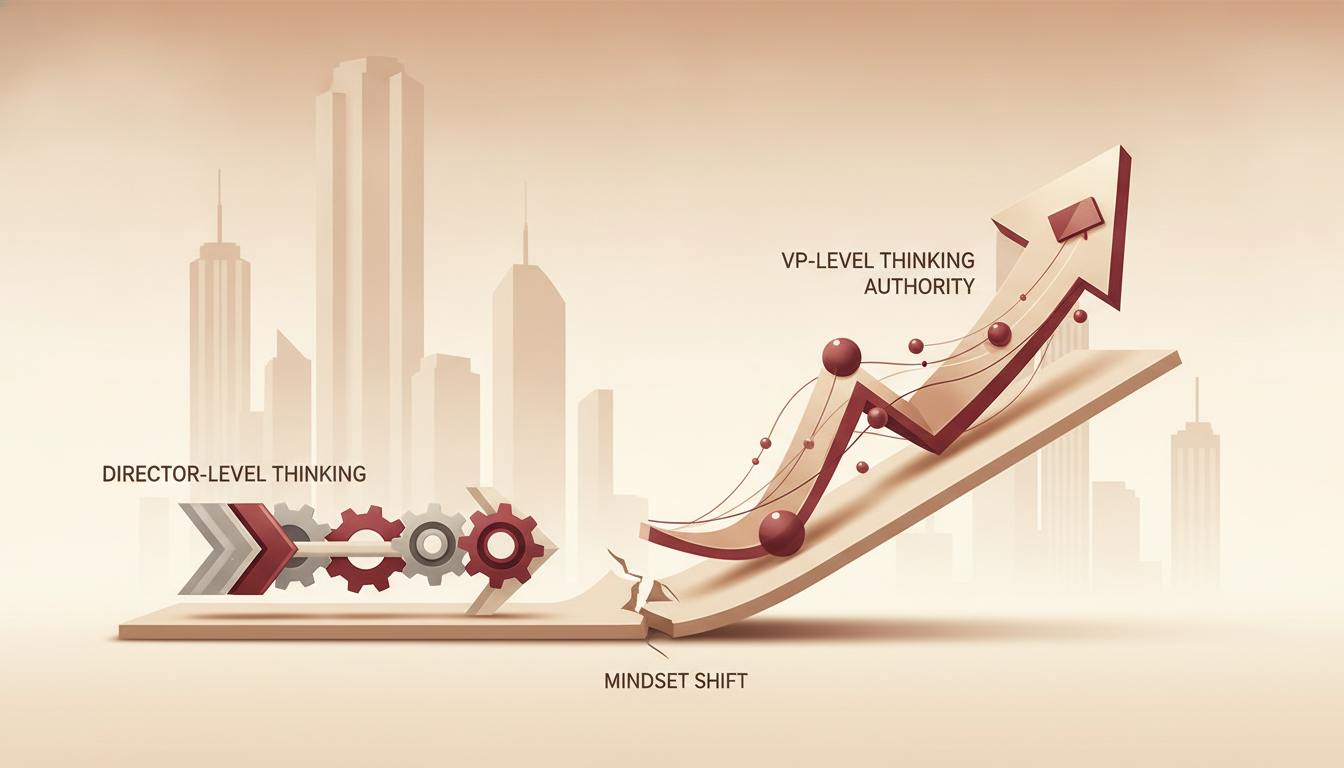
The single biggest trap that keeps talented directors stuck is continuing to be the best problem-solver in the room. At the director level, your value comes from execution excellence. At the VP level, your value comes from defining which problems matter.
Consider this scenario: Your CEO raises a concern about declining customer retention in a leadership meeting. The director response is, "I'll pull the data and build a plan to address it." The VP-level response is, "This connects to a broader pattern I've been tracking across our top three segments. I think we're looking at a positioning issue, not a service issue. Here's how I'd recommend we reframe our approach."
The first response demonstrates competence. The second demonstrates strategic vision. According to a 2023 McKinsey report on leadership transitions, 67% of executives who successfully moved into VP and C-suite roles cited "the ability to reframe problems strategically" as the most critical skill in their advancement.
To deepen this shift, explore the key differences between how executives and managers think — the gap is wider than most people realize.
Operate at the Level Above Your Current Title
Here's a principle that separates the promoted from the passed-over: you don't get promoted to the VP level and then start acting like a VP. You start acting like a VP, and then the title catches up.
This means contributing to conversations about company strategy, not just departmental tactics. It means volunteering for cross-functional initiatives that give you exposure to the C-suite. It means writing and speaking about industry trends — not just internal metrics.
A Harvard Business Review study found that professionals who were promoted to senior leadership roles had spent an average of 18 months demonstrating next-level behaviors before the promotion was formalized. The title is a lagging indicator.
Release Your Identity as the Expert
At the director level, many professionals anchor their credibility to deep functional expertise. You're the best marketer, the sharpest engineer, the most knowledgeable finance leader. But VPs aren't valued for knowing the most about one thing — they're valued for connecting many things.
This is an identity shift, and it's uncomfortable. You may need to learn how to be seen as a strategic thinker rather than a subject-matter specialist. The strategic thinker asks, "What does this mean for the business?" The expert asks, "What does this mean for my function?" VPs live in the first question.
The Communication Upgrade: How VP-Ready Leaders Speak Differently
Lead with Implication, Not Information
Directors report. VPs interpret. This distinction shows up most clearly in how you communicate upward.
When you present to senior leadership, stop leading with data and start leading with implication. Instead of saying, "Our Q3 pipeline is down 12% compared to last year," say, "We're seeing early signals that our go-to-market approach needs to evolve. Pipeline is softening in our core segments, which tells me the market is shifting faster than our positioning. Here's what I recommend."
The first version makes you a messenger. The second makes you a strategist. If you want a deeper framework for this shift, study how executives communicate differently than managers — the patterns are consistent and learnable.
Master the Executive Briefing
VPs are expected to communicate with extreme clarity and efficiency. If you can't brief a senior leader in 60 seconds, you're not ready.
Use this structure for any executive-level communication:
- The headline — State your point or recommendation in one sentence
- The context — Provide just enough background (two sentences maximum)
- The implication — Explain what this means for the business
- The ask — State clearly what you need from them
Practice this in every email, every meeting update, every hallway conversation. Executives notice when someone communicates at their speed. They also notice when someone doesn't.
Eliminate Language That Signals Middle Management
Certain phrases telegraph that you're still thinking at the director level. Purge these from your vocabulary:
- "I just wanted to flag..." → "I'm recommending we..."
- "I think we might want to consider..." → "My recommendation is..."
- "Sorry to bother you with this, but..." → Drop it entirely
- "I'm not sure if this is the right forum, but..." → "This connects to our strategic priority of..."
According to research published in the Journal of Language and Social Psychology (2020), hedging language reduces perceived competence by up to 30% in professional settings. At the VP level, every word either builds or erodes your authority. For a comprehensive list of language patterns to eliminate, review these 12 words that undermine your credibility at work.
Ready to Communicate Like an Executive? The language shifts that separate directors from VPs are subtle but powerful. Discover The Credibility Code — the complete system for building authority, credibility, and commanding presence in every professional interaction.
The Visibility Strategy: Getting Seen by the Right People
Map Your Decision-Maker Ecosystem

Positioning for VP isn't just about impressing your direct boss. It's about building credibility with the full set of decision-makers who will influence the promotion decision.
Create a stakeholder map that includes:
- Your direct leader — the person who will advocate (or won't)
- Your leader's peers — other VPs and SVPs who will weigh in
- The executive sponsor — a C-suite leader who knows your name and your work
- Cross-functional partners — leaders in other departments who can vouch for your strategic impact
- Board-adjacent contacts — anyone who interacts with the board and can mention your contributions
A 2022 study by Korn Ferry found that 85% of VP-level promotions involved sponsorship from at least one executive outside the candidate's direct reporting line. Your boss's endorsement is necessary but not sufficient. You need a network of credibility.
Create Strategic Visibility Without Self-Promotion
Many talented directors resist visibility because they don't want to seem self-promotional. This is a career-limiting belief. Visibility isn't bragging — it's ensuring that your strategic contributions are understood by people who matter.
Here are five high-integrity visibility tactics:
- Volunteer to present cross-functional updates at leadership meetings — this puts you in front of decision-makers regularly
- Write a monthly strategic insight and share it with your leader and their peers — position it as "a trend I'm watching that could affect us"
- Mentor someone publicly — sponsoring junior talent signals leadership maturity and gets your name mentioned in development conversations
- Lead a strategic initiative that crosses departmental lines — this demonstrates enterprise thinking
- Speak at industry events or internal town halls — this builds your reputation as a thought leader
For a deeper system on building career authority without feeling like you're bragging, explore how to build career authority without being self-promotional.
Build Your Executive Sponsor Relationship
An executive sponsor is different from a mentor. A mentor gives you advice. A sponsor puts your name forward in rooms you're not in.
To cultivate a sponsor:
- Identify a C-suite leader whose strategic priorities align with your work
- Find ways to contribute directly to their initiatives
- Keep them informed of your strategic contributions (quarterly, not weekly — respect their time)
- Ask for their perspective on business challenges, not career advice — this positions you as a peer thinker, not a mentee
- Make them look good by executing flawlessly on anything they're connected to
The sponsor relationship is the single most underutilized accelerant in VP positioning. According to a 2019 Center for Talent Innovation study, professionals with active sponsors are 23% more likely to advance to senior leadership than those without.
The Personal Brand Pivot: From Functional Leader to Enterprise Leader
Define Your Strategic Narrative
Every VP-track professional needs a clear answer to this question: "What do you uniquely bring to the leadership table that no one else does?"
This isn't your job description. It's your strategic narrative — the story of how your experience, perspective, and capabilities make you the right person to shape the organization's future.
Build your narrative using this framework:
- Pattern — "I've consistently [done what] across [contexts]"
- Perspective — "Which gives me a unique lens on [strategic challenge]"
- Promise — "And I'm positioned to drive [specific business outcome]"
Example: "I've consistently built high-performing teams in ambiguous, fast-changing environments — from startup mode at Company A to the turnaround at Company B. That gives me a unique lens on how to scale operations without losing culture. I'm positioned to drive our next phase of growth while protecting what makes this company special."
This narrative should show up in your personal brand statement for promotion, in how you introduce yourself at leadership events, and in how your sponsor talks about you to others.
Signal VP Readiness in Every Interaction
Your personal brand isn't what you say about yourself — it's what people say about you when you leave the room. Every interaction is a branding opportunity.
Here's what VP-ready looks like in practice:
| Situation | Director-Level Signal | VP-Level Signal |
|---|---|---|
| Team meeting | Shares detailed updates | Connects updates to strategic priorities |
| Email to leadership | Long, thorough, data-heavy | Concise, insight-led, action-oriented |
| Cross-functional conflict | Escalates or avoids | Facilitates resolution with enterprise lens |
| New initiative | Asks "What's my role?" | Asks "What's the business case?" |
| Industry disruption | Reports the news | Interprets the implications |
Every one of these micro-moments shapes whether people see you as a strong director or an emerging VP. If you want to build the daily habits that compound into leadership presence, explore this guide to developing leadership presence.
Your Authority Is Built in the Details. The micro-signals you send in meetings, emails, and conversations determine whether you're seen as VP-ready. Discover The Credibility Code to master the communication patterns that accelerate executive advancement.
The Execution Plan: A 90-Day VP Positioning Roadmap
Days 1–30: Audit and Align
Week 1–2: Perception AuditAsk five trusted colleagues (peers, direct reports, and at least one senior leader) this question: "If someone asked you what I'm known for around here, what would you say?" Their answers reveal your current brand. If the answers center on execution and reliability, you have repositioning work to do.
Week 3–4: Strategic AlignmentStudy your organization's top three strategic priorities for the next 12–18 months. Map your current work to those priorities. Identify gaps where you could contribute more visibly. Schedule a conversation with your leader to discuss how your role can be more directly connected to enterprise strategy.
Days 31–60: Build and Broadcast
Week 5–6: Cross-Functional ExpansionJoin or initiate one cross-functional project tied to a strategic priority. Begin building relationships with leaders in departments you don't normally interact with. Each new relationship is a potential advocate.
Week 7–8: Thought Leadership LaunchWrite your first strategic insight memo and share it with your leader and two of their peers. Volunteer to present at the next leadership meeting. If there's an industry conference or internal summit coming up, put your name forward as a speaker.
Days 61–90: Accelerate and Advocate
Week 9–10: Sponsor ActivationBy now, you should have identified your executive sponsor candidate. Schedule a strategic conversation — not to ask for sponsorship directly, but to share your perspective on a business challenge and ask for theirs. Begin making yourself indispensable to their priorities.
Week 11–12: The Promotion ConversationWith 90 days of strategic repositioning behind you, have a direct conversation with your leader about your VP trajectory. Use this language: "I've been intentionally expanding my strategic impact over the past quarter. I'd like to discuss what the path to VP looks like and what you'd need to see from me to be confident in that recommendation."
This isn't asking for permission. It's stating your trajectory and inviting alignment. According to LinkedIn's 2023 Workforce Report, professionals who explicitly communicated their advancement goals to leadership were 40% more likely to be promoted within 18 months than those who waited to be noticed.
Common Mistakes That Stall VP Advancement
Relying on Performance Alone
This is the most painful mistake. You exceed every metric, deliver every project, and assume that results speak for themselves. They don't — not at this level. Performance gets you considered. Positioning gets you chosen.
Staying Too Deep in Your Function
If every conversation you have is about your department, you're signaling that your ceiling is director. VPs are evaluated on their ability to think across the organization. Force yourself to engage with challenges outside your functional expertise.
Avoiding Politics
Many high-performers dismiss organizational politics as beneath them. But at the VP level, navigating stakeholder dynamics, building coalitions, and influencing without direct authority isn't politics — it's the job. If you struggle with this, study how to influence without authority at work.
Waiting for the Perfect Moment
There is no perfect moment. The VP role may not even exist yet when you start positioning. Your job is to make the case so compelling that the organization creates the opportunity — or that you're the obvious choice when it opens.
Frequently Asked Questions
How long does it typically take to move from director to VP?
The timeline varies by industry and organization, but most director-to-VP transitions take 2–5 years. However, deliberate positioning can compress this significantly. Professionals who actively manage their visibility, build executive sponsors, and communicate strategically often advance 30–50% faster than those who rely on performance alone.
What's the difference between positioning for VP vs. positioning for director?
Director positioning focuses on proving functional mastery and team leadership. VP positioning requires demonstrating enterprise-level thinking, cross-functional influence, and the ability to shape strategy — not just execute it. The communication shifts are significant: VPs must lead with business implications rather than operational details.
Can I position myself for VP without an MBA or executive education?
Absolutely. While an MBA can help, decision-makers care far more about demonstrated strategic impact, leadership credibility, and executive communication skills. Focus on building a track record of cross-functional influence and strategic contributions. Your personal brand and positioning matter more than credentials at this level.
How do I position for VP when my boss doesn't support my advancement?
This is where executive sponsors become critical. Build relationships with leaders outside your direct chain of command who can advocate for you. Increase your visibility through cross-functional initiatives, industry contributions, and strategic thought leadership. If your boss is actively blocking you, it may be time to explore internal transfers or external opportunities where your VP potential is recognized.
What if I'm an introvert — can I still position for VP effectively?
Yes. VP positioning doesn't require being the loudest voice in the room. It requires being the most strategic one. Introverts often excel at the deep thinking, one-on-one relationship building, and written communication that drive executive advancement. Focus on building leadership presence quietly through strategic contributions rather than performative visibility.
How important is executive presence in VP promotions?
Extremely important. A 2012 study by the Center for Talent Innovation found that executive presence accounts for 26% of what it takes to get promoted to senior leadership. It's the combination of how you communicate, how you carry yourself, and how you make decisions under pressure. It's not about charisma — it's about credibility.
The Gap Between Director and VP Isn't About Working Harder — It's About Communicating Differently. If you're ready to master the authority signals, communication frameworks, and credibility patterns that decision-makers look for in VP candidates, Discover The Credibility Code — your complete system for commanding presence and executive-level communication.
Ready to Command Authority in Every Conversation?
Transform your professional communication with proven techniques that build instant credibility. The Credibility Code gives you the frameworks top leaders use to project confidence and authority.
Discover The Credibility CodeRelated Articles

How to Be Seen as a Strategic Thinker at Work: 8 Moves
Being seen as a strategic thinker at work requires shifting how you communicate, contribute, and frame your ideas. Instead of only reporting what happened, you need to consistently connect your work to bigger business outcomes, ask forward-looking questions, and speak in terms of priorities rather than tasks. The eight moves below cover the specific behavioral and communication signals — from framing ideas around impact to contributing in leadership discussions — that change how colleagues and e

How to Position Yourself for Promotion: Authority-First Strategy
Positioning yourself for promotion requires more than hitting your KPIs. The professionals who get promoted fastest build credibility signals that make decision-makers see them as already operating at the next level. This means shifting how you communicate, where you show up, and which relationships you prioritize. Below, you'll find a complete authority-first strategy — including a 90-day plan — that goes beyond generic advice to focus on the communication and presence shifts that actually move

How to Position Yourself for Promotion: Authority Plan
Positioning yourself for promotion requires a deliberate 90-day strategy built on three pillars: increasing your visibility with decision-makers, demonstrating leadership before you hold the title, and building a credibility narrative that makes your advancement feel inevitable. This isn't about working harder — it's about communicating your value strategically, aligning your contributions with organizational priorities, and ensuring the people who control promotions already see you as the obvio