
How to Build Confidence Before a Presentation Fast

To build confidence before a presentation fast, follow a structured 30-minute pre-presentation protocol: spend the first 10 minutes on mental rehearsal and mindset reframing, the next 10 minutes on physiological calming techniques like box breathing and power posing, and the final 10 minutes on vocal warm-ups and opening line practice. This timed routine shifts your nervous system from threat mode to performance mode, so you walk in feeling prepared, grounded, and authoritative.
What Is Pre-Presentation Confidence?
Pre-presentation confidence is the deliberate state of mental clarity, physical calm, and vocal readiness that allows you to communicate with authority under pressure. It's not the absence of nerves — it's the structured management of them.
Unlike general self-confidence, pre-presentation confidence is situational and buildable. It's a skill you can activate on demand using specific techniques in the minutes before you speak. Think of it as a warm-up protocol, similar to what athletes do before competition — except your arena is the conference room, the stage, or the video call.
Why Most Pre-Presentation Advice Fails (And What Actually Works)
The Problem With "Just Be Yourself"
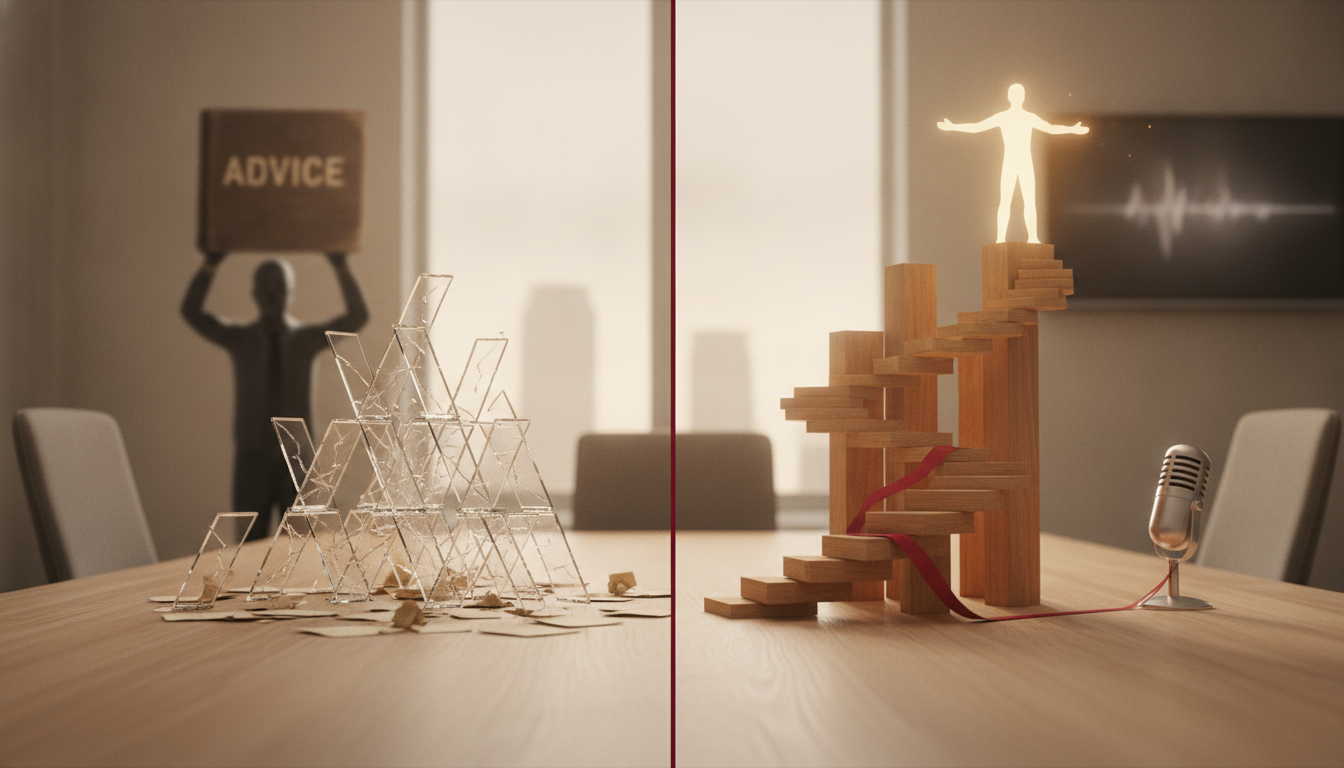
You've heard it a hundred times: "Just relax," "Be yourself," "You'll be fine." This advice isn't just unhelpful — it's counterproductive. When your sympathetic nervous system is flooding your body with cortisol and adrenaline, telling yourself to relax is like telling a fire to stop burning.
According to the American Psychological Association, approximately 75% of people experience some degree of glossophobia — fear or anxiety around public speaking. The issue isn't that you're uniquely nervous. The issue is that you don't have a system for channeling that nervous energy into commanding presence.
What the Research Says About Confidence and Performance
A landmark study published in the Journal of Experimental Social Psychology by Harvard Business School professor Amy Cuddy and colleagues found that adopting expansive body postures for just two minutes increased testosterone (linked to confidence) by 20% and decreased cortisol (linked to stress) by 25%. While subsequent replications have debated the hormonal findings, the behavioral effects — people feeling more confident and performing better — have been consistently supported.
The takeaway: confidence before a presentation isn't something you wait to feel. It's something you build through deliberate physical and mental actions. The professionals who seem effortlessly confident aren't less nervous than you. They just have a better pre-game routine.
The Confidence-Competence Loop
Here's what most people get backwards: they think competence creates confidence. In reality, the loop works both ways. When you act confident — through posture, voice, and mental framing — your brain interprets those signals as evidence that you're capable. This is called the "as-if" principle in behavioral psychology.
This means your 30-minute window before a presentation isn't wasted time. It's the highest-leverage period for your entire performance. If you want to learn how to communicate with executive presence consistently, it starts with mastering what you do in these critical minutes.
The 30-Minute Pre-Presentation Confidence Protocol
This is the core framework. Print it. Save it to your phone. Use it every single time.
Minutes 0–10: Mental Rehearsal and Mindset Reframing
Step 1: Visualize your first 60 seconds. Close your eyes. Picture yourself walking to the front of the room (or unmuting on the call). See yourself making eye contact, pausing, and delivering your opening line with calm authority. Research from the Journal of Consulting and Clinical Psychology shows that mental rehearsal activates the same neural pathways as physical practice, priming your brain for the actual performance.Don't visualize the entire presentation. Just the first 60 seconds. That's where anxiety peaks. Once you're through the opening, momentum carries you.
Step 2: Reframe anxiety as excitement. Harvard Business School professor Alison Wood Brooks published a study in the Journal of Experimental Psychology: General (2014) showing that people who reframed their anxiety as excitement performed significantly better in public speaking tasks than those who tried to calm down. The physiological states of anxiety and excitement are nearly identical — racing heart, heightened alertness, increased energy. The difference is the label you give it.Say out loud: "I'm excited about this." Not "I need to calm down." This one shift changes everything.
Step 3: Run your "authority anchor." Think of a specific moment when you communicated with total confidence — a meeting where you nailed your point, a conversation where you held your ground, a time when someone told you your insight changed their thinking. Relive that moment for 60 seconds. Feel the posture. Hear the tone. This is your anchor, and it reminds your nervous system that you've done this before.Minutes 10–20: Physiological Calming Techniques
Your body doesn't know the difference between a presentation and a predator. Your job in these 10 minutes is to tell your nervous system that you're safe.
Step 4: Box breathing (4 rounds). Inhale for 4 counts. Hold for 4 counts. Exhale for 4 counts. Hold for 4 counts. Repeat four times. This technique, used by Navy SEALs before high-pressure operations, activates your parasympathetic nervous system and lowers your heart rate within minutes. Step 5: Power posture (2 minutes). Stand with your feet shoulder-width apart, hands on hips or arms extended overhead. Hold for two minutes. Even if you're skeptical of the hormonal claims, the behavioral evidence is clear: expansive postures reduce self-reported anxiety and increase willingness to take risks. Find a private space — a bathroom stall, an empty hallway, your car — and hold the pose. Step 6: Progressive tension release. Starting at your shoulders, deliberately tense each muscle group for 5 seconds, then release. Move to your jaw, your hands, your legs. Presentation anxiety lives in your body — tight shoulders, clenched jaw, locked knees. This technique flushes the physical tension so it doesn't show up in your delivery.If you struggle with managing nervous energy before speaking, our deep dive on how to calm nerves before a presentation covers 11 additional methods you can layer into this protocol.
Ready to Command Every Room You Walk Into? The 30-minute protocol above is just the beginning. The Credibility Code gives you the complete system for building unshakable professional presence — from presentations to negotiations to everyday conversations. Discover The Credibility Code
Minutes 20–30: Vocal Warm-Ups and Opening Line Practice
Your voice is the first thing your audience evaluates. A shaky, thin, or rushed voice signals uncertainty — no matter how strong your content is.
Step 7: Hum and resonate. Hum at a comfortable pitch for 30 seconds, feeling the vibration in your chest and face. This warms up your vocal cords and drops your voice into its natural resonant range. A study published in the Journal of Voice found that vocal warm-ups significantly reduce vocal strain and improve perceived vocal quality — both of which matter when you're presenting under pressure. Step 8: Practice your first three sentences out loud. Not in your head. Out loud. At full volume. With pauses. Your opening sets the tone for everything that follows. Say it three times, each time focusing on a different element:- Round 1: Focus on volume. Project to the back of the room.
- Round 2: Focus on pace. Slow down by 20%.
- Round 3: Focus on pauses. Insert a deliberate 2-second pause after your opening statement.
Advanced Confidence Techniques for High-Stakes Presentations
The "Status Reset" for Presenting to Senior Leadership

When you're presenting to executives, the power dynamic can crush your confidence before you say a word. The status reset is a mental technique that levels the playing field.
Before you walk in, remind yourself: They invited me to speak because I have information they need. You're not performing for approval. You're delivering value they can't get elsewhere. This reframe shifts you from "supplicant seeking validation" to "expert sharing insight." It changes your body language, your vocal tone, and your word choices — all without conscious effort.
For a complete framework on presenting upward, see our guide on how to present to senior leadership.
The "Worst Case" Inoculation
Fear thrives on vagueness. The "worst case" inoculation forces you to confront your specific fears and prepare for them.
Ask yourself: What's the worst thing that could realistically happen? Maybe you lose your place. Maybe someone asks a question you can't answer. Maybe the projector fails. Now, prepare a one-sentence response for each scenario:
- Lost your place: "Let me take a moment to collect my thoughts." (Then pause, breathe, and continue.)
- Can't answer a question: "That's outside my scope today, but I'll follow up with specifics by end of day."
- Tech failure: "Let me walk you through this verbally — I know this material well enough to present without slides."
Having these responses ready eliminates the catastrophic thinking that fuels pre-presentation anxiety. You're not hoping nothing goes wrong. You're prepared for anything that does. For more on handling unexpected moments, check out our article on how to lead a meeting you didn't prepare for.
The 10-Second Grounding Ritual
This is what you do in the final 10 seconds before you begin speaking. It's the bridge between preparation and performance.
- Plant your feet. Feel the ground beneath you.
- Take one slow breath through your nose.
- Look at one person in the audience and make eye contact.
- Begin.
No rushing to the podium. No nervous throat-clearing. No "So, um, thanks for having me." You stand, you breathe, you connect, you speak. Those 10 seconds of silence before your first word communicate more confidence than anything you'll say in the next 30 minutes.
What to Avoid in the 30 Minutes Before You Present
Habits That Sabotage Your Confidence
Not everything you do before a presentation helps. Some common habits actively undermine your confidence:
Over-rehearsing your slides. Flipping through your deck for the twentieth time doesn't build confidence — it builds dependence on the slides and heightens anxiety about forgetting something. If you don't know your material by now, 30 more minutes of cramming won't fix it. Checking your phone. Email, Slack, and social media introduce new stressors and fragment your focus. A 2021 study from the University of Texas at Austin found that the mere presence of a smartphone reduces available cognitive capacity, even when the phone is face-down and silent. Put it away. Apologizing in advance. Don't tell colleagues "I'm so nervous" or "I didn't have enough time to prepare." These statements prime your audience to look for weakness and prime your brain to deliver it. If you need to talk to someone, talk about the content, not your anxiety. Sitting hunched over your laptop. Your body position in the minutes before you present directly affects your hormonal state and your confidence level. Sitting in a contracted position increases cortisol and decreases your sense of personal power. Stand up. Move. Take space.For a broader look at habits that undermine how others perceive you, our article on how to stop sounding unsure when speaking at work covers the linguistic patterns that signal uncertainty.
Your Confidence Shouldn't Depend on the Situation. The Credibility Code teaches you how to build a baseline of professional authority that shows up in every presentation, meeting, and conversation — not just when conditions are perfect. Discover The Credibility Code
Building Long-Term Presentation Confidence (Beyond the 30 Minutes)
Create a Post-Presentation Review Habit
Confidence compounds over time, but only if you build a feedback loop. After every presentation, spend five minutes answering three questions:
- What worked? (Be specific: "My opening pause landed well" or "I handled the Q&A question about budget without hedging.")
- What would I do differently? (Not "what went wrong" — what would you change.)
- What's one thing I'll practice before next time?
This habit turns every presentation into a training session. Over months, your pre-presentation anxiety decreases because you have a growing catalog of evidence that you can do this.
Invest in Your Baseline Communication Confidence
Pre-presentation confidence is easier to build when your everyday communication already carries authority. If you communicate with confidence at work daily, presentations become an extension of how you already show up — not a performance you have to manufacture.
The professionals who seem most confident before presentations aren't doing anything magical in those 30 minutes. They've built a foundation of leadership presence that makes high-stakes moments feel like a natural extension of their normal communication style.
Frequently Asked Questions
How long does it take to build confidence before a presentation?
Using a structured protocol, you can meaningfully shift your confidence level in as little as 30 minutes. The physiological techniques (box breathing, power posing) work within minutes. Mental rehearsal takes 5–10 minutes. However, building lasting presentation confidence — the kind that makes the 30-minute routine feel like fine-tuning rather than emergency repair — typically takes 3–6 months of consistent practice and intentional post-presentation review.
What's the difference between presentation anxiety and presentation confidence?
Presentation anxiety is the fear response triggered by the prospect of being evaluated while speaking. Presentation confidence is the ability to manage that response and channel it into effective delivery. They're not opposites — most confident speakers still experience anxiety. The difference is that confident speakers have systems for converting nervous energy into focused performance, while anxious speakers let the energy control them.
Can introverts build confidence before a presentation?
Absolutely. Introversion is about how you recharge, not how well you can present. Many of the most effective presenters are introverts because they prepare more thoroughly and listen more carefully. The 30-minute protocol works especially well for introverts because it's a private, structured ritual — no pep talks or group warm-ups required. For more, see our guide on how to build confidence in meetings even as an introvert.
How do I build confidence for a presentation I didn't have time to prepare for?
Focus on what you do know. Skip the slide review and spend your limited time on the physiological and vocal warm-up portions of the protocol (Steps 4–10). Then, structure your delivery around 2–3 key points you can speak to with authority. Confidence in unprepared moments comes from trusting your expertise, not your slides. A clear framework for thinking on your feet can be found in our article on how executives structure their thinking before speaking.
Does visualization really work for presentation confidence?
Yes, and the evidence is robust. A meta-analysis published in Psychological Bulletin found that mental practice produces approximately 66% of the performance benefits of physical practice. For presentations specifically, visualizing your opening — including the physical environment, your posture, and your first words — primes your brain to execute those actions with less hesitation and more fluency when the moment arrives.
What should I eat or drink before a presentation?
Avoid caffeine if you're already anxious — it amplifies the jittery symptoms of your stress response. Eat a light, protein-rich meal 1–2 hours before presenting to maintain stable blood sugar without feeling sluggish. Drink room-temperature water (cold water can constrict your vocal cords). Avoid dairy, which can increase mucus production and affect vocal clarity.
From Nervous to Commanding — In Every Professional Moment. This article gave you the 30-minute protocol. The Credibility Code gives you the complete system: the mindset frameworks, the vocal techniques, the body language shifts, and the daily habits that make professional confidence your default setting — not something you have to manufacture before every presentation. Discover The Credibility Code
Ready to Command Authority in Every Conversation?
Transform your professional communication with proven techniques that build instant credibility. The Credibility Code gives you the frameworks top leaders use to project confidence and authority.
Discover The Credibility CodeRelated Articles

How to Stop Sounding Nervous When Speaking: Quick Fixes
To stop sounding nervous when speaking, target the five vocal patterns that betray anxiety: filler words ("um," "uh," "like"), uptalk (rising pitch at sentence ends), rushed pacing, shallow breathing, and vocal fry under stress. The fix isn't "just relax"—it's retraining specific vocal habits. Use diaphragmatic breathing to steady your voice, insert deliberate pauses instead of fillers, and drop your pitch at the end of statements. These mechanical corrections work even when your nerves are stil

How to Start a Speech Without Being Nervous: 6 Methods
The first 60 seconds of a speech determine whether your audience leans in or tunes out—and it's exactly when anxiety hits hardest. To start a speech without being nervous, use a combination of physiological resets (like controlled breathing and power posing), mental reframing techniques, and rehearsed power openers that give your brain a confident script to follow. These methods neutralize the fight-or-flight response *before* you reach the podium, so you open with authority instead of apology.

Managing Speaking Anxiety at Work: 8 Proven Methods
To manage speaking anxiety at work, use evidence-based techniques that target your body's stress response before and during everyday speaking moments. The most effective methods include controlled breathing to lower cortisol, cognitive reframing to shift your threat response, structured preparation frameworks for impromptu moments, and progressive exposure to build tolerance over time. These techniques work for team updates, all-hands questions, and hallway conversations — not just formal presen