
Executive vs Regular Communication: 6 Key Differences
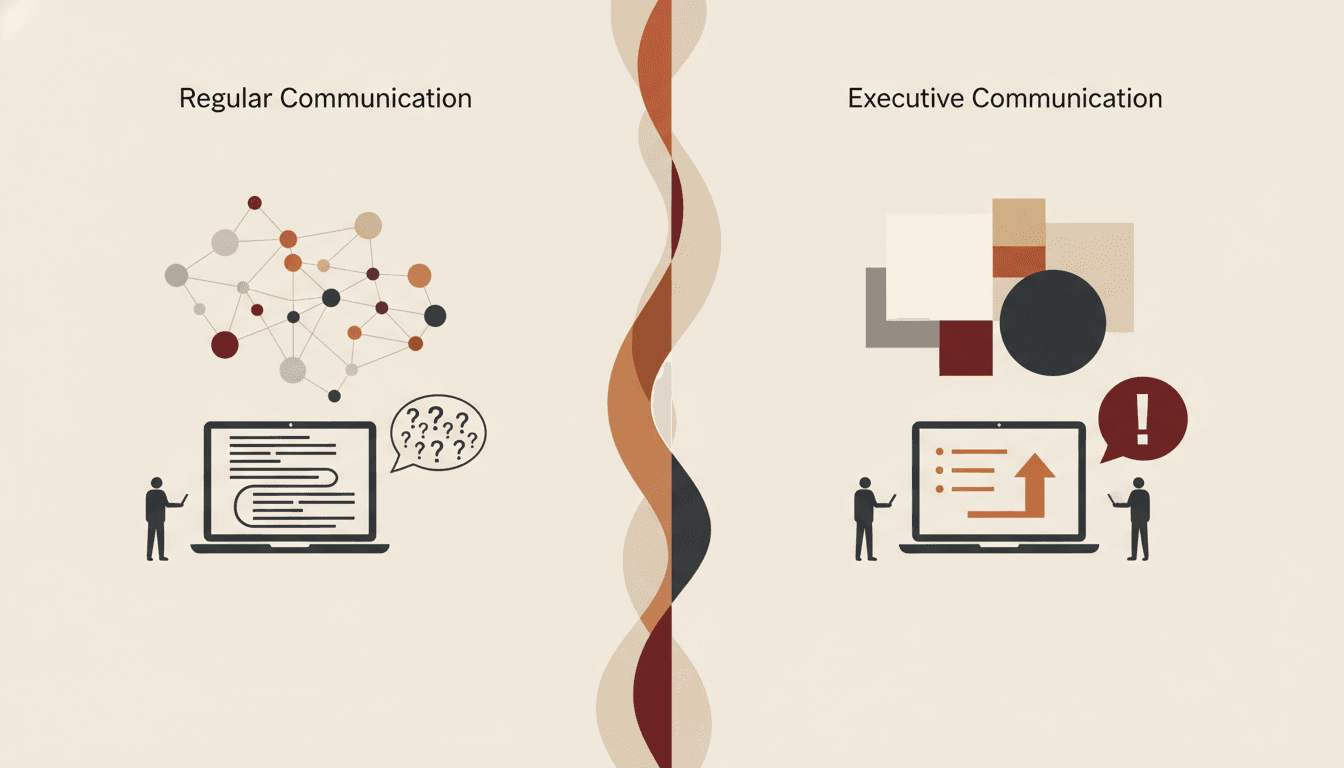
The core difference between executive communication and regular communication comes down to structure, intent, and impact. Executives lead with the conclusion, speak in outcomes rather than activities, and use language that drives decisions. Regular communicators tend to build up to their point, focus on process details, and use hedging language that dilutes authority. Understanding these six structural and tonal differences — and modeling them — is the fastest way to elevate your professional credibility and career trajectory.
What Is Executive Communication?
Executive communication is a deliberate style of professional communication characterized by clarity, brevity, strategic framing, and outcome-oriented language. It prioritizes the listener's needs over the speaker's comfort and is designed to drive decisions, not simply share information.
Unlike casual or standard workplace communication, executive communication follows predictable structural patterns: leading with the bottom line, eliminating filler, anchoring every point to business impact, and projecting composed authority through vocal tone and body language. It's not about seniority — it's a learnable skill set that signals credibility regardless of your title.
If you're working to communicate like an executive, understanding these differences is your starting point.
Difference #1: Executives Lead With the Conclusion — Regular Communicators Build Up to It
The Bottom-Line-Up-Front (BLUF) Framework
The most immediately noticeable difference between executive and regular communication is where the main point appears. Executives state their recommendation or conclusion first, then provide supporting context. Regular communicators do the opposite — they walk through background, process, and reasoning before arriving at their point.
This isn't a stylistic preference. It's a structural decision rooted in how senior leaders process information. A study by Microsoft Research found that the average professional's sustained attention span during meetings has dropped to approximately 8 seconds before they begin evaluating relevance (Microsoft Attention Spans Research, 2015). If your point doesn't land in the first two sentences, it may not land at all.
Side-by-Side Email Example
Regular communication:"Hi Sarah, I wanted to follow up on the Q3 marketing analysis. Our team spent the last two weeks reviewing campaign performance across all channels. We looked at cost per acquisition, engagement rates, and conversion funnels. After pulling the data and cross-referencing with last quarter's benchmarks, we found some interesting trends. Basically, we think we should shift 30% of our paid social budget to search."Executive communication:
"Sarah — Recommendation: Shift 30% of paid social budget to search for Q4. Search CPA is 40% lower with comparable conversion rates. Supporting data attached. Happy to walk through the analysis if useful."
The executive version is 60% shorter and delivers the decision-ready insight immediately. Notice how it also respects the reader's time by offering the detail as optional rather than mandatory.
How to Practice This Shift
Before you write any email or prepare any talking point, ask yourself: "If I could only say one sentence, what would it be?" That sentence goes first. Everything else becomes supporting evidence. For a deeper dive into this approach, see our guide on how executives structure emails for maximum impact.
Difference #2: Executives Speak in Outcomes — Regular Communicators Report Activities
Why Outcomes Trump Process
Regular communicators describe what they did. Executives describe what it means. This distinction is subtle but powerful, and it fundamentally changes how others perceive your strategic value.
According to a Leadership IQ study, 66% of managers say they would rate an employee higher if that employee consistently framed their work in terms of business outcomes rather than task completion (Leadership IQ, "The Science of Great Communication," 2021). Outcome-oriented language signals that you understand the bigger picture — a hallmark of executive thinking.
Side-by-Side Meeting Example
Regular communication (status update):"We completed the vendor evaluation. We reviewed five proposals, held three demo sessions, and compiled a comparison spreadsheet. We're still working on the final scoring."Executive communication (status update):
"We've narrowed the vendor shortlist to two finalists. Both meet our security requirements and come in under budget. I'll have a recommendation with risk analysis by Thursday."
The first version describes activities. The second version tells the listener what matters: where things stand, what's been decided, and what happens next. This is the kind of strategic thinking that gets you noticed by leadership.
The Outcome Translation Exercise
Take any update you're about to give and run it through this filter:
- What did we accomplish? (Not what did we do)
- What does it mean for the business?
- What decision or action comes next?
Strip out everything that doesn't serve one of those three questions.
Ready to communicate like a senior leader? The Credibility Code gives you the exact frameworks, scripts, and daily practices to shift from activity reporting to outcome-driven communication — the kind that gets you promoted. Discover The Credibility Code
Difference #3: Executives Eliminate Hedging Language — Regular Communicators Soften Everything
The Cost of Verbal Hedging

Words like "just," "I think," "sort of," "maybe," and "does that make sense?" are verbal hedges. They feel polite. They feel safe. And they systematically erode your credibility.
Research from the University of Texas at Austin found that speakers who used hedging language were rated 25-30% less competent and less persuasive by listeners, even when the content of their message was identical to a non-hedged version (Hosman & Siltanen, Journal of Language and Social Psychology, 2006).
Executives have trained themselves — or been coached — to remove these verbal softeners. Regular communicators haven't, and it costs them influence every day.
Side-by-Side Presentation Example
Regular communication:"So, I just wanted to kind of walk you through some ideas we had. I think maybe we could potentially look at restructuring the onboarding process? It might help with retention, I'm not sure, but does that make sense?"Executive communication:
"Our onboarding process is contributing to early attrition. I'm proposing a restructured 90-day program that addresses the three primary drop-off points. Here's the plan and the projected impact on retention."
The first version contains seven hedges in three sentences. The second version contains zero. The content is essentially the same — but the perceived authority is worlds apart.
For a comprehensive list of specific words to eliminate, read our guide on 12 words that undermine your credibility at work. And if hedging has become an unconscious habit, our piece on stopping hedging language at work provides a practical daily system.
The Hedge Audit
Record yourself in your next three meetings (with permission, or use voice memos for practice). Count every hedge word. Most professionals are shocked to find they use 10-15 hedges per meeting without realizing it. Awareness is the first step to elimination.
Difference #4: Executives Control the Frame — Regular Communicators React to It
What "Framing" Actually Means
Framing is the act of defining how a topic is understood before the discussion begins. Executives don't just contribute to conversations — they shape the lens through which everyone else evaluates the topic.
Regular communicators respond to the frame someone else has set. They answer the question as asked. Executives reframe the question to steer toward the most strategic angle.
Side-by-Side Negotiation Example
Regular communication (reacting to the frame):Manager: "We need to cut your project budget by 20%."
Regular communicator: "Okay, I'll see what we can trim. Maybe we can reduce the testing phase or cut one of the vendor contracts."Executive communication (controlling the frame):
Manager: "We need to cut your project budget by 20%."
Executive communicator: "I want to make sure we protect the outcomes leadership is expecting. Let me show you two options: one that preserves the revenue impact with a phased timeline, and one that reduces scope but keeps the original deadline. Which priority matters more right now?"
The regular communicator accepted the frame ("cut budget") and immediately began complying. The executive communicator reframed the conversation around outcomes and trade-offs, positioning themselves as a strategic partner rather than an order-taker.
According to Harvard Business Review, professionals who consistently reframe conversations around strategic trade-offs are 45% more likely to be identified as "high-potential" by senior leadership (HBR, "The Skills Leaders Need at Every Level," 2022).
How to Build Framing Skills
Before any high-stakes conversation, prepare your frame using this three-part structure:
- Acknowledge the concern (shows you're listening)
- Reframe around outcomes (shifts from tactical to strategic)
- Offer structured options (positions you as the problem-solver)
This approach works in negotiations, performance conversations, and even routine status meetings. For more on navigating these dynamics, explore our framework for speaking confidently in front of executives.
Difference #5: Executives Use Deliberate Vocal and Physical Presence — Regular Communicators Don't Manage Theirs
The Nonverbal Authority Gap
Communication isn't just words. Research by Albert Mehrabian, often cited in leadership development, found that when verbal and nonverbal signals conflict, listeners trust nonverbal cues up to 93% of the time (Mehrabian, Silent Messages, 1971). While the exact percentages are debated, the principle holds: how you deliver your message matters as much as what you say.
Executives tend to speak more slowly, pause deliberately, maintain steady eye contact, and use open body language. Regular communicators often speak quickly (signaling nervousness), fill silences with filler words, and adopt closed or shrinking postures.
Side-by-Side Behavioral Comparison
| Behavior | Regular Communicator | Executive Communicator |
|---|---|---|
| Speaking pace | Fast, rushed | Measured, deliberate |
| Pauses | Avoided or filled with "um" | Used intentionally for emphasis |
| Eye contact | Inconsistent, looks away when challenged | Steady, especially during key points |
| Posture | Leans back or hunches | Upright, takes up appropriate space |
| Vocal tone | Rises at end of statements (uptalk) | Drops at end of statements (declarative) |
| Gestures | Fidgeting, self-soothing | Purposeful, open-handed |
The 3-Second Pause Technique
One of the most powerful executive communication tools is the deliberate pause. Before answering a question, pause for a full three seconds. This does three things simultaneously: it signals that you're thoughtful (not reactive), it creates anticipation, and it gives you time to formulate a precise response.
For a complete system on developing vocal authority, see our guide on how to sound authoritative with 9 vocal and language shifts.
Your presence speaks before your words do. The Credibility Code includes vocal drills, body language blueprints, and presence exercises designed specifically for professionals who want to command attention without raising their voice. Discover The Credibility Code
Difference #6: Executives Communicate to Drive Decisions — Regular Communicators Communicate to Share Information
The Decision-Driving Mindset
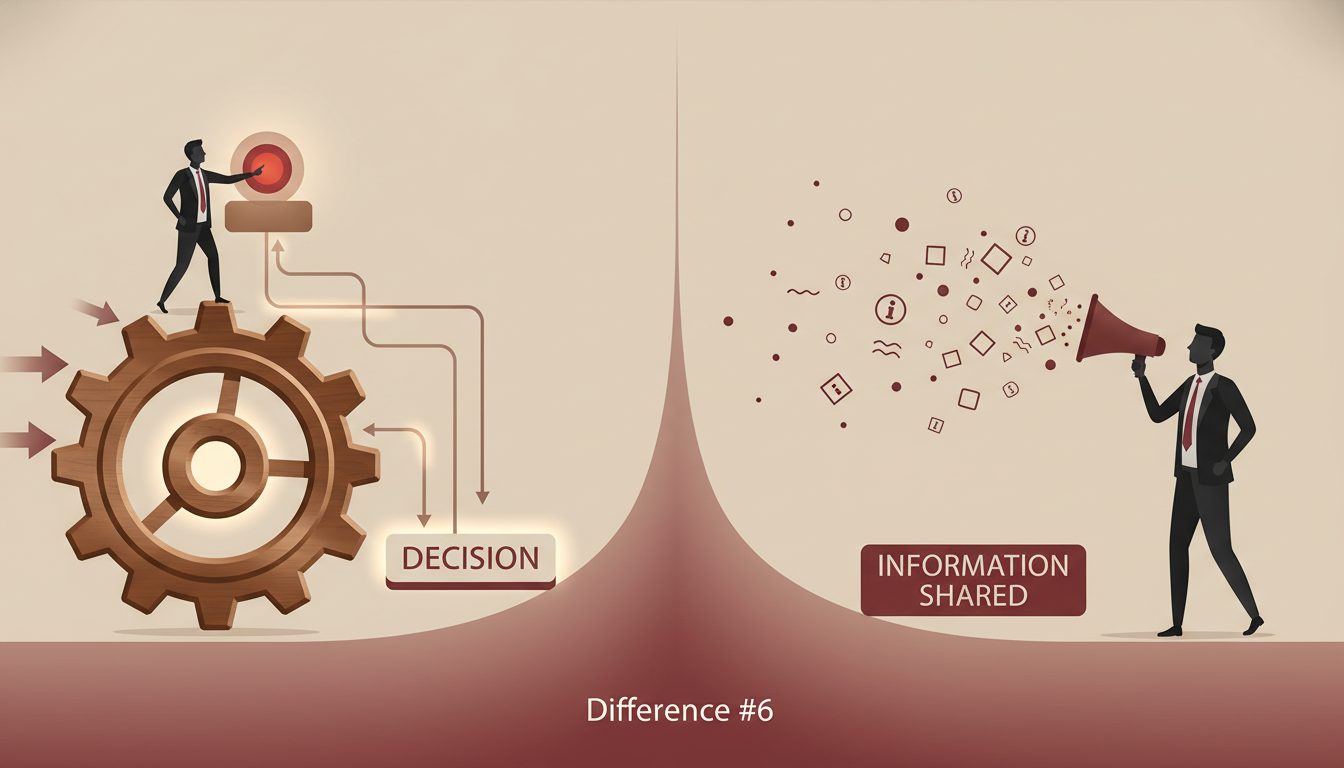
This is perhaps the most fundamental difference, and it underpins all the others. Regular communicators view communication as information transfer: "Here's what I know, here's what happened, here's what I found." Executives view communication as a decision-making tool: "Here's what we should do, here's why, here's what I need from you."
Every email, every meeting contribution, every presentation from an executive is designed to move something forward. There is always a clear "ask" — whether it's approval, alignment, resources, or a decision.
Side-by-Side Presentation Closing Example
Regular communication (closing a presentation):"So that's an overview of the customer feedback data. Happy to answer any questions. Let me know if you need anything else."Executive communication (closing a presentation):
"Based on this data, I recommend we prioritize three changes to the onboarding flow by end of Q1. I need approval on the $40K budget reallocation and a project sponsor from the product team. Can we confirm both today?"
The first closing is passive. It shares information and then hands control to the audience. The second closing is active. It states a recommendation, specifies what's needed, and requests a commitment — all in three sentences.
The "So What? Now What?" Test
Before you finish any communication — email, presentation, or meeting comment — ask yourself two questions:
- So what? Why should the listener care about what I just said?
- Now what? What specific action or decision am I requesting?
If you can't answer both questions clearly, your communication isn't finished yet. This test alone will transform how your contributions are received. For a full framework on structuring your thoughts this way, read how executives structure their thoughts before speaking.
How to Start Communicating Like an Executive Today
You don't need a title change to communicate with executive-level authority. Here's a practical 5-day challenge to begin the shift:
- Day 1: Lead every email with your conclusion or recommendation first.
- Day 2: Replace all activity language ("I worked on…") with outcome language ("We achieved…").
- Day 3: Audit one meeting for hedge words. Count them. Commit to halving the number tomorrow.
- Day 4: In your next conversation with leadership, reframe one question around outcomes and trade-offs.
- Day 5: Close every communication with a clear ask or next step.
These are small shifts, but they compound. Within weeks, colleagues and leaders will begin responding to you differently — with more attention, more respect, and more trust.
Frequently Asked Questions
What is the main difference between executive communication and regular communication?
The main difference is intent. Executive communication is designed to drive decisions and action, while regular communication typically aims to share information or provide updates. This core distinction shapes everything else — structure (conclusion first vs. build-up), language (outcome-focused vs. activity-focused), and delivery (deliberate presence vs. unconscious habits). Executives treat every interaction as an opportunity to move something forward.
Can you learn executive communication without being an executive?
Absolutely. Executive communication is a skill set, not a title. Research from the Center for Creative Leadership shows that communication style is the single strongest predictor of leadership advancement, regardless of current role (CCL, 2019). You can begin practicing bottom-line-up-front structure, outcome language, and deliberate presence at any career stage. In fact, adopting these patterns early is one of the fastest ways to build authority without a title.
How is executive communication different from leadership communication?
Executive communication is a subset of leadership communication focused specifically on brevity, strategic framing, and decision-driving. Leadership communication is broader — it includes motivating teams, coaching individuals, and building culture. An executive communicator may not be leading people directly but communicates with the clarity and authority associated with senior roles. Both require confidence and presence, but executive communication emphasizes conciseness and business impact above all.
What are the biggest mistakes in regular workplace communication?
The most common mistakes include burying the main point under background context, using hedging language ("I just think maybe…"), reporting activities instead of outcomes, failing to include a clear ask or next step, and speaking too quickly without deliberate pauses. These habits aren't character flaws — they're patterns that develop from years of workplace conditioning. Each one can be systematically corrected with awareness and practice.
How long does it take to develop an executive communication style?
Most professionals notice a measurable shift in how others respond to them within 2-4 weeks of consistent practice. The structural changes (leading with conclusions, eliminating hedges) can be implemented immediately. The presence-related shifts (vocal pacing, deliberate pauses, body language) typically take 30-60 days of daily practice to become natural. The key is consistent repetition in real workplace situations, not theoretical study.
Does executive communication work in emails, meetings, and presentations equally?
Yes, but the application varies by medium. In emails, it means front-loading your recommendation and keeping messages under 150 words. In meetings, it means contributing outcome-focused points with clear asks. In presentations, it means opening with your conclusion, supporting it with data, and closing with a specific decision request. The underlying principles — clarity, brevity, strategic framing, and action orientation — apply universally across all professional communication channels.
Bridge the gap between where you are and how executives communicate. The Credibility Code gives you the complete system — frameworks, scripts, vocal exercises, and daily practices — to communicate with authority, command respect, and accelerate your career. Discover The Credibility Code
Ready to Command Authority in Every Conversation?
Transform your professional communication with proven techniques that build instant credibility. The Credibility Code gives you the frameworks top leaders use to project confidence and authority.
Discover The Credibility CodeRelated Articles

Executive vs Regular Communication: Key Differences
Executive communication differs from regular professional communication in six critical ways: structure, brevity, strategic framing, audience orientation, decision-focus, and authority signaling. While regular communication tends to be detail-heavy, process-oriented, and chronological, executive communication leads with the bottom line, frames everything around business impact, and drives toward decisions. Understanding these differences is the single most important shift mid-career professional

Executive vs Regular Communication: Key Differences Explained
Executive communication differs from regular professional communication in five critical ways: structure, intent, language economy, audience orientation, and strategic framing. Where mid-level professionals tend to share information and explain processes, executives lead with outcomes, eliminate filler, and frame every message around business impact. Understanding these differences—and modeling them—is the fastest way to build credibility and advance your career authority.

How to Communicate Like a Senior Leader: 8 Daily Shifts
To communicate like a senior leader, shift from reporting details to framing decisions, from hedging your language to stating clear positions, and from reacting in the moment to responding with strategic intent. Senior leaders don't just share information—they shape how people think about it. The eight daily shifts below cover emails, meetings, one-on-ones, and presentations, transforming tentative mid-level communication into the authoritative style that earns trust, drives action, and accelera