
Executive vs Regular Communication: Key Differences Explained

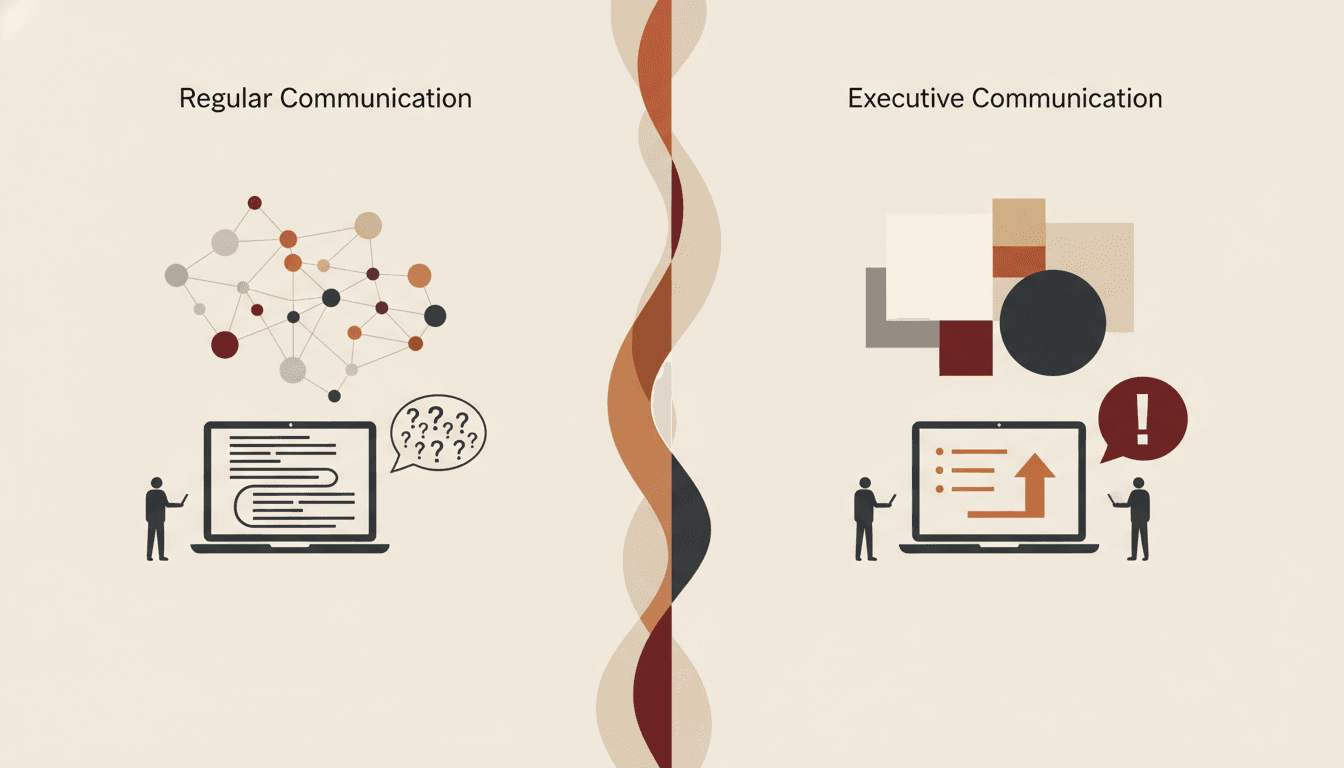
Executive communication differs from regular professional communication in five critical ways: structure, intent, language economy, audience orientation, and strategic framing. Where mid-level professionals tend to share information and explain processes, executives lead with outcomes, eliminate filler, and frame every message around business impact. Understanding these differences—and modeling them—is the fastest way to build credibility and advance your career authority.
What Is Executive Communication?
Executive communication is a strategic communication style characterized by concise, outcome-driven messaging designed to inform decisions, align stakeholders, and drive action. It prioritizes clarity over completeness and impact over thoroughness.
Unlike regular workplace communication—which often focuses on sharing updates, explaining tasks, or processing information—executive communication is built around a single question: What does my audience need to decide or do? This distinction shapes everything from email structure to how disagreements are handled in meetings.
For a deeper look at the patterns that define this style, see our guide on how executives communicate differently: 8 key patterns.
The Core Mindset Shift: Information vs. Decision Orientation
Before we compare specific tactics, you need to understand the foundational difference between executive and regular communication. It's a mindset shift that changes everything.

Regular Communication: "Here's What Happened"
Most mid-career professionals default to information-sharing mode. They report what they did, describe the process, and walk through details chronologically. This isn't wrong—it's what they've been trained and rewarded for.
A typical project update from a mid-level professional might sound like this: "We started the vendor review last Tuesday. The team evaluated four options using the criteria we discussed. We ran into some issues with pricing from Vendor B, and Sarah had to follow up twice. We're still waiting on final quotes from two vendors."
This is thorough. It's also exhausting for a senior leader who has 14 more updates to hear today.
Executive Communication: "Here's What We Need to Decide"
Executives flip the structure entirely. They lead with the conclusion, recommendation, or decision point—then provide only the supporting context that's necessary.
The same update in executive communication style: "We've narrowed vendors to two finalists. I recommend Vendor A based on cost and timeline. I need your approval by Thursday to meet our Q3 launch. Happy to walk through the comparison if helpful."
According to a 2023 study by Harvard Business Review, senior leaders spend an average of just 72 seconds reading an internal email before deciding whether to act, delegate, or archive it. That statistic alone explains why executive communicators front-load their message.
For a complete framework on structuring your messages this way, explore our post on how to communicate with senior leadership: unwritten rules.
Side-by-Side Comparisons: 5 Everyday Scenarios
This is where the differences become tangible. Below are five common workplace situations with side-by-side examples showing regular versus executive communication approaches.
Scenario 1: Delivering a Project Status Update
Regular communication: "Hi team, just wanted to give a quick update on the website redesign. We've completed the wireframes and had them reviewed by the UX team. There were some changes requested, which we're working through now. We also started looking at the CMS migration, but there are some technical questions we need to resolve. Overall things are progressing, though we're a bit behind on the timeline we originally set." Executive communication: "Website redesign status: We're one week behind schedule due to CMS migration complexity. Wireframes are approved. Two options to get back on track: (1) add a contractor for two weeks ($8K), or (2) push launch from March 1 to March 15. I recommend option 2. Need your call by Friday." What's different: The executive version names the problem, quantifies it, offers solutions, makes a recommendation, and requests a decision—all in fewer words.Scenario 2: Making a Request
Regular communication: "Hey, I was wondering if maybe we could talk about the possibility of getting some additional budget for our team? We've been really stretched thin lately and I think it would help if we could bring on some extra support. Let me know if you have time to discuss." Executive communication: "I'd like to request $15K in additional Q2 budget for contract support. Current workload exceeds team capacity by roughly 20%, which is delaying two client deliverables. I've prepared a one-page business case. Can we discuss Thursday?"A study by the Center for Creative Leadership found that professionals who frame requests with business impact and specific numbers are 47% more likely to receive approval than those who use vague or emotional appeals.
Scenario 3: Handling Disagreement
Regular communication: "I see your point, and I totally respect where you're coming from. I guess I just feel like maybe there's another way to look at it? I don't want to step on anyone's toes, but I was thinking that perhaps we could consider an alternative approach..." Executive communication: "I see this differently. The data suggests launching in Q2 carries a 30% higher risk of market overlap with Competitor X. I'd recommend Q3 instead. Here's why—and I'm open to pressure-testing this together." What's different: The executive version states a clear position, backs it with evidence, offers an alternative, and invites collaboration—without hedging, apologizing, or undermining their own point.If you struggle with this, our guide on how to disagree with your boss in a meeting respectfully provides scripts you can use immediately.
Scenario 4: Writing Emails to Senior Leaders
Regular communication: "Hi Jennifer, hope you're doing well! I wanted to reach out because I've been working on the customer retention analysis you asked about a few weeks ago. It's been really interesting—we found a lot of data points. I've attached the full report (42 pages) for your review. Let me know what you think when you get a chance!" Executive communication: "Jennifer—three findings from the retention analysis: (1) Churn is concentrated in accounts under $50K ARR. (2) Onboarding quality is the strongest predictor of renewal. (3) A proposed onboarding overhaul could reduce churn by 18%. Full report attached; executive summary on page 1. I'd like 15 minutes to discuss next steps—does Tuesday work?"For more on this specific skill, check out how to write like an executive: concise, clear, commanding.
Scenario 5: Introducing Yourself in a Professional Setting
Regular communication: "Hi, I'm David. I work in the marketing department. I've been here about three years. I mainly work on our digital campaigns and some social media stuff. Nice to meet you." Executive communication: "I'm David Chen, I lead digital acquisition for our North American markets. My team drives about 40% of our new pipeline. I'm here because I think our teams could partner on the product launch—I'd love to explore that." What's different: The executive version communicates role, impact, and intent in three sentences. It positions David as a strategic contributor, not just a job-title holder.Ready to Sound Like the Leader You Are? These side-by-side examples are just the beginning. Discover The Credibility Code to get the complete system for building authority in every conversation, email, and presentation.
The Executive Communication Framework: LEAD
To make the shift from regular to executive communication, use the LEAD Framework—a four-step structure you can apply to any message, whether spoken or written.

L — Lead With the Bottom Line
State your conclusion, recommendation, or request first. This is the single biggest difference between executive and regular communicators. According to research from McKinsey & Company, the "pyramid principle"—leading with the answer—is the communication structure used most consistently across top-performing organizations.
Practice: Before you speak or write, ask yourself: If my audience could only hear one sentence, what would it be? Start there.E — Evidence, Not Explanation
Executives support their points with data, outcomes, and business impact—not process descriptions or backstory. Regular communicators often feel the need to explain how they arrived at a conclusion. Executive communicators share why it matters.
Practice: Replace "Here's what we did" with "Here's what we found" or "Here's what this means."A — Ask for What You Need
Executive communicators are explicit about what they need from their audience: a decision, feedback, approval, resources, or alignment. Regular communicators often leave the "ask" implied or buried at the end.
According to a 2022 Grammarly Business survey, 58% of knowledge workers report wasting time on communications that don't clearly state what action is needed. Eliminating that ambiguity is a hallmark of executive-level messaging.
Practice: End every message with a clear action item and timeline. For deeper techniques, read our post on how to ask for what you want at work without apology.D — Deliver With Confidence
The how matters as much as the what. Executive communicators use direct language, steady vocal tone, purposeful pauses, and composed body language. They avoid filler words, hedging phrases ("I just think maybe..."), and upspeak.
Practice: Record yourself delivering a one-minute update. Count filler words and hedging phrases. Then re-record with those removed. The difference will be immediate.Why This Matters for Your Career
Understanding executive communication vs regular communication isn't just an academic exercise. It directly impacts how others perceive your competence, leadership potential, and readiness for promotion.
Perception Shapes Opportunity
Research from Sylvia Ann Hewlett's work on executive presence (published in Harvard Business Review) found that communication accounts for 28% of what senior leaders evaluate when assessing someone's leadership potential. That's more than appearance (5%) and nearly as much as gravitas (67%, which itself is expressed through communication).
When you communicate like a mid-level professional, people perceive you as a mid-level professional—regardless of your actual skills or results. When you communicate like an executive, people begin treating you as one.
The Credibility Compound Effect
Every email, meeting contribution, and presentation is a data point. Over time, these data points form your professional reputation. Shifting to executive-style communication doesn't just improve one interaction—it compounds into a fundamentally different perception of who you are.
This is what we call the credibility compound effect: small, consistent upgrades in how you communicate create exponential gains in how others perceive your authority. For a complete roadmap on building this kind of presence, explore how to develop leadership presence: the complete roadmap.
Common Traps That Keep You Stuck
Many capable professionals stay stuck in regular communication patterns because of three traps:
- The Thoroughness Trap: Believing more detail equals more credibility. In reality, over-explaining signals uncertainty.
- The Politeness Trap: Softening every statement with qualifiers, apologies, and hedges. Politeness is valuable; self-diminishment is not.
- The Chronology Trap: Telling the story from beginning to end instead of starting with the conclusion. Narratives are for presentations—not status updates.
Break Free From Communication Patterns That Hold You Back. The Credibility Code gives you the exact frameworks, scripts, and daily practices to communicate with executive-level authority—starting this week. Discover The Credibility Code.
How to Start Communicating Like an Executive Today
You don't need a title change to communicate differently. Here are three immediate actions you can take.
Audit Your Last Five Emails
Go back through your sent folder and read your last five work emails. For each one, ask:
- Did I lead with the bottom line or bury it?
- Did I clearly state what I needed from the recipient?
- Could I cut this by 40% without losing meaning?
Rewrite one of those emails using the LEAD framework. Notice how different it feels.
Apply the "One Sentence" Test in Meetings
Before you speak in your next meeting, mentally draft your contribution in a single sentence. Deliver that sentence first. Then—and only then—add supporting context if needed.
This single habit will immediately differentiate you from colleagues who think out loud, ramble, or over-qualify their points. For more meeting-specific strategies, see how to sound confident in a meeting: 9 subtle shifts.
Practice the "So What?" Filter
After every statement you prepare—written or spoken—ask yourself: So what? Why does this matter to my audience? If you can't answer that clearly, revise until you can. Executive communicators never leave the "so what" for the audience to figure out on their own.
Frequently Asked Questions
What is the main difference between executive communication and regular communication?
The main difference is orientation. Regular communication is information-oriented—it shares updates, explains processes, and describes what happened. Executive communication is decision-oriented—it leads with conclusions, frames messages around business impact, and explicitly states what action is needed. This shift from "here's what happened" to "here's what we need to decide" is the single biggest differentiator between the two styles.
Can you use executive communication style without being a senior leader?
Absolutely. Executive communication is a skill, not a title. Mid-career professionals, emerging leaders, and individual contributors who adopt this style are consistently perceived as more competent and promotable. In fact, adopting executive communication patterns before you have the title is one of the most effective strategies for positioning yourself for promotion.
How is executive communication different from executive presence?
Executive communication is a specific skill set focused on how you structure and deliver messages. Executive presence is a broader concept that includes communication but also encompasses gravitas, appearance, composure under pressure, and overall leadership demeanor. Communication is the most visible and trainable component of executive presence. Learn more in our comparison of executive presence vs leadership presence.
Does executive communication mean being blunt or rude?
No. Executive communication is direct, not abrasive. It eliminates unnecessary hedging and filler—but it doesn't eliminate empathy, respect, or collaboration. The goal is clarity and confidence, not dominance. The best executive communicators are both concise and warm, both decisive and open to input.
How long does it take to develop an executive communication style?
Most professionals notice a measurable difference within two to four weeks of deliberate practice. The key is consistency—applying frameworks like LEAD to daily emails, meeting contributions, and presentations. According to communication coaching research, professionals who practice structured communication techniques daily show significant improvement in perceived authority within 30 days.
What are the most common mistakes in regular communication that executives avoid?
Executives consistently avoid five habits: (1) burying the main point, (2) over-explaining or over-qualifying, (3) using vague requests instead of specific asks, (4) leading with process instead of outcomes, and (5) using hedging language that undermines their own credibility. For a full breakdown, see our post on executive communication mistakes: 11 errors that cost trust.
Your Communication Style Is Your Career Currency. Every email, meeting, and presentation either builds your authority or diminishes it. The Credibility Code gives you the complete system to communicate with the clarity, confidence, and strategic framing that defines executive-level professionals. Discover The Credibility Code and start building your career authority today.
Ready to Command Authority in Every Conversation?
Transform your professional communication with proven techniques that build instant credibility. The Credibility Code gives you the frameworks top leaders use to project confidence and authority.
Discover The Credibility CodeRelated Articles

How to Communicate Like a Senior Leader: 8 Daily Shifts
To communicate like a senior leader, shift from reporting details to framing decisions, from hedging your language to stating clear positions, and from reacting in the moment to responding with strategic intent. Senior leaders don't just share information—they shape how people think about it. The eight daily shifts below cover emails, meetings, one-on-ones, and presentations, transforming tentative mid-level communication into the authoritative style that earns trust, drives action, and accelera

Executive vs Regular Communication: Key Differences
Executive communication differs from regular professional communication in six critical ways: structure, brevity, strategic framing, audience orientation, decision-focus, and authority signaling. While regular communication tends to be detail-heavy, process-oriented, and chronological, executive communication leads with the bottom line, frames everything around business impact, and drives toward decisions. Understanding these differences is the single most important shift mid-career professional
Executive vs Regular Communication: 6 Key Differences
The core difference between executive communication and regular communication comes down to structure, intent, and impact. Executives lead with the conclusion, speak in outcomes rather than activities, and use language that drives decisions. Regular communicators tend to build up to their point, focus on process details, and use hedging language that dilutes authority. Understanding these six structural and tonal differences — and modeling them — is the fastest way to elevate your professional c