
Executive Presence for Women in Leadership: Real Guide

Executive presence for women in leadership is the ability to project confidence, credibility, and authority in a way that commands respect—without abandoning your authentic communication style. It requires navigating a well-documented double bind: women are often penalized for being "too assertive" yet overlooked for being "too soft." This guide gives you specific frameworks, language patterns, and strategies to build genuine executive presence on your own terms, not by mimicking outdated masculine leadership norms.
What Is Executive Presence for Women in Leadership?
Executive presence for women in leadership is the combination of gravitas, communication skill, and appearance that signals you belong in positions of power—and that others should trust your judgment. It's not a single trait. It's a system of behaviors that consistently communicate competence, composure, and conviction.
What makes executive presence different for women is context. Research from the Center for Talent Innovation (now Coqual) found that gravitas accounts for 67% of executive presence, yet the behaviors that signal gravitas—decisiveness, assertiveness, "commanding a room"—are evaluated differently when women exhibit them. A 2022 McKinsey & Company Women in the Workplace report found that women leaders are twice as likely as men in similar positions to be described as "too aggressive" when displaying the same assertive behaviors. This means women in leadership need a more intentional, strategic approach to presence—one this guide delivers.
The Double Bind: Why Generic Executive Presence Advice Fails Women
Understanding the Likability-Competence Penalty

The most important thing to understand about executive presence for women is the double bind, sometimes called the "likability-competence trade-off." Research by social psychologist Madeline Heilman at NYU has shown that when women display competence in traditionally male domains, they are rated as less likable. When they prioritize warmth and likability, they are rated as less competent.
This isn't a mindset problem you can simply "confidence" your way out of. It's a structural bias. Generic advice like "speak with authority" or "take up more space" ignores the reality that these behaviors trigger different reactions depending on who performs them.
Here's what this looks like in practice: A male VP says "We need to move on this now" in a strategy meeting, and he's seen as decisive. A female VP says the exact same words, and she risks being labeled as "pushy" or "difficult." A 2023 Harvard Business Review analysis confirmed that women face a narrower band of acceptable leadership behavior than men—a phenomenon researchers call the "tightrope bias."
Why "Lean In" Isn't Enough
The popular advice to simply be more assertive misses a critical nuance. Women don't lack assertiveness. They lack a system for deploying authority in ways that don't trigger backlash. The goal isn't to "lean in" harder—it's to build a communication approach that conveys power while maintaining the relational credibility that makes your leadership sustainable.
This is why cookie-cutter executive presence training often backfires for women. You need strategies designed for the actual environment you operate in. For a deeper look at this topic, see our guide on assertive communication for women at work.
The Four Pillars of Authentic Executive Presence for Women
Pillar 1: Strategic Gravitas
Gravitas isn't about being the loudest person in the room. It's about being the most grounded. For women, strategic gravitas means demonstrating depth of thinking and composure under pressure—two qualities that are rarely penalized regardless of gender.
The Anchor-Expand-Decide Framework:- Anchor your point in data or a business outcome. ("Our Q3 customer retention data shows a 12% drop in the enterprise segment.")
- Expand with strategic context. ("This aligns with what we're hearing from the sales team about competitor pricing moves.")
- Decide with a clear recommendation. ("I recommend we prioritize the loyalty pricing initiative and table the new market expansion until Q1.")
This framework works because it leads with evidence rather than opinion, which sidesteps the "too aggressive" trap while still landing a decisive position. You can practice this approach using the exercises in our executive presence training guide.
Pillar 2: Vocal Authority Without Vocal Fry Policing
Women's voices are scrutinized more than men's. Studies from Duke University's Fuqua School of Business found that women with lower-pitched voices are perceived as more competent and authoritative in leadership contexts. But the answer isn't to artificially lower your voice. That's unsustainable and inauthentic.
Instead, focus on three vocal elements you can control:
- Pace: Slow down by 15-20%. Rushed speech signals anxiety. Measured speech signals confidence.
- Downward inflection: End statements with a downward pitch, not an upward lilt. Upward inflection turns declarations into questions.
- Strategic pausing: Pause for 2-3 seconds before your most important point. The silence creates weight.
A practical scenario: You're presenting quarterly results to the board. Instead of rushing through your summary, pause after stating the headline number. Let it land. Then deliver your interpretation in a measured tone with downward inflection. This signals that you are comfortable with authority—you don't need to fill silence with hedging.
For more on vocal techniques, explore our post on how to speak with authority as a woman at work.
Pillar 3: Strategic Visibility
According to the 2023 McKinsey Women in the Workplace report, women are promoted at lower rates than men at every level, and women of color face even steeper gaps. Executive presence alone doesn't fix structural barriers, but strategic visibility ensures your contributions are seen and credited.
Three visibility moves that build presence:- The Bookend Technique: Open and close meetings you lead with a clear, concise summary statement. People remember beginnings and endings. ("Today we're deciding X. Here's where we landed on X and the next steps.")
- The Attribution Anchor: When building on a colleague's idea, name them. ("Building on what Priya raised—here's how we could operationalize that.") This builds your reputation as a leader who elevates others, which strengthens your authority rather than diminishing it.
- The Strategic Follow-Up: After important meetings, send a brief email summarizing your key contributions and next steps. This creates a written record of your leadership.
Our guide on how to stop being overlooked at work as a woman goes deeper into visibility strategies.
Ready to Build Unshakable Professional Credibility? The strategies in this article are just the beginning. The Credibility Code gives you the complete system for commanding respect in every professional interaction—frameworks, scripts, and daily practices designed for real leadership challenges. Discover The Credibility Code
Pillar 4: Composure Under Fire
Nothing signals executive presence more powerfully than composure during high-pressure moments. And nothing is policed more unfairly for women than emotional expression under stress. A 2021 study published in Organizational Behavior and Human Decision Processes found that women who expressed anger in professional settings were perceived as less competent, while men who expressed anger were perceived as more competent.
This doesn't mean you should suppress all emotion. It means you need a system for managing high-stakes moments.
The 3-Second Reset:When you're challenged, interrupted, or put on the spot:
- Breathe (one slow breath—this takes about 3 seconds and resets your nervous system).
- Acknowledge the input neutrally. ("That's an important consideration.")
- Redirect to your position. ("Here's how I see it connecting to our core objective.")
This technique keeps you in control of the conversation without appearing defensive or emotional. For more on handling pressure, see our framework for leadership presence in difficult situations.
Navigating the Five Most Common Executive Presence Traps for Women
Trap 1: The Apology Reflex
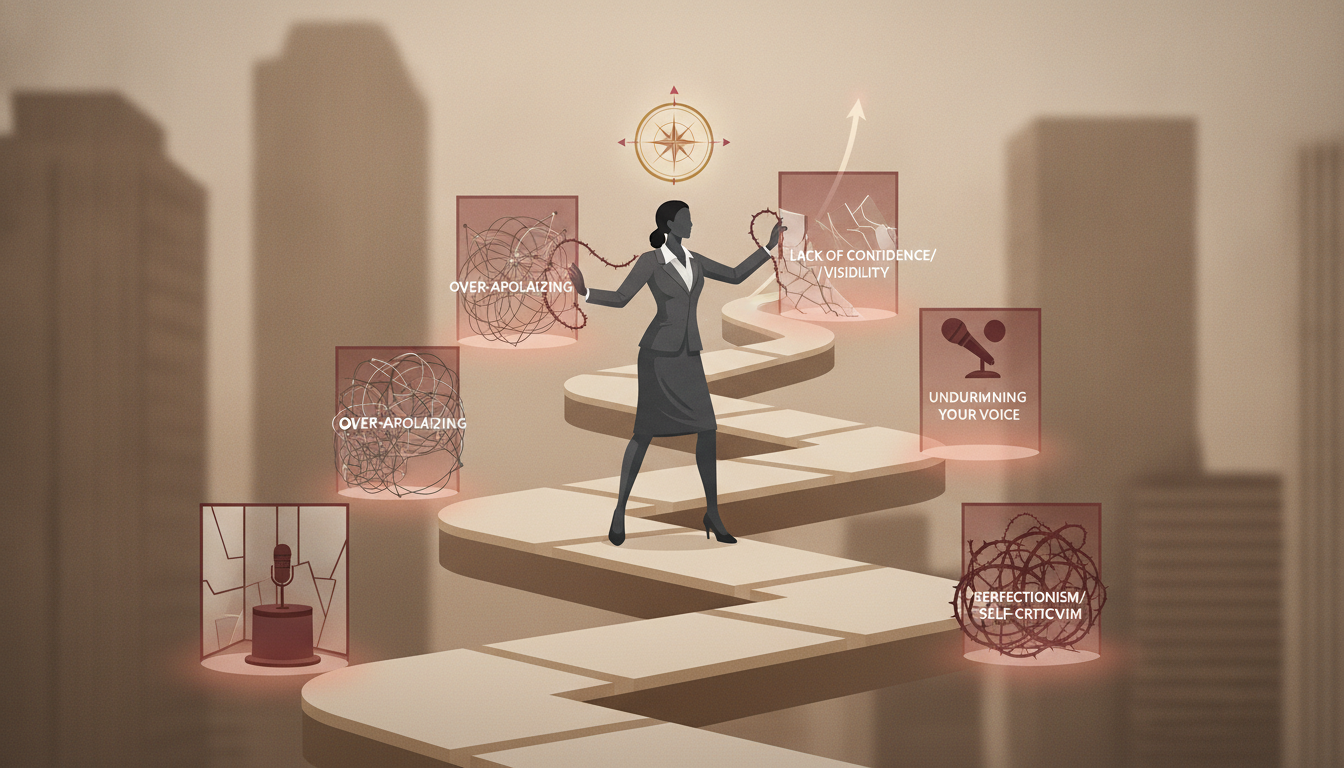
Research from the University of Waterloo found that women apologize more frequently than men—not because they make more mistakes, but because they have a lower threshold for what constitutes an offense. In leadership contexts, unnecessary apologies erode authority.
What to replace:- ~~"Sorry, but I think..."~~ → "My recommendation is..."
- ~~"Sorry to interrupt..."~~ → "I want to add to that."
- ~~"Sorry, can I ask a question?"~~ → "I have a question about that."
This isn't about never apologizing. Genuine apologies for genuine mistakes build trust. But reflexive apologies for simply existing in a conversation undermine your presence.
Trap 2: The Qualifier Cascade
Qualifiers like "I just think," "I'm not sure, but," and "This might be a dumb question" are verbal disclaimers that signal uncertainty. Women use them more frequently in mixed-gender professional settings, according to research from Georgetown University linguist Deborah Tannen.
The One-Qualifier Rule: Allow yourself a maximum of one qualifier per contribution. If you catch yourself stacking qualifiers, stop, pause, and restate your point directly. Over time, this retrains your communication patterns.For a comprehensive list of undermining language patterns, check out our post on words that make you sound less confident at work.
Trap 3: The Emotional Labor Tax
Women in leadership are disproportionately expected to manage team emotions, smooth over conflicts, and perform "office housework" like note-taking and event planning. A study from NYU and the University of Pennsylvania found that women who decline these requests face social penalties, while men who decline face none.
The executive presence trap here is subtle: if you do all the emotional labor, you're seen as "supportive" but not "strategic." If you refuse, you're seen as "cold."
The strategic middle ground: Be selective. Volunteer for high-visibility emotional labor (mentoring a high-potential hire, leading a culture initiative) and delegate low-visibility emotional labor (note-taking, scheduling). Frame your choices in terms of strategic impact, not personal preference.Trap 4: The Credit Erosion Problem
A 2023 study from the Yale School of Management found that in mixed-gender teams, men receive disproportionate credit for collaborative work, even when women contributed equally or more. This directly undermines executive presence because presence is partly built on a track record of visible impact.
Counter-strategies:- Use "I" language for your contributions: "I led the analysis that identified the cost savings" rather than "We found some cost savings."
- Send pre-meeting emails outlining your agenda items and recommendations. This timestamps your thinking.
- When someone repeats your idea, reclaim it calmly: "I'm glad that resonated—when I raised it earlier, I was thinking we could also..."
Trap 5: The Perfectionism Paralysis
A well-known internal Hewlett-Packard report found that women applied for promotions only when they met 100% of the qualifications, while men applied at 60%. This perfectionism extends to executive presence: women often feel they need to be flawlessly prepared before speaking up, while men are more comfortable with "good enough."
The 70% Rule: If you're 70% prepared, speak. The remaining 30% you'll handle in real time. Executive presence isn't about perfection—it's about showing you can think on your feet, handle ambiguity, and lead through uncertainty.Building Your Executive Presence System: A 30-Day Framework
Week 1: Audit and Awareness
Spend the first week observing your own communication patterns without trying to change them. Keep a brief daily log:
- How many times did you apologize unnecessarily?
- Did you use qualifiers before making a point?
- Were you interrupted? Did you reclaim the floor?
- How did you respond to being challenged or questioned?
This baseline data is essential. You can't change what you don't measure.
Week 2: Language and Voice
Focus on implementing three specific changes:
- Replace one apology per day with a direct statement.
- Practice the Anchor-Expand-Decide framework in at least one meeting.
- Record yourself speaking for two minutes each morning and listen for upward inflection and filler words.
For structured daily exercises, our guide on how to develop a commanding presence at work provides an excellent complement to this framework.
Week 3: Visibility and Strategic Positioning
This week, focus on being seen:
- Contribute within the first five minutes of every meeting you attend. Early contributors are perceived as more influential.
- Send one strategic follow-up email per day that documents your thinking or recommendations.
- Identify one high-visibility project or initiative you can lead or co-lead.
Week 4: Pressure and Composure
Practice the 3-Second Reset in every challenging interaction. Additionally:
- Prepare for one difficult conversation you've been avoiding. Script your opening line and your key point.
- Practice being comfortable with silence. In your next meeting, make a point and then stop talking. Don't fill the silence.
- Ask for feedback from one trusted colleague: "How do I come across in high-pressure moments?"
Your Executive Presence Transformation Starts Here. The 30-day framework above gives you the structure. The Credibility Code gives you the complete toolkit—including scripts for high-stakes conversations, daily confidence-building exercises, and frameworks for every leadership communication challenge you'll face. Discover The Credibility Code
Executive Presence in Specific High-Stakes Scenarios
Board Presentations and C-Suite Meetings
When presenting to senior leadership, women often face heightened scrutiny. The key is to lead with strategic framing, not detailed analysis.
The Executive Summary Approach:- Start with the decision you need or the outcome you're recommending.
- Provide three supporting data points maximum.
- End with a clear ask or next step.
Senior leaders respect brevity and decisiveness. Detailed analysis belongs in the appendix, not your opening remarks. For a complete breakdown, see our guide on how to present to a board of directors.
Salary and Promotion Negotiations
According to a 2023 Pew Research Center study, women earn approximately 82 cents for every dollar earned by men. Part of this gap is driven by negotiation dynamics. Women who negotiate assertively face backlash that men don't—but women who don't negotiate fall further behind.
The Collaborative Assertion Framework:- Frame your ask in terms of mutual benefit: "I want to make sure my compensation reflects the value I'm bringing to this role, which benefits both of us."
- Use market data as your anchor, not personal need: "Based on market benchmarks for this role and my track record of results, I'm targeting a range of X to Y."
- Practice your negotiation script out loud at least five times before the conversation.
Our negotiation scripts for women in leadership provide ready-to-use language for these conversations.
Virtual Meetings and Remote Leadership
Virtual settings can either amplify or diminish executive presence. Without physical presence cues, your voice, framing, and camera positioning carry more weight.
Three virtual presence essentials:- Camera at eye level, face well-lit. Looking down at a laptop camera signals disengagement.
- Speak first or second in virtual meetings. The audio delay in virtual meetings makes it harder to jump in later.
- Use the chat strategically. Drop a key data point or question in the chat while someone else is speaking. This creates a second channel of visibility.
Frequently Asked Questions
What is executive presence for women, and how is it different from general executive presence?
Executive presence for women involves the same core elements—gravitas, communication, and appearance—but requires navigating gender-specific biases like the likability-competence double bind. Women face a narrower band of acceptable leadership behavior, meaning they need more intentional strategies to project authority without triggering backlash. It's not about doing more; it's about being more strategic with how you communicate power.
Executive presence vs. confidence: What's the difference?
Confidence is an internal feeling of self-assurance. Executive presence is the external projection of authority, credibility, and composure that others perceive. You can feel confident without having presence, and you can project presence even when you feel uncertain. Executive presence is a skill set you build through deliberate practice, while confidence often follows as a result. For a deeper comparison, see our post on executive presence vs. confidence.
Can introverted women develop strong executive presence?
Absolutely. Executive presence doesn't require extroversion. Introverted women often excel at deep listening, thoughtful analysis, and composure under pressure—all core components of gravitas. The key is leveraging these strengths rather than trying to mimic extroverted communication styles. Strategic preparation, written communication, and one-on-one influence are powerful presence-building tools for introverts. Our guide on building leadership presence as an introvert covers this in depth.
How long does it take to develop executive presence?
Most professionals notice measurable changes in how they're perceived within 30-60 days of deliberate practice. Specific behaviors—eliminating qualifiers, improving vocal delivery, contributing early in meetings—can shift perceptions quickly. However, building a lasting reputation for executive presence is a 6-12 month process that requires consistency. The 30-day framework in this article gives you a structured starting point.
How do women of color navigate executive presence differently?
Women of color face compounded biases—gender bias layered with racial bias—which creates an even narrower band of acceptable leadership behavior. Research from Catalyst shows that women of color are more likely to have their competence questioned and their authority challenged. Building executive presence in this context requires additional strategies: cultivating senior sponsors (not just mentors), documenting contributions meticulously, and building alliances with other leaders who will amplify your voice in rooms where decisions are made.
What are the biggest mistakes women make when trying to build executive presence?
The three most common mistakes are: (1) over-adapting to masculine communication norms, which feels inauthentic and is often penalized anyway; (2) waiting until they feel "ready" or perfectly prepared before asserting themselves, which delays visibility; and (3) neglecting strategic relationship-building in favor of pure performance, which limits their influence to their immediate work output rather than their leadership potential.
Build the Credibility That Opens Doors. You've just read a comprehensive framework for developing executive presence as a woman in leadership. Now take the next step. The Credibility Code by Confidence Playbook gives you the complete system—daily practices, conversation scripts, and proven frameworks to communicate with authority in every professional setting. Discover The Credibility Code
Ready to Command Authority in Every Conversation?
Transform your professional communication with proven techniques that build instant credibility. The Credibility Code gives you the frameworks top leaders use to project confidence and authority.
Discover The Credibility CodeRelated Articles
Executive Presence for Women in Leadership: A Full Guide
Executive presence for women in leadership means projecting confidence, credibility, and authority in ways that feel authentic—while navigating the unique double standards women face in professional settings. It requires mastering communication, gravitas, and appearance on your own terms, not performing a version of leadership designed by and for someone else. This guide gives you specific frameworks, language shifts, and strategies to build commanding presence without sacrificing likability or

Leadership Presence for Women: A No-Nonsense Guide
Leadership presence for women requires navigating a distinct set of challenges that most generic advice ignores—namely, the double-bind expectation that women be simultaneously warm and authoritative. True leadership presence for women isn't about mimicking masculine communication norms. It's about building genuine gravitas through strategic communication, intentional body language, and frameworks that amplify your authority while staying authentic. This guide delivers specific, research-backed

Leadership Presence in Difficult Conversations: A Method
Leadership presence in difficult conversations is the ability to maintain composure, credibility, and authority when workplace tension is high—whether you're delivering tough feedback, navigating conflict, or pushing back on a senior stakeholder. The method involves four pillars: emotional regulation before and during the conversation, strategic framing of your message, deliberate body language under pressure, and specific language patterns that de-escalate without surrendering your position. Th