
Leadership Presence for Women: A No-Nonsense Guide

Leadership presence for women requires navigating a distinct set of challenges that most generic advice ignores—namely, the double-bind expectation that women be simultaneously warm and authoritative. True leadership presence for women isn't about mimicking masculine communication norms. It's about building genuine gravitas through strategic communication, intentional body language, and frameworks that amplify your authority while staying authentic. This guide delivers specific, research-backed techniques to help you command any room on your own terms.
What Is Leadership Presence for Women?
Leadership presence for women is the ability to project confidence, credibility, and authority in professional settings while navigating the gendered expectations that uniquely shape how women are perceived as leaders. It encompasses vocal authority, body language, strategic communication, and the skill of holding space in conversations where women are disproportionately interrupted or overlooked.
Unlike general leadership presence advice, this concept specifically accounts for the documented double bind women face: being penalized for being "too assertive" while also being dismissed for being "too soft." Effective leadership presence for women means finding a powerful center that commands respect without requiring you to shrink or perform.
The Double-Bind Problem: Why Generic Advice Fails Women
Understanding the Likeability-Competence Tradeoff
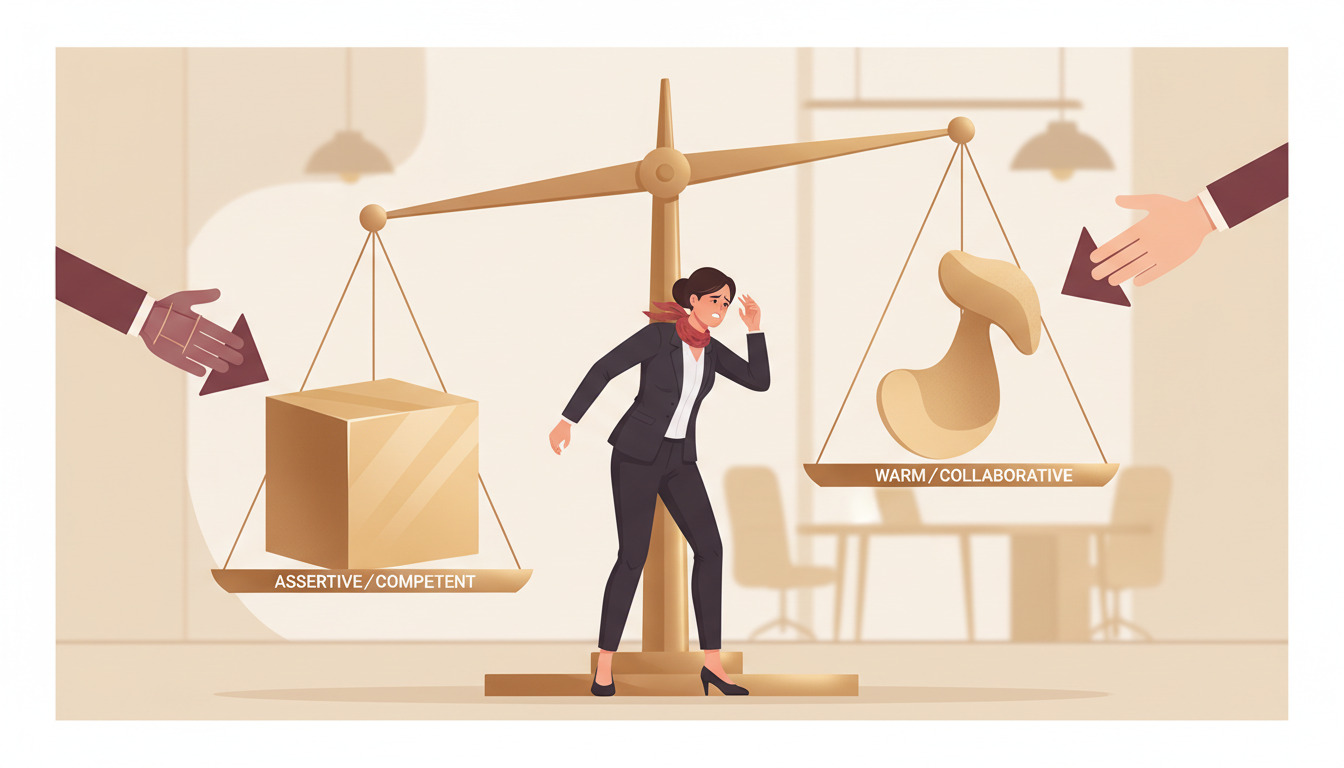
Research from Harvard Business School found that women who exhibit assertive leadership behaviors are rated as less likeable—while men displaying the same behaviors are rated as more competent. This isn't a perception problem you can simply "confidence" your way out of. It's a structural dynamic that requires strategic navigation.
Here's what this looks like in practice: Sarah, a VP of Product at a mid-size tech company, consistently delivered results that outperformed her peers. Yet in 360 reviews, she received feedback that she was "abrasive" in meetings—feedback her male counterpart, who communicated in a nearly identical style, never received.
The solution isn't to soften yourself into invisibility. It's to understand the terrain and move through it with precision.
Why "Just Be More Confident" Is Terrible Advice
Most leadership presence advice tells women to "speak up more," "take up space," or "stop apologizing." This advice isn't wrong—it's incomplete. It ignores the social penalties women face when they do exactly those things.
A 2022 study published in The Leadership Quarterly found that women who adopted dominant communication styles were 28% more likely to face social backlash than men using identical approaches. The issue isn't your confidence. The issue is that confidence in women is processed differently by many workplaces.
What you need instead are frameworks that build authority and manage perception simultaneously. That's what the rest of this guide delivers.
The Real Goal: Authority Without Performance
Leadership presence for women isn't about performing confidence. It's about developing genuine authority that's rooted in expertise, strategic communication, and intentional presence. When your authority comes from substance rather than performance, it's far more resilient to the double bind.
If you've ever felt like people don't take your contributions seriously, you're not imagining it—and it's fixable. Start with understanding why people don't take you seriously at work and how to fix it.
Reclaiming Authority When You're Talked Over
The Interruption Problem by the Numbers
A landmark study by researchers at George Washington University found that men interrupted women 33% more often than they interrupted other men in professional conversations. A separate analysis by Northwestern University's Pritzker School of Law found that female Supreme Court justices were interrupted three times more often than their male colleagues.
Being talked over isn't a minor annoyance. It systematically erodes your perceived authority in every meeting where it happens. Here's how to stop it.
The Reclaim Framework: Three Techniques That Work
Technique 1: The Verbal HoldWhen someone interrupts you, don't stop speaking. Lower your pitch slightly, maintain your pace, and continue your sentence. Most interrupters rely on the social expectation that you'll yield. When you don't—calmly, without raising your voice—they typically stop within 3-5 seconds.
Example: You're presenting a quarterly strategy recommendation. A colleague jumps in with, "Well, actually, I think—" You continue at the same pace: "—and when we look at the Q3 data, the pattern supports exactly this approach." No acknowledgment of the interruption. No pause. Just continuation.
Technique 2: The Named ReturnIf the interruption succeeds, use this after the interrupter finishes: "Thank you, Mark. As I was saying before—" and continue your original point. The named return does two things: it publicly flags that an interruption occurred, and it reasserts your ownership of the conversation.
Technique 3: The Ally PactBefore high-stakes meetings, coordinate with one or two colleagues. The agreement is simple: if one of you is interrupted, another says, "I'd like to hear [Name] finish her point." Research from the Obama White House showed that this "amplification strategy," used by senior women staffers, was so effective that President Obama began calling on women more frequently.
For more meeting-specific strategies, explore how to be more assertive in meetings without being aggressive.
Building a Reputation That Prevents Interruptions
The long game is building a professional presence so established that interrupting you carries social cost. This means consistently demonstrating expertise, speaking with vocal authority, and positioning yourself as a go-to voice on key topics. When people see you as an authority, they interrupt less—not because they're more polite, but because the group dynamic penalizes it.
Your presence shouldn't be an uphill battle. The Credibility Code gives you the exact frameworks to build authority that commands respect in every conversation—without conforming to someone else's playbook. Discover The Credibility Code
The Gravitas Gap: Building Weight Without Masculine Norms
What Gravitas Actually Means (and Doesn't Mean)

Gravitas is the quality that makes people take you seriously before you've even finished your first sentence. According to a 2012 study by the Center for Talent Innovation (now Coqual), gravitas was cited by 67% of senior executives as the most important dimension of executive presence—ahead of communication (28%) and appearance (5%).
But here's where women get derailed: many interpret gravitas as "act more like the men in the room." Deeper voice. Fewer emotions. More aggressive posture. This is a trap. Gravitas isn't about dominance. It's about weight—the sense that your words carry substance and your presence carries intention.
For a deeper dive into this concept, read our guide on gravitas in leadership and how to develop it.
The Gravitas Framework for Women: CORE
C — Conviction: Speak about your ideas with clear ownership. Replace "I think maybe we should consider..." with "Based on the data, here's what I recommend." Conviction isn't volume. It's the absence of hedging. O — Ownership: Take visible ownership of outcomes—both successes and failures. When a project succeeds, say "My team and I drove this result" rather than deflecting credit entirely. Research from Catalyst found that women who made their contributions visible were 2-3 times more likely to advance to senior roles. R — Restraint: Gravitas often lives in what you don't say. The leader who speaks concisely and lets silence work for them projects more authority than the one who fills every gap. Learn to speak concisely at work using the clarity framework. E — Emotional Steadiness: This doesn't mean suppressing emotions. It means not being destabilized by conflict, criticism, or pressure. When a colleague challenges your proposal aggressively, responding with calm precision—"That's a fair concern. Here's how the data addresses it"—projects more gravitas than any power pose ever will.Gravitas in Practice: The Boardroom Scenario
Imagine you're presenting a strategic initiative to the executive team. Halfway through, the CFO pushes back hard: "These numbers don't justify the investment."
Without gravitas: You scramble, over-explain, or backtrack. The room reads your reaction as uncertainty about your own proposal. With gravitas (using CORE): You pause for one full second. Then: "I appreciate that challenge, and it's exactly the right question. Let me walk you through the risk-adjusted model on slide seven, which accounts for that concern." Your voice stays level. Your posture stays open. You address the objection without treating it as an attack.That pause, that steadiness, that precise redirect—that's gravitas. And it has nothing to do with sounding like someone you're not.
Strategic Communication: Frameworks That Build Authority
The Authority Language Shift
Small language patterns create large perception shifts. Here are five specific swaps that increase perceived authority, backed by linguistic research:
| Instead of... | Say... | Why it works |
|---|---|---|
| "I just wanted to follow up..." | "I'm following up on..." | Removes minimizing qualifier |
| "Does that make sense?" | "What questions do you have?" | Assumes competence of your delivery |
| "Sorry, but I disagree." | "I see it differently." | Removes unnecessary apology |
| "I feel like we should..." | "The evidence points to..." | Grounds your position in data |
| "Can I add something?" | "I want to build on that." | Asserts rather than asks permission |
A 2019 study in Psychological Science found that women who used fewer hedging phrases (like "just," "kind of," "I think") were rated as 35% more competent by both male and female evaluators—with no decrease in likeability ratings. The double bind has limits, and precise language is one of the clearest paths through it.
The Pre-Meeting Authority Protocol
Before any high-stakes meeting, run through this five-minute protocol:
- Identify your one key message. What is the single thing you want the room to remember? Write it in one sentence.
- Prepare your opening line. Don't improvise your first sentence. Script it. A strong opening anchors your authority for the entire meeting.
- Anticipate two objections. Prepare calm, data-backed responses. Nothing builds gravitas faster than handling pushback without flinching.
- Choose your seat strategically. Sit where you can make eye contact with the decision-maker. Avoid corners and edges of the table—they signal peripheral status.
- Set a physical anchor. Place both feet flat on the floor. Hands visible on the table. This isn't a power pose gimmick—it's a physiological grounding technique that reduces cortisol and keeps your voice steady.
For a complete guide on body language in leadership settings, see our article on body language for leadership presence.
Navigating Feedback and Negotiation as a Woman Leader
Giving feedback upward and negotiating for yourself are two areas where the double bind hits hardest. Women who negotiate assertively for salary are penalized in likeability at rates men are not, according to research by Hannah Riley Bowles at Harvard Kennedy School.
The workaround isn't to stop negotiating. It's to frame negotiations relationally. Instead of "I deserve a higher salary because of my performance," try: "I want to make sure my compensation reflects the value I'm bringing to the team, especially given [specific results]. What can we do to align on this?"
This framing doesn't dilute your ask. It wraps it in collaborative language that neutralizes the backlash effect. For more on this approach, read our guide on how to negotiate without being pushy.
Communication is your most powerful leadership tool. The Credibility Code gives you scripts, frameworks, and strategies to communicate with authority in every professional scenario. Discover The Credibility Code
Building Your Visibility and Personal Authority
The Expert Positioning Strategy
Leadership presence isn't only about how you communicate in meetings. It's also about how you're perceived when you're not in the room. A McKinsey & Company report found that women are 24% less likely than men to receive visibility-building assignments—the high-profile projects that build reputations.
This means you can't wait to be tapped. You need to actively position yourself as an expert. Here's how:
Step 1: Claim a domain. Choose one area where you want to be the recognized authority. Not five areas. One. Depth beats breadth for credibility. Step 2: Create visible artifacts. Write the internal memo. Publish the LinkedIn article. Volunteer to present the findings. These artifacts create a trail of expertise that follows you into every evaluation and promotion conversation. Step 3: Build strategic relationships. Identify three senior leaders whose decisions your expertise can inform. Provide value to them consistently—insights, data, perspective—without asking for anything in return. Over time, you become their go-to source.For a step-by-step approach, explore how to position yourself as an expert at work.
Managing the "Office Housework" Trap
Research by NYU psychologist Madeline Heilman shows that women are 48% more likely to volunteer for non-promotable tasks—organizing events, taking notes, mentoring junior staff—and are penalized less for saying no than they fear. Yet these tasks consume time that could go toward visibility-building work.
Set a personal policy: for every non-promotable task you accept, ensure you're also attached to one high-visibility initiative. This isn't selfish. It's strategic. Your leadership presence depends on people seeing you lead, not just support.
Thought Leadership as a Presence Multiplier
Building a thought leadership presence—internally or externally—amplifies your authority exponentially. When you've published insights, spoken at events, or led visible initiatives, you walk into every room with pre-established credibility.
This doesn't require a massive platform. A well-crafted monthly LinkedIn post, a quarterly internal presentation, or a single industry panel appearance can shift how colleagues and leaders perceive your authority. Learn more about building thought leadership and personal brand through a step-by-step framework.
Frequently Asked Questions
What is leadership presence for women?
Leadership presence for women is the ability to project authority, credibility, and confidence in professional settings while navigating the gendered expectations that uniquely affect how women leaders are perceived. It includes vocal authority, strategic communication, body language, and frameworks for managing the double bind—where women are expected to be both warm and commanding simultaneously.
How can women develop executive presence without seeming aggressive?
The key is grounding your authority in substance rather than style. Use data-driven language, speak with conviction rather than volume, and practice emotional steadiness under pressure. The CORE framework—Conviction, Ownership, Restraint, and Emotional Steadiness—builds genuine gravitas without requiring you to adopt aggressive communication patterns. Research shows that competence signals reduce backlash more effectively than softening your message.
Leadership presence vs. executive presence: what's the difference?
Leadership presence is the broader ability to inspire confidence and command attention in any professional setting. Executive presence is a subset specifically tied to C-suite readiness—how senior leaders and board members perceive your fitness for top roles. For women, both require navigating the same double-bind dynamics, but executive presence places greater emphasis on strategic vision, composure under pressure, and the ability to influence at the highest organizational levels.
How do I handle being interrupted in meetings as a woman leader?
Use the Reclaim Framework: (1) The Verbal Hold—continue speaking at a steady pace without yielding. (2) The Named Return—after an interruption, say "As I was saying before..." to reassert your point. (3) The Ally Pact—coordinate with colleagues to amplify each other's contributions. These techniques address interruptions in the moment while building a long-term reputation that discourages them.
Can introverted women develop strong leadership presence?
Absolutely. Leadership presence isn't about being the loudest voice. Introverted women often excel at gravitas through deep listening, thoughtful responses, and strategic communication. The CORE framework is particularly effective for introverts because it emphasizes restraint and conviction over volume. Many of the most commanding leaders in history—from Angela Merkel to Ruth Bader Ginsburg—projected enormous presence through quiet, deliberate authority.
How long does it take to build leadership presence?
You can see measurable shifts in how people respond to you within 2-4 weeks of consistently applying specific frameworks like authority language shifts and the Pre-Meeting Authority Protocol. Building deep, reputation-level presence typically takes 3-6 months of intentional practice. The key is consistency—small, daily adjustments in how you communicate compound into significant perception changes over time.
Ready to build the kind of presence that opens doors? The Credibility Code is the complete playbook for professionals who want to communicate with authority, build lasting credibility, and command every room they walk into. Discover The Credibility Code
Ready to Command Authority in Every Conversation?
Transform your professional communication with proven techniques that build instant credibility. The Credibility Code gives you the frameworks top leaders use to project confidence and authority.
Discover The Credibility CodeRelated Articles
Executive Presence for Women in Leadership: A Full Guide
Executive presence for women in leadership means projecting confidence, credibility, and authority in ways that feel authentic—while navigating the unique double standards women face in professional settings. It requires mastering communication, gravitas, and appearance on your own terms, not performing a version of leadership designed by and for someone else. This guide gives you specific frameworks, language shifts, and strategies to build commanding presence without sacrificing likability or

Executive Presence for Women in Leadership: Real Guide
Executive presence for women in leadership is the ability to project confidence, credibility, and authority in a way that commands respect—without abandoning your authentic communication style. It requires navigating a well-documented double bind: women are often penalized for being "too assertive" yet overlooked for being "too soft." This guide gives you specific frameworks, language patterns, and strategies to build genuine executive presence on your own terms, not by mimicking outdated mascul

Leadership Presence in Difficult Conversations: A Method
Leadership presence in difficult conversations is the ability to maintain composure, credibility, and authority when workplace tension is high—whether you're delivering tough feedback, navigating conflict, or pushing back on a senior stakeholder. The method involves four pillars: emotional regulation before and during the conversation, strategic framing of your message, deliberate body language under pressure, and specific language patterns that de-escalate without surrendering your position. Th