
Assertive Communication at Work: 15 Before & After Examples

What Is Assertive Communication at Work?
Assertive communication at work is a professional communication style where you express your thoughts, needs, and boundaries directly, honestly, and respectfully. It sits between passive communication (where you stay silent or defer to avoid conflict) and aggressive communication (where you dominate, dismiss, or intimidate others).
In practice, assertive communication means saying what you mean without hedging, apologizing unnecessarily, or bulldozing. It's how credible professionals advocate for themselves, give honest feedback, and hold boundaries — while maintaining trust and respect.
According to a 2023 study published in the Journal of Occupational Health Psychology, employees who communicate assertively report 32% higher job satisfaction and are rated as significantly more effective leaders by their peers. It's not just about feeling confident — it's about being perceived as competent and credible.
Why Most Professionals Default to Passive or Aggressive Communication
Before diving into the 15 examples, it's worth understanding why assertive communication feels so difficult for most people. The problem isn't intelligence or intention — it's conditioning.

The Passive Default
Many professionals — especially those who've been micromanaged or overlooked early in their careers — develop a passive communication habit as a survival mechanism. You learn to soften every statement, add qualifiers, and defer to whoever has the loudest voice.
The result? You sound uncertain even when you're the most qualified person in the room. Research from the University of Wolverhampton found that passive communicators are 45% less likely to be considered for leadership roles, regardless of their actual performance.
The Aggressive Overcorrection
On the other end, some professionals overcorrect. They've been told to "speak up" and "be more direct," so they swing to aggressive — interrupting, dismissing, or steamrolling colleagues. This might get short-term results, but it erodes trust.
A 2022 Harvard Business Review analysis found that managers perceived as aggressive communicators had 28% higher team turnover within 18 months. Being direct doesn't mean being harsh. Assertiveness threads the needle between the two.
The Assertive Sweet Spot
Assertive communication follows a simple principle: clear, direct, and respectful. You state your position without qualifiers that undermine it, and without aggression that damages relationships. It's a skill you build — not a personality trait you're born with.
If you've been undermining yourself with weak language habits, the examples below will give you the exact phrasing to shift.
The ACR Framework: How to Transform Any Statement Into Assertive Language
Before we get to the 15 examples, here's the framework that makes assertive communication repeatable. I call it the ACR Framework:
A — Acknowledge the Situation
Start by briefly naming the context or the other person's perspective. This signals respect and shows you're not dismissing their viewpoint.
C — Communicate Your Position Clearly
State your point, need, or boundary directly. No hedging. No "I just think maybe…" Use declarative sentences. Say what you mean in one or two clear statements.
R — Redirect Toward Action
End with a forward-looking statement — a recommendation, a question, or a next step. This keeps the conversation productive and positions you as someone who solves problems, not just raises them.
Example of ACR in action:- Acknowledge: "I understand the timeline is tight."
- Communicate: "I'm not able to take on this additional project without deprioritizing the Q3 deliverable."
- Redirect: "Let's identify which project takes priority so I can allocate my time accordingly."
This framework works across meetings, emails, feedback conversations, and negotiations. Now let's see it applied in 15 specific workplace scenarios.
15 Before & After Assertive Communication Examples
Scenario 1: Declining Additional Work Without Seeming Uncooperative
Passive (Before): "Um, I guess I could try to fit it in… I'm pretty busy, but I'll see what I can do." Assertive (After): "I appreciate you thinking of me for this. My current workload includes [Project X] and [Project Y], both due this week. I can take this on if we adjust one of those deadlines. Which would you prefer to reprioritize?" Why it works: You're not saying no — you're presenting a clear trade-off. This is how leaders communicate capacity constraints, and it's a hallmark of communicating with authority at work.Scenario 2: Pushing Back on an Unrealistic Deadline
Aggressive (Before): "There's no way that's happening by Friday. Whoever set that timeline clearly doesn't understand the scope." Assertive (After): "I want to deliver quality work on this. The current scope requires approximately 10 business days. I can deliver a focused first phase by Friday and the complete deliverable by the following Wednesday. Which approach works best for the team?" Why it works: You've stated the reality without attacking anyone, and you've offered a solution.Scenario 3: Responding When Someone Takes Credit for Your Idea
Passive (Before): Stays silent. Fumes internally. Complains to a colleague later. Assertive (After): "Thanks for highlighting that, [Name]. When I initially proposed this approach in last week's meeting, I also suggested we consider [additional detail]. I'd like to walk the team through the full recommendation." Why it works: You reclaim ownership without accusation. You simply state the fact and expand on your contribution. For more on this, see our guide on what to do when someone takes credit for your idea.Scenario 4: Speaking Up When You Disagree in a Meeting
Passive (Before): "That's a good point… I mean, I kind of see it differently, but it's probably fine." Assertive (After): "I see the logic in that approach. I have a different perspective based on the data from Q2. The numbers suggest [specific evidence]. I recommend we consider [alternative] before making a final decision." Why it works: You validate the other person, present evidence, and make a clear recommendation. No hedging. No apology.Scenario 5: Giving Constructive Feedback to a Peer
Aggressive (Before): "Your presentation was confusing. You need to be more organized." Assertive (After): "Your content was strong — you clearly know this topic well. I noticed the audience seemed to lose the thread during the middle section. Structuring it around three key takeaways might help the message land more effectively. Would you like to walk through it together?" Why it works: You lead with a genuine positive, name the specific issue, offer a concrete solution, and extend support.Ready to transform how you communicate at every level? The Credibility Code gives you the complete framework for building authority, presence, and confidence in every professional conversation. Discover The Credibility Code
Scenario 6: Addressing Being Interrupted in a Meeting
Passive (Before): Stops talking. Waits. Never finishes the point. Assertive (After): "I'd like to finish my point, and then I'm happy to hear your thoughts." (Said calmly, with a brief pause and steady eye contact.) Why it works: It's direct without being combative. The pause and calm tone signal confidence, not confrontation. For a deeper dive, see how to handle being interrupted in meetings professionally.Scenario 7: Requesting a Raise or Promotion
Passive (Before): "I was wondering if maybe it might be possible to, at some point, discuss my compensation? Only if you think it's appropriate." Assertive (After): "I'd like to discuss my compensation. Over the past year, I've [specific achievement], [specific achievement], and [specific achievement]. Based on my contributions and market benchmarks, I'm requesting a salary adjustment to [specific number]. I'd like to hear your thoughts on making this happen." Why it works: You've stated your case with evidence, named a specific number, and invited dialogue. This is the approach we break down in our negotiation phrases for promotion conversations.Scenario 8: Setting a Boundary Around After-Hours Communication
Passive (Before): Responds to every 10 PM email within minutes, resents it, says nothing. Assertive (After): "I want to make sure I'm delivering my best work during business hours. Unless something is urgent, I'll respond to messages received after 6 PM the following morning. If there's an emergency, a text or call is the best way to reach me." Why it works: You've stated the boundary, explained the reasoning (quality work), and provided an exception for genuine emergencies. No apology needed.Scenario 9: Handling Condescending Feedback From a Senior Colleague
Aggressive (Before): "I don't need you to explain this to me like I'm an intern." Assertive (After): "I appreciate the context. I'm well-versed in this area — I led a similar initiative at [previous role/project]. I'd welcome your input on the strategic direction specifically." Why it works: You redirect the conversation to a peer-level exchange without escalating. You also subtly establish your credentials.Scenario 10: Saying No to a Meeting That Doesn't Require Your Attendance
Passive (Before): Attends the meeting. Sits silently for 45 minutes. Loses productive time. Assertive (After): "Thanks for the invite. Based on the agenda, I don't think I'll be able to add value to this discussion. If there are action items for my team, I'm happy to review the notes and follow up. Would that work?" Why it works: You're not rejecting anyone — you're protecting your time while offering an alternative. According to a 2023 Atlassian workplace survey, the average professional spends 31 hours per month in unproductive meetings. Assertive professionals reclaim that time.Scenario 11: Addressing a Colleague Who Consistently Misses Deadlines
Passive (Before): "No worries at all! Whenever you get to it is fine." (It's not fine.) Assertive (After): "The deliverable was due on Tuesday, and I haven't received it yet. My work on [dependent project] is on hold until I have it. Can you confirm when I'll have it today?" Why it works: You state the fact, explain the impact, and ask for a specific commitment. No blame, no passive aggression — just clarity.Scenario 12: Responding to Vague or Unfair Criticism
Passive (Before): "Oh… okay. I'll try to do better." Assertive (After): "I want to improve, and specific feedback helps me do that. Could you give me a concrete example of where you saw this issue? That way I can address it directly." Why it works: You're not accepting a vague label. You're requesting actionable information, which is both professional and self-respecting.Scenario 13: Presenting a Contrary Opinion to Senior Leadership
Passive (Before): "This is probably a dumb question, but has anyone thought about maybe…" Assertive (After): "I want to flag a risk I've identified. Based on [data/experience], this approach could result in [specific consequence]. I'd recommend we also evaluate [alternative]. Here's a brief analysis." Why it works: You lead with value ("flagging a risk"), back it with evidence, and offer a solution. This is exactly how to communicate with senior leadership effectively.Scenario 14: Assertive Communication in Email — Requesting Action
Passive (Before): "Hi! Just wanted to circle back on this when you get a chance. No rush at all! 😊" Assertive (After): "Hi [Name], I'm following up on the budget approval sent on March 3. I need your sign-off by Thursday, March 14, to keep the project on schedule. Please confirm by end of day Wednesday if there are any questions. Thank you." Why it works: Clear deadline, clear consequence, clear ask. For more on this, see our guide on how to sound authoritative in emails.Scenario 15: Handling Being Put on the Spot With a Question You Can't Answer
Passive (Before): "Oh, um, I'm not sure… I should probably know that. Let me, uh, get back to you?" Assertive (After): "That's an important question. I want to give you an accurate answer rather than speculate. I'll have the data reviewed and will follow up by end of day tomorrow. Is there a specific aspect that's most urgent for your decision?" Why it works: You don't fake it, you don't crumble. You demonstrate judgment by prioritizing accuracy over performance. For a deeper framework, see how to handle being put on the spot at work.How to Practice Assertive Communication Daily
Reading examples is a start. Building the habit requires practice. Here's a simple daily system.
The Morning Script Review (2 Minutes)
Each morning, identify one conversation or meeting where you'll need to communicate assertively. Write out your key statement using the ACR Framework. Even a single sentence prepares your brain to default to assertive phrasing instead of passive hedging.
The Post-Conversation Audit (1 Minute)
After any significant conversation, ask yourself three questions:
- Did I state my position clearly?
- Did I hedge, apologize, or over-qualify unnecessarily?
- What would I say differently next time?
This isn't about being perfect. It's about building awareness. Over two to three weeks, you'll notice your default language shifting. A 2021 study in Communication Research Reports found that professionals who practiced daily communication reflection improved their assertiveness scores by 40% within 30 days.
The Language Swap List
Keep a running list of your personal passive phrases and their assertive replacements. Common swaps include:
- "I just wanted to…" → "I'm writing to…"
- "Sorry to bother you" → "I have a quick question"
- "Does that make sense?" → "I'm happy to clarify any specifics"
- "I think maybe we should…" → "I recommend we…"
- "I'm no expert, but…" → (Delete entirely. Just state your point.)
For a complete list of language habits that undermine your credibility, see 12 credibility killers in workplace communication.
Build unshakable professional credibility. The Credibility Code gives you the frameworks, scripts, and daily practices to communicate with authority in every workplace scenario — meetings, emails, negotiations, and beyond. Discover The Credibility Code
Common Assertive Communication Mistakes to Avoid
Even well-intentioned professionals make these errors when trying to be more assertive.
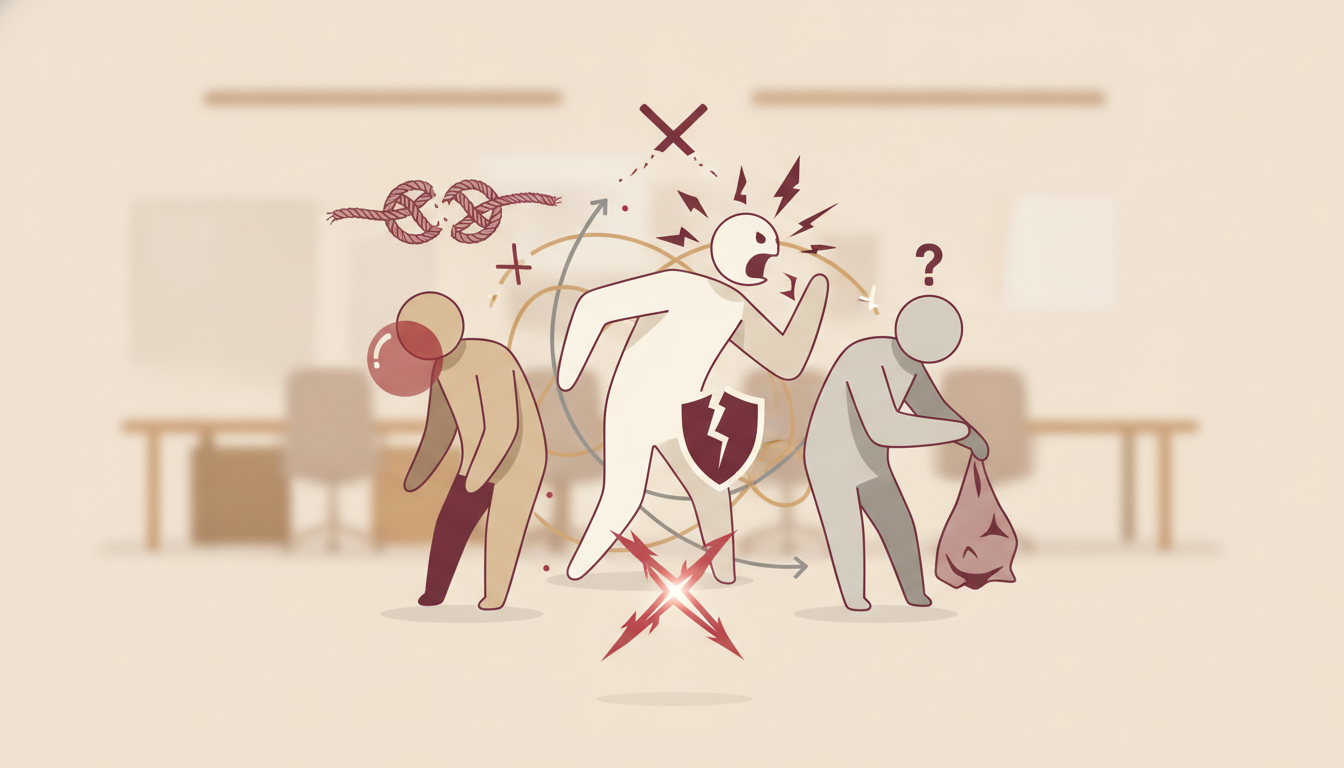
Confusing Assertiveness With Bluntness
Assertiveness includes respect. Saying "That won't work" with no context or alternative isn't assertive — it's dismissive. Always pair your position with reasoning and, when possible, a recommendation.
Over-Explaining Your Boundaries
When you set a boundary, state it once clearly. Don't follow it with three paragraphs of justification. Over-explaining signals that you don't believe you have the right to the boundary in the first place.
Using Assertive Words With Passive Body Language
If you say "I recommend we take a different approach" while avoiding eye contact, crossing your arms, and speaking in a near-whisper, the words lose their power. Assertive communication is verbal and nonverbal. Your tone, posture, and eye contact need to match your message.
Research from UCLA's Mehrabian communication studies suggests that up to 55% of communication impact comes from body language and 38% from vocal tone — meaning your how matters as much as your what.
Frequently Asked Questions
What is the difference between assertive and aggressive communication at work?
Assertive communication expresses your needs and opinions directly while respecting others. Aggressive communication prioritizes your position at the expense of others — through interrupting, dismissing, or intimidating. The key distinction: assertive communication invites dialogue; aggressive communication shuts it down. Assertive says "I disagree, and here's why." Aggressive says "You're wrong."
How can I be more assertive at work without being rude?
Focus on three principles: state facts rather than judgments, offer solutions alongside concerns, and maintain a calm, steady tone. Replace phrases like "You always miss deadlines" with "The last three deliverables arrived after the due date, which impacts my workflow. Can we discuss a solution?" Specificity and solution-orientation prevent assertiveness from being perceived as rudeness.
What are examples of assertive communication in emails?
Assertive emails use clear subject lines, direct requests, specific deadlines, and confident language. Instead of "Just checking in on this whenever you get a chance," write "I need your feedback on the attached proposal by Thursday at noon so I can finalize the client presentation." Remove unnecessary apologies, hedging phrases, and excessive exclamation points. For a complete guide, see our article on assertive communication in emails with before-and-after examples.
How long does it take to develop an assertive communication style?
Most professionals notice meaningful improvement within two to four weeks of deliberate practice. The key is daily repetition — using frameworks like ACR, reviewing your language after conversations, and gradually replacing passive habits. A 2021 study in Communication Research Reports found measurable assertiveness improvements in as few as 30 days of consistent practice.
Can introverts be assertive communicators?
Absolutely. Assertiveness is a skill, not a personality type. Introverts often excel at assertive communication because they tend to think before speaking, choose words carefully, and listen well — all of which strengthen assertive delivery. The challenge for introverts is usually frequency of speaking up, not quality. For strategies tailored to quieter communication styles, explore our guide on building leadership presence as an introvert.
How do I handle someone who reacts badly to my assertive communication?
Stay calm and don't retreat into passive mode. If someone pushes back, acknowledge their reaction ("I can see this is frustrating") and restate your position calmly. You're not responsible for someone else's discomfort with your directness. If the reaction is hostile, you can say: "I'd like to continue this conversation productively. Can we revisit this in an hour?" Holding your ground calmly is itself an act of assertive communication.
Your communication shapes your career trajectory. The Credibility Code is the complete system for professionals who want to be heard, respected, and recognized as leaders — starting with the very next conversation. Discover The Credibility Code
Ready to Command Authority in Every Conversation?
Transform your professional communication with proven techniques that build instant credibility. The Credibility Code gives you the frameworks top leaders use to project confidence and authority.
Discover The Credibility CodeRelated Articles

How to Stop Undermining Yourself at Work: 12 Habits
You undermine yourself at work every time you soften your language, shrink your body, or defer credit you've earned. To stop, you need to identify the specific habits—linguistic hedges, apologetic emails, passive body language, and deferential meeting behaviors—that silently erode your credibility. Then replace each one with a concrete alternative. This article breaks down 12 of the most common self-undermining habits and gives you exact scripts and replacement behaviors for each.

Assertive Communication for Women at Work: A Complete Guide
Assertive communication for women at work means expressing your ideas, boundaries, and needs directly and confidently — without apologizing, hedging, or softening your message to manage others' comfort. Research shows women face a documented "double bind" where they're penalized for being too direct yet overlooked for being too accommodating. This guide provides research-backed language frameworks, real scripts for common scenarios like interruptions and credit-taking, and strategies that build

How to Communicate With Confidence at Work: Daily Guide
Communicating with confidence at work requires a daily system, not a one-time effort. Start each morning with a two-minute intention-setting ritual, then apply specific techniques throughout the day—using direct language in emails, structured frameworks in meetings, and steady vocal pacing in conversations. End with a brief reflection to identify what worked. Research shows that professionals who practice confident communication habits daily are perceived as more competent and promotable. This g