
How to Stop Undermining Yourself at Work: 10 Fixes

What Is Self-Undermining at Work?
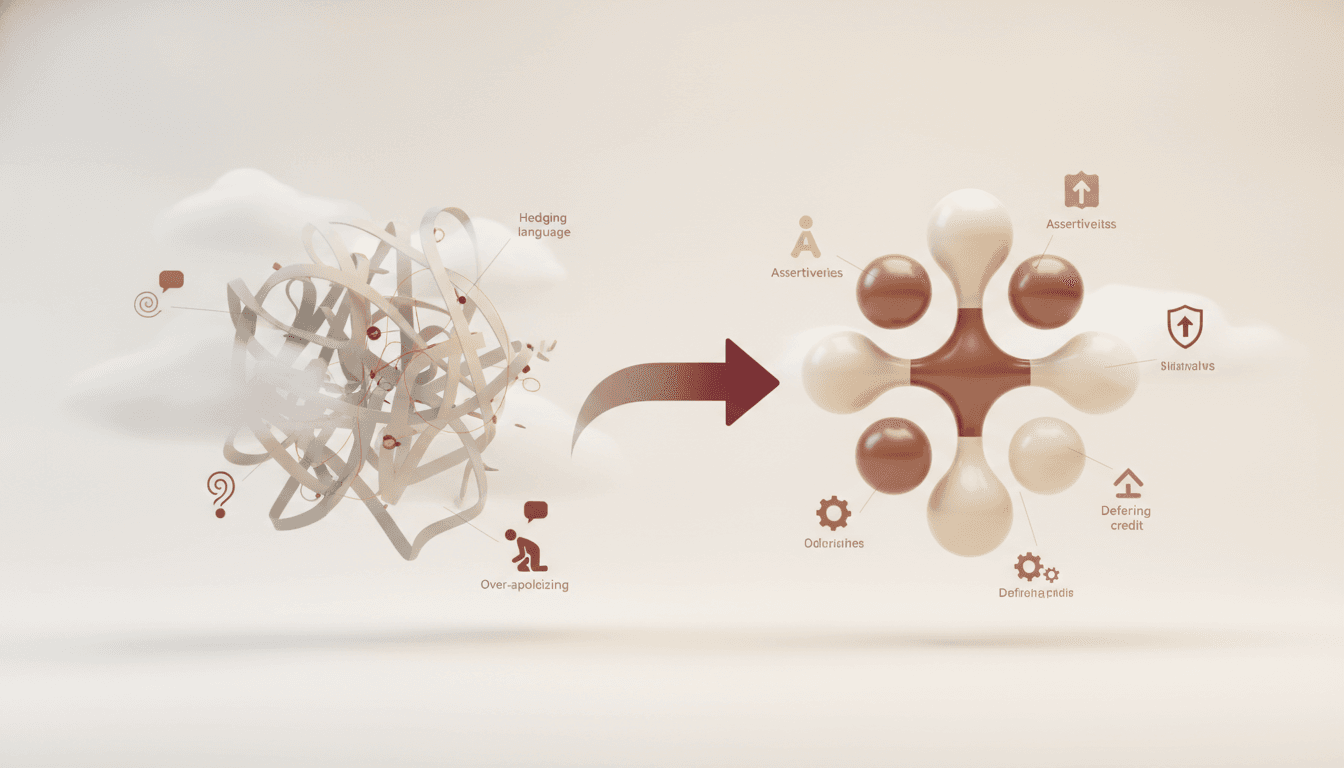
Self-undermining at work is the pattern of unconscious communication habits—verbal, vocal, and physical—that signal low confidence and reduce how others perceive your competence, authority, and credibility. It's not about lacking skill. It's about how you present your skill.
These behaviors include hedging your ideas, over-apologizing, deferring credit, speaking with a rising intonation, and physically shrinking in high-stakes moments. Research from the University of Melbourne found that confident speakers are perceived as more competent, even when their actual expertise is identical to less confident peers. Self-undermining is the gap between what you know and what others believe you know.
Why Professionals Unconsciously Undermine Themselves
The Confidence-Competence Gap

Here's the uncomfortable truth: being good at your job doesn't automatically make you look good at your job. A study published in the Journal of Personality and Social Psychology found that people who express ideas with confidence are perceived as 20-30% more competent than those who express the same ideas tentatively (Anderson et al., 2012). This means your delivery can outweigh your content.
Mid-career professionals are especially vulnerable. You've earned expertise, but years of organizational hierarchy may have trained you to soften, defer, and hedge. Those habits served you as a junior employee. They sabotage you as a leader.
The Social Conditioning Factor
Many self-undermining behaviors are socially reinforced. Women, in particular, face a well-documented double bind: research from Harvard Business Review (2019) shows that women who communicate assertively are often penalized for it, which trains many to over-qualify their statements. Introverts face a parallel challenge—quiet authority gets mistaken for uncertainty.
The result? Talented professionals develop protective communication habits that slowly erode their perceived credibility. The fixes below target each habit individually so you can dismantle the pattern piece by piece.
Fixes 1–5: Language and Vocal Habits That Undermine Credibility
Fix 1: Replace Qualifying Language with Direct Statements
The problem: Phrases like "I just think," "I'm not sure, but," "This might be a dumb question," and "I could be wrong, but" tell your audience to discount what follows before you've even said it. The script swap:| Instead of… | Say… |
|---|---|
| "I just think maybe we should…" | "I recommend we…" |
| "This might not work, but…" | "Here's one approach…" |
| "I'm no expert, but…" | "Based on my experience…" |
| "Sorry, can I add something?" | "I'd like to add a point." |
For a deeper dive into language patterns that build authority, see our guide on power language at work.
Fix 2: Stop Over-Apologizing and Start Acknowledging
The problem: Chronic apologizing—for asking questions, for having opinions, for existing in a meeting—signals that you believe you're an imposition. According to a 2019 study in Psychological Science, women apologize more frequently than men not because they make more mistakes, but because they have a lower threshold for what constitutes an offense (Schumann & Ross). The script swap:| Instead of… | Say… |
|---|---|
| "Sorry, I have a question." | "I have a question." |
| "Sorry for the delay." | "Thanks for your patience." |
| "Sorry, I disagree." | "I see it differently." |
| "Sorry to bother you." | "Do you have a moment?" |
Fix 3: Eliminate Vocal Uptick (Upspeak)
The problem: Ending statements with a rising intonation—as if you're asking a question—makes even authoritative points sound uncertain. A study from Quantified Communications found that speakers who use a downward inflection at the end of sentences are rated 35% more persuasive than those who use upspeak. The fix: Record yourself in your next meeting or rehearsal. Listen for sentences where your pitch rises at the end. Then practice this drill:- Say a declarative sentence out loud: "We should launch in Q3."
- Consciously drop your pitch on the final word.
- Repeat five times until the downward inflection feels natural.
This is one of the fastest credibility upgrades you can make. For a complete vocal authority system, read how to develop a commanding voice at work.
Fix 4: Cut Filler Words That Signal Uncertainty
The problem: "Um," "like," "you know," "so basically," and "kind of" dilute your message and make you sound unprepared. Research from the University of Texas found that speakers who use fewer filler words are rated as more credible, more intelligent, and more prepared. The fix: Replace filler with silence. A one-second pause before answering sounds confident. A string of "um, so, like, basically" does not. The 3-step filler elimination drill:- Record a 60-second explanation of your current project.
- Count every filler word.
- Re-record, replacing each filler with a deliberate pause.
Most professionals cut their filler words by 50% within two weeks of conscious practice. For more on this, see how to stop using filler words in professional speaking.
Fix 5: Answer Without Delay or Excessive Preamble
The problem: When someone asks for your opinion and you respond with "Well, that's a great question, and I think there are many ways to look at it, and I appreciate you asking…"—you've already lost authority. Excessive preamble signals that you're stalling because you're unsure. The fix: Lead with your answer. Then support it. Example: Your VP asks, "Should we expand into the European market this year?"- Undermining version: "That's a really interesting question. I think there are a lot of factors, and honestly it depends on how you look at it, but maybe?"
- Credible version: "Not this year. Our supply chain isn't ready for EU compliance timelines. I'd recommend a Q2 next-year target with a phased approach."
Ready to Overhaul Your Communication Habits? The Credibility Code gives you the complete system for replacing self-undermining patterns with authority-building habits—including scripts, drills, and frameworks for every professional scenario. Discover The Credibility Code
Fixes 6–8: Behavioral Patterns That Erode Authority
Fix 6: Stop Deferring Credit for Your Own Work

This isn't arrogance. It's accurate. Learn more about owning your professional identity in how to get promoted without feeling like a self-promoter.
Fix 7: Stop Asking for Permission When You Have Authority
The problem: "Would it be okay if I…" and "Do you mind if I share my thoughts?" are permission-seeking phrases that signal subordination—even when you have every right to contribute. The script swap:| Instead of… | Say… |
|---|---|
| "Can I share an idea?" | "I have an idea." |
| "Would it be okay if I presented first?" | "I'll present first, then hand it over to you." |
| "Do you mind if I push back?" | "I have a different perspective." |
Fix 8: Stop Physically Shrinking in High-Stakes Moments
The problem: Crossed arms, hunched shoulders, avoiding eye contact, and retreating to the corner of the conference table all signal that you don't believe you belong. Research by Amy Cuddy at Harvard Business School found that expansive postures increase feelings of confidence and are perceived as more authoritative by observers. The fix (the "Claim Your Space" checklist):- Sit in the center third of the table, not the edges.
- Place your hands on the table or use open gestures—don't hide them in your lap.
- Make eye contact for 3-5 seconds at a time when speaking.
- Stand with feet shoulder-width apart during presentations. No swaying.
For a complete body language system, read body language for leadership presence.
Fixes 9–10: Strategic Patterns That Hold You Back
Fix 9: Stop Waiting to Speak Until You Have the "Perfect" Point
The problem: Perfectionism disguised as preparation. You wait for the ideal moment, craft the perfect sentence in your head, and by the time you're ready—the conversation has moved on. A 2021 Gallup workplace survey found that employees who contribute early in discussions are 2.5x more likely to be perceived as leadership material. The fix: The "70% Rule." If your idea is 70% formed, say it. You can refine in real time. A good point delivered on time beats a perfect point delivered never. Practical script: "I'm still developing this thought, but here's where I'm leaning—[state your position]. I'd welcome input to sharpen it."This framing is honest, confident, and invites collaboration without undermining your contribution. For more on this, see how to speak up in meetings when nervous.
Fix 10: Stop Treating Every Email Like an Apology Letter
The problem: Your emails are full of softeners: "Just following up," "Sorry to circle back," "No worries if you're busy," "I might be wrong but." Every one of these trains the recipient to deprioritize you. The email authority swap:| Instead of… | Write… |
|---|---|
| "Just following up…" | "Following up on [topic]." |
| "Sorry to bother you again." | "I want to make sure this stays on track." |
| "I think maybe we should…" | "I recommend…" |
| "No worries if you can't!" | "Let me know by [date]." |
- Before: "Hi! Just wanted to circle back on this. No worries if you haven't had time, I know you're super busy! I was just thinking maybe we could possibly move the deadline? Totally understand if not!"
- After: "Hi [Name], following up on the project timeline. I recommend moving the deadline to March 15 to ensure quality. Can you confirm by Friday?"
For the full system on writing with authority, see leadership presence in email.
Transform How You Communicate—Starting Now. These ten fixes are just the beginning. The Credibility Code gives you the complete playbook for building unshakable authority in every conversation, meeting, email, and presentation. Discover The Credibility Code
How to Build a Sustainable Confidence Practice
Track Your Patterns Before You Fix Them
Don't try to fix all ten habits at once. Instead, spend one week tracking which self-undermining behaviors show up most often. Keep a simple tally in your phone or notebook:
- Monday: Caught myself saying "sorry" 6 times in meetings (only 1 was warranted)
- Tuesday: Used "I just think" 3 times in a client call
- Wednesday: Sat at the edge of the conference table again
Once you see your top 2-3 patterns, focus on those first. This approach aligns with the habit-stacking research from James Clear's Atomic Habits: small, targeted changes compound faster than sweeping overhauls.
Practice in Low-Stakes Environments First
Don't debut your new communication style in a board presentation. Start in one-on-one conversations, team standups, or internal emails. Once the replacement behavior feels natural in low-pressure settings, bring it into high-stakes moments.
For a structured daily practice, check out daily workplace confidence exercises that actually work.
Frequently Asked Questions
How do I stop undermining myself at work without seeming arrogant?
Confidence and arrogance are not the same thing. Confidence is stating your position clearly and owning your contributions. Arrogance is dismissing others. The fixes in this article—like replacing "sorry" with "thank you" or leading with your answer—don't diminish anyone else. They simply stop you from diminishing yourself. If you're worried about the line, see our guide on being assertive without being aggressive.
What is the difference between self-undermining and imposter syndrome?
Imposter syndrome is the internal feeling that you don't belong or aren't qualified despite evidence to the contrary. Self-undermining is the external behavior—the language, vocal patterns, and body language—that communicates that feeling to others. You can have imposter syndrome without undermining yourself if you learn to manage the outward signals. Conversely, you can undermine yourself through habit even when you feel confident internally.
Why do I keep undermining myself even though I know better?
Most self-undermining behaviors are deeply ingrained habits formed over years of social conditioning, workplace hierarchy, and risk avoidance. Knowing about them isn't enough—you need deliberate practice with specific replacement behaviors. Research on habit formation from University College London shows it takes an average of 66 days to form a new automatic behavior. Be patient and systematic.
Can self-undermining at work actually hurt my career?
Yes. A 2018 study by VitalSmarts (now Crucial Learning) found that employees who fail to speak up about important issues are 30% less likely to be promoted. Self-undermining behaviors—hedging, apologizing, deferring credit—signal to decision-makers that you lack confidence in your own abilities, which makes them less confident in you too. Over time, this creates a credibility deficit that directly impacts promotions, raises, and leadership opportunities.
How long does it take to stop undermining yourself at work?
Most professionals see noticeable improvement within 2-4 weeks of focused practice on one or two specific habits. Full transformation of deeply ingrained patterns typically takes 2-3 months of consistent effort. The key is targeting one behavior at a time rather than trying to overhaul everything simultaneously. Start with the fix that addresses your most frequent self-undermining habit.
How do I stop undermining myself in meetings specifically?
Meetings are the highest-visibility environment for self-undermining. Focus on three immediate fixes: (1) speak within the first five minutes to establish presence, (2) use declarative sentences instead of questions when sharing your perspective, and (3) sit in a central, visible position. For a complete meeting confidence framework, read how to sound credible in meetings.
Your Credibility Is Built in Every Interaction. Every meeting, email, and conversation is a chance to reinforce—or undermine—your professional authority. The Credibility Code gives you the complete system to make every interaction count, with scripts, frameworks, and daily practices that build lasting confidence. Discover The Credibility Code
Ready to Command Authority in Every Conversation?
Transform your professional communication with proven techniques that build instant credibility. The Credibility Code gives you the frameworks top leaders use to project confidence and authority.
Discover The Credibility CodeRelated Articles
How to Stop Undermining Yourself at Work: 11 Hidden Habits
You stop undermining yourself at work by identifying and replacing the subtle communication habits that silently erode your credibility. The most common self-undermining behaviors include hedging your language ("I just think maybe..."), over-apologizing, using upspeak, deferring credit, and shrinking your physical presence. Each habit sends an unintentional signal that you lack conviction—even when your ideas are strong. Below, you'll find all 11 hidden habits with specific before-and-after repl

How to Stop Sounding Uncertain at Work: 11 Quick Fixes
To stop sounding uncertain at work, eliminate these eleven habits immediately: uptalk (rising intonation on statements), qualifier words like "just" and "kind of," apologetic openers, hedging phrases, filler words, weak email language, tentative body language, over-explaining, permission-seeking phrasing, vocal fry trailing off, and deflecting compliments. Replace each one with a direct, confident alternative—specific before-and-after swaps are provided below.

How to Stop Undermining Yourself at Work: 12 Hidden Habits
You stop undermining yourself at work by identifying and replacing the subtle communication habits that silently erode your credibility. The most damaging self-sabotage isn't dramatic—it's the hedging language, upspeak, chronic over-apologizing, praise deflection, and over-explaining that signal uncertainty to colleagues and leaders. By swapping these 12 hidden habits for specific authority-building alternatives, you project confidence and earn the professional respect your expertise deserves.