
How to Handle Being Undermined at Work Professionally

To handle being undermined at work, first identify the specific behavior — whether it's being contradicted publicly, excluded from decisions, or having your authority bypassed. Then respond strategically, not reactively. Use direct, calm language to address the behavior in real time (e.g., "I want to make sure we're aligned — let me walk through my reasoning"). Document patterns, have a private conversation with the person involved, and rebuild your credibility through visible, high-value contributions. The goal is to neutralize the behavior without escalating conflict.
What Is Being Undermined at Work?
Being undermined at work is any behavior — overt or subtle — that erodes your professional authority, credibility, or influence. It includes actions like being publicly contradicted, having your decisions overridden without discussion, being excluded from key conversations, or having a colleague repeatedly take credit for your contributions.
Unlike straightforward disagreement, undermining is a pattern. A one-time pushback in a meeting is healthy debate. But when someone consistently chips away at your standing — especially in front of others — that's undermining. It can come from peers, direct reports, or even your own manager, and it often operates in a gray zone that makes it difficult to call out directly.
According to a 2023 survey by the Workplace Bullying Institute, 30% of U.S. workers have experienced bullying at work, with undermining behaviors like sabotage and deliberate humiliation ranking among the most common tactics reported.
Recognizing the Signs: Overt vs. Subtle Undermining
Before you can respond effectively, you need to accurately identify what's happening. Undermining doesn't always look like open hostility. In fact, the most damaging forms are often the most subtle.
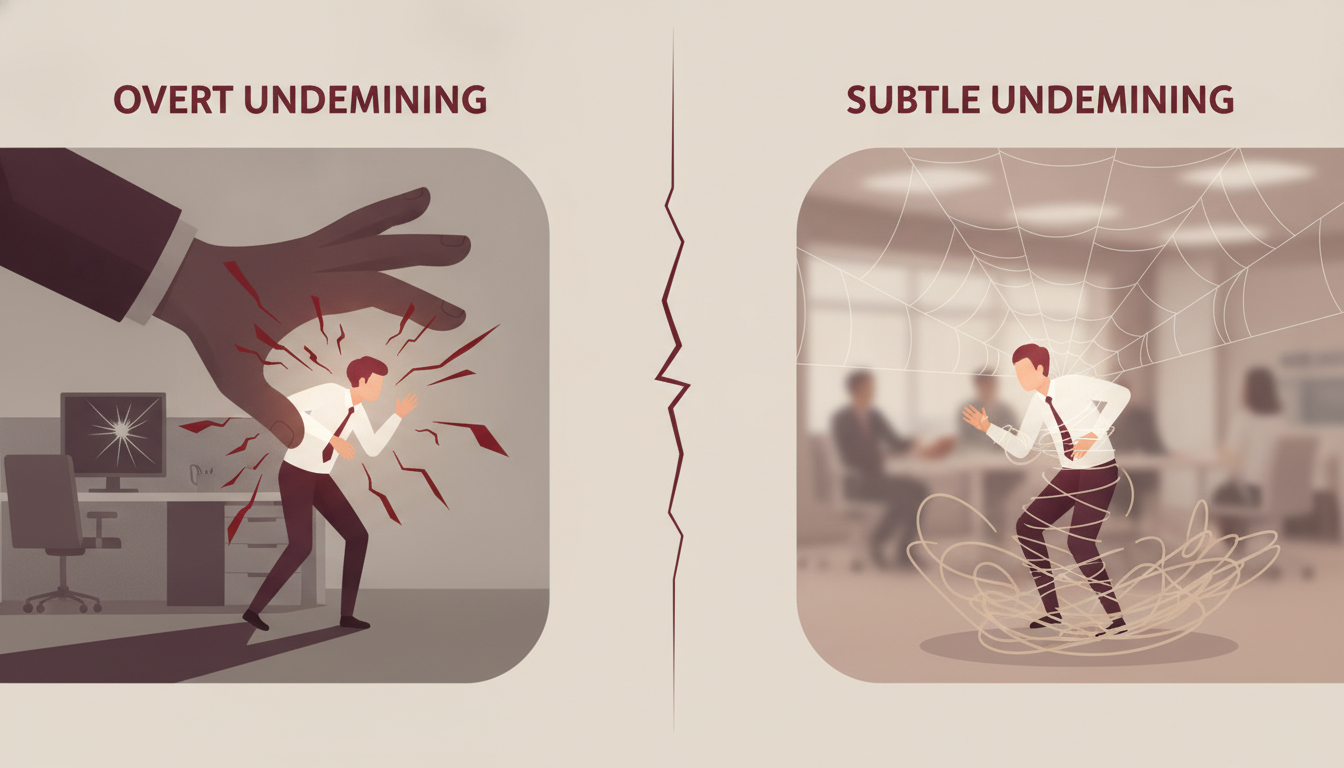
Overt Undermining Behaviors
These are easier to spot because they happen in plain sight:
- Public contradiction: A colleague openly challenges your statements or decisions in meetings, especially in front of leadership.
- Decision override: Your manager or peer reverses your decisions without consulting you, signaling to others that your judgment isn't trusted.
- Credit theft: Someone presents your ideas or work as their own. (If this is happening to you, read our guide on how to respond when someone takes credit for your idea.)
- Open dismissal: Comments like "That's not really your area" or "Let's hear from someone with more experience on this."
Subtle Undermining Behaviors
These are harder to name but equally corrosive:
- Selective exclusion: You're left off meeting invites, email threads, or Slack channels where decisions relevant to your role are made.
- Information withholding: A colleague "forgets" to share updates, leaving you unprepared or out of the loop.
- Backhanded praise: Compliments designed to diminish — "That was surprisingly good for someone new to this."
- Tone and body language: Eye-rolling, sighing, checking phones when you speak, or turning to address others while you're mid-sentence.
A 2022 study published in the Journal of Organizational Behavior found that subtle workplace incivility — including undermining — was associated with a 38% increase in employee intention to quit, even when the behavior didn't meet the threshold for formal harassment.
The Pattern Test
Ask yourself three questions to distinguish undermining from normal workplace friction:
- Frequency: Has this happened more than twice in the last month?
- Audience: Does it tend to happen in front of others, particularly people with influence?
- Targeting: Does this person behave this way with everyone, or primarily with you?
If the answers are "yes, yes, and mostly me," you're dealing with undermining, not disagreement.
How to Respond in Real Time Without Looking Reactive
The hardest part of being undermined isn't recognizing it — it's responding in the moment without appearing defensive, emotional, or petty. Your goal is to reassert your position calmly while keeping your professional image intact.
The "Restate and Redirect" Technique
When someone contradicts you publicly or dismisses your input, resist the urge to argue. Instead, use this three-step response:
- Acknowledge their point briefly (this shows composure, not agreement).
- Restate your position with supporting evidence.
- Redirect the conversation back to the decision or agenda.
This approach works because it doesn't escalate, doesn't concede, and refocuses attention on your competence. For more on communicating with gravitas in these moments, our detailed guide covers the key shifts that make your words land differently.
The "Name the Dynamic" Approach
Sometimes, the undermining is so blatant that silence becomes complicity. In those cases, you can name the pattern directly — but do it with precision, not emotion.
Scenario: A colleague consistently talks over you in cross-functional meetings. Script: "I've noticed a pattern where I'm being interrupted before I finish my point. I want to make sure everyone has the chance to contribute fully. Let me finish this thought, and then I'd welcome your input."According to research from Harvard Business Review (2021), professionals who addressed interpersonal conflict directly — but without hostility — were rated 34% higher on leadership potential by their managers compared to those who avoided confrontation.
What Not to Do
- Don't laugh it off. Dismissing undermining with humor signals that you don't take your own authority seriously.
- Don't retaliate in kind. Undermining back creates a toxic cycle and damages your credibility more than theirs.
- Don't vent publicly. Complaining to colleagues about the behavior without addressing it directly makes you look weak, not wronged.
If you struggle with staying composed in high-pressure moments, our guide on how to be assertive at work without being rude offers practical frameworks for exactly these situations.
Your Credibility Is Your Career Currency — When you're being undermined, your communication strategy matters more than ever. Discover The Credibility Code to build the kind of authority that makes undermining attempts fall flat.
Having the Private Conversation: Scripts That Work
Real-time responses handle the moment. But if the undermining is a pattern, you need a direct, private conversation to address the root cause.

How to Structure the Conversation
Use the SBI framework (Situation–Behavior–Impact), which is widely used in executive coaching because it keeps feedback specific and non-accusatory:
- Situation: Name the specific context.
- Behavior: Describe the observable action (not your interpretation of intent).
- Impact: Explain the professional consequence.
"I wanted to talk about something I've noticed. In the last two leadership meetings [Situation], my recommendations were challenged in a way that felt dismissive rather than collaborative — specifically, when my proposal was called 'not thought through' before I'd finished presenting the data [Behavior]. The impact is that it's creating confusion about ownership of this initiative, and I think it's slowing down our progress [Impact]. I'd like us to find a way to raise concerns that's more productive for both of us."
Script for a Manager:"I value your feedback, and I want to make sure we're aligned. I've noticed that a few of my decisions have been reversed in front of the team without a heads-up [Behavior]. I understand you may have additional context, but when it happens publicly, it makes it harder for me to lead the team effectively [Impact]. Could we set up a quick check-in before those conversations so I can incorporate your perspective upfront?"
When to Involve HR or Leadership
Escalation isn't your first move, but it's not off the table. Consider involving HR or a skip-level manager when:
- You've had the direct conversation and the behavior continues or worsens.
- The undermining involves discrimination, harassment, or retaliation.
- You have documentation showing a clear pattern over time.
A 2023 SHRM report found that only 30% of employees who experienced workplace conflict felt their organization resolved it effectively. This means you should prepare your case carefully — with dates, specifics, and evidence — before escalating.
Rebuilding Your Credibility After Being Undermined
Even after addressing the behavior, you may need to actively rebuild your professional standing. Undermining works by planting seeds of doubt in others' minds. Your job is to replace those seeds with evidence of your competence.
The Visibility Strategy
Don't wait for opportunities to come to you. Proactively increase your visibility in three areas:
- Meetings: Volunteer to present updates, lead agenda items, or facilitate discussions. Our guide on how to speak with authority in meetings provides nine specific shifts you can implement immediately.
- Written communication: Send concise, well-structured follow-ups after meetings that document your contributions and decisions. This creates a paper trail of your competence.
- Cross-functional relationships: Build alliances beyond your immediate team. When multiple stakeholders vouch for your work, a single underminer loses power.
The Documentation Habit
Start keeping a simple record of your contributions, decisions, and outcomes. This isn't paranoia — it's professional self-preservation. Include:
- Decisions you made and the reasoning behind them
- Positive feedback from stakeholders (save those emails)
- Metrics that demonstrate your impact
- Instances of undermining behavior (dates, witnesses, what was said)
This documentation serves two purposes: it strengthens your case if you need to escalate, and it rebuilds your own confidence by reminding you of your track record.
Rebuilding Internal Confidence
Being undermined takes a psychological toll. A 2021 study in Occupational Health Psychology found that employees who experienced chronic undermining reported 45% higher rates of self-doubt and decreased job performance — even when their actual competence hadn't changed.
The damage is internal as much as external. If your confidence has taken a hit, our guide on rebuilding workplace confidence after being overlooked provides a structured recovery plan.
Three daily practices that help:
- Pre-meeting preparation: Spend 5 minutes before any meeting reviewing your key points. Preparation is the antidote to self-doubt.
- Contribution tracking: At the end of each day, write down one thing you contributed that added value. This counters the narrative the underminer is trying to create.
- Power posture reset: Before high-stakes interactions, take 60 seconds to stand tall, breathe deeply, and remind yourself of your expertise. Research from Columbia University shows that expansive postures increase feelings of power and risk tolerance.
Stop Letting Others Define Your Professional Worth — The Credibility Code gives you the frameworks, scripts, and daily practices to build authority that can't be undermined. Discover The Credibility Code and take control of how you're perceived at work.
Preventing Future Undermining: Building an Undermining-Proof Reputation
The best defense against being undermined is a reputation so solid that attempts to chip away at it look petty rather than credible.
Establish Clear Ownership
Ambiguity invites undermining. When roles and responsibilities are vague, it's easy for someone to step on your territory and claim they were "just trying to help."
- In meetings: Use ownership language. Say "I'm leading this initiative" rather than "I'm helping with this."
- In emails: CC relevant stakeholders when making decisions so there's a clear record of your authority.
- In one-on-ones with your manager: Regularly confirm your scope and decision-making authority. Get it in writing when possible.
Build Strategic Alliances
Underminers thrive in isolation. When you have strong relationships across the organization, you have people who will speak up for you — or at least question the underminer's narrative.
Focus on building relationships with three types of people:
- Decision-makers: People who control resources, promotions, and project assignments.
- Connectors: People who are well-networked and whose opinions carry social weight.
- Peers: Colleagues at your level who can provide mutual support and serve as witnesses.
For a comprehensive approach to building professional credibility at work, our framework covers the foundational habits that make your authority difficult to challenge.
Communicate Like a Leader, Not a Victim
How you talk about the situation matters enormously. If you frame yourself as someone who's being targeted, people may sympathize — but they won't see you as a leader. Instead, frame your responses in terms of organizational impact and solutions.
Victim framing: "Sarah keeps undermining me in meetings and it's really frustrating." Leader framing: "I've noticed some misalignment in how decisions are being communicated in our team meetings. I'm going to address it directly so we can move faster."The difference is subtle but powerful. One invites pity. The other invites respect.
Frequently Asked Questions
How do you know if someone is undermining you at work or just disagreeing?
Disagreement is specific, situational, and directed at ideas. Undermining is a pattern directed at you — it's personal, repetitive, and often performed in front of an audience. If the same person consistently challenges your authority (not just your ideas), especially in public settings, that's undermining. Track the frequency, context, and targeting to distinguish the two.
What should you say when someone undermines you in a meeting?
Stay calm and use the Restate and Redirect technique: briefly acknowledge their point, restate your position with evidence, and redirect to the agenda. For example: "I hear that concern. The data from our analysis supports this approach — here's why. Let's focus on the next steps." This reasserts your authority without escalating conflict.
Being undermined at work vs. being micromanaged: what's the difference?
Micromanagement is about control — your manager doesn't trust you to execute independently but isn't necessarily trying to damage your reputation. Undermining is about credibility — someone is actively eroding how others perceive your competence or authority. Micromanagement is frustrating; undermining is strategic. Both require different responses: micromanagement needs a trust-building conversation, while undermining requires assertive boundary-setting.
Can being undermined at work be a form of workplace bullying?
Yes. When undermining is persistent, targeted, and causes harm to your professional standing or mental health, it meets most definitions of workplace bullying. The Workplace Bullying Institute classifies repeated undermining — including sabotage, public humiliation, and exclusion — as bullying behavior. If direct conversations don't stop it, document the pattern and involve HR.
How do you rebuild confidence after being undermined at work?
Start with documentation — review your accomplishments, positive feedback, and successful outcomes to counter the self-doubt. Then increase your visibility by volunteering for high-profile tasks and presenting your work directly to stakeholders. Build alliances with trusted colleagues. Finally, invest in your communication skills and professional presence to project authority that undermining can't touch.
Should you confront someone who is undermining you at work?
Yes, but strategically. Have a private, one-on-one conversation using the SBI framework (Situation, Behavior, Impact). Focus on observable actions and professional consequences — not emotions or assumed intent. Most underminers count on you staying silent. A calm, direct conversation often disrupts the pattern. If it doesn't, escalate with documentation.
Ready to Build Unshakable Professional Authority? — This article gives you the scripts and strategies to handle undermining. The Credibility Code gives you the complete system — from daily confidence habits to executive communication frameworks — so you're never in a position to be undermined again. Discover The Credibility Code and transform how you show up at work.
Ready to Command Authority in Every Conversation?
Transform your professional communication with proven techniques that build instant credibility. The Credibility Code gives you the frameworks top leaders use to project confidence and authority.
Discover The Credibility CodeRelated Articles

Communicate Confidence in Conflict at Work: Scripts
To communicate confidence in conflict at work, use structured language that separates the issue from the person, states your position clearly without hedging, and invites resolution. The key is preparation: have go-to phrases ready so you don't default to defensiveness, aggression, or silence. Confident communicators in conflict use neutral tone, specific language, and composure-preserving frameworks—scripts you can practice and deploy in real time when tensions rise.

How to Handle Being Undermined in Meetings: 8 Responses
Being undermined in meetings — whether through credit-stealing, dismissive interruptions, or subtle put-downs — requires a calm, strategic response, not silence. The most effective approach combines three elements: an immediate verbal redirect to reclaim the conversation, deliberate body language that projects authority, and a post-meeting escalation plan if the behavior repeats. Below, you'll find eight specific responses with exact scripts, body language cues, and frameworks for shutting down

How to Sound Confident in Conflict: Phrases and Tactics
To sound confident in conflict, lower your vocal pitch, slow your speaking pace by 20–30%, and use direct, neutral language that separates the issue from the person. Replace reactive phrases like "That's not fair" with grounded alternatives like "I see this differently—here's why." Pair this with steady eye contact, open body language, and intentional pauses. The goal isn't to win the argument; it's to hold your ground while keeping the conversation productive and professional.