
How to Negotiate Remote Work: Scripts That Work

What Is a Remote Work Negotiation?
A remote work negotiation is a structured professional conversation in which you request the ability to work from home—either fully or on a hybrid schedule—while maintaining or increasing your value to the organization. Unlike casual requests, a true negotiation involves preparation, a formal proposal, and a willingness to find mutually beneficial terms.
It's not about asking for a favor. It's about presenting a business case that positions flexibility as a strategic advantage for both you and your employer.
Why Most Remote Work Requests Fail (And How to Avoid It)
Most professionals lose the remote work conversation before it even starts. They lead with personal reasons—"I'd prefer to work from home"—rather than organizational value. This immediately shifts the power dynamic and frames you as someone asking for an accommodation, not a high-performer proposing a smarter way to work.
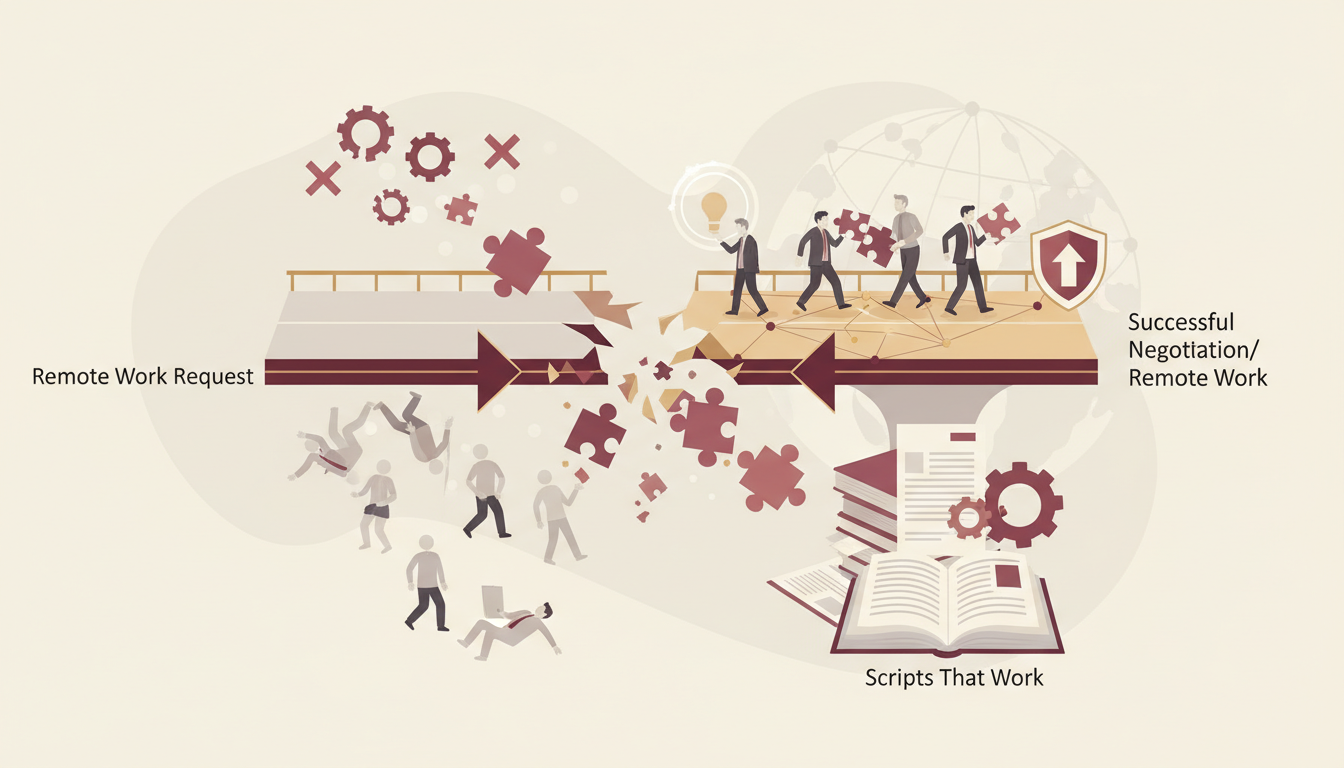
The "Personal Preference" Trap
When you say, "I'd really like to work from home a few days a week," your manager hears risk. They hear potential disruption, less oversight, and a precedent that others will want to follow. According to a 2023 survey by the Society for Human Resource Management (SHRM), 52% of managers expressed concern that remote employees are less productive—even though data consistently shows the opposite.
The fix? Never make it about you. Make it about results.
The Credibility Gap
If your manager doesn't already see you as a high-performer who delivers consistently, a remote work request can actually damage your standing. Before you negotiate, you need to have built a track record of reliability and visibility. This is where communicating with authority at work becomes essential groundwork. Your credibility is the currency you spend in this negotiation.
The Vague Ask Problem
"Can I work from home sometimes?" is not a negotiation—it's a wish. Successful remote work proposals include specific days, communication check-in schedules, measurable performance metrics, and a defined trial period. Vague requests invite vague rejections.
The VALUE Framework: 5 Steps to Negotiate Remote Work
Use this five-step framework to structure your remote work negotiation from preparation through follow-up. Each step is designed to build your credibility and reduce your manager's perceived risk.
V — Validate With Data
Before you have the conversation, gather evidence. Document your productivity metrics, completed projects, and any instances where you've already worked remotely with strong results. A Stanford study led by Professor Nicholas Bloom found that remote workers showed a 13% performance increase compared to their in-office counterparts.
Bring this kind of data—both personal and external—to the table. You're not arguing an opinion. You're presenting evidence.
Example data points to collect:- Projects delivered on time or early in the past 6 months
- Client satisfaction scores or feedback
- Any previous remote work days and what you accomplished
- Industry benchmarks showing remote work productivity
A — Anchor the Business Case
Your opening statement sets the tone for the entire conversation. Anchor it in business outcomes, not lifestyle preferences. This is the same principle behind negotiating without fear using a confidence-first approach—you lead with strength, not apology.
Script — The Opening Anchor:"I've been thinking about how to optimize my output on [specific project/responsibility], and I'd like to propose a hybrid schedule that I believe will improve my results. I've put together a brief proposal—can I walk you through it?"
Notice what this script does: it frames the conversation as being about their priorities (output, results) and positions you as proactive and prepared.
L — Lay Out the Proposal
Present a written one-page proposal. This signals professionalism and makes it easy for your manager to share with their leadership if needed. According to a 2024 Gallup workplace report, 53% of hybrid workers say their arrangement makes them more productive, giving you external validation to reference.
Your proposal should include:- Proposed schedule (e.g., remote Tuesday and Thursday)
- Communication plan (daily Slack check-ins, camera-on for team meetings)
- Performance metrics (specific KPIs you'll hit during the trial)
- Trial period (suggest 30-60 days with a formal review)
- Escalation plan (what happens if something isn't working)
Ready to negotiate with unshakable credibility? The scripts in this article are just the beginning. Discover The Credibility Code — the complete playbook for professionals who want to communicate with authority in every high-stakes conversation.
U — Understand Their Concerns
Anticipate objections before they arise. The most common concerns managers have about remote work are collaboration, accountability, and fairness to other team members. Address each one proactively.
Script — Preemptive Objection Handling:"I know visibility and collaboration are important to you—they're important to me too. That's why I've included a communication protocol in this proposal. I'd be available on Slack during core hours, camera-on for all meetings, and I'd send a brief end-of-day summary on remote days so you always have full visibility into my progress."
This technique—naming the concern before they do—is a hallmark of confident communication in difficult conversations. It shows empathy, preparation, and leadership maturity.
E — Establish a Review Point
Never ask for permanent remote work in your first negotiation. Instead, propose a trial with a clear checkpoint. This dramatically lowers the perceived risk for your manager and gives them an easy "yes."
Script — The Trial Close:"I'd like to suggest we try this for 30 days. At the end of that period, we can sit down, review the data together, and decide whether to continue, adjust, or go back to the current arrangement. That way, there's zero risk—and we'll have real numbers to guide the decision."
A 2023 Buffer "State of Remote Work" report found that 98% of remote workers want to continue working remotely at least some of the time. The demand is there. Your job is to make the path easy.
Word-for-Word Scripts for Every Scenario
Having the right words ready eliminates hesitation and helps you sound credible when it matters most. Here are scripts for the most common remote work negotiation scenarios.

Script 1: Requesting Hybrid Work for the First Time
"Hi [Manager's Name], I'd like to schedule 15 minutes to discuss a proposal I've put together. I've been looking at ways to increase my efficiency on [specific deliverable], and I believe a hybrid schedule could help me deliver stronger results. I have a written plan with metrics and a trial period built in. When would be a good time to walk through it?"Why it works: It's specific, time-bounded, and frames the ask as a business conversation—not a personal request.
Script 2: Responding to a "No" or Pushback
"I appreciate your honesty, and I understand your concerns. Could we explore a smaller pilot—maybe one day per week for two weeks—so we can test the idea with minimal disruption? I'm confident the results will speak for themselves, and I'm happy to adjust based on what we learn."Why it works: It demonstrates flexibility and persistence without being pushy. This mirrors the principles in negotiating without being pushy—you hold your ground while showing respect for their position.
Script 3: Following Up After a Successful Trial
"I wanted to share a quick update on the remote work trial. Over the past 30 days, I've [specific metric: completed X projects, reduced turnaround time by Y%, maintained 100% attendance at team meetings]. Based on these results, I'd like to propose making this a permanent arrangement. I've updated my proposal with the data—would you like me to send it over before our next check-in?"Why it works: You're letting results do the persuading. Data removes emotion from the conversation and makes the decision almost automatic.
Script 4: Negotiating Remote Work During a Job Offer
"I'm very excited about this opportunity. Before I accept, I'd like to discuss the possibility of a hybrid schedule—two to three days remote per week. In my current role, I've found that this structure helps me produce my best work on deep-focus projects while staying fully connected to the team on collaboration days. I'm happy to discuss what that would look like here."
According to a 2024 Robert Half survey, 63% of professionals said they would turn down a job that didn't offer remote work flexibility. You have leverage—use it with confidence.
Body Language and Delivery: How to Say It Matters
The words are only half the equation. How you deliver your remote work proposal can make or break the outcome. Your vocal authority and body language signal whether you truly believe in what you're proposing.
Vocal Tone and Pacing
Speak at a measured pace. Rushing signals nervousness and undermines your credibility. Drop your vocal pitch slightly at the end of statements—this is called a "downward inflection," and it signals certainty. Avoid upspeak (ending statements like questions), which makes even the strongest proposal sound tentative.
Posture and Eye Contact
Sit upright with your shoulders back. Maintain steady eye contact—not aggressive staring, but calm, confident engagement. If you're making this request over video, position your camera at eye level and look directly into the lens during key statements.
The Power of the Pause
After you deliver your key ask, pause. Don't fill the silence. Let your manager process. Silence after a strong statement communicates confidence. Most people rush to fill gaps because they're uncomfortable—resist the urge. The pause is where authority lives.
Your credibility is your greatest negotiation tool. Learn the complete system for building authority that commands respect in every professional interaction. Discover The Credibility Code and start negotiating from a position of strength.
Common Mistakes That Kill Remote Work Negotiations
Even well-prepared professionals make avoidable errors. Here are the most damaging ones.
Over-Explaining or Apologizing
Phrases like "I'm sorry to ask, but…" or "I know this might be a lot, but…" undermine your position instantly. You're not asking for a favor. You're proposing a business arrangement. If you tend to over-apologize, read our guide on how to stop over-apologizing at work.
Comparing Yourself to Colleagues
"Well, Sarah gets to work from home, so…" is one of the fastest ways to lose credibility. Your negotiation should stand on its own merits—your performance, your proposal, your results.
Negotiating Over Email (When You Shouldn't)
Initial remote work conversations should happen face-to-face or over video. Email lacks tone, and your proposal deserves the full weight of your presence. Save email for the follow-up documentation after the verbal agreement.
Failing to Follow Up
If your manager says "let me think about it," don't let it drift. Follow up within 48 hours with a brief, professional message:
"Hi [Manager's Name], just following up on our conversation about the hybrid schedule proposal. I've attached the one-page summary for your reference. Happy to discuss further whenever it's convenient."
Frequently Asked Questions
How do I negotiate remote work if my company has a strict return-to-office policy?
Focus on proposing a limited pilot rather than challenging the policy directly. Frame it as a performance experiment: "I'd like to test whether one remote day per week improves my output on [specific project]." Offer measurable KPIs and a short trial period. This approach respects the policy while creating space for flexibility based on results, not exceptions.
What's the difference between negotiating remote work and negotiating a flexible schedule?
Remote work negotiation specifically addresses where you work—home versus office. Flexible schedule negotiation addresses when you work—adjusted start/end times, compressed weeks, or asynchronous hours. You can negotiate both simultaneously, but treat them as separate asks with separate business cases to avoid overwhelming your manager.
Should I negotiate remote work during a job interview or after getting hired?
Ideally, raise it during the offer stage—after they've decided they want you but before you've accepted. This is when your leverage is highest. A 2023 FlexJobs survey found that 65% of respondents wanted to work remotely full-time, showing that flexibility expectations are now standard. Bringing it up during the offer conversation is professional and expected.
How do I maintain credibility while working remotely?
Visibility is key. Over-communicate your progress, respond promptly, and show up prepared for every meeting. Building a strong personal brand even as an introvert becomes even more important when you're not physically present. Proactively share wins, document your contributions, and maintain strong relationships with stakeholders.
What if my manager says yes to a trial but I'm worried about proving myself?
Treat the trial period like an audition. Set clear goals in writing before it begins, track your metrics daily, and prepare a summary report for the review meeting. Use daily workplace confidence exercises to stay grounded and focused. The data you collect during the trial is your strongest argument for making the arrangement permanent.
How do I negotiate remote work as a new employee?
Wait until you've established credibility—typically 90 days minimum. Use that time to exceed expectations, build relationships, and demonstrate reliability. Then propose a modest pilot. New employees who negotiate too early risk being seen as uncommitted. Build your professional credibility at a new job first, then leverage it.
From uncertain communicator to confident authority—in every negotiation. The scripts in this article give you the words. The Credibility Code gives you the complete system for building the presence, authority, and confidence that make people say yes. Discover The Credibility Code today.
Ready to Command Authority in Every Conversation?
Transform your professional communication with proven techniques that build instant credibility. The Credibility Code gives you the frameworks top leaders use to project confidence and authority.
Discover The Credibility CodeRelated Articles

How to Negotiate When You Feel Nervous: A Step-by-Step Guide
Negotiating when you feel nervous starts with accepting that anxiety is a normal biological response — not a sign of weakness. The key is a three-phase approach: prepare your mind and body before the conversation, use specific calming techniques and language patterns during the negotiation, and have recovery strategies ready if nerves spike mid-conversation. With the right preparation rituals, breathing techniques, and confidence-projecting scripts, you can negotiate effectively even when your h

Negotiation Mistakes That Hurt Your Credibility at Work
The most common negotiation mistakes that hurt credibility include over-justifying your requests, apologizing before you ask, anchoring too low, revealing desperation, making it personal instead of strategic, and failing to prepare your walkaway point. These mistakes signal low confidence and train colleagues to undervalue your contributions. Each one is fixable once you recognize the pattern and replace it with a credible alternative.

Negotiation Language Patterns That Project Confidence
Confident negotiators don't wing it—they use specific linguistic patterns that signal authority and credibility before the other party even processes the content of what's being said. The most effective negotiation language patterns include anchoring statements, declarative framing, strategic pauses, and conditional concession structures. These patterns shift you from sounding like you're asking for permission to sounding like you're presenting a well-reasoned position. Below, you'll find the ex